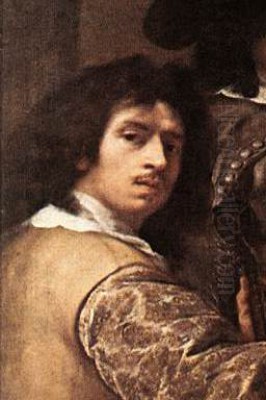
Giuseppe Nuvolone, a name perhaps less instantly recognizable than 그의 형제 Carlo Francesco Nuvolone, nonetheless carved out a significant career as a painter in the vibrant artistic milieu of 17th-century Lombardy. Born in Milan in 1619 and passing away in the same city in 1703, Giuseppe's life spanned a period of immense artistic fervor and transformation in Italy, largely defined by the dramatic and emotive style of the Baroque. His work, predominantly religious in nature, contributed to the visual landscape of churches and private collections in Milan, Cremona, Brescia, and surrounding regions, reflecting both the broader currents of Italian Baroque art and the specific artistic traditions of Lombardy.
A Family Steeped in Art: The Nuvolone Dynasty
Giuseppe Nuvolone was born into a family where art was a generational pursuit. His father, Panfilo Nuvolone (c. 1581–1651), was a respected painter from Cremona, known for his still lifes, particularly of fruit, as well as religious subjects and frescoes. Panfilo established the family's artistic reputation, working in a style that bridged late Mannerism with the emerging naturalism of the early Baroque. It was under Panfilo's tutelage that both Giuseppe and his older, more celebrated brother, Carlo Francesco Nuvolone (1609–1662), received their initial artistic training.
Carlo Francesco, often referred to as the "Lombard Raphael" or the "Lombard Guido Reni" for the grace and sweetness of his figures, became one of the leading painters in Milan during the mid-17th century. His style, characterized by soft modeling, delicate colors, and a gentle sentimentality, was influenced by artists like Guido Reni and later, the Spanish master Bartolomé Esteban Murillo. Carlo Francesco's success undoubtedly cast a long shadow, but it also provided an environment rich in artistic discourse and opportunity for his younger brother. Giuseppe's artistic development was thus intrinsically linked to his family, particularly the stylistic leanings and professional network of his father and elder brother.
Giuseppe reportedly showed artistic promise from a very young age, with some accounts suggesting he began drawing and painting under his father's guidance as early as four years old. By the age of sixteen, he was considered capable of undertaking independent commissions, a testament to the intensive workshop training typical of the era. This early immersion in the practical aspects of painting, from preparing canvases and grinding pigments to mastering compositional principles, laid the foundation for his long and productive career.
The Artistic Landscape of Lombardy in the 17th Century
To understand Giuseppe Nuvolone's work, it's crucial to consider the artistic environment of Lombardy, particularly Milan, during his formative years and throughout his career. The early 17th century in Milan was dominated by the "Pestanti," a group of influential painters including Giovanni Battista Crespi (Il Cerano), Giulio Cesare Procaccini, and Pier Francesco Mazzucchelli (Il Morazzone). These artists responded to the Counter-Reformation's call for art that was clear, emotionally engaging, and doctrinally sound, often imbuing their works with intense drama, pathos, and a mystical religiosity. Their influence shaped the taste and expectations for religious art in the region.
While Giuseppe was younger than these figures, their legacy would have been palpable. Furthermore, Milan, as a major artistic center, was open to influences from other parts of Italy and beyond. The naturalism of Caravaggio, though he had left Milan decades earlier, continued to resonate. The classical tendencies of the Bolognese school, particularly the Carracci and their followers like Guido Reni and Domenichino, offered an alternative to more overt drama. Flemish artists like Peter Paul Rubens and Anthony van Dyck also made a significant impact on Italian art, particularly in Genoa, and their influence, characterized by rich colors, dynamic compositions, and a sensuous rendering of textures, permeated throughout the peninsula.
Giuseppe Nuvolone's artistic journey navigated these diverse currents. He absorbed the Lombard tradition of expressive intensity and rich color, while also showing an awareness of the softer, more graceful styles popularized by artists like his brother Carlo Francesco, and further south, by painters such as Guercino (Giovanni Francesco Barbieri) in his later phase, or the aforementioned Murillo.
Giuseppe Nuvolone's Artistic Style: Drama, Color, and Devotion
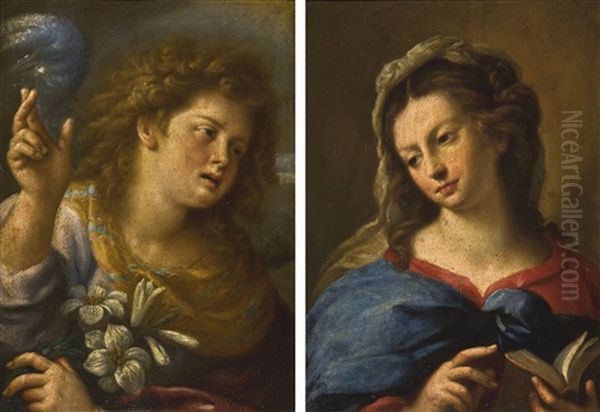
Giuseppe Nuvolone's style is firmly rooted in the Baroque. His works are characterized by a penchant for dynamic compositions, often featuring figures in expressive, sometimes theatrical, poses. He employed a rich and often warm color palette, and like many Baroque artists, he was adept at using chiaroscuro – the dramatic interplay of light and shadow – to model forms, create depth, and heighten the emotional impact of his scenes. While perhaps not possessing the same level of refined elegance or profound psychological depth as his brother Carlo Francesco, Giuseppe's paintings often convey a robust energy and a direct, accessible piety.
His religious paintings, which form the bulk of his oeuvre, typically depict scenes from the lives of Christ, the Virgin Mary, and various saints. These were often large-scale altarpieces or canvases intended for the decoration of church interiors, designed to inspire devotion and convey narrative clarity to the faithful. He was particularly active in creating works for churches in Milan, Cremona, and Brescia, demonstrating a consistent demand for his skills in these Lombard centers.
Compared to Carlo Francesco, whose style evolved towards a greater softness and idealization, Giuseppe often retained a more vigorous, earthy quality in his figures. His brushwork could be more robust, and his compositions, while adhering to Baroque principles of dynamism, sometimes favored a more straightforward narrative presentation. However, he was also capable of moments of tenderness and grace, particularly in his depictions of the Madonna and Child or female saints, where a gentler sentiment, possibly reflecting his brother's influence or that of Murillo, can be discerned.
The influence of other artists is also traceable. The dramatic lighting and emotional intensity in some of his works might echo the legacy of Caravaggio or the Lombard "Pestanti." The rich textures and vibrant colors could suggest an awareness of Venetian traditions, perhaps filtered through Rubens or Van Dyck. His engagement with the works of Guercino is also plausible, given Guercino's widespread influence on Italian painting.
Key Works and Commissions
Identifying a definitive, exhaustive list of Giuseppe Nuvolone's works is complex, as is common with many prolific artists of his era. However, several key paintings and commissions are consistently attributed to him and help to illustrate his artistic contributions.
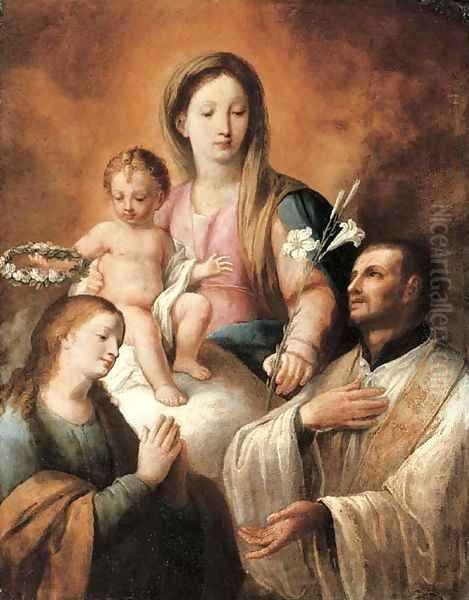
One of his notable early works is the "Madonna with St. Charles Borromeo and St. Felix of Cantalice," dated 1647. St. Charles Borromeo was a particularly venerated figure in Milan, and his inclusion underscores the local relevance of such commissions. This painting would likely exhibit the earnest piety and clear narrative structure favored by the Counter-Reformation Church.
The "Death of St. Lucy" (1656) is another significant piece. This work is often cited as showing the influence of Bartolomé Esteban Murillo, whose tender and sentimental religious scenes were gaining popularity. St. Lucy, a virgin martyr, was a popular subject, allowing for depictions of pathos and divine grace. Nuvolone's interpretation would likely have emphasized her serene acceptance of martyrdom, rendered with soft lighting and emotive figures.
For the Church of San Domenico in Cremona, Giuseppe executed an altarpiece depicting "St. Dominic Resurrecting the Dead." This subject, inherently dramatic, would have provided ample opportunity for Nuvolone to showcase his skills in composing a multi-figure scene with strong emotional content and dynamic action. The use of light to highlight the miracle and the reactions of the onlookers would have been key elements.
Also for Cremona, specifically for the Church of Santa Rosa, he painted an altarpiece of the "Miracle of St. Rose." St. Rose of Lima was the first saint canonized from the Americas, and her cult was spreading in Europe during the 17th century. Such a commission indicates Nuvolone's engagement with contemporary devotional trends.
He was also involved in the restoration and redecoration of the Church of San Domenico in Cremona, contributing an altarpiece of the "Madonna and Saints." This type of "sacra conversazione" (holy conversation) was a staple of Italian religious art, allowing the artist to depict the Virgin and Child enthroned, surrounded by various saints relevant to the patrons or the specific church. Nuvolone would have aimed for a harmonious composition, differentiating the saints through their attributes and expressions, all bathed in a unifying, divine light.
Other works attributed to him include frescoes and further altarpieces across Lombardy. For instance, his hand is seen in decorations for the Certosa di Pavia, a major monastic complex, and in various churches in Brescia. His productivity was considerable, and his works, while perhaps not always reaching the heights of innovation seen in Italy's foremost Baroque masters like Gian Lorenzo Bernini or Pietro da Cortona in Rome, were nonetheless competent, devout, and well-suited to the needs of his patrons.
The Nuvolone Brothers: A Complex Artistic Relationship
The relationship between Giuseppe and Carlo Francesco Nuvolone is a recurring theme in discussions of Giuseppe's career. Carlo Francesco was undoubtedly the more famous and, by many contemporary and later accounts, the more gifted artist. His style, with its refined grace and delicate emotionality, resonated strongly with patrons and critics. Giuseppe, while sharing the family's artistic inclinations and training, developed a style that, while related, possessed its own characteristics.
It is likely that the brothers collaborated on certain projects, as was common in family workshops. Giuseppe may have assisted Carlo Francesco on larger commissions, or they may have shared aspects of their workshop practice. However, Giuseppe also maintained an independent career, particularly after Carlo Francesco's death in 1662. He continued to receive commissions for several decades, indicating that his work was valued in its own right.
While some art historians have characterized Giuseppe's output as being of a "lower artistic quality" than his brother's, this assessment should be nuanced. "Quality" can be subjective, and Giuseppe's more robust and direct style may have appealed to different sensibilities or suited different types of commissions. His ability to manage a prolific output and secure consistent patronage across Lombardy speaks to his professional competence and the appeal of his work. He was a skilled practitioner of the Baroque idiom, capable of producing large-scale, effective religious imagery that fulfilled the devotional and aesthetic requirements of his time.
The comparison with Carlo Francesco, while inevitable, should not entirely overshadow Giuseppe's individual contributions. He was an active participant in the Lombard art scene for over half a century, contributing to the region's rich artistic heritage.
Personal Anecdotes and Character
Historical records sometimes offer glimpses into the personalities of artists, though these are often fragmentary or anecdotal. One interesting, though perhaps apocryphal, story associated with Giuseppe Nuvolone is his supposed fear of water, or hydrophobia. It is recounted that on a journey from Lake Como back to Milan, he experienced extreme discomfort due to his fear of the lake. While such personal details do not directly impact an assessment of his art, they add a human dimension to the historical figure.
His personality is generally described as more introverted compared to the potentially more outgoing or socially adept figures in the art world. This, however, is speculative. What is clear is his dedication to his craft, evidenced by his long and productive career. He navigated the competitive art world of 17th-century Italy, managing a workshop, securing commissions, and producing a substantial body of work.
Later Career, Death, and Legacy
Giuseppe Nuvolone continued to paint into his later years, adapting to evolving tastes while largely remaining true to his established Baroque style. The artistic landscape of Milan and Lombardy began to shift towards the end of the 17th century and into the 18th, with the emergence of Rococo sensibilities and new generations of artists. However, the demand for traditional religious art remained, and Nuvolone continued to fulfill this need.
He passed away in Milan in 1703, at the advanced age of 84. His death marked the end of a significant chapter for the Nuvolone family's artistic legacy. While his fame may have been eclipsed by that of his brother, and by other luminaries of the Italian Baroque such as Caravaggio, the Carracci, Bernini, Borromini, Pietro da Cortona, Luca Giordano, or later, Giovanni Battista Tiepolo (though Tiepolo represents a later, Rococo phase), Giuseppe Nuvolone's contribution to Lombard art is undeniable.
His paintings are found in numerous churches and collections in Lombardy, and examples of his work appear in museums internationally. He represents a vital strand of regional Italian Baroque painting – an artist who, while perhaps not a revolutionary innovator, was a skilled and prolific practitioner, deeply engaged with the religious and cultural life of his time. His work helped to disseminate and sustain the Baroque style in Lombardy, providing the visual accompaniment to faith and devotion for generations.
In the broader narrative of art history, artists like Giuseppe Nuvolone play a crucial role. They form the rich tapestry of artistic production that exists beyond the handful of universally recognized "great masters." They demonstrate the depth and breadth of artistic talent in a given period and region, and their works offer valuable insights into local tastes, patronage patterns, and devotional practices. Giuseppe Nuvolone, the diligent painter from a Milanese artistic family, remains a significant figure for understanding the full scope of Baroque art in Lombardy. His legacy is preserved in the altarpieces and canvases that continue to adorn the spaces for which they were created, or that now reside in public collections, bearing witness to a life dedicated to the art of painting.