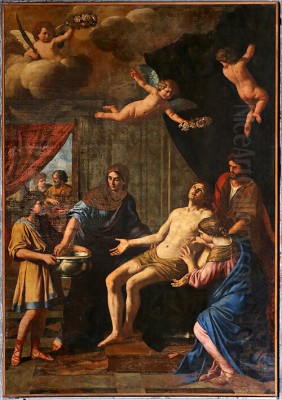
Giacinto Gimignani stands as a significant, if sometimes overlooked, figure in the vibrant artistic landscape of seventeenth-century Rome. Born in Pistoia in 1606 and active until his death in Rome in 1681, Gimignani navigated the complex stylistic currents of the Baroque era, forging a distinct artistic identity. His career unfolded primarily in Rome, the epicenter of artistic innovation and papal patronage, where he absorbed the influences of leading masters and contributed to the decoration of some of the city's most important churches and palaces. His work is characterized by a thoughtful synthesis of classical principles and Baroque dynamism, often applied to grand historical and religious narratives.
Early Life and Artistic Formation
Giacinto Gimignani's artistic journey began in his hometown of Pistoia, a Tuscan city with a rich artistic heritage. He was the son of Alessio Gimignani (1567–1651), a painter of local repute, from whom he likely received his initial training. This familial introduction to the arts would have provided a foundational understanding of painting techniques and the prevailing artistic tastes of the region. However, the allure and opportunities of Rome, the artistic capital of Europe at the time, proved irresistible for an ambitious young painter.
Around 1630, Gimignani moved to Rome to further his artistic education. This was a pivotal moment, as Rome was a melting pot of artistic ideas, dominated by the revolutionary naturalism of Caravaggio (though Caravaggio himself had died in 1610, his influence was still potent) and the burgeoning Baroque style. Two artists, in particular, would play a crucial role in shaping Gimignani's development: the French classicist Nicolas Poussin (1594–1665) and the Italian High Baroque master Pietro da Cortona (1596–1669). He is documented as having worked in the studio of Pietro da Cortona, a direct engagement that would have been immensely formative. He also came under the influence of Poussin, whose workshop was a beacon for artists seeking a more ordered, classical approach to painting.
The Roman Artistic Milieu
The Rome to which Gimignani arrived was a city undergoing a magnificent transformation, largely fueled by the patronage of the Catholic Church during the Counter-Reformation, as well as by powerful noble families such as the Barberini, Pamphili, and Chigi. Artists like Gian Lorenzo Bernini (1598–1680) were redefining sculpture and architecture with dramatic flair, while painters were exploring new avenues of expression, from the grand illusionistic ceilings of Pietro da Cortona to the more restrained classicism of Andrea Sacchi (1599–1661).
This environment was both competitive and collaborative. Artists vied for prestigious commissions but also learned from one another, forming informal academies and engaging in spirited debates about the nature and purpose of art. The Accademia di San Luca, the official artists' guild in Rome, played a significant role in the professional lives of painters, sculptors, and architects. Gimignani would later become a prominent member and even served as its Principe (Prince or Director) in 1650, a testament to his standing within the Roman artistic community. This position underscored his acceptance and respect among his peers.
Key Influences: Poussin and Cortona
Giacinto Gimignani's style is often described as a fascinating amalgamation of the seemingly contrasting approaches of Nicolas Poussin and Pietro da Cortona. From Poussin, Gimignani absorbed a commitment to clarity of composition, a certain gravitas in the depiction of figures, and an interest in historical and mythological subjects that demanded intellectual engagement. Poussin's emphasis on disegno (drawing and design) and his carefully constructed, stage-like compositions provided a model of order and rational beauty. Gimignani's works often exhibit this Poussin-esque precision in their arrangement of figures and their narrative legibility.
From Pietro da Cortona, Gimignani learned the dynamism, rich color palette, and theatrical energy characteristic of the High Baroque. Cortona was a master of large-scale fresco decorations, creating breathtaking, illusionistic scenes teeming with movement and emotion. His influence is evident in Gimignani's more fluid brushwork at times, his vibrant use of color, and a sense of architectural grandeur in his settings. While Poussin offered a model of classical restraint, Cortona provided the tools for dramatic impact and sensory appeal. Gimignani's ability to draw from both these powerful sources allowed him to create a versatile style adaptable to various commissions. He was not merely an imitator but an intelligent synthesizer, selecting and adapting elements to suit his own artistic temperament and the specific demands of his subjects.
Gimignani's Evolving Artistic Style
Throughout his career, Gimignani's style evolved, sometimes leaning more towards Poussin's classicism, at other times embracing Cortona's more exuberant Baroque. His early works, from the 1630s and early 1640s, often show a stronger Poussinist influence, with carefully balanced compositions and a more sculptural treatment of figures. However, even in these, a Cortonesque warmth in color and a certain softness in modeling can often be detected.
As he matured, Gimignani developed a more personal synthesis. He became adept at managing complex multi-figure compositions, a skill essential for the large altarpieces and fresco cycles he undertook. His figures, while often possessing a classical dignity, could also convey strong emotion, and his narratives were typically rendered with clarity and dramatic force. He paid considerable attention to the architectural settings of his scenes, often imbuing them with a sense of monumentality that enhanced the solemnity or grandeur of the depicted event. His palette, while capable of Poussin-like clarity, could also achieve a richness and vibrancy reminiscent of Cortona, particularly in his depiction of draperies and atmospheric effects. This fusion of classical structure with Baroque sensibility became a hallmark of his mature style.
Major Works and Commissions
Giacinto Gimignani's oeuvre is substantial, encompassing altarpieces, frescoes, and easel paintings, primarily on religious and historical themes. His works adorned numerous churches and palaces in Rome and, to a lesser extent, in other Italian cities.
One of his early significant commissions was for the Baptistery of San Giovanni in Laterano in Rome, undertaken in the 1630s under the supervision of Andrea Sacchi. Here, Gimignani contributed frescoes depicting scenes from the life of Constantine, including The Vision of Constantine and The Battle of Milvian Bridge. These works demonstrate his early engagement with large-scale narrative painting and his ability to work within a major collaborative project.
His painting The Adoration of the Magi, dated 1634, originally an altarpiece for the "Prado Palace" (likely a reference to a chapel or collection that later became associated with or whose works ended up in the Prado Museum, or perhaps a misremembered location, as his primary activity was in Italy), showcases his ability to handle a traditional theme with a fresh perspective, balancing a complex grouping of figures with a clear narrative flow.
Around 1640, he painted The Holy Family with St. Anne. This work is noted for its tender sentiment and its monumental quality, which art historians suggest shows an awareness of High Renaissance masters like Michelangelo and Raphael, whose influence was a constant undercurrent in Roman art. The dignified figures and balanced composition reflect classical ideals, while the warmth of the human interaction adds an accessible emotional layer.
A significant project from the mid-1640s was his work for the Palazzo Pamphili in Piazza Navona, where he collaborated with other artists under the patronage of Pope Innocent X. This demonstrates his integration into high-level artistic circles and his involvement in prestigious decorative schemes.
Later in his career, Gimignani continued to produce important religious works. The Sacrament of St. Francis Borgia (circa 1671) is a powerful depiction of a solemn religious ceremony, showcasing his skill in portraying complex group scenes with dignity and spiritual intensity. The composition is carefully structured, guiding the viewer's eye to the central figures, and the use of light and shadow enhances the dramatic and devotional atmosphere.
Another notable late work is St. Teresa Curing a Nun Possessed by a Demon (1670). This painting captures a moment of intense spiritual conflict and divine intervention. Gimignani effectively conveys the drama of the exorcism, with the serene power of St. Teresa contrasting with the tormented state of the possessed nun, all within a carefully rendered architectural setting.
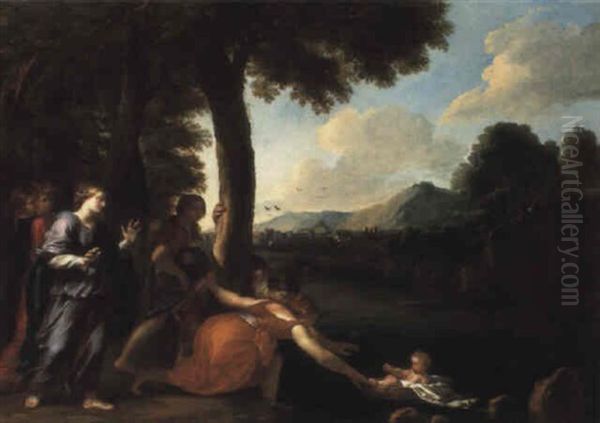
He also executed frescoes in the Fonseca Chapel in San Lorenzo in Lucina, Rome, including Elijah Purifying the Waters of Jericho with Salt (1664). Fresco painting demanded speed and confidence, and Gimignani's contributions to various Roman churches, such as S. Maria ai Monti and S. Giovanni Battista de' Fiorentini, attest to his proficiency in this medium. His work in San Carlo ai Catinari, particularly the depiction of The Vision of St. Charles Borromeo, is another example of his contribution to Roman church decoration.
Religious Themes and Patronage
Like most artists of his time in Rome, Giacinto Gimignani's career was heavily reliant on religious commissions. The Counter-Reformation Church actively used art as a tool for instruction, inspiration, and the assertion of its doctrines. Gimignani's paintings often depicted scenes from the lives of saints, biblical narratives, and moments of divine revelation, all rendered in a manner that was both anagogical and emotionally engaging.
His personal piety is suggested by some accounts, including a devotion to St. Philip Neri. It is said that he painted an image of St. Philip kneeling before the Virgin, Child, and St. Joseph, and that this work was mentioned in his will, indicating its personal significance. This deep engagement with religious subject matter likely resonated with his patrons, who included various religious orders, cardinals, and noble families seeking to adorn their private chapels or contribute to public churches. The clarity of his narratives and the dignified yet expressive portrayal of his figures made his work well-suited to the devotional and didactic purposes of Counter-Reformation art.
His patrons were diverse, ranging from major papal families like the Pamphili to individual churches and confraternities. Securing and successfully executing these commissions required not only artistic skill but also an ability to navigate the complex social and political landscape of Rome. His election as Principe of the Accademia di San Luca indicates that he possessed these diplomatic and managerial skills in addition to his artistic talents.
Collaborations, Workshop, and Influence
Giacinto Gimignani was part of a network of artists in Rome. He collaborated with others on large decorative projects, a common practice in the seventeenth century. His son, Ludovico Gimignani (1643–1697), also became a painter, following in his father's footsteps and often working in a style similar to his, sometimes leading to confusion in attributions. Ludovico undoubtedly trained in his father's workshop and likely assisted him on numerous commissions, eventually establishing his own successful career.
Gimignani's workshop would have been a busy place, training assistants and producing works to meet demand. The presence of a workshop was crucial for an artist undertaking large-scale commissions, allowing for the efficient execution of preparatory drawings, underpaintings, and less critical areas of large canvases or frescoes.
While he may not have had the revolutionary impact of a Caravaggio or a Bernini, Gimignani's influence was felt among his contemporaries and pupils. His ability to synthesize the classical and Baroque modes offered a viable and respected artistic path. His works were known and sometimes, as noted in historical accounts, even misattributed to more famous contemporaries like Guercino (Giovanni Francesco Barbieri, 1591–1666), which, while frustrating for accurate attribution, speaks to the quality and stylistic affinities of his painting.
Other contemporaries in the Roman scene whose work provides context for Gimignani's include Lazzaro Baldi (1624–1703), also from Pistoia and a pupil of Pietro da Cortona, thus sharing a similar artistic lineage. Giovanni Battista Gaulli, known as Baciccio (1639–1709), was a younger contemporary who became a leading figure in Roman High Baroque ceiling painting, pushing Cortona's illusionism to new heights. Carlo Maratti (1625–1713) became the leading painter in Rome in the later part of the 17th century, championing a more classical, refined Baroque style that built upon the legacies of artists like Sacchi and Raphael, but also showed an awareness of the grandeur of Cortona. Even artists working in different veins, like the landscape painter Claude Lorrain (1600–1682), were part of this rich artistic tapestry. The influence of earlier masters like Andrea del Sarto (1486–1530) from the High Renaissance also continued to be felt, particularly for artists with Tuscan origins like Gimignani.
Later Career and Legacy
Giacinto Gimignani remained active and respected throughout his long career. He continued to receive commissions and contribute to the artistic life of Rome until his death in 1681. His later works generally maintain the high standards of his mature period, demonstrating a consistent command of composition, color, and narrative.
In the broader sweep of art history, Gimignani is recognized as a skilled and important representative of the Roman Baroque. He successfully navigated the dominant artistic currents of his time, creating a body of work that is both accomplished and historically significant. While perhaps not as widely known today as some of his more famous contemporaries, his contributions to the decoration of Roman churches and palaces were substantial. His paintings offer valuable insights into the religious and cultural preoccupations of seventeenth-century Rome and exemplify the rich synthesis of styles that characterized the Baroque era.
His legacy was also continued through his son Ludovico, who ensured that the Gimignani name remained prominent in the Roman art world into the late seventeenth century. Art historians continue to study his work, clarifying attributions, analyzing his stylistic development, and assessing his place within the complex web of influences and innovations that defined Baroque art. His paintings can be found in major museums and collections worldwide, as well as in situ in the Roman churches for which they were created, allowing contemporary audiences to appreciate his skill and artistic vision.
Conclusion
Giacinto Gimignani was a quintessential Roman Baroque painter. His artistic journey from Pistoia to the heart of the art world in Rome, his absorption of the lessons of masters like Poussin and Cortona, and his prolific output of religious and historical paintings mark him as a significant contributor to his era. He skillfully blended the classical emphasis on order and clarity with the Baroque love for dynamism and emotional intensity, creating works that were both intellectually engaging and visually compelling. His involvement in major decorative projects, his leadership role in the Accademia di San Luca, and the continuation of his artistic lineage through his son Ludovico all attest to a successful and respected career. Giacinto Gimignani's art remains a testament to the richness and complexity of seventeenth-century Roman painting, embodying the spirit of an age that sought to inspire awe and piety through the power of the image.