The vibrant artistic crucible of late seventeenth and early eighteenth-century Naples, a city teeming with creative energy and lavish patronage, produced a constellation of remarkable painters. Among these, Nicola Malinconico (1663-1726) carved out a significant, albeit sometimes underappreciated, niche. A prolific artist, he excelled primarily in large-scale religious commissions, adorning churches and chapels with dramatic altarpieces and expansive frescoes. His artistic journey was profoundly shaped by his tutelage under the celebrated Luca Giordano, yet Malinconico developed a distinctive style characterized by rich color palettes, dynamic compositions, and a sensitive rendering of human emotion. This exploration delves into the life, work, and artistic milieu of Nicola Malinconico, examining his key contributions, his relationships with contemporary artists, and his enduring place within the rich tapestry of Neapolitan Baroque art.
The Neapolitan Cauldron: Early Life and Artistic Formation
Born in Naples in 1663, Nicola Malinconico emerged during a period when the city was a dominant artistic center in Italy, rivaling even Rome and Venice in its output and innovation. The Spanish Viceroys, the powerful Catholic Church, and a wealthy aristocracy fueled a constant demand for art, particularly for religious narratives that could inspire piety and affirm doctrinal tenets in the wake of the Counter-Reformation. It was into this fervent environment that Malinconico began his artistic training.
The most pivotal influence on Malinconico's early development was undoubtedly his apprenticeship in the bustling workshop of Luca Giordano (1634-1705). Giordano, nicknamed "Luca fa presto" (Luca works quickly) for his astonishing speed and prolific output, was an international superstar of the Baroque era. His style, characterized by its luminous colors, fluid brushwork, and grandiose compositions, drew inspiration from a vast array of sources, including Veronese, Titian, and Pietro da Cortona. Working under Giordano, Malinconico would have absorbed not only technical skills in oil painting and fresco but also an understanding of how to manage large-scale commissions and orchestrate complex multi-figure scenes. The impact of Giordano's vibrant palette and expressive figural language is readily apparent in Malinconico's mature works.
While Giordano was his primary master, the artistic air of Naples was thick with other influences. The legacy of Caravaggio, who had worked in Naples decades earlier, still resonated, particularly in the dramatic use of chiaroscuro and a commitment to naturalism, aspects of which were further developed by Neapolitan Caravaggisti like Jusepe de Ribera ("Lo Spagnoletto"). Ribera's powerful, often gritty, realism and his profound psychological insight into his subjects left an indelible mark on Neapolitan painting, and Malinconico would have been well-acquainted with his works. The generation preceding Malinconico also included masters like Mattia Preti, whose robust figures and dramatic lighting further enriched the local artistic vocabulary.
Ascending the Ranks: Major Religious Commissions
Nicola Malinconico’s reputation grew steadily, leading to a series of significant commissions for religious institutions throughout Naples and the surrounding regions. He demonstrated a remarkable aptitude for large-scale narrative paintings, a skill highly valued for decorating the vast interiors of Baroque churches. His ability to fill expansive canvases and walls with compelling religious scenes, imbued with both doctrinal clarity and emotional fervor, made him a sought-after artist.
One of the early indicators of his rising stature came in 1693 and 1694 when he was entrusted with continuing the fresco decorations in the important church of San Giacomo degli Spagnoli in Naples. Significantly, he took over this project from his master, Luca Giordano, who had been called to Spain. This commission was a clear vote of confidence in Malinconico's abilities and signaled his emergence as an independent master capable of handling prestigious projects.
His oeuvre includes numerous altarpieces and fresco cycles. Among his notable religious works are the altarpiece for the church of San Michele Arcangelo in Naples, which would have showcased his ability to create a powerful devotional image for a central liturgical focus. He also executed frescoes in the Sorrento Cathedral, demonstrating his proficiency in this demanding medium, which required swift execution and a confident hand. The Duomo di Napoli (Naples Cathedral), the city's principal religious edifice, also benefited from his artistry, with Malinconico contributing an altarpiece that would have been seen by countless worshippers.
Further examples of his religious output include three large frescoes in the church of Santa Maria Donnallina, where he would have had the opportunity to develop extended narrative cycles. His painting of the Madonna of Mercy for the Santissimo Sacramento church highlights his capacity for conveying tender devotion and divine compassion. These works typically feature dynamic compositions, a rich and often warm color palette reminiscent of Giordano, and figures that, while idealized, often possess a tangible human presence and emotional depth. He skillfully managed complex groupings of figures, using gestures and expressions to convey the narrative and engage the viewer.
A particularly poignant example of his religious narrative painting is Adam and Eve Mourning the Death of Abel (circa 1690). This work, likely an earlier piece, would have allowed him to explore themes of grief, loss, and the consequences of sin, subjects that resonated deeply within the Baroque sensibility. Another significant religious painting, The Good Samaritan (circa 1703-1706), showcases Malinconico's mature style. While the theme itself was famously treated by artists like Ribera, Malinconico's interpretation is filtered through the lens of Giordano's influence, evident in the fluid brushwork and vibrant use of color, creating a scene that is both dramatically engaging and emotionally resonant.
His religious works were not confined to Naples alone. For instance, his Coronation of the Virgin, preserved in the Santa Maria Basilica on the Colle di Lampedusa, stands as a testament to his reach. This work, like many others in venerable churches, has undergone restoration, ensuring its survival and continued appreciation. Such restorations are crucial for understanding the original intent and brilliance of artists like Malinconico, whose works could suffer from the passage of time and environmental factors.
A Refined Sensibility: Malinconico and Still Life Painting
Beyond his extensive work in religious art, Nicola Malinconico also made notable contributions to the genre of still life painting, a field that flourished in Naples during the Baroque period. Neapolitan still life was renowned for its opulence, its detailed realism, and often its symbolic undertones, with artists like Paolo Porpora, Giovan Battista Ruoppolo, and Giuseppe Recco setting high standards. Malinconico approached this genre with a distinct sensibility, creating compositions that were both decorative and imbued with a subtle elegance.
His Still Life with Pheasant is cited as a particularly innovative work, described as a late masterpiece of the Baroque style that exhibits a form of "minimalist and elegant Oriental Baroque." This suggests a departure from the more crowded and overtly lavish still lifes of some of his contemporaries, perhaps favoring a more focused composition and a refined aesthetic. Such a piece would highlight his versatility and his engagement with different artistic trends.
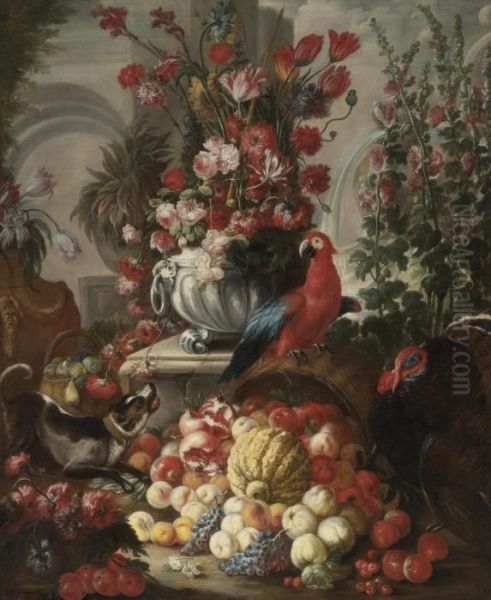
Other still life works attributed to him, such as Natura morta con pavone (Still Life with Peacock) and Natura morta con pappagallo (Still Life with Parrot), point to an interest in depicting exotic birds, which were popular motifs in Baroque art, symbolizing wealth, luxury, and the wonders of the natural world. These paintings would have showcased his meticulous attention to detail, his ability to render textures – from the iridescent plumage of the peacock to the smooth skin of fruits – and his sophisticated sense of color and composition.
It is noted that Malinconico's still life style shows influences from artists like "Brueghel" (likely referring to the tradition established by Jan Brueghel the Elder and his followers, known for their detailed flower pieces and allegorical still lifes) and Andrea Belvedere (1652-1732). Belvedere was a prominent Neapolitan still life painter, particularly known for his flower paintings, and his influence would have been contemporary and direct. The mention of a "French style" in connection to these influences suggests an awareness of international trends, possibly the more elegant and less overtly dramatic still lifes popular in France. This indicates Malinconico was not working in isolation but was receptive to broader European artistic currents, adapting them to his own refined vision. His still lifes, therefore, represent an important facet of his artistic personality, demonstrating a capacity for delicate observation and sophisticated design alongside his more monumental religious works.
Artistic Circle, Collaborations, and Wider Influences
Nicola Malinconico operated within a dynamic artistic community in Naples, and his career was inevitably shaped by interactions with other painters, both as a student, a contemporary, and potentially as a mentor himself. His primary artistic debt, as established, was to Luca Giordano. The foundational training in Giordano's workshop provided him with the technical facility and stylistic vocabulary that underpinned much of his subsequent work. He inherited Giordano's preference for luminous colors, fluid brushwork, and a certain theatricality in composition, though Malinconico often imbued his figures with a slightly more restrained or introspective quality compared to the sheer exuberance of his master.
The Neapolitan art scene was a complex web of influences and counter-influences. While Malinconico absorbed lessons from Giordano, he also navigated a landscape populated by other significant figures. Francesco Solimena (1657-1747), a near contemporary, rose to become the leading painter in Naples in the early 18th century, especially after Giordano's death. Solimena's style, characterized by its strong chiaroscuro, academic classicism, and dramatic compositions, represented another powerful artistic force in the city. While distinct from Malinconico's approach, the presence of such a dominant figure would have been part of the artistic environment in which Malinconico worked and competed for commissions.
Paolo de Matteis (1662-1728), another prominent pupil of Giordano, was a direct contemporary of Malinconico. Their careers would have run parallel, and they likely vied for similar projects. Comparing their respective interpretations of Giordano's legacy reveals the diverse paths taken by his students. De Matteis, for instance, developed a more classical and graceful style, influenced by Roman academicism.
Malinconico is also recorded as having collaborated with other artists, particularly in the realm of decorative and still life painting. His associations with painters like Gasparo Lopez (c. 1677-c. 1732), known as "Gaspare dei Fiori" for his flower paintings, Francesco Cassisa, and Gaetano Cusati, highlight the collaborative nature of some artistic production, especially for large decorative schemes or specialized genres. Such collaborations allowed artists to combine their respective strengths, with one perhaps excelling in figures and another in floral or landscape elements.
The influence of earlier masters continued to permeate Neapolitan art. The dramatic naturalism of Jusepe de Ribera, though belonging to an earlier generation, remained a potent force. Malinconico's Good Samaritan, for example, while stylistically indebted to Giordano, treats a theme that Ribera had rendered with profound pathos. It's plausible that Malinconico consciously engaged with Ribera's thematic legacy, reinterpreting it through the more painterly and coloristic lens of the late Baroque. Other figures from the earlier Neapolitan Baroque, such as the battle painter Aniello Falcone or the poetic Bernardo Cavallino, contributed to the rich artistic heritage that Malinconico inherited.
His still life work, as mentioned, shows an awareness of Northern European traditions, possibly transmitted through imported works or itinerant artists, as well as the local expertise of Andrea Belvedere. This openness to diverse influences, filtered through his own artistic temperament, allowed Malinconico to create a body of work that, while firmly rooted in the Neapolitan school, also possessed its own individual character.
Stylistic Hallmarks and Technical Prowess
Nicola Malinconico's artistic style is firmly situated within the late Baroque idiom of Naples, yet it possesses several distinguishing characteristics. His debt to Luca Giordano is undeniable, particularly in his adoption of a vibrant and luminous color palette. Unlike the darker, more tenebrous tones favored by earlier Neapolitan Caravaggisti, Malinconico, following Giordano, embraced brighter hues and a more open illumination, which lent his religious scenes an uplifting, often celebratory quality, even when depicting solemn subjects.
His compositions are typically dynamic and well-structured, capable of organizing numerous figures into coherent and engaging narratives. He had a strong sense of theatricality, using gestures, poses, and facial expressions to convey emotion and advance the story. This is particularly evident in his large altarpieces and frescoes, where the scale demanded a clear and impactful visual statement that could be read from a distance. However, his drama is often tempered with a degree of elegance and a sensitivity that prevents it from becoming overly bombastic.
In his handling of figures, Malinconico demonstrated skilled draughtsmanship. His figures are generally robust and well-proportioned, imbued with a sense of movement and life. While he could achieve a high degree of idealization suitable for religious subjects, there is often an underlying naturalism, a sense of tangible human presence that makes his characters relatable. This is evident in the tender expressions of his Madonnas or the earnest devotion of his saints.
His brushwork, while perhaps not as famously rapid as Giordano's, was fluid and confident, capable of rendering both broad forms and finer details. In his still lifes, this attention to detail would have been particularly pronounced, capturing the varied textures of flowers, fruits, and fabrics with precision. The "minimalist and elegant Oriental Baroque" description of his Still Life with Pheasant suggests a refined sense of design and an ability to achieve sophisticated effects through carefully chosen elements and a harmonious arrangement.
Malinconico was proficient in both oil on canvas and fresco. Fresco painting, executed on wet plaster, required speed, precision, and an ability to visualize the final effect, as mistakes were difficult to correct. His commissions for fresco cycles in churches like Sorrento Cathedral and San Giacomo degli Spagnoli attest to his mastery of this challenging medium. His oil paintings, whether large altarpieces or more intimately scaled still lifes, allowed for greater richness of color, depth of tone, and meticulous detail.
The scarcity of detailed biographical records, as noted in some accounts, means that a full appreciation of his artistic development and the nuances of his technique often relies heavily on the direct study of his surviving works and comparative analysis with his contemporaries. However, the visual evidence clearly points to an artist of considerable technical skill, a sophisticated colorist, and a painter capable of conveying both grand religious narratives and the subtle beauty of the everyday world.
Later Career, Legacy, and Historical Perspective
Nicola Malinconico remained active into the early decades of the 18th century, continuing to contribute to the artistic landscape of Naples until his death in 1726. His later career would have seen the continued dominance of Francesco Solimena, whose classicizing Baroque style became the prevailing taste. While Malinconico may not have achieved the same level of overarching influence as Giordano or Solimena, he maintained a successful practice, fulfilling commissions and upholding the strong painterly traditions of the Neapolitan school.
The relative lack of extensive contemporary biographical documentation, a common issue for many artists of the period who were not of the absolute first rank like a Giordano or a Bernini, means that his personal life and the precise chronology of all his works can sometimes be challenging to reconstruct fully. Art historical scholarship often relies on stylistic analysis, archival mentions of payments, and inscriptions on paintings to piece together an artist's career. Despite these challenges, a significant body of work has been attributed to him, allowing for a solid understanding of his artistic contributions.
Malinconico's legacy lies in his role as a significant practitioner of the late Neapolitan Baroque. He was a vital link in the chain of artistic transmission, absorbing the lessons of the great Luca Giordano and perpetuating a style characterized by vibrant color, dynamic composition, and emotional expressiveness. His religious paintings served their devotional purpose effectively, adorning numerous sacred spaces and contributing to the visual splendor of Neapolitan churches. His altarpieces and frescoes would have formed an integral part of the religious experience for countless individuals, shaping their understanding and appreciation of sacred narratives.
In the realm of still life, Malinconico offered a refined and elegant counterpoint to some of the more exuberant or rustic examples of the genre. His ability to imbue these compositions with a delicate sensibility and an eye for decorative harmony demonstrates his versatility and his engagement with diverse artistic currents. The recognition of influences from artists like Brueghel and Belvedere, as well as an affinity with French aesthetics, underscores his sophisticated artistic awareness.
While perhaps overshadowed in broader art historical narratives by his towering master, Giordano, or the highly influential Solimena, Nicola Malinconico remains an important figure for understanding the depth and breadth of artistic talent in Baroque Naples. His works are represented in significant collections and continue to be studied by scholars specializing in the Neapolitan Seicento and Settecento. The ongoing efforts to conserve and restore his paintings, such as the Coronation of the Virgin in Lampedusa, ensure that his artistic achievements can be appreciated by future generations. He stands as a testament to the rich artistic ecosystem of his time, an artist who, while working within established traditions, forged a distinctive and accomplished body of work.
Conclusion: An Enduring Neapolitan Voice
Nicola Malinconico was a gifted and productive painter whose career spanned a crucial period of transition in Neapolitan art, from the high-energy Baroque of Luca Giordano to the more classicizing trends of the early 18th century. Born and trained in Naples, he became a master of large-scale religious painting, creating compelling altarpieces and frescoes that enriched the city's churches and those in the surrounding regions. His style, deeply influenced by Giordano, was marked by vibrant colors, dynamic compositions, and a sensitive portrayal of human emotion, making his sacred narratives both visually striking and spiritually engaging.
Beyond his significant contributions to religious art, Malinconico also distinguished himself as a painter of elegant and refined still lifes, demonstrating a keen eye for detail and a sophisticated sense of design. His engagement with this genre, and his apparent awareness of both local and international trends, highlights his versatility and artistic intelligence.
Though perhaps not as widely known today as some of his Neapolitan contemporaries like Giordano, Ribera, or Solimena, Nicola Malinconico was a key figure in the artistic fabric of his time. His works in churches such as San Michele Arcangelo, the Sorrento Cathedral, and the Duomo di Napoli, alongside specific pieces like The Good Samaritan and his delicate still lifes, affirm his skill and importance. As an art historian, it is clear that Nicola Malinconico deserves recognition as a significant contributor to the rich legacy of Neapolitan Baroque painting, an artist whose works continue to resonate with their color, dynamism, and heartfelt expression.