Introduction to Henry Calvert
Henry Calvert, born in 1798 and passing in 1869, was a notable British artist who carved a niche for himself primarily as an animal painter during the vibrant artistic landscape of the 19th century. His works frequently graced the exhibitions of the prestigious Royal Academy in London, a testament to his skill and recognition within the art community of his time. While his name might occasionally be confused with other prominent figures of the era bearing the same surname, such as the distinguished military officer General Sir Harry Calvert (born George Harry Calvert, later Verney, 1763-1826), it is Henry Calvert the painter, with his distinct focus on the animal kingdom and rural life, who is the subject of this exploration. His career unfolded during a period of significant artistic evolution, and his contributions, particularly his depictions of animals, place him among the respected, if sometimes overlooked, talents of his generation.
Calvert's artistic journey was primarily situated in England, with a significant period of activity in Wales, where the rugged landscapes and pastoral scenes undoubtedly provided ample inspiration for his canvases. He specialized in capturing the form, spirit, and character of animals, a genre that enjoyed considerable popularity in 19th-century Britain, reflecting the nation's agricultural heritage and the gentry's passion for sport and livestock. His paintings often featured horses, hunting scenes, and domestic animals, rendered with an observational acuity that was compared favorably by his contemporaries to other established animal painters.
Early Artistic Development and Influences
Information regarding Henry Calvert's earliest training and formative influences is somewhat scarce, a common challenge when reconstructing the biographies of artists who did not achieve the towering fame of some of their peers. However, it is noted that, like many artists of his period, he may have initially felt the pervasive artistic currents of the time. One significant, though perhaps indirect or early, influence mentioned in connection with artists of the Calvert name, including his contemporary Edward Calvert, was the visionary poet and artist William Blake (1757-1827).
Blake's highly individualistic and mystical style, with its emphasis on spiritual and imaginative content, had a profound impact on a circle of younger artists, notably "The Ancients," which included Edward Calvert and Samuel Palmer. While Henry Calvert's primary focus on animal portraiture and sporting scenes might seem distant from Blake's overtly symbolic and religious works, the Romantic sensibility that Blake championed – an emphasis on emotion, individualism, and the sublime power of nature – permeated the artistic atmosphere. It is plausible that Henry Calvert, in his formative years, absorbed aspects of this Romantic spirit, which could have informed his approach to capturing the vitality and inherent dignity of his animal subjects.
However, sources also suggest that Henry Calvert, like his contemporary Edward Calvert, eventually moved beyond any early Blakean echoes. He is said to have turned his attention towards the more classical and naturalistic traditions of landscape and animal painting. This included an appreciation for the works of masters like Claude Lorrain (1600-1682), whose idealized landscapes and masterful handling of light set a standard for generations of artists. Such a shift would indicate a maturation of style, moving towards a more direct engagement with the observable world, refined by an understanding of established artistic conventions.
A Career Centered on Animal Art
Henry Calvert's professional career as an artist is most clearly demarcated by his consistent participation in the exhibitions of the Royal Academy of Arts in London. Between the years 1826 and 1854, he regularly submitted works for public display, a crucial avenue for artists to gain patronage, critical attention, and sales. The Royal Academy was the epicenter of the British art world, and to exhibit there was a mark of professional standing.
His specialization was unequivocally animal painting. This genre, while sometimes viewed as secondary to historical or grand manner portraiture by academic hierarchies, was immensely popular with the British public and aristocracy. The 19th century saw a flourishing of animal art, driven by agricultural advancements, the rise of pedigree breeding, and the enduring cultural importance of hunting and equestrian pursuits. Artists like George Stubbs (1724-1806) and Sawrey Gilpin (1733-1807) had earlier elevated animal painting to a high art form, and Calvert worked within this established tradition.
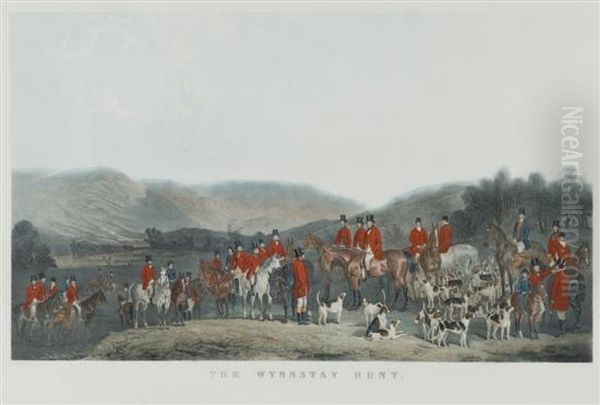
His exhibited works at the Royal Academy included titles that clearly reflect his thematic focus. Among these were "A Brood Mare," a subject that would appeal to landowners and breeders, showcasing his ability to render the noble qualities of prized livestock. Another significant work was "The Wynnstay Hunt," a painting that would have captured the dynamism and social rituals of a fox hunt, a popular subject demanding skill in depicting horses and hounds in vigorous action, as well as the surrounding landscape. "The Royal Pair of the Jungle," likely depicting exotic animals such as lions or tigers, suggests a broadening of his subject matter, possibly influenced by the growing public fascination with animals from the expanding British Empire, often seen in menageries or illustrated publications.
Calvert's skill in this domain was recognized by his peers and critics, who reportedly considered his work comparable to that of other respected animal painters of the time, such as Henry Bernard Chalon (1770-1849) and Richard Barrett Davis (1782-1854). Both Chalon and Davis were well-known for their sporting and animal subjects, so this comparison situates Calvert firmly within the mainstream of competent and admired animal specialists.
Artistic Style, Mediums, and Techniques
Henry Calvert predominantly worked in oil paint, the standard medium for finished exhibition pieces during the 19th century. His oil paintings, such as the "Bay Stallion in an Open Landscape" which appeared at auction with an estimate of £1,000 to £1,500, demonstrate his commitment to this medium. Oil paint allowed for rich colors, detailed rendering, and the subtle gradations of light and shadow necessary to convey the texture of animal coats, the musculature of their forms, and the atmosphere of their settings.
While oil painting was his primary focus and the basis for his reputation, Calvert also reportedly created some woodcut prints. Woodcuts, a relief printing technique, offered a different expressive potential, often characterized by bold lines and strong contrasts. However, his works in this medium are considered less prominent compared to his achievements in oil. This might suggest that printmaking was a secondary pursuit, or perhaps that fewer examples have survived or been widely documented. The production of prints could serve various purposes, from personal experimentation to wider dissemination of images at a lower cost than original paintings.
In terms of style, Calvert's work is described as evolving. If there was an early, perhaps diffused, influence from the Romanticism of figures like William Blake, he is said to have later developed his own distinct artistic voice. This mature style was characterized by a "serene spiritual state," a quality that could imply a calm, empathetic observation of his subjects, imbuing them with a sense of quiet dignity rather than overt drama or sentimentality. This characteristic, if accurately attributed, would indeed lend his work a unique flavor within the broader currents of Romantic art, which often leaned towards the more overtly passionate or sublime.
His paintings likely demonstrated a keen understanding of animal anatomy, a prerequisite for any successful animalier. This would have been acquired through careful observation of live animals, and possibly the study of anatomical texts or écorché models. The ability to depict animals accurately, both at rest and in motion, was crucial for capturing their essential nature and for satisfying the discerning eyes of patrons who were often experts in horsemanship or animal husbandry.
The Royal Academy Exhibitions and Public Engagement
Exhibiting at the Royal Academy was a cornerstone of Henry Calvert's career. These annual exhibitions were major social and cultural events, drawing large crowds and extensive press coverage. For an artist like Calvert, they provided an indispensable platform to showcase his latest works to potential buyers, critics, and the art-loving public. The period of his activity, from 1826 to 1854, spans a dynamic era in British art, witnessing the tail end of Regency elegance, the rise of Victorian sensibilities, and the flourishing of various artistic movements.
One interesting anecdote, though its precise dating in relation to Henry Calvert's specific exhibition history requires careful consideration, highlights the vibrant interplay between different cultural forms during this period. An account mentions a Royal Academy exhibition in 1805 (this date precedes Calvert's documented exhibition period, suggesting it might refer to another Calvert or a general RA event characteristic of the era he later joined) that coincided with the theatrical sensation surrounding the young actor William Henry West Betty, known as "Master Betty." The RA exhibition reportedly opened the day before Betty's debut in "Hamlet" at Covent Garden and featured portraits related to the theatrical world. While this specific event might not directly involve our Henry Calvert, it illustrates the kind of cultural synergy that surrounded the Royal Academy. Artists often drew inspiration from, and contributed to, the broader cultural conversations of their day, including theatre, literature, and public events.
Henry Calvert's consistent presence at the Royal Academy for nearly three decades indicates a sustained level of artistic production and acceptance by the selection committees. His animal paintings would have contributed to the diversity of genres on display, catering to a significant segment of the art market. The subjects he chose – brood mares, hunts, and even exotic "jungle" animals – were all popular themes that resonated with the interests and lifestyles of the British elite and the burgeoning middle class.
The Welsh Connection: Landscape and Inspiration
A significant aspect of Henry Calvert's artistic life was his work in Wales. While the specifics of his time there – such as the duration or exact locations – are not extensively detailed in the provided summaries, the mention of Wales as a key area of his activity is important. The Welsh landscape, with its dramatic mountains, verdant valleys, and rugged coastline, has long been a source of inspiration for artists. For an animal painter, Wales would have offered a rich tapestry of pastoral scenes, hardy native breeds of livestock, and a distinct rural culture.
It is plausible that Calvert undertook sketching tours in Wales, gathering material that would later be developed into finished oil paintings in his studio. The quality of light, the unique atmospheric conditions, and the specific character of the Welsh countryside could have influenced the backgrounds and overall mood of his animal portraits and genre scenes. Artists of the Romantic era were particularly drawn to such landscapes, seeking out the picturesque and the sublime.
His Welsh works might have depicted local farming practices, Welsh ponies or cattle, or even hunting scenes set against the distinctive backdrop of the Welsh hills. This regional focus could have also appealed to patrons with Welsh connections or those who appreciated art that captured the diverse character of the British Isles. The experience of working in Wales may have contributed to the "serene spiritual state" noted in his art, as he immersed himself in the natural beauty and rural tranquility of the region. This connection adds another dimension to his profile as an artist, suggesting a willingness to explore beyond the more conventional artistic circuits of London.
Contemporaries and the Artistic Milieu of the 19th Century
Henry Calvert practiced his art during a period rich with diverse talents and evolving artistic ideas. Understanding his work benefits from considering him in relation to his contemporaries, both those with similar specializations and those who represented broader artistic trends.
His work was directly compared to that of Henry Bernard Chalon (1770-1849) and Richard Barrett Davis (1782-1854). Chalon was a prolific painter of animals and sporting scenes, appointed Animal Painter to the Duchess of York and later to the Prince Regent. Davis, similarly, was known for his hunting scenes and portraits of horses and dogs, enjoying royal patronage. Placing Calvert in their company underscores his competence in this popular field.
Other prominent animal painters of the era, or slightly preceding it but whose influence lingered, include the great George Stubbs (1724-1806), whose scientific approach to equine anatomy revolutionized animal painting. Sawrey Gilpin (1733-1807) was another key figure, known for his romantic and often dramatic depictions of horses. Closer to Calvert's active period were artists like James Ward (1769-1859), who produced powerful animal paintings and large-scale agricultural scenes, and Abraham Cooper (1787-1868), noted for his battle scenes and sporting subjects. The towering figure of Sir Edwin Landseer (1802-1873), a direct contemporary, became Queen Victoria's favorite painter, and his sentimental yet masterfully executed animal paintings achieved immense popularity. John Frederick Herring Sr. (1795-1865) was another highly successful contemporary, famed for his detailed and lively depictions of racehorses and farmyard scenes. Calvert's work would have been seen alongside, and judged against, the output of these artists.
The artistic environment also included figures like Edward Calvert (1799-1883), a near-exact contemporary who shared the same surname and was deeply influenced by William Blake (1757-1827). Edward Calvert was a central member of "The Ancients," a group of young artists who gathered around Blake in his later years and sought to create art imbued with pastoral innocence and spiritual intensity. Other members of this group included Samuel Palmer (1805-1881), whose visionary landscapes of Shoreham are iconic, and George Richmond (1809-1896), who later became a successful portrait painter. While Henry Calvert the animal painter may not have been directly part of this mystical circle, their shared surname and contemporaneity mean their paths might have crossed, or they would have at least been aware of each other's work within the relatively small London art world.
The mention of Charles Calvert as a brother and fellow painter, specializing in landscapes, also adds to the picture of a family potentially engaged in the arts. If this Charles Calvert is the landscape painter Charles Calvert (1785-1852) who was active in Manchester and won awards there, he would have been an older brother or relative. This Charles Calvert was known for his oil and watercolour landscapes. The Calvert family, it seems, had multiple members contributing to the artistic fabric of 19th-century Britain.
The influence of earlier masters like Claude Lorrain (1600-1682), noted in relation to both Henry and Edward Calvert's stylistic development, points to the enduring importance of the classical landscape tradition. Artists often looked to such exemplars for guidance on composition, light, and atmospheric effect, even when depicting contemporary British scenes.
Later Career, Legacy, and Historical Position
Details about Henry Calvert's later career, after his last documented Royal Academy exhibition in 1854, and his final years leading up to his death in 1869, are not extensively covered in the provided information. It is common for artists' public visibility to wane in their later years due to various factors, including changing artistic tastes, declining health, or a shift to more private artistic pursuits or teaching.
His historical position is that of a skilled and respected animal painter active during the first half of the 19th century. He contributed to a genre that was highly valued in British society, reflecting national identity, rural pursuits, and a deep appreciation for the animal kingdom. His ability to capture the likeness and character of animals, particularly horses, placed him in good standing among his peers. The comparison to artists like H.B. Chalon and R.B. Davis suggests he was considered a proficient and reliable practitioner in his chosen field.
The art world's assessment of Henry Calvert, as gleaned from the provided text, acknowledges his talent. His early connection, however tentative, to the broader Romantic currents influenced by figures like William Blake, followed by a development towards a more personal style potentially informed by classical landscape painters like Claude Lorrain, suggests an artist who was responsive to the artistic dialogues of his time while forging his own path. The description of his work possessing a "serene spiritual state" and holding a "unique position in Romantic art" (though this latter point might be more strongly associated with Edward Calvert by some scholars) indicates that his art had distinctive qualities that were recognized.
While perhaps not achieving the household-name status of a Landseer or a Stubbs, Henry Calvert's contributions are part of the rich tapestry of 19th-century British art. His paintings would have adorned the homes of landowners, sporting enthusiasts, and those who appreciated finely rendered depictions of animals. Today, his works would be of interest to collectors of British sporting and animal art, and to art historians studying the genre and the period. The auction record of his "Bay Stallion in an Open Landscape" indicates a continuing, if modest, market interest in his work.
Conclusion: Appreciating Henry Calvert's Contribution
Henry Calvert (1798-1869) stands as a noteworthy figure in the realm of 19th-century British animal painting. His career, marked by regular exhibitions at the Royal Academy over nearly three decades, demonstrates a sustained commitment to his craft and a recognized level of skill. Specializing in a genre beloved by the British public, he captured the grace of horses, the excitement of the hunt, and the diverse forms of the animal world, with a significant portion of his work possibly inspired by his time in Wales.
While navigating a complex artistic landscape that included the visionary Romanticism of Blake and his followers, the classical traditions of landscape, and the burgeoning popularity of detailed naturalism, Calvert appears to have developed a style appreciated for its sensitivity and observational skill. His comparison with established animal painters like Chalon and Davis attests to his proficiency.
Though overshadowed in historical narratives by some of his more famous contemporaries, Henry Calvert's oeuvre contributes to our understanding of the artistic tastes and cultural preoccupations of 19th-century Britain. His paintings offer a window into a world where the relationship between humans and animals, whether in sport, agriculture, or companionship, was a central facet of life and a worthy subject for artistic representation. His legacy is that of a dedicated and talented artist who skillfully depicted the animal kingdom, earning a respectable place within the tradition of British animal art.