Henry James Johnstone (1835-1907) stands as a fascinating figure in the art history of both Britain and Australia. A man of diverse talents, he navigated the burgeoning world of photography while simultaneously cultivating a respected career as a painter, particularly lauded for his evocative landscapes. His life and work offer a window into the artistic currents of the Victorian era, the colonial art scene in Australia, and the dynamic interplay between the lens and the brush. This exploration will delve into his origins, his significant contributions to photography, his development as a painter under notable influences, his celebrated masterwork, and his place among the artistic talents of his time.
Early Life and Artistic Awakenings in Birmingham
Born in Birmingham, England, in 1835, Henry James Johnstone's formative years were spent in a city at the heart of the Industrial Revolution, a place of dynamic change and manufacturing prowess, but also one with a growing appreciation for arts and culture. His initial artistic training was received at the esteemed Birmingham School of Design. This institution, like others established across Britain during this period, aimed to improve the quality of British manufactured goods by instilling principles of good design in artisans and would-be industrial designers. It provided a solid grounding in drawing and the fundamentals of visual composition, skills that would prove invaluable in both his photographic and painterly pursuits.
Beyond the structured environment of the School of Design, Johnstone sought further refinement of his skills through instruction from various private tutors. This tailored education likely allowed him to explore specific interests and techniques more deeply. A pivotal early experience was his apprenticeship within his father's photography company. In the mid-19th century, photography was a relatively new and rapidly evolving medium. Daguerreotypes, ambrotypes, and the wet collodion process were transforming the way people saw the world and recorded their own images. This immersion in the technical and commercial aspects of photography from a young age provided Johnstone with a practical skill set and an understanding of a medium that was beginning to challenge and influence traditional art forms.
The allure of new horizons and opportunities, a common theme in Victorian Britain, soon beckoned. The gold rushes in Australia, particularly in Victoria, created a powerful draw for ambitious individuals from across the globe.
The Australian Sojourn: Photography and New Landscapes
In 1853, at the age of eighteen, Henry James Johnstone embarked on a significant journey, traveling to Melbourne, Australia. This city was then a bustling boomtown, its population and economy rapidly expanding due to the Victorian gold rush. While the provided information suggests he may have initially been drawn to the goldfields, his photographic background quickly became his professional focus. After approximately three years in Australia, he returned to Britain, a period that likely allowed him to consolidate his experiences and perhaps acquire further capital or expertise.
His return to Australia marked a new phase in his professional life. He didn't return alone in his business endeavors. Johnstone partnered with Emily Florence Kate O'Shaughnessy to establish a photography studio in Melbourne. Initially known as Johnstone & Co., the firm quickly gained a reputation for quality. The partnership was evidently successful and enduring, as by 1865, the company was rebranded as Johnstone, O'Shannessy & Co. (the spelling of O'Shaughnessy often varied in records). This studio became one of Melbourne's leading photographic establishments, catering to a growing colonial society eager for portraits, family records, and views of their new environment.
The success of Johnstone, O'Shannessy & Co. is underscored by their participation in major international exhibitions. They showcased their photographic work at the Philadelphia Centennial Exposition in 1875, a significant world's fair celebrating the 100th anniversary of American independence. This event provided a global platform for arts and industries. Later, their work was also featured at the Melbourne International Exhibition in 1888. These exhibitions were crucial for establishing reputations and demonstrating the technical and artistic advancements of the colonies. Their inclusion speaks volumes about the high regard in which their photographic output was held, rivaling that of established studios in Europe and America. Photographers like Nadar (Gaspard-Félix Tournachon) in Paris and Julia Margaret Cameron in England were, at this time, elevating photography to an art form, and colonial studios like Johnstone's were part of this global movement, documenting society and landscape with increasing sophistication.
The Influence of Buvelot and the Painter's Path
While deeply engaged in his successful photography business, Henry James Johnstone did not abandon his passion for painting. Indeed, his time in Australia provided him with new subjects and, crucially, influential artistic connections. One of the most significant of these was with the Swiss-born artist Louis Buvelot. Buvelot had arrived in Melbourne in 1865 and quickly became a leading figure in the Australian art scene. He is often regarded as a father figure of Australian landscape painting, bringing with him a style influenced by the Barbizon School painters of France, such as Jean-Baptiste-Camille Corot and Théodore Rousseau, who emphasized direct observation of nature and a more naturalistic, less idealized approach to landscape.
Johnstone became a student of Buvelot, and this tutelage was profoundly important. Buvelot's emphasis on plein air (open air) sketching and his sensitive depiction of the Australian bush, with its unique light and subtle colours, offered a departure from the more formal, often romanticized European landscape traditions. Other artists who benefited from Buvelot's influence or shared a similar sensibility in capturing the Australian scene included Eugene von Guérard, known for his detailed and majestic landscapes, and, slightly later, the key figures of the Heidelberg School, such as Tom Roberts, Arthur Streeton, and Frederick McCubbin. While Johnstone's style retained a certain Victorian polish, Buvelot's impact is evident in his treatment of light and atmosphere.
Johnstone proved adept in both oil and watercolour, demonstrating a versatility that allowed him to capture a range of subjects, from the grandeur of natural landscapes to the specifics of urban architecture. His photographic eye for composition and detail likely informed his painting, while his painterly understanding of light and colour would have, in turn, enriched his photographic work. This dual practice was not uncommon; artists like Gustave Le Gray in France also moved between photography and painting, each discipline informing the other.
Evening Shadows: An Australian Icon
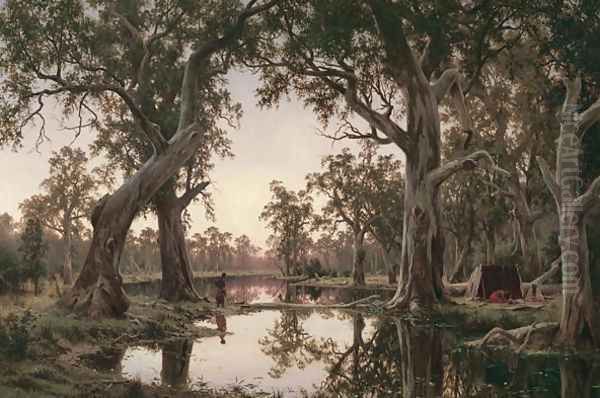
The culmination of Henry James Johnstone's painting career in Australia, and arguably his most famous work, is the large oil painting titled Evening Shadows, Backwater of the Murray, South Australia, completed in 1880. This painting holds a special place in Australian art history. It was the very first painting acquired by the Art Gallery of South Australia, then known as the National Gallery of South Australia, in 1881, purchased with funds from the South Australian government. This inaugural acquisition signaled the colony's commitment to fostering a public art collection and celebrating depictions of the local landscape.
Evening Shadows depicts a serene, almost elegiac scene of the Murray River at dusk. The painting is characterized by its meticulous detail, its subtle rendering of the fading light, and the tranquil atmosphere it evokes. The towering gum trees, the still water reflecting the sky, and the sense of quietude capture a quintessential aspect of the Australian landscape. Its popularity was immense, and it became one of the most frequently reproduced Australian paintings of the 19th and early 20th centuries, appearing in prints and even on household items. This widespread dissemination made it a familiar image to generations of Australians, cementing its iconic status.
The painting's appeal lay in its ability to resonate with both colonial nostalgia for a perceived untouched wilderness and an appreciation for the unique beauty of the Australian environment. It stands in contrast to the more heroic or dramatic landscapes of earlier colonial artists like John Glover or Conrad Martens, offering instead a more intimate and contemplative vision. The success of Evening Shadows highlights Johnstone's skill in capturing the specific atmospheric effects of the Australian landscape, a quality highly prized by his contemporaries and the public alike.
Artistic Style, Themes, and Broader Context
Henry James Johnstone's artistic style, particularly in his landscape paintings, can be situated within the broader currents of Victorian art. There's a clear commitment to naturalism, a desire to represent the visible world with accuracy, which was a hallmark of much 19th-century painting. His work often displays a careful attention to botanical detail and geological formations, reflecting the Victorian era's keen interest in science and the natural world. This detailed approach can also be seen in the work of British contemporaries like John Brett or the landscape elements in Pre-Raphaelite paintings by artists such as John Everett Millais.
However, Johnstone's work is not merely topographical. It is imbued with a lyrical quality, a sensitivity to mood and atmosphere, particularly evident in his handling of light. Evening Shadows is a prime example, but other works, such as his depictions of forests, rivers, and lakes, often convey a sense of tranquility and the sublime beauty of nature. His paintings are often described as decorative and poetic, suggesting an aim to create works that were not only accurate representations but also aesthetically pleasing and emotionally resonant. The influence of the Barbizon school, via Buvelot, is apparent in this focus on capturing transient effects of light and weather, and a more personal response to the landscape, moving away from the grand, formulaic compositions of earlier academic landscape traditions.
While landscape was his forte, Johnstone also painted portraits and, as mentioned, depicted urban architecture. His versatility extended to his choice of media, being proficient in both oils, which allowed for rich colours and textures, and watercolours, a medium well-suited for capturing fleeting effects of light and for more intimate studies. His work in Australia contributed to a growing body of art that sought to define a distinctly Australian visual identity, moving beyond purely European conventions to engage with the unique characteristics of the new continent. He was part of a generation of artists, including Nicholas Chevalier (though no direct collaboration is noted, they were contemporaries in the Melbourne art scene) and S.T. Gill (known for his lively depictions of colonial life), who were instrumental in shaping the visual culture of colonial Australia.
Anecdotes and Character: Glimpses of the Man
Beyond his artistic and photographic output, some anecdotes offer glimpses into Henry James Johnstone's personality. One rather striking story recounts an incident during a visit to a girls' school. Apparently, upon finding that the school's headmistress had not complied with one of his directives, Johnstone, in a moment of pique, used his gold-headed cane to break a glass window. This suggests a man of strong will, perhaps with an impatient or imperious streak, accustomed to having his instructions followed – a trait that might have served him well in managing a successful business.
Another interesting facet mentioned is his opposition to the extreme cruelty of French penal practices. This indicates a humanitarian concern and an engagement with the social issues of his time. The Victorian era was a period of significant social reform movements, and individuals often held strong opinions on matters of justice and punishment.
Perhaps the most curious piece of information relates to a purported contribution to medicine, specifically his skill in controlling fever, for which he was praised while on a committee in Bristol. This is an unusual detail for an artist and photographer. It's possible this refers to a different Henry James Johnstone, or that our artist had diverse interests and skills beyond his primary profession. If it is indeed the same man, it adds another layer to his biography, suggesting a polymathic inclination or a civic-mindedness that led him to contribute in unexpected ways. Such versatility was not unheard of in the Victorian era, when gentlemen often pursued multiple areas of knowledge and public service.
Later Years and Enduring Legacy
The provided information indicates Henry James Johnstone passed away in 1907. While his most prominent period of activity, particularly his influential painting Evening Shadows, is associated with his time in Australia, he was born and died in England. It's common for colonial artists to have careers that spanned continents, often returning to Britain later in life.
Johnstone's legacy is multifaceted. As a photographer, he, along with his partner Emily O'Shaughnessy, ran one of the most successful studios in colonial Melbourne, contributing significantly to the visual record of that era. Their participation in international exhibitions demonstrates the quality and ambition of their work.
As a painter, his impact is most profoundly felt through Evening Shadows. Its status as the first acquisition of a major state gallery and its enduring popularity underscore its cultural significance. He was a skilled practitioner of landscape painting, influenced by European traditions but adapting them to the Australian environment. His tutelage under Louis Buvelot places him within an important lineage of Australian landscape art that paved the way for later movements like the Heidelberg School, whose members, including Charles Conder, further developed a distinctively Australian vision, often with a greater emphasis on capturing the brilliant light and colours of the continent, sometimes leaning towards Impressionistic techniques.
Henry James Johnstone's career exemplifies the Victorian era's spirit of enterprise and artistic exploration. He successfully navigated the commercial demands of a photography business while pursuing his passion for painting, leaving behind a body of work that continues to be appreciated for its technical skill and its sensitive portrayal of the natural world. His ability to capture the unique atmosphere of the Australian landscape, particularly the interplay of light and shadow, ensures his place in the annals of Australian art history, while his broader career reflects the interconnectedness of the artistic worlds of Britain and its colonies during a period of profound global change. His work, bridging the meticulous eye of the photographer with the expressive hand of the painter, remains a testament to a versatile and accomplished artistic talent.