Hermann Hartwich (1853-1926) stands as a notable figure in the annals of late 19th and early 20th-century art, a painter whose career bridged the artistic currents of both Germany and the United States. Born in New York City to German immigrant parents, Hartwich's life and art embody a fascinating transatlantic dialogue. He was primarily a realist, celebrated for his evocative landscape paintings and genre scenes that captured the nuances of rural and urban daily life with a keen eye for atmospheric effects and the play of light. His artistic journey took him from the burgeoning metropolis of New York to the esteemed art academies of Munich, and back again, leaving a legacy of works that continue to resonate with their quiet dignity and profound appreciation for the natural world.
Early Life and Artistic Inclinations
Hermann Hartwich was born on July 8, 1853, in New York City. His formative years were spent in an environment shaped by the experiences of his German immigrant family, a background that likely instilled in him a connection to European cultural traditions. While details of his earliest artistic stirrings are not extensively documented, it is clear that a passion for visual expression took root early on. The New York of his youth was a rapidly expanding city, a hub of commerce and culture, yet it was the call of European artistic training, particularly in Germany, that would significantly shape his development as a painter.
The decision to pursue formal art education in Germany was a common path for many aspiring American artists of that era. Germany, and Munich in particular, was renowned for its rigorous academic training and its vibrant artistic community. This move marked a pivotal moment for Hartwich, setting him on a course that would immerse him in the rich traditions of European painting while allowing him to cultivate his unique artistic voice.
The Munich Academy: A Crucible of Realism
Hartwich enrolled in the prestigious Munich Academy of Fine Arts (Akademie der Bildenden Künste München), a leading institution that attracted students from across Europe and America. During his time there, from approximately 1881 to 1885, he studied under influential figures of the Munich School. Among his instructors were Wilhelm von Diez and Ludwig von Löfftz, both highly respected painters known for their commitment to realism and their mastery of technique. The Munich School emphasized direct observation, a rich, often dark, palette, and bravura brushwork, drawing inspiration from 17th-century Dutch Masters like Frans Hals and Rembrandt, as well as contemporary realists such as Gustave Courbet.
The atmosphere at the Munich Academy was one of intense study and artistic exploration. Hartwich would have been surrounded by a generation of artists grappling with the legacy of academicism while embracing new approaches to subject matter and technique. Fellow American artists who also sought training in Munich around this period included figures like Frank Duveneck and William Merritt Chase, who, upon their return to the United States, played significant roles in disseminating the principles of the Munich School. Hartwich's training instilled in him a strong foundation in draftsmanship, composition, and the realistic depiction of form and light. He also briefly studied with Johann Wagner-Deines, further broadening his technical and stylistic exposure.
Artistic Style: Capturing Light and Atmosphere
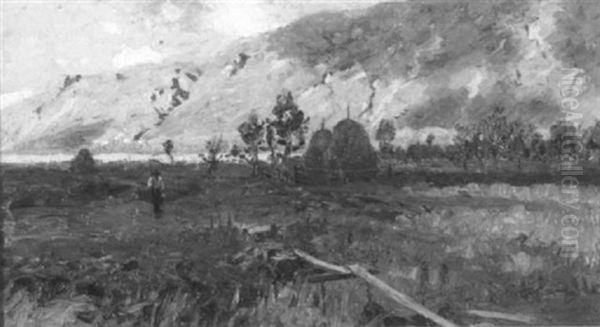
Hermann Hartwich's artistic style is firmly rooted in Realism, with a particular sensitivity to the effects of light and atmosphere that sometimes verges on an Impressionistic sensibility, though he remained committed to representational accuracy. He excelled in capturing the subtle gradations of light at different times of day and during various seasons, lending his scenes a palpable mood and a sense of immediacy. His landscapes, whether depicting the rolling hills of the American countryside or the pastoral scenes of northeastern Germany, are characterized by a profound understanding of nature's rhythms.
His brushwork, while controlled, often possessed a confident application that conveyed texture and form effectively. He was adept at rendering the specific qualities of different environments – the crisp air of a winter morning, the hazy warmth of a summer afternoon, or the dampness of an autumnal day. Unlike the more radical experiments of the French Impressionists such as Claude Monet or Camille Pissarro, Hartwich did not dissolve form into pure light and color; instead, he used light to model form and to create a cohesive, believable space. His genre scenes, depicting everyday activities of rural folk or quiet urban moments, share this commitment to verisimilitude and atmospheric depth.
Thematic Focus: Rural Life and Natural Beauty
The primary thematic concerns in Hartwich's oeuvre revolve around the depiction of landscapes and scenes of daily life. He found inspiration in the unspoiled beauty of the American countryside and the traditional agricultural landscapes of Germany. His paintings often feature pastoral motifs: cattle grazing by a stream, farmers returning from the fields, quiet village streets, or snow-covered winter vistas. These subjects allowed him to explore his fascination with the changing seasons and the enduring connection between humanity and the natural world.
Works such as "Cattle Watering," "Winter in the Village," and "Returning from the Fields" (titles may vary or be descriptive of common subjects) exemplify his approach. In these paintings, human figures are often integrated harmoniously within the landscape, depicted with a sense of quiet dignity as they go about their daily tasks. There is a nostalgic quality to many of his rural scenes, a gentle appreciation for a way of life that was increasingly being transformed by industrialization and urbanization during his lifetime. His urban scenes, though perhaps less numerous, also demonstrate his keen observational skills, capturing the character of cityscapes with the same attention to light and atmosphere.
Exhibitions and Recognition: A Transatlantic Presence
Hartwich's talent did not go unnoticed. He actively participated in exhibitions on both sides of the Atlantic, gaining recognition for his skillful and evocative paintings. A significant moment in his career came in 1901 when he was awarded a second-class medal for painting ("Médaille de 2me Classe Peinture") at the prestigious Paris Salon. The Paris Salon was one of the most important art exhibitions in the world, and receiving an award there was a considerable honor, signifying international acclaim. This medal is now part of the collection of the Smithsonian American Art Museum, a testament to his achievement.
Throughout his career, Hartwich also exhibited regularly at the Munich Glaspalast (Glass Palace), a major venue for art exhibitions in Germany, with recorded participation from 1883 to 1910. His works were well-received and found their way into private collections in both Europe and the United States. This transatlantic appeal underscores the universal quality of his art, which resonated with audiences in different cultural contexts. His ability to capture the essence of both American and German landscapes contributed to his broad appeal.
A Career Spanning Continents
Hermann Hartwich's career was characterized by movement between his native United States and his adopted artistic home in Germany. After completing his studies in Munich, he established himself as a professional artist. He returned to New York in 1894, bringing with him the techniques and sensibilities honed in Europe. During his time in the United States, he would have engaged with the American art scene, which was itself undergoing significant transformations with the rise of American Impressionism and the continued strength of Realist traditions.
Artists like Winslow Homer and Thomas Eakins were dominant figures in American Realism, known for their powerful and unsentimental depictions of American life and landscape. While Hartwich shared their commitment to realism, his style, influenced by the Munich School, had its own distinct characteristics. Later in his life, Hartwich chose to return to Munich, the city where he had received his foundational artistic training and where he had achieved significant recognition. He passed away in Munich on March 8, 1926.
Hartwich in the Context of His Contemporaries
To fully appreciate Hermann Hartwich's contributions, it is useful to consider him within the broader context of his contemporaries. In Munich, besides his teachers Löfftz and Diez, the artistic environment was shaped by figures like Wilhelm Leibl, a leading proponent of German Realism known for his unvarnished portraits and scenes of peasant life. Franz von Lenbach was another prominent Munich artist, celebrated for his society portraits. The influence of the Barbizon School, with artists like Jean-Baptiste-Camille Corot and Jean-François Millet, who championed realistic landscape and peasant scenes in France, also resonated across Europe and informed the realist tendencies of the Munich School.
In America, Hartwich's work can be seen in relation to the Hudson River School's legacy of landscape painting, though his approach was generally more focused on intimate, everyday scenes rather than grand, sublime vistas. His realism aligns with that of Eastman Johnson, who also depicted rural American life. While American Impressionism was gaining traction with artists like Childe Hassam, Theodore Robinson, and Mary Cassatt, Hartwich largely remained within the realist tradition, though his attention to light and atmosphere shows an awareness of Impressionist concerns.
In Germany, the late 19th and early 20th centuries also saw the rise of German Impressionism, with key figures such as Max Liebermann, Lovis Corinth, and Max Slevogt. These artists, while embracing a more broken brushwork and a brighter palette than traditional Munich School painters, shared an interest in capturing fleeting moments and the effects of light, often depicting scenes of modern life and leisure. Hartwich's work, therefore, occupies a space that bridges the meticulous realism of the Munich School with a sensitive, almost impressionistic, rendering of atmosphere, distinguishing him from both the more academic painters and the more radical modernists who would emerge in the early 20th century, such as the artists of Die Brücke like Ernst Ludwig Kirchner or Emil Nolde, whose expressive and bold style marked a significant departure from realism.
Representative Works: A Glimpse into Hartwich's World
While a comprehensive, universally agreed-upon list of Hartwich's most famous "masterpieces" can be elusive, as is common for many artists of his era whose works are widely dispersed, several paintings and types of scenes are consistently associated with his name and exemplify his artistic strengths.
One notable example is often titled or described as "Winter Landscape with Figures" or "Snowy Village Scene." These paintings typically depict a serene, snow-covered village, often with figures bundled against the cold, perhaps a horse-drawn sleigh, and smoke curling from chimneys. Hartwich excelled at capturing the diffused light of a winter sky and the subtle blues and violets in the shadows on the snow, creating a palpable sense of cold, crisp air.
Another recurring theme is "Cattle by a Stream" or "Pastoral Scene with Livestock." These works showcase his skill in animal painting and his ability to integrate figures and animals seamlessly into the landscape. The placid water, the textures of the animals' hides, and the lushness of summer foliage are rendered with care and a deep appreciation for the bucolic. Paintings like "Cattle Watering at the River's Edge" highlight his ability to capture the reflective qualities of water and the peaceful rhythm of rural life.
"Returning from the Fields" or "Harvesters at Rest" are genre scenes that focus on the human element within the agricultural landscape. These paintings often depict farmers, men and women, engaged in or resting from their labor. There is a sense of quiet dignity in these figures, and Hartwich masterfully conveys the light of late afternoon or early evening, casting long shadows and imbuing the scene with a sense of closure to the day's work.
His painting "The Old Mill Stream" (or similar titles depicting mills) would combine his interest in picturesque rural architecture with the dynamic element of water and the surrounding landscape, often evoking a sense of nostalgia for a pre-industrial era.
The specific work for which he won the Paris Salon medal in 1901, while its exact title might require specific archival research, would undoubtedly have been a prime example of his mature style, demonstrating his mastery of composition, light, and realistic depiction that so impressed the Salon jury. These representative subjects, consistently appearing in auction records and collection attributions, paint a clear picture of Hartwich's artistic preoccupations and his skill in rendering them.
Later Years and Enduring Legacy
Hermann Hartwich spent his later years in Munich, continuing to paint and contribute to the artistic life of the city. His decision to return to Germany suggests a deep and abiding connection to the country and its artistic traditions. He died in Munich in 1926, leaving behind a significant body of work that reflects his dedication to the principles of realism and his sensitive observation of the world around him.
The legacy of Hermann Hartwich lies in his skillful and heartfelt depictions of landscapes and everyday life. His paintings offer a window into the rural and urban environments of the late 19th and early 20th centuries, captured with an artist's eye for beauty and a realist's commitment to truth. His transatlantic career makes him an interesting figure in the study of cultural exchange between Europe and America during this period. While perhaps not as widely known today as some of his more revolutionary contemporaries, Hartwich's work maintains its appeal through its technical proficiency, its atmospheric qualities, and its quiet celebration of the enduring beauty of the natural world and the simple dignity of ordinary life. His paintings are held in various private and public collections, ensuring that his contribution to the art of his time continues to be appreciated.
Conclusion: A Painter of Quiet Realities
Hermann Hartwich was an artist who found profound beauty in the observable world. His journey from New York to the academies of Munich and back, and finally settling in Germany, shaped a career dedicated to the nuanced portrayal of light, landscape, and life. As a German-American realist, he navigated the artistic currents of his time with a steady hand, creating works that speak to a deep appreciation for both the American and German environments he inhabited. His paintings, characterized by their meticulous detail, atmospheric depth, and empathetic portrayal of everyday scenes, stand as a testament to a dedicated artist who skillfully chronicled the quiet realities of his era. His recognition at the Paris Salon and his consistent exhibition record underscore the respect he garnered during his lifetime, and his works continue to offer a serene and insightful glimpse into the world as he saw it.