Abraham Hermanjat: A Swiss Painter Between Tradition and Modernity
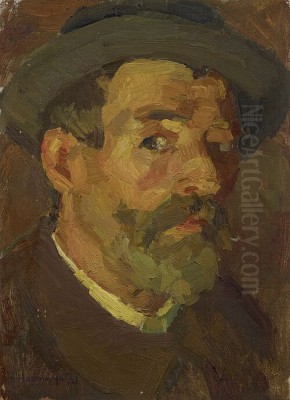
Abraham Hermanjat stands as a significant, if sometimes overlooked, figure in Swiss art history. Born in Geneva on September 29, 1862, and passing away in Aubonne on October 12, 1932, Hermanjat's artistic journey navigated the diverse currents of late 19th and early 20th-century European art. His oeuvre reflects a fascinating synthesis of influences, ranging from Orientalism and Symbolism to the revolutionary approaches of Divisionism and Fauvism, all while maintaining a profound connection to the Swiss landscape. He was among the pioneering Swiss artists to engage with the work of Paul Cézanne, and his career was marked by a continuous evolution of style and a dedicated involvement in the Swiss artistic community.
Early Life and Artistic Formation
Jacques Elie Abraham Hermanjat, who would later be known simply as Abraham Hermanjat, began his life in the cosmopolitan city of Geneva. After receiving his initial education in public schools, a significant chapter of his youth unfolded in Algeria. He moved there to join his parents and brother, and it was in this North African setting that he continued his artistic studies. The vibrant colours, intense light, and distinct cultural environment of Algeria undoubtedly left an impression on the young artist, an experience that would later surface in his Orientalist-themed works.
A noteworthy detail in his personal history is the evolution of his surname. Based on genealogical research, in 1910, he officially adopted the spelling "Hermanjat," distinguishing it from the earlier family spelling "Hermenjat." This decision reflects a conscious connection to his heritage and identity. His early artistic inclinations were shaped by the prevailing academic traditions, but he was soon to explore more contemporary modes of expression.
The Allure of the Orient and Emerging Influences
Hermanjat's time in Algeria provided him with rich subject matter and a palette distinct from the more subdued tones of his native Switzerland. This period saw him produce works that aligned with the broader 19th-century European fascination with the "Orient." Artists like Eugène Delacroix and Jean-Léon Gérôme had popularized exotic scenes from North Africa and the Middle East, and Hermanjat contributed to this genre, capturing the landscapes, people, and daily life he encountered.
Upon his return to Europe, Hermanjat's artistic vision began to broaden. He absorbed the influences of Symbolism, a movement that sought to express ideas and emotions through suggestive imagery rather than direct representation. Artists like Arnold Böcklin, a fellow Swiss, were prominent figures in Symbolism, and its emphasis on mood and inner worlds likely resonated with Hermanjat. Concurrently, he was one of the first Swiss artists to recognize the profound innovations of Paul Cézanne. Cézanne's methodical deconstruction of form and his emphasis on the underlying structure of nature were revolutionary, and Hermanjat began to incorporate these principles into his own work, particularly in his treatment of landscape.
The Impact of Divisionism and Fauvism
The early 20th century was a period of radical experimentation in art, and Hermanjat was receptive to these new currents. He became particularly known for his engagement with Divisionism and Fauvism. Divisionism, pioneered by artists like Georges Seurat and Paul Signac, and notably practiced in Alpine landscapes by Giovanni Segantini, involved applying small, distinct dots or strokes of pure colour to the canvas, allowing the viewer's eye to optically mix them. This technique aimed to achieve greater luminosity and vibrancy. Hermanjat adopted Divisionist principles, using them to capture the intense light and atmospheric effects of the Swiss mountains.
Closely following this, or perhaps concurrently, Hermanjat explored Fauvism. Emerging in France around 1905 with artists like Henri Matisse and André Derain, Fauvism was characterized by its use of strong, non-naturalistic colours and bold brushwork to convey emotional intensity. While the user's provided text notes his colours were often softer than those of Matisse or Derain, his engagement with Fauvist principles demonstrates his willingness to experiment with expressive colour as a primary tool. This period, particularly around 1908-1909, also saw him influenced by the work of fellow Swiss artists Auguste Baud-Bovy and Giovanni Giacometti (father of Alberto Giacometti), who were themselves exploring Post-Impressionist techniques.
Ferdinand Hodler: A Dominant Inspiration
A pivotal influence in Hermanjat's mature period was Ferdinand Hodler, one of Switzerland's most celebrated artists. Hodler's powerful, symbolic landscapes and his theory of "Parallelism" – emphasizing symmetry and repetition in composition – had a profound impact on Swiss art. By the mid-1910s, Hermanjat had turned decisively towards Hodler's style, and Hodler became a primary source of inspiration.
This admiration was mutual to some extent, or at least Hermanjat deeply valued Hodler's work, as evidenced by his personal collection which included two paintings by Hodler. One of these was "Les Bûcherons" (The Woodcutters) from 1889, a work that exemplifies Hodler's monumental style and his focus on themes of labour and nature. Hermanjat's own landscapes, particularly his depictions of mountains, often echoed Hodler's sense of grandeur and structural clarity, though filtered through Hermanjat's own evolving sensibilities.
The Alpine Landscapes of Valais
While his early work included Orientalist scenes, Hermanjat became increasingly renowned for his depictions of the Swiss Alps, especially the landscapes of the Valais region. This area, with its dramatic peaks, deep valleys, and unique light conditions, provided endless inspiration. His mountain scenes were not merely topographical records; they were imbued with the artistic philosophies he had absorbed, from Cézanne's structural analysis to the vibrant colour theories of Divisionism and Fauvism, and the symbolic weight found in Hodler's work.
His frequent activities in Valais also brought him into contact with other cultural figures, including the celebrated poet Rainer Maria Rilke. Such encounters suggest Hermanjat was part of a vibrant intellectual and artistic milieu. His dedication to capturing the essence of the Swiss mountains places him firmly within a strong tradition of Alpine painting, yet his modern approach distinguished his work.
Representative Works and Stylistic Traits
Among Hermanjat's notable works is "Sol Praz" (often translated as "Return from the Forest"). This painting, depicting a snow scene, is said to have been inspired by "Ritorno dal bosco" by Albert Muret, another Swiss artist with whom Hermanjat shared an affinity for naturalistic depictions of the Valais Alps. "Sol Praz" likely showcases Hermanjat's skill in rendering the subtle colours and textures of a winter landscape, perhaps employing Divisionist techniques to capture the reflective quality of snow and light.
Another significant piece is "Château de Glérolles en hiver" (Glérolles Castle in Winter). This work particularly demonstrates the influence of Ferdinand Hodler, perhaps in its composition, its treatment of form, or its evocative atmosphere. Hermanjat's style, as it evolved, was characterized by a sophisticated understanding of colour, a strong sense of composition often informed by his engagement with Cézanne and Hodler, and an ability to convey both the physical presence and the emotional resonance of his subjects, primarily landscapes. He also reportedly used a special pigment formula that was also employed by the Italian painter Cesare Laurenti, suggesting a meticulous approach to his materials and techniques.
Engagement with the Swiss Art World
Abraham Hermanjat was not a reclusive artist; he was actively involved in the Swiss art community and its cultural politics. He served as a member of the central committee of the Swiss Society of Painters, Sculptors and Architects (SPAS) from 1910 to 1928. This long tenure indicates his respected position among his peers and his commitment to advancing the interests of Swiss artists.
Furthermore, he was a member of the Federal Commission for Fine Arts from 1922 until at least the later part of that decade (the provided end date of 1955 is likely an error, as he passed away in 1932). His role on this commission would have involved him in decisions related to public art, acquisitions, and the promotion of Swiss art. Hermanjat also served as a juror for various teaching positions and art competitions, further contributing his expertise to the development of artistic talent in Switzerland. His participation in major exhibitions, such as the 1896 National Exhibition in Geneva where he showed six paintings (alongside Hodler, who exhibited seven, including his famous Marignano murals), and representing Switzerland at the 1918 Venice Biennale, underscored his national and international standing.
Connections and Contemporaries
Hermanjat's artistic journey was enriched by his interactions with and awareness of other artists. His connection with Ferdinand Hodler was paramount, as was his stylistic dialogue with the work of Paul Cézanne and Giovanni Segantini. His relationship with Albert Muret is evident in their shared interest in the Valais landscapes and the prevailing naturalistic styles of France and Switzerland. The shared pigment formula with Cesare Laurenti hints at a network of technical knowledge exchange among artists.
The broader Swiss art scene of his time included figures like Cuno Amiet, who, like Hermanjat, was exploring Post-Impressionist colour and form, and Félix Vallotton, known for his starkly modern compositions and woodcuts. While their styles differed, they were all part of a generation of Swiss artists grappling with tradition and the influx of new artistic ideas from Paris and other European centers. Hermanjat's ability to synthesize these diverse influences—from the structural concerns of Cézanne, the light-filled canvases of the Impressionists like Claude Monet, the emotional colour of Vincent van Gogh, the systematic approach of Divisionists, the boldness of Fauves, and the national romanticism of Hodler—into a personal vision is a testament to his artistic intelligence.
Later Years and Continued Artistic Exploration
Throughout his career, Hermanjat continued to paint and evolve. His focus remained largely on landscapes, particularly the majestic scenery of the Swiss Alps, which he approached with an ever-deepening understanding of light, colour, and form. His later works likely consolidated the various stylistic explorations of his middle period, resulting in a mature style that was uniquely his own yet bore the imprint of the many artistic currents he had engaged with.
His dedication to his craft and his active role in arts administration continued until his death in Aubonne in 1932. While perhaps not achieving the same level of widespread international fame as some of his more radical contemporaries during his lifetime, his contribution to Swiss art was substantial and enduring.
Legacy and Rediscovery
For a period, Abraham Hermanjat's work was somewhat overshadowed in art historical narratives. However, thanks in large part to the efforts of his adopted daughter, Ada Hermanjat (1902-2009), his artistic legacy has been preserved and promoted. Ada, who was initially a painter herself, dedicated much of her later life to ensuring her adoptive father's contributions were recognized.
Upon her passing, Ada Hermanjat bequeathed funds for the establishment of the Foundation Abraham Hermanjat. This foundation played a crucial role in bringing his work back to public attention. In 2010, it organized the first major retrospective of Hermanjat's paintings at the Musée d'art moderne (now Musée cantonal des Beaux-Arts) in Lausanne. This exhibition was a significant step in re-evaluating his place in Swiss art history.
Further recognition came in 2012, when an important exhibition was held in Nyon to commemorate the 80th anniversary of his death and what would have been his 150th birthday. These efforts have helped to reintroduce Hermanjat to a new generation of art lovers and scholars, highlighting the quality and diversity of his oeuvre. The existence of an "Abraham Hermanjat Prize" for modern art also speaks to the enduring recognition of his name within the Swiss art world.
Conclusion: A Bridge Between Eras
Abraham Hermanjat's artistic career serves as a fascinating bridge between the 19th-century traditions and the modernist upheavals of the early 20th century. He was an artist who remained open to new ideas, skillfully integrating diverse influences such as Orientalism, Symbolism, Cézanne's structural innovations, Divisionist color theory, Fauvist expressiveness, and the monumental vision of Ferdinand Hodler. His primary dedication to the Swiss landscape, particularly the Valais, resulted in a body of work that is both a personal testament and a valuable contribution to the rich tapestry of Swiss art.
His active participation in arts organizations further underscores his commitment to the cultural life of his nation. While his name may not have always been at the forefront of international art discourse, the recent efforts to re-examine his work have rightfully repositioned Abraham Hermanjat as a significant Swiss painter whose art continues to resonate with its blend of technical skill, evolving style, and profound connection to place. His journey reflects the dynamic and often complex path of an artist navigating a period of immense artistic change.