James Docharty (1829-1878) stands as a notable, if sometimes overlooked, figure in the rich tapestry of 19th-century Scottish art. A landscape painter of considerable skill and dedication, he devoted his career to capturing the varied moods and majestic beauty of his native Scotland, particularly its rugged Highlands and serene lochs. Though his life was relatively short, his body of work offers a sincere and often atmospheric portrayal of the Scottish environment, contributing to a tradition of landscape painting that sought to define a national artistic identity. His journey from industrial design to fine art reflects a period of significant change in both Scottish society and its artistic expressions.
Early Life and Artistic Awakenings
Born in Bonhill, near Caldervale, Dunbartonshire, in 1829, James Docharty's early life was rooted in an industrial milieu. His father was a calico printer, specifically an engraver of patterns for calico printing, a significant industry in the Glasgow area at the time. This familial connection to design and pattern-making likely provided young Docharty with an initial exposure to visual composition and craftsmanship. He initially followed a similar path, training and working as a pattern designer for calico printing. He served a seven-year apprenticeship in this field and was employed at the Barrowfield print-works in Glasgow.
However, the allure of fine art proved stronger than the demands of industrial design. The mid-19th century was a period of burgeoning artistic activity in Scotland, with a growing appreciation for landscape painting. Docharty, driven by a passion for art and perhaps seeking a more expressive outlet, decided to transition into painting. This was not an uncommon path; many artists of the era emerged from craft or design backgrounds, bringing with them a disciplined approach to their new vocation. The American Civil War (1861-1865) also played an indirect role in this career shift. The conflict severely disrupted the cotton trade, which was vital for the calico printing industry in Britain, leading to what was known as the Lancashire Cotton Famine. This economic downturn likely made a career in calico design less secure, providing further impetus for Docharty to pursue his artistic inclinations more fully.
Formal Training and Development
To hone his skills, James Docharty enrolled at the Glasgow School of Art, one of Scotland's premier institutions for artistic education. Founded as the Glasgow Government School of Design in 1845, it played a crucial role in training artists and designers. Here, Docharty would have received formal instruction in drawing, perspective, and composition. Alongside his studies at the art school, he understood the vital importance of direct observation. Like many aspiring landscape painters of his time, he dedicated himself to extensive sketching directly from nature. This practice of plein air (outdoor) sketching was becoming increasingly central to landscape art, allowing artists to capture the fleeting effects of light, atmosphere, and the true colours of the natural world.
His commitment to learning also took him to Paris for a period, a city that was then the undisputed centre of the European art world. While the exact duration and nature of his Parisian studies are not extensively documented, exposure to French art, potentially including the works of the Barbizon School painters like Jean-Baptiste-Camille Corot or Théodore Rousseau, who emphasized naturalism and direct observation, would have been invaluable. This period likely broadened his artistic horizons and reinforced his commitment to landscape painting.
Upon his return to Scotland, Docharty established himself as a landscape painter. He was known for his diligent work ethic and his deep engagement with the Scottish scenery. His early career as a designer may have instilled in him a meticulous attention to detail, which, combined with his direct study of nature, formed the bedrock of his artistic practice.
Artistic Style and Influences
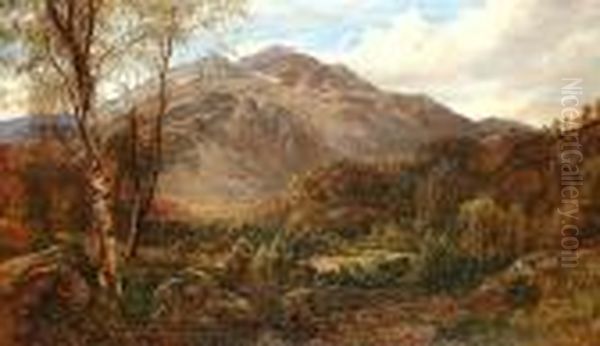
James Docharty's style is generally characterized as naturalistic, with a focus on the faithful representation of the Scottish landscape. He was particularly drawn to the Highlands, capturing their grandeur and often their more intimate, secluded aspects. His work demonstrates a keen eye for the topography of the land, the quality of light, and the specific atmospheric conditions of Scotland.
A significant influence on Docharty, and indeed on many Scottish landscape painters of his generation, was Horatio McCulloch (1805-1867). McCulloch was a dominant figure in Scottish art, celebrated for his romantic yet detailed depictions of Highland scenery. His grand canvases, often imbued with a sense of national pride, set a benchmark for landscape painting. Docharty's work, while perhaps less overtly romantic than McCulloch's, shares a similar dedication to capturing the distinctive character of the Scottish terrain.
Another contemporary Glasgow landscape painter, Milne Donald (1819-1866), is also cited as an influence. Donald, like Docharty, focused on Scottish scenes, and their shared artistic environment in Glasgow would have facilitated mutual awareness and potential influence. Docharty's paintings often feature a somewhat subdued and harmonious colour palette, frequently employing greys, blues, and earthy tones to convey the often misty and changeable weather of Scotland. This careful modulation of colour contributes to the tranquil and sometimes melancholic mood of his works.
While his paintings are praised for their sincerity and detailed observation, some critics have noted that they occasionally lack the strong emotional intensity or poetic lyricism found in the work of contemporaries such as Alexander Fraser the Younger (1827-1899), who was known for his more evocative and atmospheric interpretations of nature. Docharty's strength lay more in his honest and direct engagement with the visual facts of the landscape, rendered with a careful and considered technique. He was a friend of Robert Greenlees (1820-1894), a prominent figure at the Glasgow School of Art and a painter known for a more vibrant use of colour, which might have offered a contrasting perspective within Docharty's artistic circle.
His approach was less about dramatic invention and more about a quiet appreciation for the inherent beauty of the scenes before him. This naturalism, while perhaps not as revolutionary as later movements, was part of a broader Victorian trend towards greater fidelity to nature, a reaction against the more idealized conventions of earlier landscape traditions.
Thematic Focus: The Scottish Highlands and Beyond
Docharty's primary subject matter was the landscape of Scotland, with a particular emphasis on the Highlands. He painted scenes in Perthshire, Argyllshire, and along the lochs and rivers that define so much of the Scottish terrain. His works often depict the interplay of mountains, water, and sky, capturing the unique light and atmosphere of these regions. He was adept at rendering the textures of rock and foliage, the reflections in still waters, and the distant haze of mountains.
His paintings were not always of the most famous or dramatic vistas. He also found beauty in quieter, less celebrated corners of the landscape, such as secluded glens, riverbanks, and wooded areas. This focus on the specific and the local aligns with a growing interest in regional identity and the natural heritage of Scotland during the 19th century. The rise of tourism, facilitated by improved transport links, also meant that there was a growing market for images of the Scottish landscape, both among Scots themselves and visitors from further afield.
Docharty's dedication to sketching from nature meant that his studio paintings were well-grounded in direct observation. This practice ensured an authenticity in his depictions, even when compositions were refined or elements combined in the studio. He sought to convey the truth of the Scottish landscape as he experienced it, with its subtle variations in light and colour, and its often-unpredictable weather.
Key Works and Exhibitions
Throughout his career, James Docharty exhibited regularly, primarily at the Royal Scottish Academy (RSA) in Edinburgh and the Glasgow Institute of the Fine Arts (later the Royal Glasgow Institute of the Fine Arts). His consistent presence at these exhibitions helped to establish his reputation among his peers and with the art-buying public.
One of his most highly regarded works is "A Salmon Stream," exhibited at the Glasgow Institute in 1878, the year of his death. This painting, now in the collection of the Glasgow Museums, is celebrated for its depiction of a Highland river, likely capturing the essence of a specific location known for its fishing. It exemplifies his ability to render moving water, the surrounding terrain, and the atmospheric quality of a Scottish day.
Another significant work often cited is "View on the Lochy, with Ben Nevis in the distance." This painting showcases his skill in depicting expansive Highland scenery, with the majestic Ben Nevis providing a dramatic backdrop. Such works demonstrate his ambition to tackle grand landscape themes, following in the tradition of painters like McCulloch.
His paintings were acquired by private collectors and also found their way into public collections, a testament to their appeal and perceived quality. In 1877, he was elected an Associate of the Royal Scottish Academy (ARSA), a significant recognition of his standing within the Scottish art establishment. This honour would have been a source of considerable pride and would have further solidified his professional status. His works were also shown in London and Manchester, indicating a reach beyond Scotland.
Contemporaries and the Scottish Art Scene
James Docharty worked within a vibrant and evolving Scottish art scene. Glasgow, in particular, was becoming an increasingly important artistic centre, challenging Edinburgh's traditional dominance. He was part of a generation of landscape painters who built upon the foundations laid by earlier artists like Alexander Nasmyth (1758-1840) and John Thomson of Duddingston (1778-1840), who were pioneers in establishing a distinctively Scottish school of landscape painting.
Besides Horatio McCulloch and Milne Donald, other notable Scottish landscape painters active during Docharty's time included Sam Bough (1822-1878), known for his vigorous and atmospheric watercolours and oils, and Waller Hugh Paton (1828-1895), who, like Docharty, was an ARSA and later an RSA, and was celebrated for his detailed and often luminist depictions of Scottish scenery, particularly sunsets. John MacWhirter (1839-1911) was another prominent contemporary who gained international fame for his Highland landscapes.
Docharty also had connections with younger artists who would go on to form the nucleus of the "Glasgow Boys," a group that revolutionized Scottish painting in the later 19th century. He is known to have had a close association with William York MacGregor (1855-1923), often considered the "father" of the Glasgow School. In 1877, Docharty and MacGregor undertook sketching trips together to locations such as St. Andrews, Stonehaven, and Nairn. This interaction with a younger, more progressive artist suggests Docharty was open to new ideas, even if his own style remained more traditional.
James Paterson (1854-1932), another key member of the Glasgow Boys, was also a friend and, to some extent, a student of Docharty. These connections place Docharty as a transitional figure, respected by the established order (as evidenced by his RSA associateship) but also engaging with the emerging generation that would push Scottish art in new directions, often influenced by French Realism and plein air painting. Tom McEwan (1846-1914), another Glasgow artist, was a friend with whom Docharty went on a sketching tour in 1872. The interactions within this artistic community, through sketching trips, shared studio spaces, and exhibitions, were crucial for the development of Scottish art. Other figures who would become prominent in the Glasgow Boys movement, such as James Guthrie (1859-1930) and E.A. Walton (1860-1922), were beginning their careers around the time of Docharty's later years.
Later Years, Health, and Legacy
Unfortunately, James Docharty's later career was affected by ill health. It is recorded that his later works sometimes showed the effects of partial paralysis, which understandably impacted his ability to paint with his earlier facility. This may have affected the colour and handling in some of his final pieces, preventing him from fully realizing his artistic potential in his last years.
He passed away relatively young, in 1878, at the age of 49, in Glasgow. Despite his shortened career and the health challenges he faced, James Docharty left behind a significant body of work. His paintings are valued for their honest and skilled portrayal of the Scottish landscape, contributing to the rich tradition of this genre in Scottish art. His nephew, A.B. Docharty (Alexander Brownlie Docharty, 1862-1940), also became a notable landscape painter, continuing the family's artistic legacy into the 20th century and achieving considerable success in his own right, often painting similar Highland scenes.
While perhaps not as widely known today as some of his contemporaries or the more radical Glasgow Boys who followed, James Docharty's contribution is recognized by art historians and connoisseurs of Scottish painting. His works are held in several public collections, including the Glasgow Museums, the Hunterian Art Gallery (University of Glasgow), and the Paisley Museum and Art Galleries. These holdings ensure that his vision of Scotland continues to be accessible.
His dedication to direct observation and his sincere engagement with his subject matter mark him as an important figure in the development of naturalistic landscape painting in Scotland. He represents a generation of artists who were deeply committed to capturing the unique character of their native land, paving the way for further innovations in Scottish art.
Conclusion: A Sincere Vision of Scotland
James Docharty was a painter of quiet conviction and considerable skill. Emerging from a background in industrial design, he embraced the world of fine art with a dedication that saw him become a respected member of the Scottish artistic community. His paintings of the Scottish Highlands and other landscapes are characterized by their careful observation, harmonious, if often subdued, colour, and a genuine affection for the scenery he depicted.
Though his career was cut short, and he may not have achieved the revolutionary impact of some who followed, his work provides a valuable and enduring record of the Scottish landscape in the mid-Victorian era. He stands as a testament to the enduring appeal of nature as an artistic subject and to the particular resonance of the Scottish terrain for its native artists. His influence on younger painters like W.Y. MacGregor and James Paterson also hints at a broader, if subtle, impact on the course of Scottish art. James Docharty's legacy is that of a sincere and talented artist who dedicated his life to portraying the timeless beauty of Scotland.