Johann Hermann Carmiencke: A Transatlantic Landscape Painter
Johann Hermann Carmiencke stands as a fascinating figure in nineteenth-century art, a bridge between the established traditions of European landscape painting and the burgeoning artistic identity of the United States. Born in Germany, trained in Denmark, and ultimately finding his home and artistic community in America, Carmiencke's life and work reflect the dynamic cultural exchanges of his era. He was not only a skilled painter but also an accomplished engraver and etcher, celebrated for his sensitive handling of light and color, and his detailed depictions of the natural world. His journey led him from the patronage of Danish royalty to a significant role within the influential Hudson River School, leaving behind a legacy of evocative landscapes that capture the beauty of both the Old World and the New.
Early Life and European Foundations
Johann Hermann Carmiencke entered the world in Hamburg, Germany, in 1810. His artistic inclinations emerged early, leading him to pursue formal training. The 1830s were a formative period, during which he studied painting in several key artistic centers, including Dresden, Copenhagen, and Leipzig. This exposure to different artistic environments provided him with a broad foundation, but his development was particularly shaped by his time under the tutelage of significant figures in Northern European art.
A crucial early influence was the Norwegian landscape painter Johan Christian Dahl, who was based in Dresden but retained strong ties to Copenhagen. Dahl, a leading figure in European Romanticism, was known for his dramatic yet naturalistic depictions of landscapes, often emphasizing the wild beauty of Scandinavia. Carmiencke absorbed Dahl's approach to capturing the specific character of a place and the atmospheric effects of light and weather. This mentorship instilled in him a deep appreciation for direct observation of nature, a practice that would remain central throughout his career.
Further refining his skills, Carmiencke enrolled at the prestigious Royal Danish Academy of Fine Arts in Copenhagen. There, he studied under Christoffer Wilhelm Eckersberg, often called the "Father of Danish Painting." Eckersberg represented the Danish Golden Age, a period characterized by a blend of Neoclassical clarity and an objective, yet sensitive, rendering of reality. Eckersberg emphasized meticulous drawing, careful composition, and the precise study of light and perspective. Studying under both Dahl and Eckersberg provided Carmiencke with a unique synthesis of Romantic sensibility and disciplined technique.
Court Painter in Denmark
Carmiencke's talent did not go unnoticed in Denmark. His skill in landscape painting, honed through his studies and travels, earned him considerable recognition. In 1846, a significant honor was bestowed upon him when he was appointed Court Painter to King Christian VIII of Denmark. This position solidified his status within the Danish art world and provided him with opportunities to create works for the royal collection and associated circles. During his time in Copenhagen, he moved within a vibrant cultural milieu, reportedly forming connections with prominent figures, including the famed writer Hans Christian Andersen.
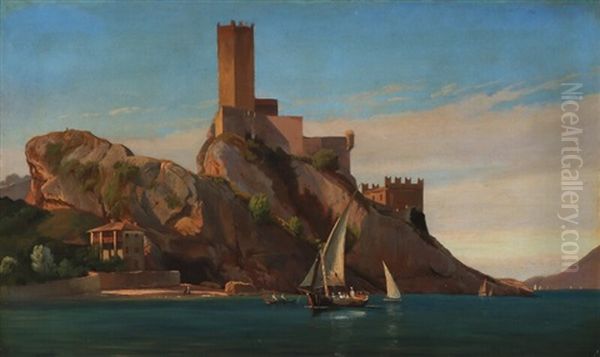
His works from this period often depicted Danish landscapes as well as scenes from his travels in Germany, Italy, and Scandinavia. A notable example reflecting his European work is Lake Garda with the medieval castle Castello Scaligero, painted around 1840 during his travels. These paintings showcased his developing style, characterized by careful composition, attention to detail, and an increasingly sophisticated handling of light, often capturing serene or picturesque moments in nature. He exhibited his works regularly in Europe, building a solid reputation before political events altered the course of his life.
The relationship between Denmark and the German states grew increasingly tense during the mid-nineteenth century, culminating in the First Schleswig War (1848-1851). This conflict, fought over the control of the duchies of Schleswig and Holstein, placed German-born individuals living in Denmark in a difficult position. Carmiencke, despite his ties to the Danish court, felt the strain of the political situation. Reportedly disillusioned by the hostilities between his homeland and his adopted country, he made the life-changing decision to leave Europe behind.
A New Beginning in America
In 1851, seeking a new environment free from the political turmoil of Europe, Johann Hermann Carmiencke emigrated to the United States. He settled in the bustling metropolitan area of New York City, establishing himself initially in the city proper before eventually making his home across the river in Brooklyn. America, particularly the New York art scene, was experiencing a period of great energy and optimism, centered largely around the celebration of the nation's unique natural landscapes.
Carmiencke arrived at a time when the Hudson River School, America's first major school of landscape painting, was reaching its zenith. This movement, pioneered by artists like Thomas Cole and Asher B. Durand, focused on the detailed and often idealized portrayal of the American wilderness, particularly the landscapes of the Hudson River Valley, the Catskill Mountains, and New England. The artists associated with the school shared a belief in the spiritual and national significance of nature, often infusing their works with a sense of awe and divine presence.
With his strong European training in landscape painting and his sensitivity to natural detail and atmospheric effects, Carmiencke found a natural affinity with the Hudson River School artists. He quickly integrated into the New York art community, bringing with him a technical proficiency and a slightly different European perspective that enriched the existing artistic dialogue. His background, particularly his training under Dahl and Eckersberg, equipped him well to contribute meaningfully to the American landscape tradition.
The Hudson River School and Artistic Style
Carmiencke became recognized as an important member of the Hudson River School, contributing actively to its exhibitions and artistic discourse. His style aligned well with the school's core tenets: a commitment to realistic depiction based on careful observation, combined with a Romantic sensibility that often emphasized the beauty and tranquility of nature. His work is noted for its precise draftsmanship, a likely legacy from his studies with Eckersberg, combined with a masterful control over soft light and subtle color gradations, reminiscent of certain aspects of European Romanticism.
While sharing the general aims of the Hudson River School, Carmiencke's work often possessed a distinct quality. Compared to the sometimes dramatic, large-scale canvases of contemporaries like Frederic Edwin Church or Albert Bierstadt, Carmiencke's paintings frequently offered more intimate, detailed views. He excelled at capturing specific atmospheric conditions – the hazy light of a summer afternoon, the crisp air of autumn, or the gentle reflections on water. His European training perhaps lent his work a certain refinement and meticulousness that set it apart.
He actively participated in the American art world, exhibiting his works frequently at prominent venues such as the National Academy of Design in New York, the Pennsylvania Academy of the Fine Arts in Philadelphia, the Boston Athenaeum, and the Maryland Historical Society in Baltimore. These exhibitions placed his work alongside that of the leading American artists of the day, including figures like Sanford Robinson Gifford and Jasper Francis Cropsey, further cementing his position within the Hudson River School circle. His dedication to outdoor sketching, a practice common among Hudson River School painters, allowed him to gather detailed studies directly from nature, which he then elaborated upon in his studio paintings.
Chronicler of the American Landscape and Industry
Carmiencke embraced the American landscape as his primary subject matter after his arrival. He traveled and sketched in the Hudson Valley, the Catskills, and other scenic areas of the Northeast, capturing the unique beauty of his new homeland. His paintings often depict serene river views, tranquil lakes, rolling hills, and picturesque forests, rendered with his characteristic attention to detail and atmospheric nuance. Works depicting iconic locations like Lake George or views near the Hudson River became staples of his American oeuvre.
Interestingly, Carmiencke also turned his artistic attention to the burgeoning industrial presence within the American landscape. This was somewhat unusual for Hudson River School painters, who often preferred to depict pristine wilderness. His painting Poughkeepsie Iron Works (Bech's Furnace) from 1856 is a significant example. Rather than presenting industry as an intrusion, Carmiencke integrates the iron works harmoniously into the surrounding pastoral landscape, bathed in a soft, unifying light. The work reflects a Romantic-era fascination with the relationship between nature and human enterprise, documenting an early phase of American industrialization with artistic sensitivity.
This interest in industrial subjects may have stemmed partly from specific commissions. It is documented that Carmiencke was employed at one point by an engineer to create detailed sketches of iron mines and factories. These drawings were then transferred to woodblocks for professional engravers to create illustrations, serving as valuable visual records of early industrial sites. This work highlights Carmiencke's versatility and his ability to apply his precise drawing skills to documentary purposes as well as fine art. Another known commission involved creating landscape views of Hyde Park, New York, for the prominent Astor family, resulting in works like Hyde Park, New York (1859).
Engraving and Etching
Beyond his considerable achievements in oil painting, Johann Hermann Carmiencke was also a skilled printmaker, proficient in both engraving and etching. While perhaps less known than his paintings today, his work in these media formed an integral part of his artistic practice. Printmaking allowed for the wider dissemination of images and often served as a way for artists to reproduce their popular compositions or explore ideas in a different format.
His etchings and engravings often mirrored the subjects of his paintings – detailed landscapes, scenic views, and occasionally architectural studies. The precision and fine linework required for these techniques resonated well with his meticulous approach to drawing. It is likely that his prints helped to broaden his reputation, making his interpretations of European and American scenery accessible to a larger audience. The skills honed through engraving may also have contributed to the clarity and detail evident in his painted works. While specific catalogues of his prints may be less common than those of his paintings, his identity as a painter-etcher underscores his technical versatility and his engagement with multiple facets of visual art production in the nineteenth century.
The Brooklyn Art Association and Later Years
As Carmiencke established himself in the New York area, he became deeply involved in the local art community, particularly in Brooklyn, where he resided later in his American years. Recognizing the need for a dedicated organization to support artists and promote art appreciation in the rapidly growing city of Brooklyn, Carmiencke played a pivotal role in founding a new institution.
In 1866, alongside a group of twenty-three other artists, Carmiencke co-founded the Brooklyn Art Association (BAA). This organization quickly became a vital center for the arts in Brooklyn, hosting regular exhibitions that showcased the work of local and national artists, including many prominent members of the Hudson River School. The BAA provided exhibition opportunities, fostered camaraderie among artists, and offered art instruction, contributing significantly to Brooklyn's cultural development. Carmiencke's involvement as a founder highlights his commitment not only to his own art but also to fostering a supportive environment for fellow artists and engaging the public with art. He also took on students, further contributing to the artistic education available in the region.
He continued to paint and exhibit actively in his later years, maintaining his presence in major exhibitions. His dedication to his craft remained unwavering until his death. Johann Hermann Carmiencke passed away in Brooklyn in 1867, at the age of 56. He left behind a significant body of work that captured the landscapes of two continents with skill and sensitivity.
Legacy and Significance
Johann Hermann Carmiencke occupies a unique position in the history of nineteenth-century art. His career trajectory, moving from Germany and Denmark to the United States, exemplifies the transatlantic flow of artistic ideas and talent during this period. He successfully navigated different cultural and artistic contexts, absorbing influences from key European movements like German Romanticism (perhaps indirectly through Dahl) and the Danish Golden Age, and integrating them into the framework of the American Hudson River School.
His contributions to the Hudson River School are notable. He brought a refined European technique and a particular mastery of light and atmosphere to the depiction of American scenery. While celebrating the beauty of the American landscape in line with his contemporaries, his work often maintained a sense of intimacy and meticulous detail that reflected his unique background. His willingness to incorporate industrial elements into his landscapes, as seen in Poughkeepsie Iron Works, also offers a valuable perspective on the changing American environment during a period of significant transformation.
Beyond his paintings, his work as an engraver and etcher, his role as a court painter in Denmark, and his crucial contribution to founding the Brooklyn Art Association demonstrate a multifaceted artistic life dedicated to creation, community building, and cultural enrichment. Though perhaps not as universally recognized today as figures like Church or Cole, Carmiencke's work is held in numerous museum collections and remains appreciated for its technical skill, serene beauty, and its representation of a significant chapter in both European and American art history. He remains a testament to the enduring power of landscape painting and the rich possibilities that arise from cross-cultural artistic journeys.