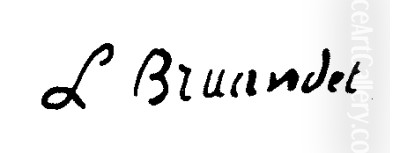
Lazare Bruandet, a French painter whose life spanned from 1755 to 1804, holds a significant, if sometimes overlooked, position in the annals of art history. Often cited with the alternative first name Eleazard, he is most accurately known as Lazare Bruandet. His oeuvre, primarily focused on the evocative depiction of natural landscapes and animated hunting scenes, marks him as a pivotal figure in the transition towards a more direct and unidealized representation of nature, positioning him as an important precursor to the celebrated Barbizon School.
Early Life and Artistic Inclinations
Born in Paris, Bruandet emerged as an artist during a period of profound societal and artistic transformation in France. The late 18th century was witnessing the waning dominance of Rococo frivolity and the stern Neoclassicism championed by artists like Jacques-Louis David. While historical and mythological subjects held sway in the official Salon exhibitions, a growing interest in landscape painting, particularly one that captured the specific character of the French countryside, was beginning to take root.
Details about Bruandet's formal artistic training are somewhat scarce, a common reality for many artists of the period who did not achieve the highest echelons of academic fame during their lifetimes. However, his work demonstrates a solid grounding in painterly technique. He would have been aware of the classical landscape tradition of Claude Lorrain and Nicolas Poussin, whose idealized Italianate scenes had long set the standard. He would also have been exposed to the detailed naturalism of Dutch Golden Age landscape painters such as Jacob van Ruisdael and Meindert Hobbema, whose influence was increasingly felt in France. Bruandet's path, however, veered towards a more immediate and less formalized engagement with the natural world around him.
The Allure of the Forest: Fontainebleau and Beyond
The Forest of Fontainebleau, a vast and ancient woodland near Paris, became a recurring and defining subject in Bruandet's work. This forest, with its rugged rock formations, towering trees, and dappled light, offered a rich tapestry of natural motifs. Bruandet was one of the earlier artists to systematically explore its picturesque qualities, long before it became the spiritual home of the Barbizon painters. His depictions of Fontainebleau are characterized by a desire to convey the forest's wild, untamed essence, often imbuing his scenes with a sense of quietude or, conversely, the thrill of the hunt.
His commitment to rendering these natural scenes with a degree of verisimilitude set him apart. While not strictly a plein air painter in the way the Impressionists later would be (the practice was still in its nascent stages), his works suggest close observation of natural light, foliage, and terrain. He sought to capture the specific atmosphere of a place, moving away from the generalized landscapes of earlier traditions. This focus on the particular, on the tangible reality of the French landscape, was a crucial step towards the Realism that would flourish in the mid-19th century.
Artistic Style and Techniques
Lazare Bruandet's artistic style is primarily characterized by naturalism and a burgeoning realism. He meticulously rendered details of trees, undergrowth, and distant vistas, striving for an authentic representation of the scenes before him. His palette, while capable of richness, often favored earthy tones and subtle gradations of light and shadow to convey depth and atmosphere. The application of paint was generally controlled, though in some passages, one can detect a more expressive brushwork that hints at the romantic sensibilities emerging at the time.
Oil on canvas was his primary medium, allowing for the layering of glazes and the depiction of textural variety, from the rough bark of trees to the soft foliage and the reflective surfaces of water. His compositions often feature a strong sense of depth, leading the viewer's eye through wooded paths or across open clearings. While nature was his principal subject, Bruandet frequently populated his landscapes with figures – hunters, travelers, or simple peasants – which added a narrative element and a sense of scale to his scenes. These figures are typically well-integrated into the landscape, part of its fabric rather than dominant elements.
Some art historians have noted that certain works by Bruandet exhibit qualities that could be seen as early manifestations of Impressionistic concerns, particularly in his handling of light and his attempt to capture fleeting atmospheric effects. While he remained rooted in a more traditional representational style, this sensitivity to the nuances of the natural world foreshadowed later developments.
Key Works and Their Characteristics
Several works by Lazare Bruandet exemplify his artistic concerns and stylistic approach. Among his most noted paintings is:
_Landscape with Hunters_: Currently housed in the Musée Magnin in Dijon, this painting is a quintessential Bruandet. It depicts a serene, expansive countryside, likely inspired by the environs of Paris or Fontainebleau. The composition typically features a foreground with detailed foliage and figures of hunters, perhaps with their dogs, resting or preparing for the chase. The middle ground opens up to fields and distant trees, all under a carefully observed sky. The painting showcases Bruandet's skill in creating a harmonious and believable natural setting, filled with a quiet, pastoral atmosphere. The figures are rendered with attention to their activity, yet they remain subordinate to the grandeur of the landscape itself.
Other significant works, many of which are in private collections or their current locations are less widely publicized, include:
_Garde-chasse et son chien en forêt de Fontainebleau_ (Gamekeeper and his Dog in the Forest of Fontainebleau): This title suggests a work deeply rooted in his favored locale. It would likely feature a detailed rendering of the forest's interior, with the gamekeeper and his dog providing a focal point and narrative interest, emphasizing the human interaction with this wild environment.
_Chemin à travers les arbres_ (Path Through the Trees): Such a work would highlight Bruandet's ability to create a sense of recession and enclosure within a woodland scene. The interplay of light filtering through the canopy and illuminating the path would be a key element, demonstrating his observational skills.
_Study of an overgrown slope_: The title itself points to a direct study from nature, focusing on the textures and forms of untamed vegetation. This aligns with the growing practice of making oil sketches outdoors, a method later perfected by artists like John Constable and the Barbizon painters.
_Highwaysmen in the forest_: This painting introduces a more dramatic, perhaps Romantic, element. The forest, often a place of refuge or solitude in his other works, here becomes a setting for potential danger and intrigue. It reflects a popular theme in art and literature of the period, where the wilderness could also harbor outlaws.
_Les promeneurs_ (The Walkers): This likely depicts figures strolling through a landscape, perhaps enjoying the restorative qualities of nature. It would emphasize the more benign and picturesque aspects of the countryside, appealing to the burgeoning appreciation for nature as a place for leisure and contemplation.
These works, collectively, demonstrate Bruandet's commitment to landscape painting, his keen eye for detail, and his ability to evoke specific moods and atmospheres. They underscore his role in shifting the focus of French landscape art towards a more direct engagement with the native environment.
A Forerunner of Barbizon
Lazare Bruandet is widely recognized as a significant precursor to the Barbizon School, a group of painters who, from the 1830s to the 1870s, gathered in the village of Barbizon, on the edge of the Forest of Fontainebleau, to paint directly from nature. Artists like Théodore Rousseau, Jean-François Millet, Charles-François Daubigny, Constant Troyon, Jules Dupré, and Narcisse Virgilio Díaz de la Peña (often simply known as Diaz) championed a form of landscape realism that was revolutionary for its time.
Bruandet's earlier explorations of Fontainebleau and his dedication to capturing its specific character paved the way for these artists. He shared their interest in the unadorned beauty of the natural world, their rejection of purely idealized or classical landscapes, and their focus on the French countryside. While the Barbizon painters would take the practice of plein air painting further and develop more distinct individual styles, Bruandet's work laid important groundwork. His paintings demonstrated that the native French landscape, particularly the Forest of Fontainebleau, was a worthy subject for serious artistic endeavor. He helped to cultivate an appreciation for the kind of direct observation and sincere emotional response to nature that would become hallmarks of the Barbizon School. The Barbizon painters, in turn, would profoundly influence the Impressionists, including artists like Claude Monet and Camille Pissarro.
Influence and Interactions with Contemporaries
During his lifetime, Bruandet was an active participant in the Parisian art world. He exhibited his works at the official Salons, for instance, in 1791 and 1793. These exhibitions were crucial for an artist's reputation and commercial success. His focus on local scenery and his somewhat romanticized yet naturalistic approach made him a notable figure among the landscape painters of his generation, and some considered him a model for Romantic painters.
Bruandet is known to have collaborated with other artists, a common practice at the time, especially for landscape painters who might have another artist add the figures (staffage) to their scenes. He worked with Jean-Louis Demarne (or De Marne), a painter known for his genre scenes and landscapes often in the Dutch style, and Jacques-François Swebach-Desfontaines, who specialized in battle scenes, hunts, and everyday life, often featuring horses with great skill. These collaborations would have enriched his practice and expanded his network.
One of his most significant artistic relationships was with Georges Michel (1763-1843). Michel, who is himself considered a precursor of the Barbizon School and renowned for his atmospheric views of the outskirts of Paris, became friends with Bruandet in the 1790s. It is documented that Michel first ventured into the Parisian suburbs to paint landscapes in Bruandet's company. This suggests a mentorship or at least a strong collegial influence, with Bruandet perhaps guiding the younger Michel in the practice of landscape painting directly inspired by local scenery. Michel's later dramatic, windswept landscapes, while distinct, share a foundational interest in direct observation with Bruandet's work.
The artistic environment in which Bruandet worked also included figures like Pierre-Henri de Valenciennes (1750-1819), a highly influential theorist and painter who advocated for the practice of making oil sketches from nature as part of a landscape painter's training, even if his finished works remained more neoclassical. While their finished styles differed, the underlying emphasis on studying nature directly was a shared current. Bruandet's generation was also aware of the work of English landscape painters like Thomas Gainsborough, whose naturalistic approach was gaining international recognition. Furthermore, the legacy of earlier French landscape artists like Joseph Vernet, known for his seascapes and landscapes, provided a rich national tradition upon which to build.
The Salon and Public Reception
The Paris Salon, the official art exhibition of the Académie des Beaux-Arts, was the primary venue for artists to display their work and gain recognition. Bruandet's participation in Salons, such as those in 1791 and 1793, indicates his engagement with the established art system. During this revolutionary period, the Salon itself was undergoing changes, becoming more accessible to a wider range of artists.
Landscape painting, while still often considered secondary to historical painting, was gaining in popularity. The public's taste was evolving, with an increasing appreciation for scenes that depicted the familiar French countryside. Bruandet's works, with their blend of naturalism and picturesque qualities, would have appealed to this growing sensibility. His hunting scenes, in particular, tapped into a long-standing aristocratic and bourgeois interest.
While he may not have achieved the fame of some of his contemporaries who specialized in more highly-regarded genres, his consistent production and exhibition of landscapes contributed to the gradual elevation of this genre's status. The fact that his works, such as Landscape with Hunters, found their way into significant collections like the Musée Magnin, attests to the esteem in which he was held.
There is a minor art historical note suggesting that some of Bruandet's style might have been an imitation of "Northern" (likely Dutch) styles rather than being entirely original. This is not an uncommon observation for landscape painters of this era, as the influence of 17th-century Dutch masters was pervasive and widely admired. However, his specific focus on French locales, particularly Fontainebleau, and his role in pioneering its artistic exploration, remain significant contributions.
Legacy and Place in Art History
Lazare Bruandet's legacy lies primarily in his contribution to the development of French landscape painting. He was among the vanguard of artists who turned their attention to the direct and faithful representation of their native scenery, moving away from the idealized and often foreign landscapes that had previously dominated the genre. His depictions of the Forest of Fontainebleau, in particular, helped to establish it as a key site for artistic pilgrimage and inspiration, a role it would fully assume with the Barbizon School.
By emphasizing naturalism, detailed observation, and the specific character of a place, Bruandet helped to lay the groundwork for the Realist movement in landscape art. His work provided a bridge between the more formalized traditions of the 18th century and the more direct, empirical approach of the 19th century. His influence on Georges Michel is a clear instance of his impact on a subsequent generation.
Though perhaps not as widely known today as the major figures of the Barbizon School or the Impressionists, Lazare Bruandet's role as a precursor is undeniable. He was a dedicated painter of the French landscape, capturing its beauty and its moods with sincerity and skill. His art reflects a pivotal moment in the history of landscape painting, a shift towards a more intimate and authentic engagement with the natural world. Artists like Jean-Baptiste-Camille Corot, who, while unique, shared some of the Barbizon sensibilities and also painted extensively in Fontainebleau, can be seen as inheritors of the tradition that Bruandet helped to foster. Even later, the Impressionists, in their radical pursuit of capturing fleeting moments of light and atmosphere en plein air, built upon the foundations laid by these earlier generations of landscape painters who dared to look closely at the world around them.
Conclusion
Lazare Bruandet (1755-1804) was more than just a painter of pleasant landscapes. He was an artist who, in his own way, contributed to a significant shift in artistic vision. His dedication to the French countryside, especially the Forest of Fontainebleau, and his naturalistic style marked him as an important forerunner of the Barbizon School and, by extension, the broader movement towards Realism in 19th-century art. Through works like Landscape with Hunters and his many depictions of forest interiors, Bruandet invited viewers to appreciate the unadorned beauty of their native land, playing a crucial part in the evolving story of how artists perceive and represent the natural world. His collaborations and friendships, notably with Georges Michel, further underscore his active role in the artistic currents of his time, solidifying his place as a noteworthy figure in the rich tapestry of French art history.