Unraveling the Tapestry: The Lives and Legacies of Figures Named George Henry Mason
The name George Henry Mason echoes through different corridors of history, belonging to individuals who, though sharing a name, carved distinct paths in military service, artistic documentation, and colonial administration. This exploration seeks to distinguish these figures, particularly focusing on Major George Henry Mason of the British Army and the George Henry Mason associated with the significant work, "The Costumes of China," while also acknowledging other namesakes to provide a clearer historical perspective. Understanding their individual contributions requires careful delineation, as the threads of their lives, at times, seem to intertwine in historical records, leading to potential confusion.
Major George Henry Mason: A Twentieth-Century Military Career
One notable figure is Major George Henry Mason, whose life spanned from 1888 to 1967. He passed away on March 31, 1967, at the age of 79. His military career is primarily associated with the British Army in the twentieth century. In 1928, he joined The Gloucestershire Regiment, a territorial army unit. This period was one of significant geopolitical tension in Europe, with the clouds of another major conflict gathering.
With the outbreak of the Second World War, Major Mason's service took him to the front lines. In 1939, he was deployed to France with his regiment. This deployment placed him directly in the path of the German Blitzkrieg in 1940. He participated in the Battle of Ledrighem, a fierce engagement that was part of the larger Battle of France. As the Allied forces faced overwhelming German advances, many units were forced into a strategic retreat. Major Mason was among those successfully evacuated from Dunkirk, a pivotal moment in the early stages of the war that saw the rescue of hundreds of thousands of Allied soldiers. His experiences during this tumultuous period undoubtedly shaped his later life, reflecting the bravery and resilience of those who served.
It is important to distinguish this Major George Henry Mason from other historical figures bearing similar names, such as George Mason (1725-1792), the American Founding Father, whose life and contributions belong to an entirely different era and context. The military career of Major George Henry Mason (1888-1967) is firmly rooted in the global conflicts of the 20th century.
George Henry Mason and "The Costumes of China": A Window into the Qing Dynasty
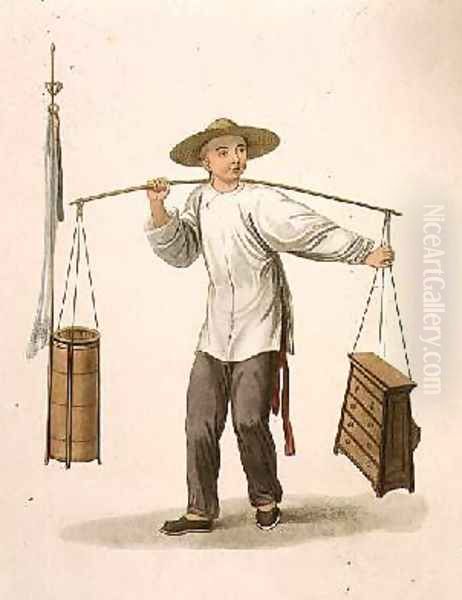
Another significant, albeit somewhat enigmatic, George Henry Mason is intrinsically linked to the world of art and ethnography through the publication "The Costumes of China." This lavishly illustrated volume, published in London by William Miller in 1800, offers a fascinating glimpse into the society of Qing Dynasty China. The book features sixty hand-coloured aquatints, accompanied by explanatory text in both English and French. These plates were based on original drawings by Pu Qua, a Cantonese artist.
"The Costumes of China" was part of a broader European fascination with distant lands and cultures, a phenomenon often termed "Chinoiserie" when specifically related to Chinese influences. The book meticulously depicts various ranks of society, from mandarins and scholars to merchants, artisans, and labourers, along with their distinctive attire and tools of their trade. It also illustrates modes of transport, ceremonies, and aspects of daily life, catering to a Western audience eager for knowledge about the then-remote Chinese Empire.
The identity of this George Henry Mason, the author or compiler of "The Costumes of China," is subject to some debate. Some sources suggest he was a Major in the 102nd Regiment of Foot. However, the precise details of his life and his exact role in the creation of the book—whether as primary author, editor, or simply a facilitator—remain somewhat obscure. It has also been posited that "George Henry Mason" might have been a pseudonym, or that he primarily served as the compiler of Pu Qua's original works for a Western audience.
The artistic style of the plates in "The Costumes of China" is characteristic of Chinese export art produced in Canton (Guangzhou) during that period. Artists like Pu Qua, Spoilum, Lam Qua, Sunqua, and Tingqua were highly skilled in adapting their traditional techniques to suit Western tastes, often working in watercolour or gouache on paper or pith. These works were not only decorative but also served an important documentary function, providing visual information about a society largely inaccessible to most Europeans. The aquatint process, expertly used for the reproductions in Miller's publication, allowed for subtle gradations of tone, enhancing the delicacy of the hand-colouring. This technique was popularised in Britain by artists like Paul Sandby and used extensively by publishers such as Rudolph Ackermann for illustrated books.
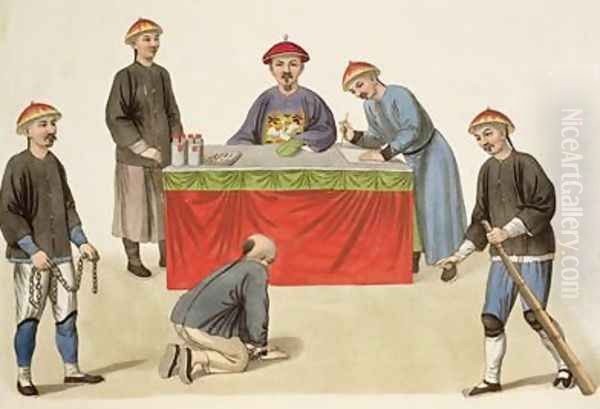
The creation of "The Costumes of China" occurred within a specific historical context. The Canton System restricted foreign trade to a small area, and direct interaction with Chinese society was limited for Westerners. Works like Mason's, and those by other contemporary observers and artists such as William Alexander, who accompanied the Macartney Embassy to China in 1792-1794, or Thomas Daniell and William Daniell, famed for their depictions of India, played a crucial role in shaping European perceptions of these distant lands. These publications fed a growing market for exotic imagery and information, influencing decorative arts, literature, and even garden design in Europe. The style can be seen as part of a wider European interest in ethnographic representation, akin to how Jean-Baptiste Vanmour documented the Ottoman Empire earlier in the 18th century.
The artistic merit of "The Costumes of China" lies in its detailed observation and the skill of Pu Qua, translated through the medium of aquatint. While Mason's exact contribution is debated, the book itself stands as a valuable historical document. It reflects a period of burgeoning global interaction and the Western desire to understand and categorize the wider world. The idealised and sometimes romanticised depictions also reveal much about the European gaze and the construction of "the Orient" in Western imagination, a theme that artists like François Boucher and Jean-Baptiste Pillement had explored in the Rococo period through their Chinoiserie fantasies, albeit with less ethnographic intent. The architectural designs of Sir William Chambers, who had visited Canton, also incorporated Chinese motifs, further popularizing the style.
Other Figures Named George Mason: Navigating Identities
The historical record also contains references to other individuals named George Mason or George Henry Mason, whose lives and activities further illustrate the need for careful differentiation. For instance, a George Henry Mason is recorded as having served as a Sub-Protector of Aborigines and a police officer in the Wellington district of South Australia during the 1840s. This individual reportedly had a long-term relationship with Louisa Karpany, a respected Ngarrindjeri woman, with whom he had two children, George Karpany and Margaret Mackenzie (also known as Pinkie).
This George Henry Mason's life in colonial Australia presents a different narrative, one intertwined with the complex and often fraught interactions between European settlers and Indigenous populations. Louisa Karpany herself was a significant figure, known for her knowledge and ability to navigate the challenging cultural landscape of the time. Their relationship, occurring in a remote colonial outpost, reflects the "creolised" forms of exchange and personal connections that could develop, sometimes away from the stricter social codes of larger colonial settlements. The story of this George Henry Mason and Louisa Karpany offers a micro-history of colonial encounters, kinship, and cultural brokerage.
The existence of multiple George (Henry) Masons active in different fields—military, artistic/ethnographic, colonial administration—underscores the importance of contextualizing historical figures accurately. Each individual, while potentially sharing a name, contributed to or participated in vastly different historical narratives.
Artistic Style and Influence: The Case of "The Costumes of China"
Returning to the George Henry Mason associated with "The Costumes of China," his (or Pu Qua's, as the primary artist) artistic style is characterized by meticulous detail, clear outlines, and a focus on the accurate representation of attire, objects, and social activities. The compositions are often straightforward, designed to convey information clearly. The use of vibrant hand-colouring adds to their appeal and ethnographic value.
The influence of such works was significant. They provided source material for Western designers and artists, contributing to the Chinoiserie trend that swept through Europe. Porcelain, textiles, wallpaper, and furniture often incorporated motifs derived from such illustrated books. Beyond the decorative arts, these images informed scholarly understanding, popular perceptions, and even political discourse regarding China. They were part of a larger body of travel literature and visual documentation that expanded Europe's imaginative and intellectual horizons.
While this George Henry Mason may not have been a painter in the same vein as contemporary European masters like Jacques-Louis David in France or Francisco Goya in Spain, his role in bringing Pu Qua's images to a wider audience was a contribution to the visual culture and ethnographic knowledge of his time. The collaborative nature of such publications, involving local artists, Western compilers or authors, engravers, and publishers, was common in the production of illustrated books about foreign lands.
Unique Contributions and Potential Controversies
The unique contribution of the George Henry Mason linked to "The Costumes of China" is undoubtedly the book itself. It remains a primary visual source for the study of Qing Dynasty society and material culture. The controversy, as mentioned, revolves around his precise identity and the extent of his authorship versus Pu Qua's artistic creation. If Mason was primarily a compiler or editor, his contribution would be in recognizing the value of Pu Qua's work and facilitating its dissemination to a Western audience. This act of cultural transmission, regardless of the exact nature of his involvement, was significant.
For Major George Henry Mason (1888-1967), his unique contribution lies in his military service during a critical period of modern history. His participation in the Battle of France and the Dunkirk evacuation places him among those who faced the direct onslaught of total war. There are no major controversies readily apparent in the provided information regarding his military career, which appears to be one of dedicated service.
The Australian George Henry Mason's story, particularly his relationship with Louisa Karpany, contributes to a more nuanced understanding of colonial history, highlighting personal relationships that crossed cultural divides. The "controversy" in such contexts often relates to the power dynamics inherent in colonial relationships and the subsequent historical interpretations of these unions.
Concluding Thoughts: Distinct Legacies
In conclusion, the name George Henry Mason, while singular, represents multiple distinct historical actors. Major George Henry Mason (1888-1967) was a military officer whose service spanned some of the most defining conflicts of the 20th century. His story is one of duty and participation in events that shaped the modern world.
The George Henry Mason associated with "The Costumes of China" (fl. c. 1800) played a role, whether as author, compiler, or patron, in creating a vital visual record of Chinese life that informed and fascinated the West. This work, primarily showcasing the artistry of Pu Qua, remains an important document for art historians, ethnographers, and scholars of Sino-Western cultural exchange. It sits alongside the works of other artists and explorers who sought to bridge the gap between distant cultures through visual representation, such as the aforementioned William Alexander, the Daniells, and even earlier figures like Maria Sibylla Merian whose detailed illustrations of insects and plants of Suriname in the early 18th century set a precedent for scientific and artistic expeditions.
The George Henry Mason of South Australia offers yet another perspective, one rooted in the complexities of colonial administration and intercultural relationships on the Australian frontier.
By carefully distinguishing these individuals and their respective contexts, we can appreciate their unique contributions and understand the diverse ways in which individuals named George Henry Mason have left their marks on history. Their stories, though separate, collectively enrich our understanding of military history, artistic representation, and the intricate tapestry of human interaction across different eras and cultures. The challenge for the historian is to unravel these threads, ensuring that each individual's story is told with the clarity and specificity it deserves.