Maria Spilsbury, later Maria Taylor (1776-1820), was a notable English painter active during the late eighteenth and early nineteenth centuries. In an era when female artists faced considerable obstacles, Spilsbury carved out a respectable career, producing a body of work characterized by its gentle sensibility, moral undertones, and keen observation of domestic and rural life. Her paintings, often imbued with a quiet religiosity, resonated with the prevailing tastes of her time, particularly within circles influenced by the Evangelical Revival. Though her name might not be as widely recognized today as some of her male contemporaries, her contributions offer valuable insights into the artistic, social, and cultural currents of Georgian Britain and early nineteenth-century Ireland.
Early Life and Artistic Beginnings in a Creative Household
Born in London in 1776, Maria Spilsbury was fortunate to enter a family environment that nurtured artistic pursuits. Her father, Jonathan Spilsbury (c. 1737–1812), was an accomplished engraver and portrait painter. While not reaching the uppermost echelons of the art world, Jonathan was a recognized professional who exhibited at the Royal Academy and other London venues. He is also sometimes credited, alongside his brother John Spilsbury the cartographer (famous for inventing the dissected puzzle or jigsaw), with fostering a creative atmosphere. Maria’s mother was Rebecca Spilsbury.
Unlike many aspiring male artists who could attend the Royal Academy Schools or apprentice formally under established masters, Maria’s artistic education was largely informal, centered within her father's studio. This was a common path for many women artists of the period, including figures like Angelica Kauffman and Mary Moser, who often received their initial training from artist fathers or other male relatives. Within this domestic setting, Maria would have learned the fundamentals of drawing, painting, and possibly even the rudiments of printmaking, absorbing the practical skills and artistic sensibilities of her father. This early exposure undoubtedly shaped her technical abilities and thematic inclinations.
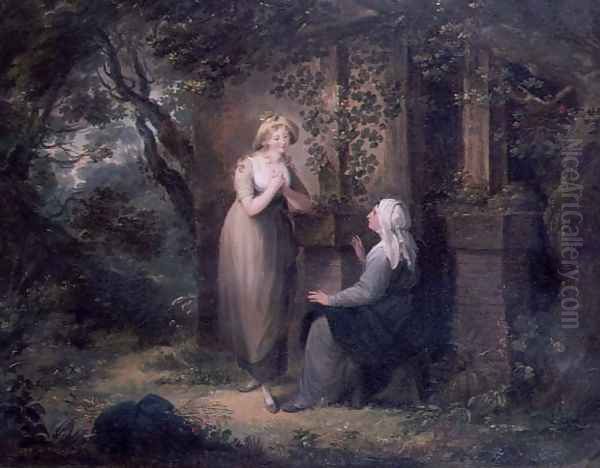
The Spilsbury family’s connections to the Moravian Church and the broader Evangelical movement likely played a significant role in shaping Maria's worldview and, consequently, the subject matter of her art. Evangelicalism, with its emphasis on personal piety, moral conduct, domestic virtue, and philanthropic activity, was a powerful force in British society at this time. Artists like William Blake, though highly individualistic, also engaged with religious and spiritual themes, albeit in a far more mystical and unconventional manner than Spilsbury.
The Artistic Climate of Late Georgian Britain
Maria Spilsbury embarked on her artistic career during a vibrant and transformative period in British art. The Royal Academy of Arts, founded in 1768 under the patronage of King George III with Sir Joshua Reynolds as its first president, had firmly established itself as the premier institution for artistic training and exhibition. Its annual summer exhibitions were major social and cultural events, providing artists with a crucial platform to display their work, attract patrons, and gain critical recognition.
Portraiture reigned supreme, with artists like Sir Thomas Lawrence, Sir Henry Raeburn in Scotland, John Hoppner, and George Romney commanding high fees for their flattering depictions of the aristocracy and the burgeoning wealthy middle class. History painting, considered the noblest genre according to Academic theory, was championed by figures like Benjamin West, Reynolds's successor as President of the Royal Academy. However, landscape painting was gaining unprecedented popularity, with artists like J.M.W. Turner and John Constable beginning to forge revolutionary new approaches to depicting the natural world, moving beyond the classical compositions of Claude Lorrain or the picturesque aesthetics advocated by William Gilpin.
Genre painting, depicting scenes of everyday life, also found a ready market. Artists such as George Morland, with his rustic scenes of rural life, and Francis Wheatley, known for his sentimental "Cries of London" series, catered to a taste for the charming, the anecdotal, and sometimes the morally instructive. It is within this context of genre painting, often infused with a moral or religious sentiment, that much of Maria Spilsbury's work can be situated. The rise of the middle class, with its disposable income and desire for art that reflected its values and experiences, created new opportunities for artists working in these less grandiose, more accessible genres.
Navigating the Art World as a Woman
For women artists like Maria Spilsbury, the path to professional recognition was fraught with challenges. While the Royal Academy did admit two women, Angelica Kauffman and Mary Moser, as founding members, its doors were largely closed to female students for formal training for many decades. Societal expectations often confined women to the domestic sphere, and artistic pursuits, if encouraged at all, were frequently viewed as genteel accomplishments rather than serious professional endeavors.
Despite these limitations, a number of women artists achieved success. Angelica Kauffman, a Swiss-born artist who spent a significant part of her career in London, was celebrated for her history paintings and portraits in a Neoclassical style. Mary Moser was a renowned flower painter. Other women, such as Catherine Read and Anne Forbes, specialized in portraiture, often in pastels. These women, like Spilsbury, often relied on family connections, private tuition, and the support of enlightened patrons to build their careers. They typically exhibited at the Royal Academy, the Society of Artists, or the Free Society of Artists, seeking public validation and commercial success in a male-dominated field. Spilsbury’s ability to exhibit regularly at the Royal Academy speaks to the quality of her work and her determination.
Maria Spilsbury's Emergence and Early Works
Maria Spilsbury began exhibiting her work in the 1790s, making her public debut at the Royal Academy in 1792. Her early works often focused on portraits, a commercially viable genre, but she soon developed a reputation for subject pictures with religious, moral, or educational themes. These pieces resonated with the contemporary emphasis on sensibility and didacticism, reflecting the influence of the Evangelical movement and the broader cultural concern with virtue and social improvement.
One of her most significant early works is The Ascent of the Innocents, exhibited at the Royal Academy in 1800. While the specific visual details of this painting are not widely reproduced, its title suggests a religious theme, possibly depicting the souls of children ascending to heaven, a subject that would have appealed to the sentimental and pious sensibilities of the era. Such themes were not uncommon; artists like Philip James de Loutherbourg, for instance, sometimes tackled dramatic biblical scenes, though Spilsbury's approach was likely more gentle and less theatrical.
Another important painting from this period is The Sunday-School, exhibited in 1803. This work depicts a young woman teaching children in a rustic cottage setting. It directly reflects the burgeoning Sunday School movement, a key initiative of the Evangelical Revival aimed at providing basic literacy and religious instruction to working-class children. The painting would have been seen not only as a charming genre scene but also as an endorsement of this important social and religious cause. It highlights themes of education, piety, and the role of women in moral instruction, all central concerns of the time. The detailed rendering of the cottage interior and the expressive figures would have added to its appeal. Such scenes of domestic virtue and education were popular, and artists like Thomas Webster would later specialize in similar schoolroom scenes, though with a more Victorian flavor.
Exhibiting at the Royal Academy and Gaining Recognition
Between 1792 and 1808, Maria Spilsbury was a consistent, if not prolific, exhibitor at the Royal Academy. She was listed as an "Honorary Exhibitor" in some catalogues, a designation that could imply various statuses, sometimes indicating an amateur or someone not solely reliant on art for income, though in Spilsbury's case, it likely reflected her standing as a respected contributor. Her works were generally well-received, and she gained a reputation for her skillful execution and the appealing nature of her subjects.
During these years, she would have exhibited alongside many of the leading artists of the day. The Royal Academy exhibitions were a melting pot of styles and genres, from the grand portraits of Lawrence and Hoppner to the emerging landscapes of Turner and Constable, the historical epics of West and Henry Fuseli (known for his more gothic and imaginative works), and the genre scenes of Morland and Wheatley. Sculptors like John Flaxman and Joseph Nollekens also showcased their latest creations. For Spilsbury, participating in these exhibitions was crucial for maintaining visibility and attracting patronage.
Her paintings often depicted children, family groups, and scenes of domestic life, rendered with a sensitivity and attention to detail that appealed to contemporary tastes. The emphasis on sentiment and moral uplift in her work aligned with the cultural climate, where literature by authors like Hannah More, also deeply involved in the Evangelical movement and the promotion of Sunday schools, enjoyed widespread popularity.
Marriage, Move to Ireland, and New Artistic Horizons
In 1809, Maria Spilsbury married John Taylor. Following her marriage, she moved with her husband to Dublin, Ireland. This relocation marked a new phase in her life and artistic career. While London was undoubtedly the center of the British art world, Dublin possessed its own vibrant cultural scene. The early 19th century in Ireland was a period of significant social and political change, following the Act of Union in 1801 which formally incorporated Ireland into the United Kingdom.
In Dublin, Maria Taylor (as she was now known) continued to paint and exhibit. She became associated with the artistic community there, and her work began to reflect her new surroundings. She developed a keen interest in Irish life, customs, and landscapes, which provided fresh subject matter for her art. Irish artists active around this time included portraitists like Hugh Douglas Hamilton (though his main period was slightly earlier) and Martin Archer Shee (who later became President of the Royal Academy in London), and landscape painters such as William Ashford and Thomas Sautelle Roberts, who were capturing the distinctive beauty of the Irish countryside.
Maria Taylor’s engagement with Irish themes demonstrates her adaptability as an artist and her responsiveness to her environment. Her English background, combined with her immersion in Irish culture, allowed her to bring a unique perspective to her depictions of Irish life.
Capturing Irish Life: Pattern at Glendalough and Other Works
One of Maria Taylor's most celebrated works from her Irish period is The Pattern at Glendalough, painted around 1813-1816 and exhibited at the Hawkins Street exhibition in Dublin in 1816. A "pattern" (derived from "patron," as in patron saint) was a traditional Irish religious festival, often held at a holy well or ancient monastic site, involving prayers, pilgrimages, and, increasingly, secular festivities such as dancing, drinking, and faction fighting. These events were a significant part of Irish rural life but were often viewed with disapproval by both the Protestant Ascendancy and the Catholic clergy due to their perceived unruliness and pagan undertones.
Taylor's painting of the Pattern at Glendalough, a picturesque valley in County Wicklow renowned for its early medieval monastic settlement, is a remarkable social document. It captures the lively, multifaceted nature of the event, with numerous figures engaged in various activities against the backdrop of the stunning landscape. The painting is noted for its detailed observation of costume, custom, and social interaction, providing a valuable visual record of a traditional Irish cultural practice. It stands as a significant piece of Irish genre painting, comparable in its documentary impulse to the work of later Irish artists like Erskine Nicol or Aloysius O'Kelly who also depicted scenes of Irish rural life, though often with a different political or social emphasis.
Her interest in Irish traditions is further evidenced by her records related to St. Patrick's Well (Tobaraboghill). It's noted that she documented the suppression of rituals and gatherings at such religious sites around 1816, a period when authorities were increasingly clamping down on large popular assemblies. This suggests an ethnographic interest, a desire to record and perhaps preserve aspects of a culture that was undergoing significant change.
Her sketchbooks from this period would have been filled with observations of Irish landscapes, people, and daily life. These sketches formed the raw material for her finished paintings and provide insight into her working methods and artistic interests. The practice of sketching from life was common among artists; J.M.W. Turner, for example, was a prolific sketcher, filling countless notebooks with his observations. While not directly collaborating, the mention of her sketchbooks alongside those of an artist like John Butler Yeats (father of W.B. Yeats and Jack B. Yeats, though J.B. Yeats was of a later generation than Spilsbury) in discussions of Irish art collections highlights the value placed on these direct, observational records.
Artistic Style, Themes, and Influences
Maria Spilsbury Taylor's artistic style can be characterized as belonging to the broader tradition of British genre painting, marked by careful drawing, a clear and detailed rendering of figures and settings, and a focus on narrative and sentiment. Her palette was generally warm and harmonious, and her compositions well-ordered. She excelled at capturing expressions and gestures, imbuing her figures with a sense of life and individual character.
Her thematic concerns remained consistent throughout her career: religious subjects, scenes of moral instruction, domestic interiors, portraits (especially of children), and, later, depictions of Irish rural life and customs. The influence of the Evangelical movement is palpable in many of her works, with their emphasis on piety, education, and virtuous conduct. This aligns her with a broader cultural trend that valued art not only for its aesthetic qualities but also for its capacity to edify and inspire.
While not an innovator in the mould of a Turner or a Constable, Spilsbury Taylor worked skillfully within established conventions, creating art that was both accomplished and appealing to her contemporaries. Her focus on the particularities of Irish life in her later career also gives her work a distinct regional flavor and historical importance. She can be seen as a precursor to later 19th-century artists who took a deeper interest in depicting the specific cultural identities of different regions within Britain and Ireland.
Contemporaries and the Wider Art World Context
To fully appreciate Maria Spilsbury Taylor's place, it's useful to consider her alongside other artists active during her lifetime. In portraiture, she worked in the shadow of giants like Sir Thomas Lawrence, whose dazzling brushwork and glamorous depictions set the standard. However, there was ample room for artists offering more modest, intimate portraits, particularly of children and families.
In genre painting, George Morland's often sentimentalized but popular scenes of rural life and Francis Wheatley's charming urban and pastoral subjects provide a contemporary comparison. David Wilkie, a Scottish artist who rose to prominence in the early 19th century, achieved enormous success with his meticulously detailed and humorous scenes of Scottish peasant life, such as The Blind Fiddler or Chelsea Pensioners Reading the Waterloo Dispatch. While Wilkie's work was often more complex and ambitious in scale than Spilsbury's, they shared an interest in depicting ordinary people and their daily lives.
The tradition of depicting children was strong in British art, with artists like William Beechey and the aforementioned Thomas Lawrence creating memorable child portraits. Spilsbury's focus on children in educational or domestic settings, however, often carried a stronger didactic or sentimental message, reflecting the changing attitudes towards childhood and education in this period.
In Ireland, she would have been aware of artists like Solomon Delane, a landscape painter, or Adam Buck, who was known for his delicate Neoclassical-style portraits and subject pictures, often reproduced as prints. The Dublin Society (later the Royal Dublin Society) played a crucial role in promoting art and design in Ireland, and its drawing schools trained many Irish artists.
Later Life, Legacy, and Rediscovery
Maria Spilsbury Taylor continued to live and work in Ireland until her relatively early death in Dublin in 1820, at the age of about 44. She supported her family through her art, particularly after her marriage, demonstrating a professional commitment that was noteworthy for a woman of her time. Her ability to achieve a degree of economic independence through her artistic practice served as an example for other women aspiring to a professional life in the arts.
For many years after her death, Maria Spilsbury Taylor's work, like that of many female artists of her era, fell into relative obscurity. Art history traditionally focused on male "masters" and grand artistic movements, often overlooking the contributions of women and those working in less monumental genres. However, in recent decades, there has been a concerted effort by art historians to re-evaluate and rediscover the work of female artists. This has led to a renewed appreciation for figures like Spilsbury Taylor, whose art provides valuable insights into the social, cultural, and religious life of her time.
Her paintings are now recognized for their artistic merit, their charming depiction of domestic and rural scenes, and their importance as historical documents, particularly her Irish subjects like Pattern at Glendalough. They offer a window into the concerns and sensibilities of the late Georgian and Regency periods, reflecting the growing influence of the middle class, the impact of the Evangelical Revival, and the burgeoning interest in regional cultures and traditions.
Conclusion: A Gentle Observer of Her Times
Maria Spilsbury Taylor stands as a significant, if sometimes overlooked, figure in British and Irish art of the late 18th and early 19th centuries. Working within the constraints and opportunities available to female artists of her era, she produced a body of work that is both technically proficient and thematically engaging. Her paintings of religious and moral subjects, her sensitive portrayals of children and family life, and her later depictions of Irish customs and landscapes all attest to her keen powers of observation and her ability to connect with the sentiments of her audience.
Her art reflects a world undergoing profound social and cultural shifts – a world shaped by Enlightenment ideals, the rise of Evangelicalism, the beginnings of industrialization, and evolving notions of domesticity and national identity. Through her gentle and insightful portrayals, Maria Spilsbury Taylor not only achieved professional recognition in her own lifetime but also left behind a valuable artistic legacy that continues to inform our understanding of this pivotal period in history. Her rediscovery enriches the narrative of art history, reminding us of the diverse talents and perspectives that have shaped our visual culture.