The Dutch Golden Age, a period spanning roughly the 17th century, was a time of unprecedented economic prosperity, scientific advancement, and artistic flourishing in the Netherlands. Within this vibrant cultural milieu, still life painting emerged as a highly popular and specialized genre, reflecting the nation's wealth, its global trade connections, and a complex interplay of worldly pride and moral contemplation. Among the accomplished practitioners of this art form was Pieter de Ring, a painter whose life remains somewhat shrouded in mystery but whose works speak volumes about the era's taste for sumptuous display and meticulous realism. Though perhaps not as universally recognized today as some of his contemporaries, De Ring carved a distinct niche for himself with his lavish "pronkstilleven," or ostentatious still lifes, which continue to captivate viewers with their rich detail and vibrant execution.
Uncertain Beginnings and a Fateful Shift
The precise origins of Pieter de Ring are a subject of some debate among art historians. He is generally believed to have been born around 1615, though some sources suggest dates as early as 1613 or as late as 1620. His birthplace is equally uncertain; while Leiden in the Dutch Republic is often cited, Ypres in present-day Belgium has also been proposed. Unfortunately, conclusive documentary evidence is scarce. The municipal archives of Leiden, which might have contained definitive records, were tragically destroyed during World War I in 1914, and any records from Ypres met a similar fate. This lack of primary documentation has contributed to the enigmatic aura surrounding his early life.
What is known, or at least widely accepted, is that De Ring's initial path was not directed towards the painter's easel. He is reported to have begun his working life as an apprentice stone mason. However, a burgeoning passion for painting eventually led him to abandon this trade and pursue a career in the arts. This transition, from the physically demanding craft of masonry to the delicate and intellectual pursuit of painting, suggests a strong artistic calling and a determination to follow his true vocation. The identity of the patron or circumstances that enabled this shift remains unclear, but it marked a pivotal moment in his life. His parents were Daniel de Ring and Harris van der Hoek of Amsterdam; his father passed away in 1648, followed by his mother in 1650. These familial losses during his formative artistic years may have had an impact on his personal life and perhaps even his artistic outlook, though direct correlations are difficult to draw from the limited biographical data available.
Under the Tutelage of a Master: Jan Davidsz. de Heem
A crucial turning point in Pieter de Ring's artistic development was his apprenticeship under Jan Davidsz. de Heem (c. 1606 – 1683/1684). De Heem was one of the most celebrated and influential still life painters of the Dutch Golden Age, renowned for his incredibly detailed, richly colored, and complex compositions. Born in Utrecht, De Heem worked in both Leiden and, significantly, Antwerp, where he absorbed the Flemish Baroque's exuberance and opulence. His style was characterized by a brilliant rendering of textures, a sophisticated use of light and shadow, and an ability to arrange a multitude of objects into harmonious and dynamic compositions.
De Ring proved to be a talented and receptive student. He thoroughly assimilated De Heem's techniques, particularly his master's vibrant color palette and his skill in depicting luxurious items. The influence of De Heem is palpable in De Ring's work, evident in the choice of subject matter – lavish displays of fruit, seafood, and precious objects – and in the overall richness and complexity of his paintings. While De Ring developed his own distinct artistic personality, the foundation laid during his time with De Heem was undeniably formative. He is often considered one of De Heem's most successful pupils, capably emulating and adapting his teacher's celebrated style.
The Signature Style: Pronkstilleven and the Ring Motif
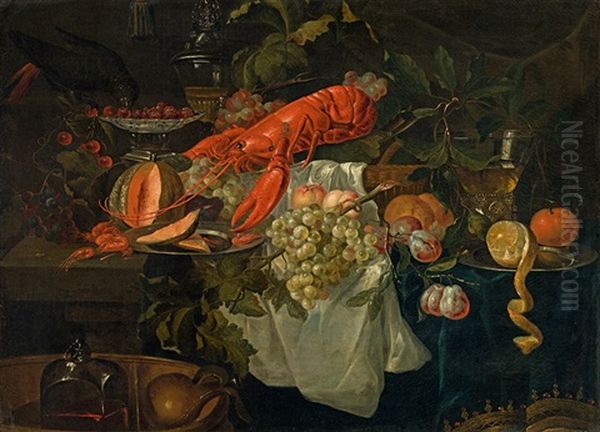
Pieter de Ring specialized in a particular type of still life known as "pronkstilleven." The Dutch word "pronk" translates to ostentation, show, or display, and these paintings were indeed designed to impress with their depiction of luxury and abundance. Pronkstilleven typically feature an elaborate arrangement of expensive and exotic items: gleaming silverware, intricate glass goblets (often Venetian or façon de Venise), imported Chinese porcelain, richly patterned Oriental carpets or velvet drapes, succulent fruits (including exotic varieties like peaches, grapes, and peeled lemons), and opulent seafood such as lobsters, oysters, and shrimp.
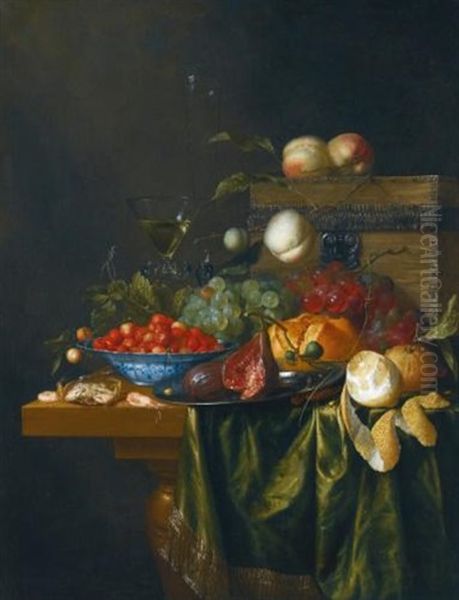
These compositions were more than mere displays of technical skill; they were potent symbols of the wealth and global reach of the Dutch Republic. The objects depicted often carried multiple layers of meaning. For instance, a peeled lemon, a common motif, could signify temperance or the bittersweet nature of life, while also showcasing the painter's skill in rendering its translucent flesh and textured rind. Lobsters and oysters, luxury foodstuffs, spoke of affluence but could also carry vanitas connotations, reminding the viewer of the transience of earthly pleasures and the inevitability of decay.
A distinctive and charming aspect of Pieter de Ring's oeuvre is his signature. He often signed his paintings with a visual pun: a painted ring. This clever device, directly referencing his surname, is typically incorporated subtly into the composition, perhaps adorning a finger in a less prominent part of the scene or simply placed among the objects. Sometimes, he would use a Latinized version of his name, "P.A. Annulo" (Annulus being Latin for ring). This unique signature serves as an identifying mark and adds a personal touch to his works, a playful nod to his identity embedded within the opulent scenes he created.
Masterpieces of Abundance: Key Works Explored
Several key works exemplify Pieter de Ring's skill and artistic vision. Perhaps his most famous painting is Still Life with a Golden Goblet, currently housed in the Rijksmuseum in Amsterdam. This masterpiece showcases all the hallmarks of his style. A table, partially covered with a rich, dark green velvet cloth and an intricately patterned Oriental rug, is laden with an array of luxurious items. A prominent golden goblet, exquisitely rendered with reflections of light, stands as a central feature. Around it are arranged luscious fruits – grapes, peaches, a peeled lemon – alongside a cooked lobster, oysters, and shrimp. A Wanli porcelain bowl, a testament to Dutch global trade, holds more fruit. The interplay of light and shadow, the meticulous rendering of different textures (the smooth gleam of metal, the soft fuzz of a peach, the rough shell of a lobster), and the vibrant colors all contribute to the painting's opulent effect. The signature ring is subtly present, a testament to the artist's identity.
Another notable work, often titled Pronk Still Life or similar variations like Still Life with a Lobster and Fruit, further demonstrates his mastery. These paintings typically feature similar elements: a profusion of fruit, seafood, and precious tableware, often with a dramatic curtain or drape adding to the theatricality of the scene. De Ring's ability to create a sense of depth and to balance a multitude of objects within a coherent and visually appealing composition is consistently impressive. He paid close attention to the way light interacted with different surfaces, capturing the sheen of metal, the translucency of grapes, and the delicate wetness of oysters. His colors are rich and saturated, contributing to the overall feeling of luxury and sensory delight.
These works not only highlight De Ring's technical prowess but also offer a window into the material culture and aesthetic preferences of the Dutch Golden Age. They reflect a society that valued worldly goods and took pride in its commercial success, yet also grappled with underlying moral and religious considerations about the fleeting nature of such possessions.
The Artistic Landscape: Still Life in the Dutch Golden Age
To fully appreciate Pieter de Ring's contribution, it's essential to understand the broader context of still life painting in the 17th-century Netherlands. This genre enjoyed immense popularity, driven by a burgeoning middle class of merchants and burghers who sought art for their homes. Unlike the grand religious or mythological scenes favored in Catholic Europe, Dutch art, influenced by Calvinist sensibilities, often focused on secular subjects: portraits, landscapes, genre scenes, and still lifes.
Still life painting itself was highly diverse, with artists specializing in various sub-genres. There were "ontbijtjes" (breakfast pieces) and "banketjes" (banquet pieces), which depicted simpler or more elaborate table settings. Willem Claesz. Heda (1594–1680) and Pieter Claesz (1597–1660) were renowned masters of the more monochrome and restrained breakfast pieces, excelling in capturing subtle tonal variations and textures of pewter, glass, and bread.
Flower painting was another incredibly popular specialization, with artists like Rachel Ruysch (1664–1750) and Jan van Huysum (1682–1749) creating breathtakingly detailed and vibrant bouquets, often combining flowers that bloomed in different seasons – a testament to both artistic license and the collector's desire for perpetual beauty. Clara Peeters (1594–c. 1657), one of the few prominent female painters of the era, was an early pioneer in still life, known for her meticulous depictions of food, flowers, and precious objects. Balthasar van der Ast (1593/94–1657) was another significant figure, known for his delicate arrangements of shells, insects, and flowers.
The pronkstilleven, De Ring's specialty, represented the most opulent end of the still life spectrum. Willem Kalf (1619–1693) was arguably the preeminent master of this sub-genre, creating deeply atmospheric and richly textured compositions that often featured similar motifs to De Ring's work, such as Chinese porcelain, silver, and citrus fruits, but often with a more somber and reflective mood. Abraham van Beijeren (c. 1620/21–1690) was another contemporary known for his lavish banquet pieces and fish still lifes, characterized by a looser, more painterly style.
Even artists primarily known for other genres, like Rembrandt van Rijn (1606–1669), who spent his early formative years in Leiden, occasionally engaged with still life elements or produced works like The Slaughtered Ox that share a focus on meticulously observed reality. Other Leiden artists, such as Gerrit Dou (1613–1675), a founder of the "fijnschilders" (fine painters) school, emphasized minute detail and polished surfaces, an aesthetic that resonated with the precision often found in still life. Jan Steen (c. 1626–1679), also active in Leiden, though primarily a genre painter, often incorporated rich still life elements into his lively domestic scenes. The broader Dutch art scene also included giants like Johannes Vermeer (1632–1675) and Frans Hals (c. 1582/83–1666), whose mastery in their respective fields of genre painting and portraiture contributed to the overall artistic vibrancy of the era.
Pieter de Ring operated within this rich and competitive artistic environment. His work, while clearly indebted to De Heem, also shows an awareness of the prevailing trends and an ability to carve out his own niche through his distinctive signature and consistent focus on opulent displays.
Contemporaries and Artistic Dialogue
While direct records of Pieter de Ring's interactions with many other specific painters are scarce, his artistic development and output were undoubtedly shaped by the broader artistic community, particularly in Leiden and through his connection with Jan Davidsz. de Heem, who himself had a wide network. De Heem's studio would have been a hub of activity, and it's plausible that De Ring encountered other aspiring artists or established figures there.
His style, focusing on the pronkstilleven, naturally invites comparison with Willem Kalf. Both artists excelled in depicting luxurious objects with remarkable realism. However, Kalf's compositions often have a more profound sense of gravitas and a more dramatic use of chiaroscuro, while De Ring's works can feel somewhat brighter and more overtly celebratory of material wealth, though vanitas undertones are usually present.
Compared to the more subdued and tonal still lifes of Willem Claesz. Heda and Pieter Claesz., De Ring's paintings are far more colorful and elaborate, aligning him with the more flamboyant tradition influenced by Antwerp. His work shares a certain richness with that of Abraham van Beijeren, though Van Beijeren's brushwork is often more vigorous and less polished than De Ring's meticulous finish.
The influence of his teacher, Jan Davidsz. de Heem, is paramount. De Heem's ability to combine a multitude of diverse objects into a cohesive and dynamic whole, his rich colorism, and his detailed rendering of textures are all echoed in De Ring's work. De Ring, however, developed his own compositional preferences and, of course, his unique ring signature, which set his works apart. He was active in Leiden's artistic community, and while specific names of painters he directly collaborated or socialized with (beyond De Heem) are not extensively documented, the shared visual language of the time suggests a lively, if indirect, dialogue among artists working in similar genres. The Guild of Saint Luke, the professional organization for painters and other craftsmen, would have provided a framework for such interactions in cities like Leiden.
Unresolved Questions and Enduring Legacy
Despite the visual richness of his paintings, Pieter de Ring's personal life remains largely an enigma. As mentioned, his precise birth year and location are not definitively established. Details about his personal circumstances, such as whether he married or had children, or significant property holdings, are not well-documented. This lack of biographical information makes it challenging to construct a full narrative of his life beyond his artistic output.
The provenance and attribution of some works have also presented challenges over time. Like many artists of the period, his paintings have passed through various collections, and occasionally, questions of authenticity or attribution arise, as evidenced by discussions around works appearing at auction, such as a piece at a Christie's sale in 1988. The interpretation of symbolism in his paintings, while generally aligning with common 17th-century conventions (lemons for temperance or the bitterness of life, lobsters for wealth or transience), can also be subject to scholarly debate, with some arguing for more nuanced or specific readings, while others caution against over-interpreting every element.
Pieter de Ring passed away on September 22, 1660, at the relatively young age of 45. He was buried in the Pieterskerk, a prominent church in Leiden, suggesting a degree of standing within the community. His active period as a painter seems to have been primarily between the 1640s and his death in 1660.
While his name may not be as instantly recognizable as Rembrandt or Vermeer, Pieter de Ring made a significant contribution to the tradition of Dutch Golden Age still life painting. His works were popular in his time, catering to the tastes of a wealthy clientele eager to see their prosperity reflected in art. Today, his paintings are valued for their technical skill, their vibrant depiction of luxury, and the fascinating glimpse they offer into the material culture and symbolic language of 17th-century Holland. His unique ring signature remains a charming and memorable aspect of his artistic identity.
Conclusion: A Luminous Talent in a Golden Age
Pieter de Ring stands as a notable figure among the many talented artists of the Dutch Golden Age. His specialization in the pronkstilleven allowed him to showcase both his meticulous technique and his flair for depicting opulence. Deeply influenced by his master, Jan Davidsz. de Heem, he nonetheless forged a recognizable style, marked by vibrant colors, complex compositions, and his ingenious ring signature. His paintings are more than just beautiful objects; they are historical documents, reflecting the global trade, material wealth, and complex cultural values of a nation at its zenith.
The mysteries surrounding his life only add to the intrigue of his art. While the archives may be silent on many aspects of his personal story, his canvases speak eloquently of his skill and his engagement with the artistic currents of his time. Pieter de Ring's legacy endures in the sumptuous visual feasts he left behind, inviting contemporary audiences to marvel at the skill of a 17th-century master and to ponder the enduring allure of beauty, abundance, and the subtle reminders of life's fleeting nature. His works continue to be appreciated in museums and collections, ensuring that the "ring" of his name and his art continues to resonate through the centuries.