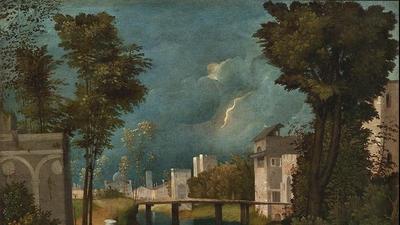
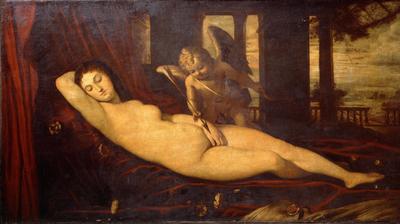
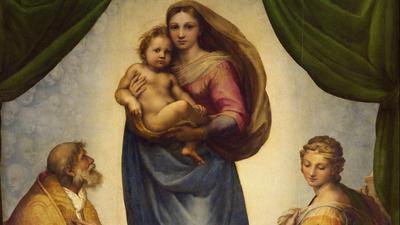
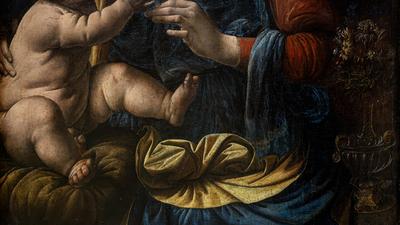
In the quiet landscape of the early sixteenth century, a masterpiece emerged that would redefine beauty forever. Painted around 1509 by the Venetian master Giorgione, this is the Sleeping Venus, a vision of absolute serenity resting within the soft embrace of nature. The goddess lies diagonally across the canvas, her body forming a gentle, flowing curve that mirrors the rolling hills in the distance. Her eyes are closed in a peaceful slumber, one arm resting behind her head, while the other lies softly across her lap. There is no tension here, only a profound sense of stillness. She is not performing for the viewer; she is simply existing, cradled by a lush, velvet-red drapery that crinkles beneath her fair skin.
Giorgione uses a palette of warm, golden light and muted earthy tones to blur the boundaries between the figure and the earth. The soft glow of her skin radiates against the deepening shadows of the landscape, while the hazy atmosphere—a technique that softens every edge—creates a dreamlike unity. The horizon glows with a pale, amber light, suggesting the quiet transition of dusk or dawn. This work marks a revolutionary moment where the human form and the natural world are treated as one harmonious soul. It is a poem of curves and light, capturing a fleeting moment of perfect, undisturbed grace. In this silent meadow, the world seems to hold its breath.