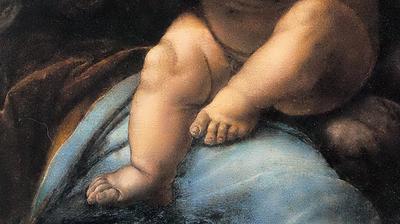
In 1475, a young Leonardo da Vinci painted the Madonna of the Carnation. This early masterpiece captures a quiet, intimate moment between a mother and her child, set against the backdrop of a darkening room. At the center, Mary sits with a gentle poise, her gaze fixed tenderly on the infant Jesus. In her hand, she holds a delicate red carnation—a symbol of love and future sacrifice. The baby reaches out with soft, chubby hands, his eyes wide with innocent curiosity. Through the arched windows behind them, a hazy, pale blue mountain range stretches into the distance, creating a sense of vast, quiet space.
The painting is bathed in a soft, golden glow that spills across Mary’s intricate golden brooches and the heavy, velvety folds of her blue cloak. Leonardo’s brushwork creates a remarkable sense of texture, from the translucent skin of the infant to the dew-like sparkle of the flower. Notice the subtle use of shadow, or sfumato, which blurs the edges of their faces, making the scene feel breathable and alive rather than frozen in time. There is a profound humanity in this work. It moves beyond religious iconography to capture the universal warmth of a mother’s devotion and the fleeting beauty of childhood. In this small panel, we witness the birth of a genius, finding divine grace in the simplest of human gestures.