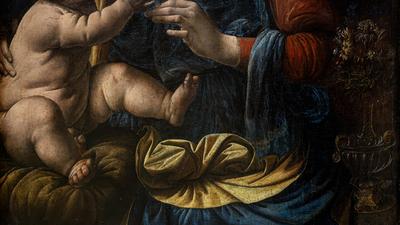
In the heart of the Louvre hangs a testament to patience and grace: The Virgin and Child with Saint Anne, a masterpiece Leonardo da Vinci refined over the final decade of his life. Look closely at the figures unfolding before you. Three generations are unified in a tender, cascading flow. Saint Anne sits at the peak, her gaze fixed with quiet wisdom upon her daughter, Mary. Mary, in turn, leans forward with motherly instinct, reaching out to the Christ Child, who playfully yet symbolically grasps a young lamb. Their bodies weave together in a soft, rhythmic dance of limbs and draped fabric, creating a sense of profound intimacy. Notice the composition—a stable pyramid that feels both solid and ethereal. Leonardo’s signature sfumato technique dissolves harsh outlines into a smoky, dreamlike haze.
A soft glow bathes their skin, while muted tones of blue and earthy ochre bridge the transition from the warm shadows of the foreground to the icy, jagged mountains in the distance. This atmospheric perspective makes the landscape feel infinite, as if the figures are emerging from a primordial mist. The painting captures more than just a family; it captures a fleeting moment of human emotion suspended in time. It is a meditation on lineage, sacrifice, and the gentle cycles of life. In this unfinished harmony, Leonardo invites us to witness the divine reflected in the softness of a mother’s touch.