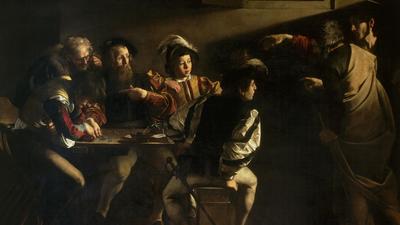
In 1601, the Italian master Caravaggio completed "Supper at Emmaus," a striking oil painting that captures a profound moment of sudden realization. Two weary travelers sit at a modest table with a stranger, only to discover, through the breaking of bread, that their companion is the resurrected Christ. To the left, a disciple leaps from his chair in disbelief, his elbow seemingly poking through the canvas toward us. On the right, another man flings his arms wide, his gesture spanning the depth of the room. At the center, a youthful, beardless Jesus remains calm, his downcast eyes and raised hand creating a pocket of stillness amidst the shock.
The scene is defined by dramatic "chiaroscuro," where deep, velvety shadows collide with a piercing, theatrical light. This sharp glow illuminates the textures of the rumpled tablecloth and the waxy skin of a precarious basket of fruit, which teeters on the very edge of the table. Every detail, from the frayed sleeve of a pilgrim to the soft gleam on a glass of wine, pulls the viewer into the physical space of the room. Caravaggio transforms a divine miracle into a gritty, human experience. By placing the viewer at the table and using such visceral, earthy details, he collapses the distance between the sacred and the everyday. It is a masterpiece of frozen motion, where a single second of revelation is preserved forever in light and shadow.