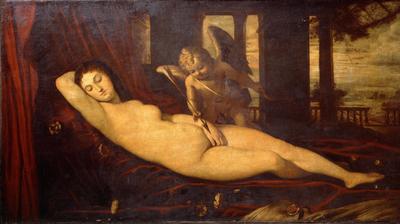
Painted in 1538 by the Venetian master Titian, the Venus of Urbino remains one of the most captivating portraits of the High Renaissance. It invites the viewer into a private, sun-drenched interior, where a young woman rests elegantly across a plush couch. Her body reclines in a gentle, fluid curve, her skin glowing with a creamy radiance against the dark backdrop. She gazes directly outward with a look that is both modest and incredibly bold. In her right hand, she holds a small cluster of red roses, their petals soft and delicate, while a small, furry dog sleeps peacefully at her feet, symbolizing domestic fidelity. In the distance, servants flutter about a wooden chest, adding a touch of rhythmic movement to the quiet scene.
Titian’s mastery is visible in the rich, sensory textures. Notice the heavy fall of the velvet cushions and the crisp, cool white of the linen sheets. He uses a technique of layering oil glazes to create a warm, golden atmosphere that seems to vibrate with life. The deep crimson of the mattress balances the muted tones of the background, guiding the eye across the canvas in a harmonious flow. This work is not merely a portrait; it is a celebration of sensuality and the idealized beauty of the human form. By placing a mythological figure in a contemporary domestic setting, Titian bridged the gap between the divine and the everyday. It is a timeless meditation on grace, intimacy, and the enduring power of the gaze.