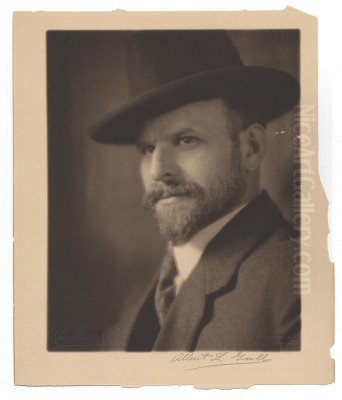
Albert Lorey Groll stands as a significant figure in the annals of American landscape painting, particularly renowned for his evocative depictions of the American Southwest. Born in the bustling metropolis of New York City in 1866, Groll's artistic journey would take him across the Atlantic for training and ultimately lead him to find his most profound inspiration in the vast, arid landscapes of Arizona and New Mexico. His unique ability to capture the dramatic skies, the subtle colors of the desert, and the immense scale of the Western terrain earned him considerable acclaim during his lifetime and secured his place in American art history. He passed away in his native New York in 1952, leaving behind a legacy of work that continues to resonate with viewers today.
Early Life and European Training
Groll's artistic inclinations emerged early, prompting him to seek formal training not in the United States, but in the established art centers of Europe. This decision set him on a path distinct from many of his American contemporaries. He traveled to Germany to study at the prestigious Royal Academy of Munich, a major hub for international artists in the late 19th century. There, he honed his skills under the tutelage of Ludwig Loefftz, a respected German painter known for his genre scenes and portraits, and a proponent of the detailed, realistic Munich style.
Following his time in Munich, Groll expanded his European education by studying in Antwerp, Belgium, at the Royal Academy of Fine Arts, and also spent time learning and observing in London. Exposure to the different artistic currents and pedagogical approaches in these cities provided Groll with a solid foundation in academic technique, particularly in drawing and composition. During these formative years, his primary focus, like many aspiring artists of the era, was on figure painting and portraiture, disciplines that demanded rigorous anatomical knowledge and skillful rendering.
The experience Groll gained in Europe was invaluable. The Munich School, in particular, emphasized strong draftsmanship, tonal control, and often a darker palette, elements that can be subtly discerned even in his later landscape work. His time abroad equipped him with technical proficiency and a broad understanding of European artistic traditions, preparing him for a professional career upon his return to the United States.
Return to New York and Artistic Transition
In 1895, Albert Lorey Groll returned to his native New York City, ready to establish himself as a professional artist. Initially, he intended to pursue the path he had trained for, focusing on figure painting and portraiture. However, the practical realities of an artist's life soon intervened. Groll found the expense associated with hiring models to be prohibitively high, a common challenge for artists lacking steady commissions or patronage.
Faced with this economic constraint, Groll made a pragmatic yet ultimately transformative decision: he shifted his focus from the human figure to the landscape. This change, born partly of necessity, proved to be, as some accounts describe it, a "fortunate" turn of events. It redirected his artistic energies towards a genre where he would achieve his greatest success and make his most lasting contribution.
While he would later become synonymous with the Southwest, his initial landscape work likely explored the scenery closer to his New York base. The parks, coastlines, and rural areas of the East Coast offered subjects readily available without the cost of models. This period allowed him to adapt his European-honed techniques to the nuances of outdoor light and natural forms, setting the stage for his eventual encounter with the dramatically different landscapes of the American West.
Discovery of the American Southwest
The pivotal moment in Groll's artistic career arrived in 1904. He embarked on his first journey to the American Southwest, specifically to Arizona. This trip was undertaken in the company of Stewart Culin, a noted ethnologist affiliated with the Brooklyn Museum. Culin's purpose was scholarly – to study and document the traditional games of the region's Native American populations. For Groll, however, the journey became an artistic revelation.
The vast, open spaces, the unique quality of light, the dramatic geological formations, and, perhaps most importantly, the immense, cloud-filled skies of the Arizona desert captivated him. It was a landscape unlike anything he had experienced in Europe or the eastern United States. The scale, the atmosphere, and the raw beauty of the region resonated deeply with his artistic sensibilities. This initial encounter sparked a lifelong fascination with the Southwest.
His companion on some of these early Western explorations was the artist William Robinson Leigh, another painter who would become known for his depictions of Western scenes. Traveling with colleagues like Leigh and interacting with figures like Culin provided Groll with both practical support and intellectual stimulation, enriching his understanding and appreciation of the region he was beginning to paint. The 1904 trip marked a definitive turning point, shifting his primary artistic focus westward.
The Desert Muse: Arizona and New Mexico
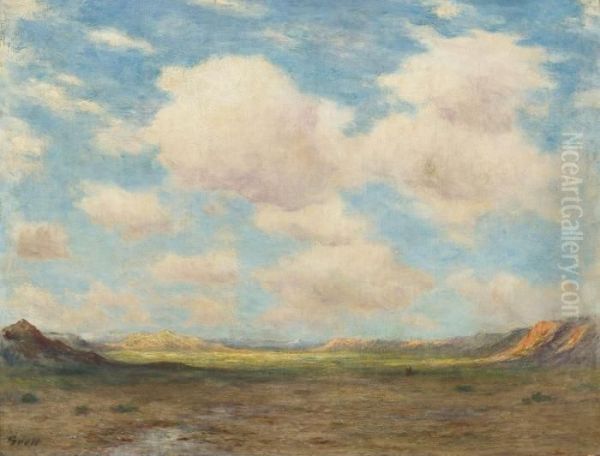
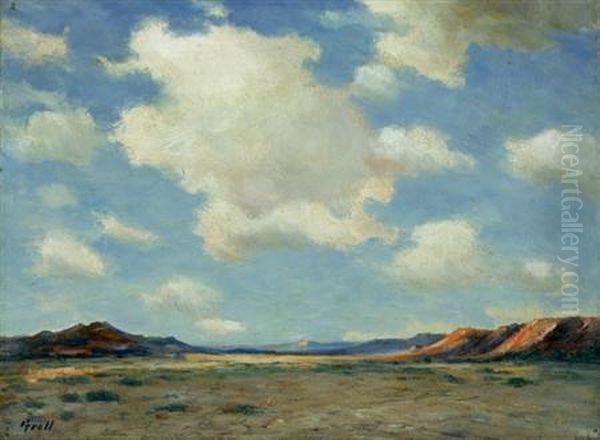
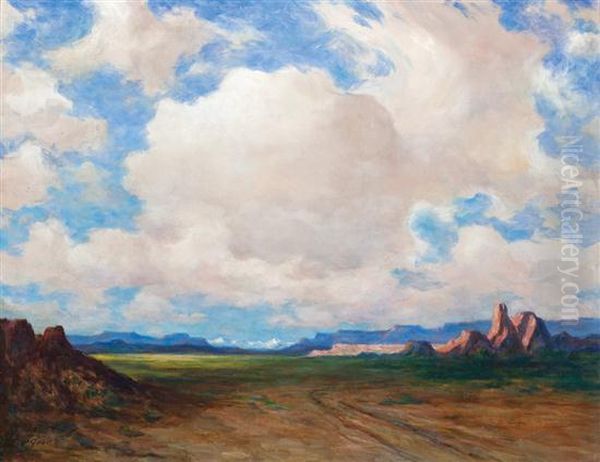
Following his initial foray in 1904, the landscapes of Arizona and New Mexico became Groll's principal subjects and enduring muse. He returned to the region repeatedly, drawn by its unique aesthetic potential. He became particularly adept at capturing the feeling of immense space characteristic of the desert, often employing low horizons that allowed the sky to dominate the canvas.
His paintings frequently feature dramatic cloud formations – towering cumulus clouds, wispy cirrus streaks, or heavy, rain-laden thunderheads – rendered with a sensitivity to light and atmosphere that became his hallmark. He wasn't just painting topography; he was painting the air, the light, and the weather of the Southwest. His work conveyed the solitude and grandeur of the desert environment, often emphasizing the power and majesty of nature over human presence.
Groll developed a particular affinity for the area around Laguna Pueblo in New Mexico. His depictions of the local landscape were admired by the Pueblo residents themselves. They bestowed upon him the affectionate and descriptive nickname "Chief Bald Head-Eagle Eye," a testament to both his appearance and the keen observational skills evident in his paintings. This connection highlights a respectful relationship with the land and its indigenous inhabitants, reflected in the sensitive portrayal of their environment. Unlike artists focused on the romanticized action of the "Wild West," such as Frederic Remington or Charles M. Russell, Groll concentrated on the enduring, atmospheric qualities of the land itself.
Artistic Style and Techniques
Albert Lorey Groll's artistic style is often characterized as a blend of realism and tonalism, with elements that sometimes verge on the abstract. While grounded in the accurate observation of nature learned through his academic training, his paintings are not mere photographic reproductions. He filtered his observations through his artistic sensibility, emphasizing mood, atmosphere, and the decorative qualities of the landscape.
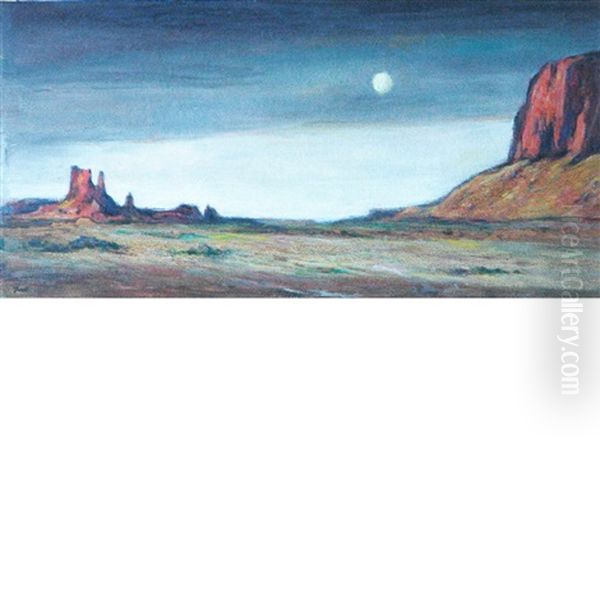
His handling of paint was distinctive. Groll frequently employed a palette knife alongside brushes, allowing him to build up textures and apply color in broad, expressive strokes, particularly effective in rendering the rugged terrain and the dynamic skies. Some accounts mention his experimental use of crayon mixed with oil paint to achieve unique surface effects and textures, adding another layer of individuality to his work.
Color was a crucial element in his paintings. He skillfully captured the subtle and sometimes surprisingly vibrant hues of the desert – the ochres, siennas, and purples of the earth and rock formations, contrasted with the intense blues and whites of the sky. His work often exhibits a strong sense of light, whether the brilliant sunshine of midday or the soft, diffused light of dawn or dusk. While distinct from the broken brushwork of French Impressionism, his focus on light and atmosphere aligns him with American Tonalist painters like George Inness, whose work emphasized mood and poetic interpretation over strict detail.
Beyond his oil paintings, Groll was also an accomplished etcher. He translated many of his Southwestern themes into this medium, creating prints that captured the stark contrasts and linear beauty of the desert landscape and its inhabitants. These etchings further demonstrate his versatility and his commitment to exploring the artistic possibilities of his chosen subject matter.
Key Works and Recognition
Groll's dedication to the Southwestern landscape quickly brought him recognition. One of his most celebrated early works is No-Man's Land, Arizona (also known as Arizona), painted around 1906. This painting, showcasing a vast expanse of desert under a dramatic, cloud-filled sky with a characteristically low horizon, perfectly encapsulates his signature style. Its exhibition at the prestigious Pennsylvania Academy of the Fine Arts (PAFA) annual exhibition in 1906 earned Groll a gold medal, a significant honor that boosted his reputation and brought his work to wider attention.
The success of No-Man's Land, Arizona was further cemented when it was acquired by the Corcoran Gallery of Art in Washington, D.C. (whose collection is now largely integrated into the National Gallery of Art). This acquisition by a major national institution signaled his arrival as an important voice in American landscape painting.
Another notable work is Lake Louise in the Rocky Mountains, which, despite depicting a Canadian scene, showcases his mastery of atmospheric effects and landscape composition. This painting earned him the George Inness Gold Medal from the National Academy of Design in 1912. While best known for the Southwest, this award demonstrates his skill extended to other majestic North American landscapes. Other typical subjects included views of specific locations like Acoma Pueblo or generalized scenes capturing the essence of Hopi or Navajo lands, all rendered with his characteristic focus on sky and atmosphere.
Awards and Honors
The gold medal from the Pennsylvania Academy of the Fine Arts in 1906 was just the beginning of a series of accolades Groll received throughout his career. His growing stature within the American art world was formally recognized in 1910 when he was elected an Associate (ANA) of the National Academy of Design in New York. This venerable institution was a cornerstone of the American art establishment, and election was a significant mark of peer recognition.
Two years later, in 1912, the National Academy further honored him with the prestigious George Inness Gold Medal for his landscape painting, specifically awarded for Lake Louise in the Rocky Mountains. Named after the renowned Tonalist painter George Inness, this award underscored Groll's mastery in the field of landscape art.
His engagement with the art community continued, and his reputation grew. He later became a member of the American Watercolor Society, indicating his proficiency in that medium as well, although he remains best known for his oils. In 1933, he achieved the distinction of being elected a full Academician (NA) of the National Academy of Design. That same year, he was also recognized by election to the National Institute of Arts and Letters (now the American Academy of Arts and Letters), an organization dedicated to honoring America's leading figures in art, music, and literature. These memberships and awards firmly placed Groll within the mainstream of respected American artists of his time.
Exhibitions and Collections
Albert Lorey Groll actively exhibited his work throughout his career, ensuring its visibility to the public and critics alike. Beyond the annual exhibitions at the National Academy of Design and the Pennsylvania Academy of the Fine Arts, his paintings were featured in numerous other venues. A significant platform was the Panama-Pacific International Exposition (PPIE) held in San Francisco in 1915, a major international event where American artists showcased their talents to a global audience. Groll's participation in such prominent expositions helped solidify his national reputation.
His success in exhibitions translated into acquisitions by major museums, further cementing his legacy. Today, works by Albert Lorey Groll are held in the permanent collections of many important American art institutions. These include the Metropolitan Museum of Art in his native New York City, the Smithsonian American Art Museum in Washington, D.C., the Brooklyn Museum (connecting back to his early association with Stewart Culin), the Fine Arts Museums of San Francisco, and the National Gallery of Art (through the Corcoran collection), among others. The presence of his work in these collections ensures its accessibility for study and appreciation by future generations.
His etchings also found an audience, sometimes appearing as illustrations in art journals like The Studio, indicating their perceived quality and relevance within contemporary art discussions. The breadth of his exhibition record and the quality of the collections holding his work attest to the high regard in which he was held during his lifetime and the enduring appeal of his art.
Artistic Circle and Influence
Although much of his subject matter was rooted in the remote Southwest, Albert Lorey Groll maintained his primary residence and studio in New York City. This placed him at the center of the American art world, allowing him to interact with fellow artists, critics, dealers, and patrons. He was part of the city's cultural elite, bridging the perceived gap between the "wild" West and the sophisticated East Coast art scene.
His friendships and professional associations were important. His travels with William Robinson Leigh and his collaboration with Stewart Culin provided camaraderie and context for his Western explorations. Through his paintings and exhibitions, Groll played a role in popularizing the Southwest as a compelling subject for American artists. While the Taos Society of Artists, including figures like Ernest L. Blumenschein and Bert Geer Phillips, was establishing a distinct art colony in New Mexico focused on both landscape and local cultures, Groll, operating more independently, brought his unique vision of the region's deserts and skies to a broad audience, particularly on the East Coast.
His work offered a different perspective on the West compared to the narrative-driven paintings of Remington and Russell, or the sublime, often topographically detailed vistas of earlier explorers like Thomas Moran. Groll's contribution lay in his atmospheric, slightly abstracted interpretations, emphasizing the emotional and aesthetic impact of the landscape. He encouraged other artists, directly or indirectly, to discover the artistic potential of these regions, contributing to the growing appreciation of the diverse American landscape in the early 20th century. His success demonstrated that distinctly American subjects could be rendered with technical sophistication and artistic depth worthy of international attention.
Later Life and Legacy
Albert Lorey Groll continued to paint and exhibit throughout his long life. While his most influential period is associated with the first few decades of the 20th century, he remained an active artist, committed to the landscape genre that had brought him renown. He maintained his connection to the New York art scene while periodically returning to the Southwest for inspiration.
He passed away in New York City in 1952 at the age of 86. By the time of his death, the art world had undergone significant transformations, with Modernism challenging many traditional approaches to painting. However, Groll's work retained its appeal, representing a distinct chapter in the story of American landscape art.
His legacy rests on his powerful and personal interpretations of the American Southwest. He was among the first generation of artists to seriously engage with the desert environment not just as a backdrop for narrative, but as a subject worthy of deep artistic exploration in its own right. His focus on the vast skies and dramatic cloud formations became his signature, influencing subsequent painters of the region. He successfully blended his European academic training with a modern sensibility for atmosphere, color, and composition, creating a body of work that captures the unique beauty and grandeur of the American West. Today, Albert Lorey Groll is remembered as a key figure who helped shape America's perception of its own diverse and majestic landscapes.
Conclusion
Albert Lorey Groll's journey from a figure painter trained in Europe to the preeminent painter of the Southwestern sky is a compelling narrative in American art history. Driven by a combination of practical necessity and profound artistic inspiration, he found his true voice in the deserts of Arizona and New Mexico. His ability to convey the immense scale, the dramatic weather, and the unique light of the region resulted in paintings that are both visually stunning and emotionally resonant. Through works like No-Man's Land, Arizona, his distinctive use of color and texture, and his celebrated focus on cloudscapes, Groll carved out a unique niche. Honored by major institutions and collected by leading museums, he not only achieved personal success but also significantly contributed to the appreciation and artistic interpretation of the American West, leaving a legacy that continues to inspire awe and admiration.