Anton Domenico Gabbiani stands as a significant figure in the artistic landscape of late Baroque Florence. His life, spanning from 1652 to 1726, coincided with a period of rich artistic activity, albeit one often seen as a transition from the High Baroque's grandeur towards the lighter sensibilities of the Rococo. Gabbiani, primarily a painter of frescoes, altarpieces, and portraits, navigated this era with considerable skill, securing prestigious commissions and leaving a distinct mark on Florentine art, particularly through his long association with the Medici family.
Early Life and Florentine Apprenticeship
Born in Florence on February 13, 1652, Anton Domenico Gabbiani's artistic journey began in his native city, a place steeped in centuries of unparalleled artistic achievement. His initial training was under the guidance of prominent figures in the Florentine art scene. He first apprenticed with Justus Sustermans (Giusto Suttermans), the esteemed Medici court portraitist renowned for his elegant and psychologically insightful depictions of the ruling family and aristocracy. This early exposure to the meticulous art of portraiture undoubtedly honed Gabbiani's skills in capturing likenesses and conveying character.
Following his time with Sustermans, Gabbiani furthered his education under Vincenzo Dandini. Dandini, himself a product of the Florentine tradition and influenced by artists like Pietro da Cortona, would have imparted a broader understanding of compositional principles and the grand manner of history painting. This foundational training in Florence provided Gabbiani with a solid grounding in disegno – the emphasis on drawing and design that was a hallmark of Central Italian art – as well as an appreciation for color and painterly execution.
Roman Sojourn: Broadening Horizons and Influences
To truly mature as an artist in 17th-century Italy, a period of study in Rome was almost obligatory. Around 1673, supported by a stipend from Grand Duke Cosimo III de' Medici, Gabbiani traveled to the Eternal City. He enrolled in the Florentine Academy in Rome (Accademia Fiorentina nell'Urbe), an institution established to provide Florentine artists with exposure to Roman classicism and the vibrant contemporary art scene.
In Rome, Gabbiani studied under Ciro Ferri, one of Pietro da Cortona's principal pupils and collaborators. Ferri was a master of the High Baroque style, known for his dynamic compositions and rich color palettes, particularly in large-scale fresco decorations. This mentorship was crucial, as it directly connected Gabbiani to the legacy of Cortona, whose exuberant and illusionistic ceiling frescoes, such as those in the Palazzo Barberini, had redefined monumental painting.
Gabbiani also reportedly studied with Ercole Ferrata, a prominent Baroque sculptor. While Ferrata's medium was different, his involvement with the Roman artistic and academic environment, and his own classical leanings, would have contributed to Gabbiani's understanding of form, anatomy, and the classical tradition that underpinned much of Baroque art.
The Roman artistic environment was a melting pot of influences. The towering figures of the High Baroque, Pietro da Cortona and Gian Lorenzo Bernini, had left an indelible mark. Moreover, the classical-Baroque style championed by Carlo Maratti (also known as Maratta) was gaining prominence. Maratti's work, characterized by its clarity, grace, and idealized figures, offered a more restrained and ordered alternative to the dynamism of Cortona, and it profoundly influenced Gabbiani. The impact of Maratti's refined classicism can be seen in Gabbiani's later works, tempering the more exuberant Cortonesque elements.
While in Rome, Gabbiani would have also absorbed the lingering influence of earlier masters. The dramatic naturalism and chiaroscuro of Caravaggio, though from an earlier generation, had irrevocably changed painting, and its echoes could still be felt. Similarly, the Bolognese classicism of Annibale Carracci and his followers, including Guido Reni and Domenichino, provided models of ideal beauty, balanced composition, and emotional restraint that were integral to the academic tradition.
Return to Florence and Medici Patronage
After approximately three years in Rome, Gabbiani spent a brief period in Venice around 1678-1679. This sojourn, though short, exposed him to the Venetian tradition's emphasis on colorito (color) and painterly effects, exemplified by masters like Titian, Paolo Veronese, and Tintoretto. This experience likely enriched his palette and his handling of light.
By 1680, Gabbiani was back in Florence, ready to establish himself as an independent master. His Roman training and diverse influences made him a versatile and sought-after artist. He soon came to the attention of Grand Prince Ferdinando de' Medici, son of Cosimo III. Ferdinando was a highly cultured and discerning patron of the arts, particularly music and painting, and his support was instrumental to Gabbiani's career.
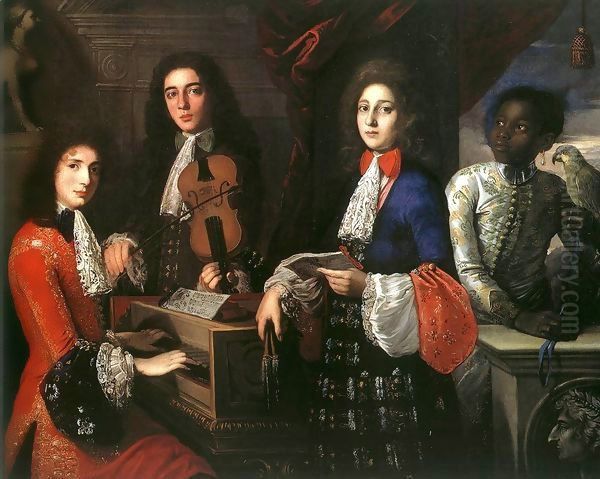
For Grand Prince Ferdinando, Gabbiani undertook numerous commissions, including portraits, mythological scenes, and allegorical works. One of his most famous works from this period is the Portrait of Three Musicians of the Medici Court (also known as Musicians of Prince Ferdinando de' Medici or The Concert), housed in the Galleria dell'Accademia, Florence. This group portrait, likely depicting musicians in Ferdinando's employ (possibly Pietro Salvetti, Giovanni Battista Gigli, and Antonio Rivani), is celebrated for its informal yet elegant composition, its sensitive portrayal of the individuals, and its depiction of the musical culture of the Medici court. Bartolomeo Cristofori, the inventor of the piano, was also part of Ferdinando's circle, highlighting the prince's passion for music.
Gabbiani also executed significant fresco cycles for the Medici. His work in the Palazzo Pitti, the primary residence of the Medici grand dukes, includes ceiling frescoes. Among these, the Annunciation is often cited, showcasing his ability to create dynamic, illusionistic scenes suitable for grand architectural spaces. He also worked at Medici villas, such as Poggio a Caiano and Pratolino, further cementing his status as a favored court artist. His frescoes often depicted mythological or allegorical subjects, rendered with a fluency and decorative elegance that appealed to the tastes of his patrons.
Artistic Style and Techniques
Anton Domenico Gabbiani's style is a synthesis of various influences, primarily rooted in the Florentine tradition of disegno but enriched by Roman High Baroque grandeur and Venetian colorism. His work demonstrates a strong command of human anatomy, a legacy of his academic training and the Florentine emphasis on drawing from life.
In his frescoes, Gabbiani often employed complex, multi-figure compositions, creating a sense of movement and drama. He was adept at foreshortening and creating illusionistic depth, making his ceilings appear to open up to the heavens. His color palette could range from rich and vibrant, reminiscent of Cortona or Venetian painting, to more subdued and harmonious tones, reflecting the influence of Maratti's classicism.
His oil paintings, whether portraits or religious and mythological subjects, exhibit a refined technique. Portraits like that of Grand Prince Ferdinando de' Medici reveal his ability to capture not only a physical likeness but also a sense of the sitter's status and personality. His religious works, such as the Madonna with Saints or Miracles of St. Francis of Paola, often convey a sincere piety, combined with a Baroque sense of drama and emotional intensity. He utilized chiaroscuro effectively to model forms and create focal points, though generally not with the starkness of Caravaggio, but rather in a softer, more blended manner.
Gabbiani was also a prolific draftsman. Numerous preparatory drawings survive, attesting to his careful planning of compositions and his skill in rendering the human figure. These drawings, often in red or black chalk, are characterized by their fluidity and confidence.
Major Works: A Closer Look
While Gabbiani produced a considerable body of work, several pieces stand out as particularly representative of his style and importance.
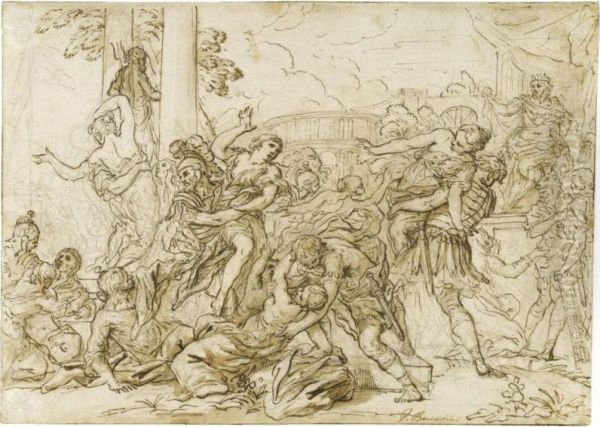
The Rape of the Sabine Women: This subject, popular in Baroque art for its dramatic potential and the opportunity to depict numerous dynamic figures, was tackled by Gabbiani. Such a composition would have allowed him to showcase his mastery of anatomy, complex groupings, and expressive emotion, drawing on a tradition that included artists like Giambologna (in sculpture) and Pietro da Cortona.
Frescoes in Palazzo Pitti: His contributions to the decoration of the Palazzo Pitti are among his most significant achievements. The specific scenes, such as the aforementioned Annunciation or other allegorical and mythological cycles (like the Apotheosis of the Medici or similar themes common in palace decoration), demonstrate his skill in large-scale decorative painting. These works were designed to impress and to convey the power and prestige of the Medici family. He competed and collaborated with other artists of the time in these vast decorative schemes, such as Alessandro Gherardini.
St. Francis in Glory with Saints (or similar titles for altarpieces): Gabbiani executed numerous altarpieces for churches in Florence and Tuscany. These works typically feature a central religious figure, often in a moment of ecstasy or divine revelation, surrounded by saints and angels. His St. Francis of Paola Healing a Sick Child is an example of his religious commissions, demonstrating his ability to convey narrative and pathos.
Portrait of Three Musicians of the Medici Court: As mentioned earlier, this group portrait is a masterpiece of its kind. It moves beyond formal court portraiture to offer a more intimate glimpse into the cultural life of Ferdinando's circle. The interplay between the figures, their engagement with their music, and the rich depiction of their attire and instruments make it a captivating work.
Self-Portrait: Like many artists, Gabbiani painted self-portraits, offering insights into how he wished to be perceived. These works, often found in collections like the Uffizi Gallery's self-portrait collection, are valuable documents of the artist's persona.
Anecdotes, Professional Life, and Challenges
Gabbiani's career was not without its interesting moments and professional considerations. An anecdote recounts that in 1715, he was sent to Rome to assess a painting attributed to Paolo Veronese. Gabbiani reportedly found the work "too lively" (perhaps too vibrant or too modern in handling for what was expected of a Veronese), and it was subsequently rejected. This incident highlights the complexities of connoisseurship and the expectations placed upon artists when judging the works of past masters.
Another story illustrates his professional independence. In 1689, he is said to have refused a commission from the Medici because he found their requirements too restrictive or demanding. This suggests an artist confident in his abilities and unwilling to compromise his artistic integrity beyond a certain point, even for powerful patrons.
Despite his success, there were periods of financial difficulty. It's recorded that a stay in Florence was cut short due to economic hardship, prompting a return to Rome where he continued to find work, including for the Medici. This underscores the precarious nature of an artist's life, even for those with significant patronage.
Artistic criticism also touched Gabbiani. Some contemporaries and later critics felt that his work could be overly imitative of his influences, particularly Titian or other great masters, suggesting a lack of profound originality. However, in an era where emulation of established masters was often seen as a virtue and a sign of learning, this criticism needs to be contextualized. His ability to synthesize various influences into a coherent and skilled personal style was, in itself, a significant achievement.
Influence, Legacy, and Students
Anton Domenico Gabbiani played an important role as an educator, passing on his knowledge and skills to a new generation of artists. He maintained an active studio and taught numerous pupils who went on to have successful careers.
Among his most notable students were:
Ignazio Enrico Hugford: Of English descent but born in Italy, Hugford was not only a painter but also an art historian and critic, known for his writings on artists like Anton Domenico Tempesti.
Benedetto Luti: Luti became a highly successful painter, working in both Florence and Rome. He developed a refined style that blended late Baroque and early Rococo elements, achieving international recognition, particularly for his pastel portraits and religious paintings. His work shows a clear debt to Maratti as well as to Gabbiani.
Giovanni Battista Ranieri del Pace: A Florentine painter who worked on various decorative projects and altarpieces, continuing the local tradition.
Tommaso Redi: Another Florentine artist who benefited from Gabbiani's tutelage, Redi was known for his anatomical studies and paintings.
Through these students, Gabbiani's influence extended into the 18th century, contributing to the continuity of the Florentine artistic tradition. His own work, particularly his frescoes in prominent Florentine locations, remained visible and influential for subsequent generations.
In the broader art historical context, Gabbiani can be seen as a key figure in the transition from the High Baroque to the Late Baroque and early Rococo in Florence. He upheld the strong tradition of Florentine disegno while incorporating the dynamism of Roman Baroque and the chromatic richness of Venetian painting. While perhaps not as revolutionary as a Caravaggio or as overwhelmingly grand as a Pietro da Cortona, Gabbiani was a master of his craft, a skilled decorator, an insightful portraitist, and an important teacher. His contemporaries in Italy included artists like the prolific Neapolitan Luca Giordano, who worked across Italy and Spain, and the Venetian Sebastiano Ricci, who helped disseminate a lighter, more Rococo-inflected style. Compared to the dramatic illusionism of ceiling painters like Andrea Pozzo or Giovanni Battista Gaulli (Baciccio) in Rome, Gabbiani's fresco work, while accomplished, often maintained a slightly more restrained Florentine character.
Final Years and Death
Anton Domenico Gabbiani remained active as an artist until late in his life. He died in Florence on November 22, 1726, at the age of 74, reportedly as a result of a fall from scaffolding while working on a fresco. This tragic end, in the midst of artistic creation, underscores his lifelong dedication to his craft.
His death marked the passing of one of the leading figures of Florentine painting of his generation. His works continue to be studied and appreciated for their technical skill, their embodiment of late Baroque aesthetics, and their reflection of the cultural environment of Medici Florence. He is buried in the church of San Felice in Piazza, Florence.
Conclusion: Gabbiani's Place in Art History
Anton Domenico Gabbiani occupies a respected place in the annals of Italian art. As a prominent painter in late 17th and early 18th-century Florence, he skillfully navigated the artistic currents of his time. His training under masters like Sustermans and Dandini, followed by transformative years in Rome studying with Ciro Ferri and absorbing the influence of Pietro da Cortona and Carlo Maratti, equipped him with a versatile and sophisticated artistic vocabulary.
His long and fruitful relationship with Grand Prince Ferdinando de' Medici resulted in some of his most celebrated works, including intimate portraits of court musicians and grand decorative schemes. Gabbiani's ability to synthesize Florentine disegno, Roman Baroque grandeur, and Venetian colorito allowed him to excel in various genres, from monumental frescoes in palazzi and churches to sensitive portraits and compelling religious narratives.
While sometimes viewed as an artist who consolidated existing styles rather than forging entirely new paths, his technical mastery, his prolific output, and his role as a teacher to influential artists like Benedetto Luti solidify his importance. His legacy is preserved not only in his numerous surviving artworks, which adorn churches and palaces and are held in museum collections worldwide, but also in his contribution to the enduring artistic heritage of Florence during a fascinating period of transition. Anton Domenico Gabbiani remains a testament to the enduring vitality of the Florentine school in the late Baroque era.