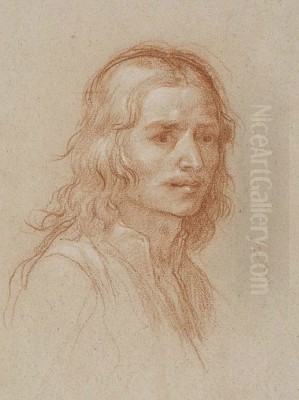
Baldassarre Franceschini, more widely known by his moniker Il Volterrano, stands as a pivotal figure in the landscape of Italian Late Baroque art. Born in Volterra in 1611 and active primarily in Florence until his death in 1689, Franceschini carved a significant niche for himself as a painter and etcher, particularly celebrated for his expansive and dramatic fresco cycles. His nickname, "Il Volterrano," served not only to identify his origin but also to distinguish him within the bustling artistic milieu of Tuscany. His career unfolded under the patronage of powerful families, most notably the Medici, leaving an indelible mark on the walls of villas, palaces, and churches across the region. His work embodies the transition and flourishing of the Baroque style in Florence, blending local traditions with influences absorbed from artistic centers like Rome and Parma.
Early Life and Artistic Formation in Tuscany
Baldassarre Franceschini's journey into the world of art began in his birthplace, Volterra, a historically rich town in Tuscany. Born into an artistic family, his father, Gaspare Franceschini, was a sculptor, providing an environment where creative pursuits were likely encouraged from a young age. This early exposure undoubtedly nurtured his innate talents. His formal training commenced locally under the guidance of Cosimo Daddi, a Volterran painter. While Daddi provided foundational skills, Franceschini's ambition and talent soon pointed towards Florence, the vibrant heart of Tuscan art.
Supported by the discerning eye and patronage of the Curradi family and later, more significantly, by the influential Marquise Inghirami (likely related to the esteemed Inghirami family of Volterra, known patrons of the arts), Franceschini made the crucial move to Florence. This transition marked a significant step up in his artistic education. He entered the bustling workshop of Matteo Rosselli, one of the leading painters in Florence at the time. Rosselli's studio was a major training ground, known for its emphasis on strong draughtsmanship and compositional clarity, rooted in the Florentine tradition.
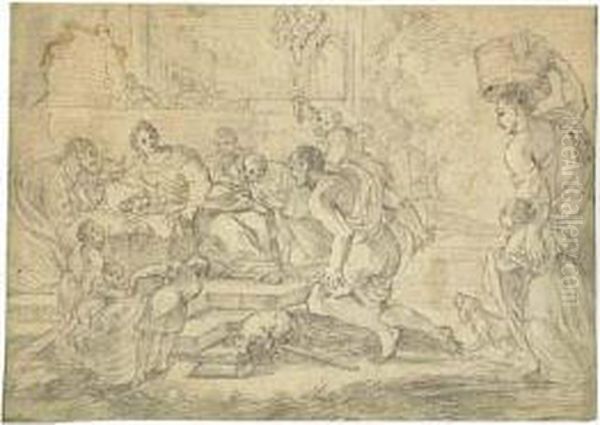
Franceschini's education was further enriched by his association with Giovanni da San Giovanni (Giovanni Mannozzi). He worked alongside and learned from this dynamic and innovative fresco painter, known for his lively narratives and lighter palette. The influence of both Rosselli's structured approach and Giovanni da San Giovanni's more exuberant style shaped Franceschini's early development, creating a foundation upon which he would build his unique artistic identity. His talent quickly became apparent, distinguishing him even within these prominent workshops.
The Medici Patronage and the Villa La Petraia Commission
Franceschini's burgeoning reputation soon attracted the attention of the most powerful patrons in Florence: the Medici Grand Dukes. A pivotal moment in his early career arrived in 1636 with a prestigious commission from Don Lorenzo de' Medici. He was tasked with decorating the courtyard loggia of the Villa La Petraia, one of the Medici's favoured countryside residences just outside Florence. This project, depicting the "Fasti Medicei" or Splendors of the Medici, was monumental in both scale and importance.
The frescoes at Villa La Petraia were intended to glorify the history and achievements of the Medici dynasty, showcasing key moments and allegorical representations of their rule and influence. This commission was a significant undertaking for the young artist, demanding not only technical skill in large-scale fresco painting but also the ability to navigate complex historical and allegorical subject matter in a manner befitting his patrons. Franceschini dedicated approximately twelve years to this extensive project, working intermittently from 1636 until around 1648.
The Petraia frescoes cemented Franceschini's status as a favoured artist of the Medici court and a leading painter in Florence. Stylistically, these works demonstrate his mastery of the Florentine tradition inherited from Rosselli, characterized by clear narrative and solid figures. However, they also reveal the growing influence of Giovanni da San Giovanni's lighter, more theatrical approach, particularly in the handling of light and the dynamic arrangement of figures. The successful completion of this demanding cycle showcased his reliability and artistic prowess, opening doors to numerous subsequent commissions from both the Medici and other Florentine nobility.
Artistic Evolution: Travels and the Influence of the High Baroque
Seeking to broaden his artistic horizons and engage with the latest developments in Italian art, Franceschini embarked on travels beyond Tuscany in the 1650s. These journeys proved crucial for his stylistic evolution, exposing him to the powerful currents of the High Baroque flourishing in other artistic centers. He visited cities in Northern Italy, including Parma and Bologna, where he could study the works of masters like Correggio and the Carracci family (Annibale Carracci and Ludovico Carracci), known for their emotional intensity, dynamic compositions, and rich use of color.
Perhaps the most transformative experience was his time in Rome. There, Franceschini encountered firsthand the monumental works of Pietro da Cortona, a leading proponent of the Roman High Baroque. Cortona's vast, swirling ceiling frescoes, such as those in the Palazzo Barberini, with their complex allegories, dramatic foreshortening (di sotto in sù), and vibrant energy, left a profound impression on the Florentine painter. He absorbed Cortona's approach to creating grand, unified decorative schemes that seemed to open up the architecture to the heavens.
Returning to Florence, Franceschini integrated these experiences into his own work. His style shifted noticeably, moving away from the more restrained classicism of his early training towards a more fully developed Baroque aesthetic. His compositions became more dynamic, his figures imbued with greater movement and emotional intensity, and his use of color richer and more luminous. He skillfully adapted the lessons learned in Rome and elsewhere to the specific tastes and traditions of Florence, creating a distinctive synthesis that characterized his mature style. This fusion of Florentine disegno (emphasis on drawing and design) with Roman and North Italian colore (color) and dynamism marked him as a key figure in the development of the Florentine Baroque.
Major Fresco Cycles in Florentine Churches
Building on the success of the Villa La Petraia and enriched by his travels, Il Volterrano received numerous commissions to decorate important ecclesiastical spaces in Florence. These large-scale fresco projects allowed him to fully deploy his mature Baroque style, creating immersive and spiritually uplifting environments. Among his most celebrated religious works are the decorations for the Santissima Annunziata and the Basilica di Santa Croce.
For the Basilica della Santissima Annunziata, a church deeply venerated in Florence, Franceschini painted the dome of the Cappella della Madonnina (or Cappella del Giambologna). His fresco depicting the Coronation of the Virgin is a swirling vortex of celestial figures, demonstrating his mastery of di sotto in sù perspective learned from Cortona. The work creates a powerful illusion of the heavens opening above the viewer, filled with light, movement, and divine glory, perfectly suited to the devotional intensity of the site.
Another significant commission was for the Niccolini Chapel in the Basilica di Santa Croce, the burial place of many illustrious Italians. Between 1653 and 1661, Franceschini adorned the chapel's dome and pendentives with frescoes. The dome features Moses and the Bronze Serpent and The Assumption of the Virgin, while the pendentives depict Sibyls and Virtues. These works showcase his ability to handle complex theological themes with dramatic flair and technical brilliance. The figures are robust and expressive, caught in dynamic poses, and the overall effect is one of Baroque grandeur and spiritual intensity, rivaling the works he had seen in Rome.
He also contributed decorations to the Orlandini Chapel in the church of Santa Maria Maggiore in Florence. These various ecclesiastical projects solidified his reputation as the preeminent fresco painter in Florence during the mid-17th century. His ability to combine narrative clarity with Baroque dynamism made him highly sought after for decorating the city's sacred spaces.
Works in Oil and Other Media
While Il Volterrano is primarily celebrated for his monumental frescoes, he was also a capable painter in oils, producing altarpieces, devotional paintings, and portraits throughout his career. Though perhaps less numerous than his wall paintings, his works on canvas demonstrate a similar stylistic trajectory, evolving towards a more dynamic and coloristically rich Baroque manner.
Among his notable oil paintings are religious subjects such as the Adoration of the Shepherds, which showcases his ability to handle tender narrative moments with sensitivity and atmospheric lighting, possibly showing subtle influences from the naturalism associated with followers of Caravaggio. Another powerful work is The Mocking of St. John (or sometimes identified as St. John the Baptist Pointing to Christ), demonstrating his skill in depicting intense emotion and dramatic interaction between figures. His Assumption of the Virgin, likely related thematically to his fresco work, further exemplifies his engagement with popular Counter-Reformation subjects.
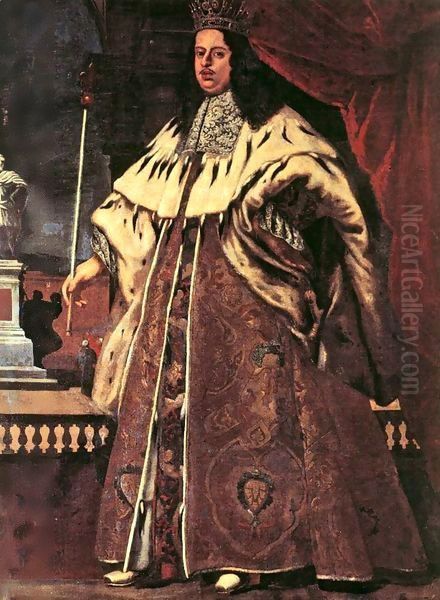
Franceschini also undertook portraiture, capturing the likenesses of prominent figures of his time. His portrait of Grand Duke Cosimo III de' Medici, for instance, displays a capacity for conveying both the sitter's status and a sense of individual character, rendered with the careful attention to detail typical of Florentine portrait traditions but infused with Baroque vitality. Some accounts and anecdotes suggest that Franceschini occasionally left oil paintings unfinished or that attribution questions surround some easel works, perhaps indicating the immense demands placed upon him by large fresco commissions or the involvement of workshop assistants, a common practice at the time. He was also active as an etcher, translating some of his compositional ideas into the print medium.
Contemporaries and the Florentine Artistic Milieu
Baldassarre Franceschini did not work in isolation. His career unfolded within the rich and competitive artistic environment of 17th-century Florence, interacting with, learning from, and sometimes competing against numerous other artists. His primary teachers, Matteo Rosselli and Giovanni da San Giovanni, provided his foundational training and remained significant figures in the Florentine scene during his early career. The influence of Pietro da Cortona, though based in Rome, was arguably the most decisive external factor shaping his mature style.
Within Florence itself, Franceschini was contemporary with several other notable painters. Francesco Furini, known for his soft, sfumato-laden style and sensual mythological subjects, offered a different interpretation of the Baroque. While their styles differed, both artists navigated the patronage systems of the Medici court and Florentine nobility. Other contemporaries included Jacopo Vignali, another pupil of Rosselli, who maintained a more restrained, classical Baroque manner, and Lorenzo Lippi, who was known for his clear, naturalistic style and also for his literary pursuits.
The somewhat eccentric Cecco Bravo (Francesco Montelatici) represented a more idiosyncratic strand of Florentine painting, focusing on complex allegories and dynamic, often unsettling, compositions. Franceschini's work, while fully embracing Baroque dynamism, generally retained a greater degree of compositional clarity and narrative legibility compared to Bravo's more turbulent canvases. His travels also brought him into contact, directly or indirectly, with the legacies of North Italian masters like Correggio and the Carracci, whose influence permeated Italian art of the period. While some sources mention tenuous links or comparisons to much earlier artists like Giorgione or even the Dutch master Johannes Vermeer, these connections are generally considered highly improbable or based on superficial resemblance by modern art historical scholarship; his core influences remain rooted in Florentine tradition and the impact of Roman and North Italian Baroque. His position was central to the Florentine school, absorbing dominant trends while maintaining a distinct artistic personality.
Later Career, Death, and Legacy
Il Volterrano remained active and highly regarded throughout his later career, continuing to receive important commissions in Florence and surrounding Tuscan towns. His mastery of fresco technique, combined with his ability to create grand, illusionistic spaces filled with dynamic figures, ensured his services were consistently in demand for both ecclesiastical and secular decorations. He maintained his position as one of the leading painters in Florence, influencing younger artists through his work and potentially through pupils in his workshop, such as Anton Domenico Gabbiani.
His later works continued to display the hallmarks of his mature style: dramatic compositions, rich color, and expressive figures, all hallmarks of the High Baroque adapted to Florentine sensibilities. He continued working until shortly before his death. According to biographical sources, Baldassarre Franceschini suffered from apoplexy, likely a stroke, and passed away in Florence on January 6, 1689, at the age of 78.
His legacy is substantial. Il Volterrano is considered one of the most important exponents of the Baroque style in Florence, particularly in the demanding medium of fresco. His work successfully bridged the gap between the more restrained local traditions and the full-blown High Baroque emanating from Rome. The Villa La Petraia frescoes remain a landmark of Medici patronage and dynastic representation. His decorations in Santa Croce and Santissima Annunziata are key monuments of Florentine religious art of the period. Through his prolific output and influential style, Baldassarre Franceschini, Il Volterrano, left an enduring imprint on the artistic heritage of Tuscany, ensuring his place as a master of the Italian Baroque. His works continue to be studied and admired in churches, villas, and museums, testament to his skill and enduring artistic vision.
Conclusion: A Florentine Baroque Master
Baldassarre Franceschini, Il Volterrano, navigated the complex artistic landscape of 17th-century Italy with remarkable success. From his origins in Volterra and formative training in Florence under masters like Matteo Rosselli and Giovanni da San Giovanni, he rose to become the preeminent fresco painter of his generation in the Tuscan capital. His career was defined by prestigious commissions, most notably from the Medici family, for whom he created the celebrated historical cycle at the Villa La Petraia. His crucial encounters with the High Baroque, particularly the work of Pietro da Cortona in Rome, transformed his style, leading to the dynamic and illusionistic masterpieces that adorn the domes and walls of Florence's major churches. While renowned for fresco, his oil paintings and portraits further demonstrate his versatility and skill. As a central figure in the Florentine Baroque, Il Volterrano skillfully synthesized local traditions with broader Italian artistic currents, leaving behind a rich legacy of dramatic, colorful, and technically brilliant works that continue to define the visual culture of the era in Tuscany.