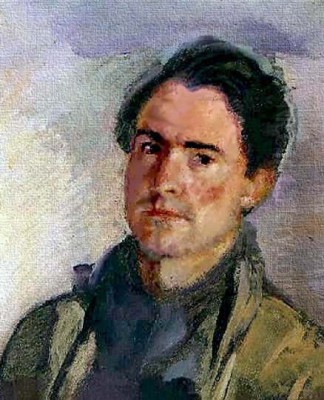
Armando Spadini (1883-1925) stands as a significant, albeit sometimes underappreciated, figure in the landscape of early twentieth-century Italian art. Born in Poggio a Caiano, near Florence, on July 29, 1883, and passing away prematurely in Rome on March 31, 1925, Spadini's relatively short career was marked by a vibrant exploration of light, color, and intimate domesticity. He navigated the complex artistic currents of his time, forging a personal style that drew from the rich heritage of Italian masters while engaging with the burgeoning spirit of modernism, particularly Impressionism and Symbolism. His work, often characterized by its warmth and luminosity, offers a unique window into the transition of Italian painting during a pivotal era.
Early Life and Florentine Formation
Armando Spadini's artistic journey began in Florence, the cradle of the Renaissance, a city steeped in artistic history. He received his foundational art education at the local art school, the Accademia di Belle Arti di Firenze. This formal training provided him with the essential technical skills. However, Spadini was also a dedicated autodidact. He diligently supplemented his academic studies by immersing himself in the masterpieces housed in Florence's numerous museums and galleries. This direct engagement with the art of the past, from Renaissance giants to later Italian schools, profoundly shaped his visual vocabulary and understanding of composition and technique.
During these formative years, he would have been exposed to the lingering influence of the Macchiaioli, a group of Italian painters active in Tuscany in the second half of the 19th century who, like the French Impressionists, emphasized painting outdoors to capture natural light and color. Artists like Giovanni Fattori, who was a professor at the Florentine Academy during Spadini's youth, represented this strong tradition of observational painting and a departure from strict academicism. While Spadini would later develop his own distinct path, the Macchiaioli's focus on light and everyday subjects likely resonated with his burgeoning artistic sensibilities. He also participated in competitions, such as the Alinari competition for illustrations of Dante's "Divine Comedy" in 1901, where he competed alongside artists like Alberto Zardo, Ernesto Bellandi, and Alberto Martini, showcasing his early ambition.
The Move to Rome and Artistic Development
A pivotal moment in Spadini's career was his relocation to Rome. The capital city, with its own rich artistic heritage and a burgeoning contemporary art scene, offered new stimuli and opportunities. In Rome, Spadini connected with a circle of intellectuals and artists, including figures like the writer and critic Ardengo Soffici, who was a prominent voice in Italian modernism, and Giovanni Papini, another influential literary figure. These interactions undoubtedly broadened his intellectual horizons and exposed him to contemporary European artistic debates. Emilio Cecchi, a noted art critic, also became a significant supporter and friend, playing a role in the later appreciation of Spadini's work.
It was in Rome that Spadini's artistic style began to mature. He became increasingly known for his ability to capture the fleeting effects of light and atmosphere, leading to comparisons with French Impressionists, most notably Pierre-Auguste Renoir. Indeed, Spadini has often been dubbed the "Italian Renoir" for his sensuous brushwork, his warm palette, and his focus on intimate scenes, particularly those involving women and children. Like Renoir, Spadini excelled at portraying the joy and tenderness of family life, imbuing his canvases with a palpable sense of warmth and affection. His paintings often feature sun-dappled interiors or figures bathed in a soft, diffused light, showcasing his mastery in rendering luminous surfaces and vibrant colors.
Impressionistic Sensibilities and Italian Roots
While the influence of French Impressionism, particularly artists like Renoir, Claude Monet, and Edgar Degas, is undeniable in Spadini's handling of light and color, his art remained deeply rooted in Italian traditions. He did not simply replicate Impressionist techniques but rather assimilated them into a distinctly Italianate vision. His work often reveals a profound admiration for the masters of the 16th and 17th centuries. Echoes of Venetian colorists like Titian and Veronese can be discerned in the richness of his palette, while the dramatic use of light and shadow (chiaroscuro) in some works suggests an awareness of Caravaggio and his followers.
Spadini's engagement with these historical precedents was not a mere academic exercise but a vital dialogue. He sought to revive and reinterpret the sensuousness and painterly qualities of earlier Italian art within a modern context. This fusion of Impressionistic immediacy with a classical sense of form and composition gives his work a unique character. He was less concerned with the scientific theories of light that preoccupied some French Impressionists and more focused on the emotive power of color and the intimate portrayal of his subjects. His landscapes, often depicting Roman scenes or the Tuscan countryside, are imbued with a lyrical quality, capturing the specific light and atmosphere of the Italian peninsula.
Themes of Domesticity and Portraiture
A significant portion of Armando Spadini's oeuvre is dedicated to themes of family and domestic life. His wife, Pasqualina Cervone, and their children were frequent subjects, depicted with a tenderness and intimacy that transcends mere representation. Works like "Children in the Sun" (Bambini al sole) or "Portrait of the Mother" (Ritratto della Madre) exemplify this aspect of his art. These paintings are not just portraits but are vibrant celebrations of familial bonds, filled with light, movement, and affection. Spadini had a remarkable ability to capture the unposed, natural gestures of children at play or in quiet moments, conveying their innocence and vitality.
His portraits extend beyond his immediate family. He was a sought-after portraitist, valued for his ability to capture not only a physical likeness but also the personality and inner life of his sitters. In these works, his Impressionistic brushwork and sensitivity to color create a lively surface that animates the subject. He managed to achieve a delicate balance between formal structure and a sense of spontaneity, resulting in portraits that feel both timeless and immediate. The warmth of his palette and the play of light often contribute to a sympathetic and engaging portrayal of the individual.
Symbolist Undercurrents
Beyond his Impressionistic leanings, Spadini's work also reveals an engagement with Symbolism, an artistic and literary movement that sought to express ideas and emotions through suggestive imagery rather than direct representation. While not a Symbolist in the vein of Gustave Moreau or Odilon Redon, Spadini's art often carries an evocative, poetic quality. The intimate scenes he painted can sometimes take on a more universal, almost dreamlike atmosphere, hinting at deeper emotional or psychological states.
This Symbolist sensibility is perhaps most evident in the mood and atmosphere he creates. The way light falls, the choice of colors, and the gentle melancholy that pervades some of his works suggest an interest in conveying an inner world. His painting "Confidenze" (Confidences), for example, while depicting a seemingly straightforward scene, carries an air of quiet introspection and shared secrets, characteristic of Symbolist concerns with the unseen and the unspoken. This aspect of his work aligns him with other Italian artists of the period who were exploring Symbolist themes, such as Giovanni Segantini or Gaetano Previati, though Spadini's approach was generally more grounded in observable reality.
Engagement with Artistic Movements: Roman Secession and Valori Plastici
Armando Spadini was an active participant in the artistic life of his time, engaging with various movements and exhibiting his work in important venues. He was involved with the Roman Secession (Secessione Romana), an exhibiting society founded in 1913 that aimed to promote modern Italian art and provide an alternative to the more conservative official salons. The Secession exhibitions, held between 1913 and 1916, brought together a diverse group of artists and showcased international trends, contributing to a more cosmopolitan artistic environment in Rome. Spadini's participation in these exhibitions indicates his alignment with the forces seeking to modernize Italian art.
His relationship with the "Valori Plastici" (Plastic Values) movement and its influential journal, founded in 1918 by Mario Broglio, was more complex. Valori Plastici championed a "return to order" and a renewed appreciation for classical Italian artistic traditions, often in reaction to the perceived excesses of Futurism and other avant-garde movements. Key figures associated with Valori Plastici included Giorgio de Chirico, Carlo Carrà, and Giorgio Morandi. Initially, Spadini's art, with its Impressionistic vibrancy and sensuousness, was met with some criticism from circles associated with Valori Plastici. For instance, Gino de Chirico (Giorgio's brother, also known as the writer Alberto Savinio, though the criticism mentioned in the source is attributed to Gino, a critic), wrote a harsh review in 1919, deeming Spadini's work lacking in depth.
However, Spadini's reputation grew, and his work began to gain wider acceptance, even within these circles. He exhibited at the "Fiorentina Primaverile" in 1922, an important exhibition in Florence that featured many artists associated with Valori Plastici. While some critics at this exhibition still found his work somewhat "fragmented," it also garnered positive attention. By 1924, Spadini was given a solo exhibition at the prestigious Venice Biennale, a significant mark of recognition. This event signaled a broader appreciation of his unique synthesis of modern sensibilities and traditional painterly values. Indeed, even Gino de Chirico's opinion reportedly evolved, leading to a more positive assessment of Spadini's art by 1925.
Critical Reception and Historical Standing
The critical reception of Armando Spadini's work evolved significantly throughout his career and posthumously. Initially, his Impressionistic style faced criticism from those who perhaps found it too derivative or not sufficiently aligned with emerging avant-garde trends like Futurism, which was championed by artists such as Umberto Boccioni and Giacomo Balla. However, as his personal vision matured, and as the artistic climate shifted in the post-World War I era towards a re-evaluation of tradition, Spadini's art found increasing favor.
The 1924 Venice Biennale solo show was a turning point, solidifying his status as one of Italy's leading contemporary painters. Critics began to appreciate the balance he achieved between sensuousness and structure, his mastery of color, and the genuine emotion conveyed in his depictions of family life and landscapes. Figures like Emilio Cecchi played an important role in championing his work. Despite his relatively early death in 1925, his influence continued to be felt. He is considered an important figure within the Scuola Romana (Roman School), a term used to describe a group of artists active in Rome who, particularly in the period between the wars, developed a figurative style characterized by expressive intensity and a rich painterly quality, often drawing on both modern and historical sources. While Spadini's career predates the full flourishing of artists often associated with the later Roman School, like Mario Mafai or Scipione (Gino Bonichi), his work shares some of their concerns with intimate subject matter and expressive paint handling.
His friendship with fellow artist Felice Carena, another significant painter of the period, underscores his connections within the Italian art world. Furthermore, his art resonated beyond Italy, as evidenced by his friendship with the Brazilian artist Mario Bacchetti, indicating a degree of international reach.
Later Years, Health, and Legacy
Spadini's later years were marked by growing recognition but also by personal challenges. The provided information mentions that he was conscripted after World War II (this seems anachronistic, as he died in 1925; it likely refers to World War I or a period of military service during that era). This experience, particularly being assigned to a hospital in Rome, reportedly took a toll on his health and spirit. He suffered from health problems, including kidney stones, which ultimately contributed to his premature death at the age of 41.
Despite his short life, Armando Spadini left a significant body of work that continues to be appreciated for its beauty, warmth, and technical skill. His art represents a distinctive strand within early 20th-century Italian painting, one that successfully navigated the tensions between tradition and modernity. He did not align himself with the radical breaks of the avant-garde but instead sought a path that honored the painterly traditions of Italy while embracing the modern preoccupation with light, color, and subjective experience.
His legacy lies in his ability to infuse everyday scenes with a profound sense of poetry and light. He demonstrated that a commitment to figurative painting and traditional subjects could coexist with a modern sensibility. His works are held in numerous public and private collections in Italy and abroad, and he is recognized as a key interpreter of an Italianate Impressionism and a precursor to certain aspects of the Roman School. His dedication to capturing the intimate moments of life, rendered with a vibrant and luminous palette, ensures his enduring appeal. He remains a testament to the enduring power of painting to convey emotion and celebrate the beauty of the everyday world, bridging the gap between the rich artistic past of Italy and the evolving language of 20th-century art, standing alongside contemporaries who also sought to redefine Italian art, such as Amedeo Modigliani, who, though working primarily in Paris, shared a commitment to figuration and expressive line.
Representative Works: A Closer Look
Several works are consistently cited as representative of Armando Spadini's artistic achievements, each showcasing different facets of his talent.
"Confidenze" (Confidences) is a work that exemplifies his ability to capture intimate moments. The painting likely depicts figures in quiet conversation, imbued with a sense of shared intimacy and introspection. The handling of light and the subtle emotional undertones would be characteristic of Spadini's approach, blending observational skill with a hint of Symbolist mood.
"Paesaggio romano" (Roman Landscape) would showcase his skills as a landscape painter. These works typically capture the unique light and atmosphere of Rome and its surroundings, rendered with his characteristic warm palette and fluid brushwork. He was adept at conveying the play of sunlight on ancient structures or the lushness of the Roman countryside, often imbuing these scenes with a lyrical, almost timeless quality.
"Portrait of the Mother" (Ritratto della Madre) highlights his strength in portraiture and his deep connection to his family. Such a work would be expected to convey not only a physical likeness but also a profound sense of affection and respect, rendered with the warmth and sensitivity that characterize his best portraits. The interplay of light and shadow would likely model the form gently, while the colors would contribute to the overall emotional tone.
"Children in the Sun" (Bambini al sole) is perhaps one of his most iconic themes. These paintings celebrate the joy and innocence of childhood, often depicting his own children at play. The brilliant rendering of sunlight, the vibrant colors, and the capturing of spontaneous movement are hallmarks of these works. They radiate a sense of happiness and vitality, reflecting Spadini's deep affection for his subjects and his mastery in depicting the effects of light.
These, and other works like them, demonstrate Spadini's consistent dedication to themes of family, the beauty of the Italian landscape, and the expressive power of light and color. His art offers a personal and heartfelt vision, one that continues to resonate with viewers for its warmth, sincerity, and painterly skill, placing him in a lineage of Italian painters who valued sensuous beauty and human emotion, from the Renaissance masters to more modern interpreters of the Italian spirit. His contribution, though perhaps quieter than some of his more radical contemporaries, remains a vital part of the rich tapestry of Italian art history.