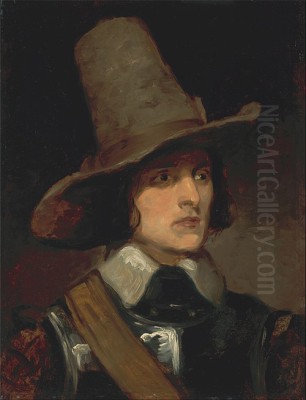
Augustus Leopold Egg (1816–1863) was a prominent English painter of the Victorian era, celebrated for his poignant narrative works that often explored contemporary social issues and moral dilemmas. Though his career was tragically cut short by ill health, Egg left an indelible mark on the British art scene, particularly through his association with "The Clique" and his engagement with the Pre-Raphaelite Brotherhood's ideals. His paintings, rich in detail and emotional depth, provide a fascinating window into the mores and anxieties of mid-19th century Britain.
Early Life and Artistic Formation
Born in Piccadilly, London, on May 2, 1816, Augustus Egg was the son of Joseph Egg, a prosperous and well-respected gunsmith whose clientele included members of the royal family. This comfortable upbringing likely provided him with the financial stability to pursue an artistic career. His early education was at Mr. Henry Sass’s celebrated art school in Bloomsbury, a preparatory institution for many aspiring artists of the time. It was here that Egg would have honed his foundational drawing skills.
In 1836, at the age of twenty, Egg gained admission to the prestigious Royal Academy Schools. This was a crucial step for any young artist seeking recognition and a formal arts education in Britain. The Royal Academy, founded by artists like Sir Joshua Reynolds, was the epicentre of the British art world, dictating taste and providing a platform for exhibition. During his time at the Academy, Egg would have been immersed in the traditional curriculum, which emphasized drawing from antique casts and life models, and studying the works of Old Masters.
His talent began to gain public recognition relatively early. In 1838, just two years after entering the Academy, Egg exhibited his first painting there, titled A Spanish Girl. This debut marked his official entry into the professional art world. His early works often drew inspiration from literary and historical sources, a common practice among Victorian painters who sought to elevate their art with noble or instructive themes.
The Clique and Early Career Trajectory
During the late 1830s and early 1840s, while still a young artist, Egg became a key member of "The Clique." This informal group of young painters, who met to sketch and critique each other's work, included Richard Dadd, William Powell Frith, Henry Nelson O'Neil, Alfred Elmore, and John Phillip. They shared a dissatisfaction with the perceived academicism and high-mindedness of the Royal Academy, preferring instead subjects drawn from everyday life, literature, and history that offered opportunities for narrative and character study.
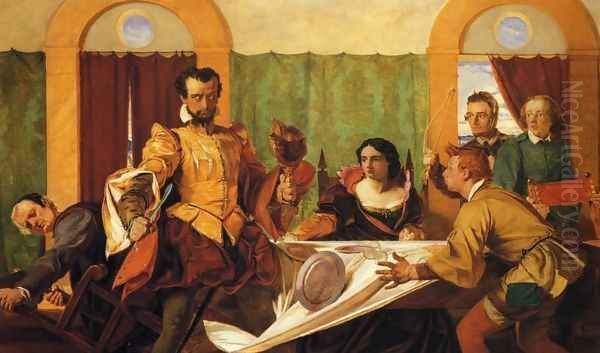
The Clique did not issue manifestos or adhere to a strict artistic doctrine, but its members generally favoured genre painting and subjects with popular appeal. They often chose scenes from Shakespeare, Cervantes, Molière, or contemporary authors like Sir Walter Scott and Lord Byron. Egg's contributions during this period reflected these preferences. He produced works such as The Victim (1844), inspired by Le Sage's Gil Blas, and scenes from Shakespeare, including The Taming of the Shrew (1847) and The Life and Death of Buckingham (1855).
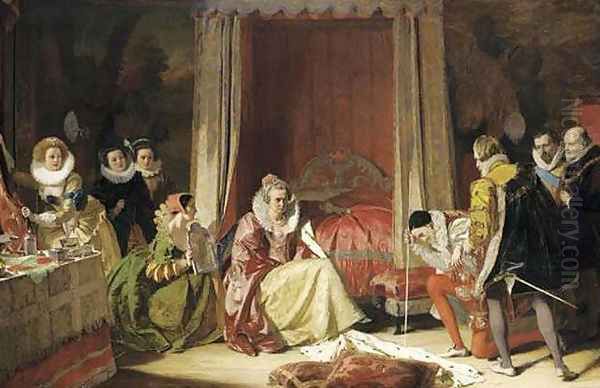
These literary and historical paintings were characterized by competent draughtsmanship, a clear narrative structure, and often a touch of humour or pathos. For instance, Queen Elizabeth Discovers She is No Longer Young (1848) captures a moment of human vulnerability in a historical figure, showcasing Egg's ability to imbue historical scenes with psychological insight. His technical skill and engaging subject matter earned him growing recognition, and he was elected an Associate of the Royal Academy (ARA) in 1848, a significant milestone in his career.
The camaraderie within The Clique was important. William Powell Frith, who would go on to achieve immense fame with panoramic scenes of modern life like Derby Day and The Railway Station, remained a lifelong friend. Richard Dadd's tragic descent into madness and subsequent parricide in 1843 deeply affected the group, but Egg and Frith continued to support him during his confinement in Bethlem Hospital and later Broadmoor.
Engagement with Pre-Raphaelitism
While Egg was never formally a member of the Pre-Raphaelite Brotherhood (PRB), which was founded in 1848 by William Holman Hunt, John Everett Millais, and Dante Gabriel Rossetti, he was sympathetic to their aims and became a close associate. The Pre-Raphaelites advocated for a return to the detailed realism, intense colours, and complex compositions of Quattrocento Italian art, rejecting what they saw as the formulaic and overly idealized art promoted by the Royal Academy since the time of Raphael.
Egg was particularly friendly with William Holman Hunt and Ford Madox Brown, an older artist who, though not a PRB member, shared many of their artistic principles. Egg's engagement with Pre-Raphaelite ideas led to a noticeable shift in his style. He began to adopt their brighter palette, meticulous attention to detail, and a greater emphasis on "truth to nature." This influence is evident in the heightened realism and more vibrant colours of his later works.
He also shared the Pre-Raphaelites' interest in modern-life subjects that could carry a moral or social message. While artists like Millais in Ophelia or Hunt in The Awakening Conscience explored themes of love, betrayal, and redemption with intense symbolism, Egg would adapt these concerns to his own narrative style. He learned from Hunt about specific colour theories and techniques, which contributed to the visual impact of his paintings. John Ruskin, the influential art critic and champion of the Pre-Raphaelites, also recognized Egg's talent and the sincerity of his work.
Masterpieces of Social Realism: Past and Present
Augustus Egg's most famous and arguably most powerful work is the triptych Past and Present, exhibited at the Royal Academy in 1858. This series of three paintings tells the tragic story of a middle-class Victorian family destroyed by the wife's adultery. It is a stark and uncompromising piece of social commentary, reflecting contemporary anxieties about domesticity, female sexuality, and the sanctity of the Victorian home.
The central panel, subtitled Misfortune, depicts the moment of crisis. The husband sits rigidly in his chair, a letter revealing his wife's infidelity crushed in his hand, his foot symbolically resting on a portrait of her supposed lover. The wife lies prostrate on the carpet, her wrists clasped, a picture of utter despair. The comfortable middle-class drawing-room is filled with symbols of their shattered life: a fallen apple, one half bruised on the floor, the other on the table beside a child’s toy house of cards, which is collapsing. Two young daughters are present, one trying to comfort her father, the other looking on in confusion. The mirror above the fireplace reflects an open door, suggesting the wife's imminent expulsion from the home.
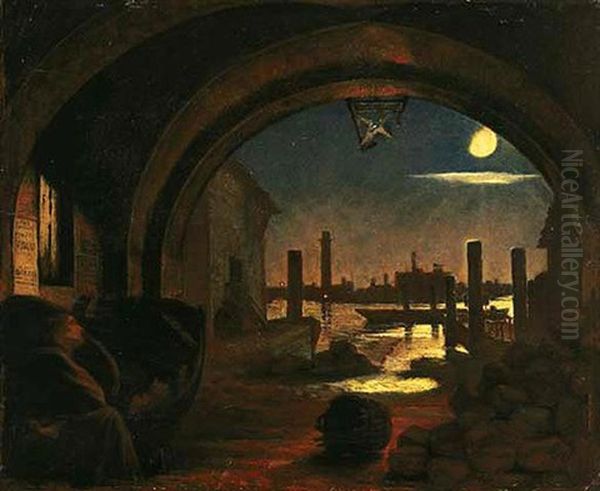
The two smaller, flanking panels depict the consequences some years later. The left panel, Despair, shows the now orphaned daughters, older and dressed in mourning, gazing out of a window at a full moon, a traditional symbol of chastity and sorrow. They are evidently living in reduced circumstances. The right panel, Retribution (though some sources suggest the titles were not explicitly given by Egg but inferred), shows the disgraced wife, now an outcast, huddled alone beneath the dark arches of the Adelphi, a notorious haunt of prostitutes and the destitute. She clutches a child, presumably illegitimate, and gazes towards the same moon, which for her symbolizes her lost purity and isolation. The posters on the wall behind her, advertising plays like "A Cure for Love" and "The Victims," add a layer of bitter irony.
Past and Present caused a considerable stir. Its subject matter was controversial, and its narrative, read sequentially, was deeply unsettling to Victorian sensibilities, which often preferred moral lessons to be delivered with less brutal honesty. The work was compared to William Hogarth's narrative series like Marriage A-la-Mode in its moralizing intent, but Egg's treatment was more aligned with the contemporary "fallen woman" theme explored by other artists like Dante Gabriel Rossetti in Found and Holman Hunt in The Awakening Conscience. Ford Madox Brown, a close friend, praised the work's emotional power and truthfulness.
The Travelling Companions and Other Notable Works
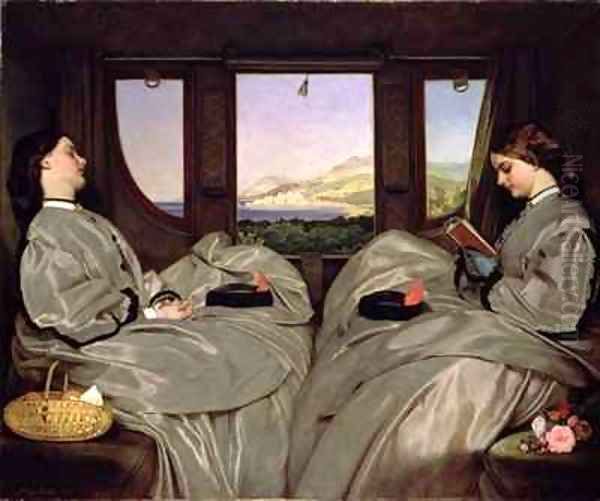
Another significant painting from Egg's mature period is The Travelling Companions, exhibited in 1862. This work presents a striking contrast to the overt drama of Past and Present. It depicts two identically dressed young women seated opposite each other in a railway carriage, presumably on a journey through Italy, as suggested by the coastal landscape visible through the window.
The painting is a study in symmetry and subtle contrasts. One woman is asleep, her head lolling, while the other is awake and reading a book. Their identical crinoline dresses, bonnets, and shawls create a mirror-image effect, prompting viewers to ponder their relationship and individual states of mind. The meticulous detail, from the fabric of their dresses to the fruit basket and the reflection in the carriage window, showcases Egg's refined technique, influenced by Pre-Raphaelite principles.
The Travelling Companions has been interpreted in various ways. Some see it as a comment on the boredom and confinement of Victorian women's lives, even during leisure. Others focus on the duality it presents – activity versus passivity, consciousness versus unconsciousness – perhaps even representing two aspects of a single personality or the passage of time. Unlike Past and Present, it does not offer a clear moral narrative, instead inviting contemplation and a more nuanced psychological reading. Its ambiguity and aesthetic appeal make it one of Egg's most admired works.
Throughout his career, Egg also produced smaller genre scenes and literary illustrations. Works like Pepys's Introduction to Nell Gwynne (1851) demonstrate his continued interest in historical anecdotes, while paintings such as The Outcast (a single-figure study related to the themes of Past and Present) show his ongoing concern with social issues.
Friendship with Charles Dickens and Theatrical Involvement
Beyond his painting, Augustus Egg was actively involved in the literary and theatrical circles of his time, most notably through his close friendship with the novelist Charles Dickens. Egg was a frequent guest at Dickens's home and participated in the amateur theatrical productions that Dickens famously organized. These productions often involved a host of literary and artistic figures, including Mark Lemon, editor of Punch, and fellow artists like Daniel Maclise and Clarkson Stanfield.
Egg not only acted in these plays but also assisted with costume and set design, demonstrating his versatility. His theatrical experience may have influenced the staging and narrative clarity of his paintings, which often have a tableau-like quality.
This collaboration extended to philanthropic efforts. Egg was a staunch supporter of the Guild of Literature and Art, an organization co-founded by Dickens and Edward Bulwer-Lytton (another prominent novelist and playwright for whom Egg sometimes designed). The Guild aimed to provide financial assistance to struggling artists and writers, a cause close to Egg's heart. He served as the treasurer for the Guild, reflecting his commitment and organizational skills. His social conscience, evident in his paintings, was thus also expressed through practical action.
Later Life, Health Issues, and Legacy
Throughout his life, Augustus Egg suffered from poor health, primarily chronic asthma. This condition often necessitated travel to warmer climates in search of relief. He made several trips to the south of France and Italy, sometimes accompanied by friends like John Phillip or Richard Dadd (before Dadd's illness). These journeys, while undertaken for health reasons, also provided artistic inspiration, as seen in the Italian setting of The Travelling Companions.
Despite his recurring illness, Egg remained productive. He was elected a full Royal Academician (RA) in 1860, the highest honour for a British artist, cementing his status within the art establishment. However, his health continued to decline. In late 1862, seeking a more beneficial climate, he travelled to Algiers in North Africa.
Tragically, the change of scenery did not bring lasting improvement. Augustus Leopold Egg died in Algiers on March 26, 1863, at the relatively young age of 46. His premature death was a significant loss to the British art world. He was buried in the Protestant cemetery in Algiers.
Augustus Egg's legacy lies in his contribution to Victorian narrative painting and social realism. His works, particularly Past and Present, are considered important examples of how artists engaged with the moral and social concerns of their era. He successfully bridged the gap between the anecdotal genre painting of The Clique and the more intense, symbolic realism of the Pre-Raphaelites. His paintings are valued not only for their technical skill and aesthetic qualities but also as historical documents that reflect the complexities of Victorian society.
His influence can be seen in the work of later narrative painters, and his willingness to tackle difficult social themes paved the way for other artists to explore similar subjects. While perhaps not as widely known today as some of his contemporaries like Millais, Hunt, Rossetti, or even Frith, Egg's contribution is significant. His paintings continue to be studied for their artistic merit and their insightful commentary on the human condition within the specific context of 19th-century Britain, alongside works by other socially conscious artists of the period such as Luke Fildes or Hubert von Herkomer, who also depicted scenes of poverty and social distress. His friendship and collaboration with figures like Charles Dickens also highlight the interconnectedness of the Victorian artistic and literary worlds. Augustus Egg remains a compelling figure, an artist who used his considerable talents to tell stories that were both visually engaging and morally resonant.