Benjamin Robert Haydon stands as one of an most enigmatic and ultimately tragic figures in the history of British art. A painter of immense ambition, a passionate writer, and a vociferous advocate for the grand style of historical painting, Haydon's life was a tumultuous journey marked by flashes of brilliance, bitter feuds, crippling debt, and a dramatic end. His career, spanning the early to mid-19th century, offers a fascinating window into the artistic, social, and intellectual currents of his time. Though he never achieved the widespread acclaim or financial stability he so desperately craved during his lifetime, his influence, particularly through his writings and his unwavering belief in the didactic power of art, has resonated through subsequent generations.
Early Life and Artistic Awakening
Born on January 26, 1786, in Plymouth, Devon, Benjamin Robert Haydon was the son of another Benjamin Robert Haydon, a prosperous printer and bookseller, and Sarah Cobley, the daughter of a local rector. This background provided him with a degree of comfort and access to literature, which likely fueled his later intellectual pursuits. From an early age, Haydon displayed a fervent passion for art, a calling that seemed almost preordained despite his father's initial hopes that he would join the family business.
His early education at Plympton Grammar School – the same institution attended by the illustrious Sir Joshua Reynolds, a fact Haydon would later cherish – further nurtured his artistic inclinations. Despite suffering from an eye ailment that would periodically affect his vision throughout his life, Haydon's determination to become a painter was unshakeable. In 1804, against his parents' initial reservations but with their eventual reluctant blessing and financial support, the ambitious young man set off for London to enroll in the prestigious Royal Academy Schools.
The Royal Academy and Early Aspirations
Upon his arrival in London, Haydon threw himself into his studies at the Royal Academy. He was a diligent student, known for his intense focus and his early embrace of anatomical studies, which he believed were fundamental to the depiction of the human form, especially in the grand historical narratives he aspired to create. He studied under influential figures such as Henry Fuseli, whose own dramatic and often fantastical compositions left an impression on the young artist. He also formed significant early friendships, most notably with David Wilkie, a fellow student who would go on to achieve great success as a genre painter. Their early camaraderie, however, would later be strained by differing artistic paths and Haydon's often prickly temperament.
Haydon quickly made his mark. His first major exhibited work, Joseph and Mary Resting on the Road to Egypt (1807), was well-received. He was determined to revive what he saw as the declining prestige of historical painting in Britain, a genre he believed to be the noblest form of art, following in the tradition of the Old Masters and the theoretical pronouncements of Sir Joshua Reynolds on the "Grand Manner." Haydon envisioned vast canvases depicting heroic and morally uplifting scenes from history, mythology, and the Bible, believing such art could elevate the national character.
The Grand Manner and Monumental Ambitions
Haydon’s artistic philosophy was deeply rooted in the concept of the "Grand Manner," which emphasized idealized forms, noble subjects, and a clear moral message. He was a fervent admirer of the Elgin Marbles, the classical Greek sculptures brought to Britain by Lord Elgin, and campaigned vigorously for their public purchase, recognizing their unparalleled anatomical and aesthetic perfection. He spent countless hours sketching them, believing them to be the ultimate exemplars for any artist aspiring to greatness. His detailed anatomical studies, including dissections, were part of this quest for verisimilitude and ideal form.
His ambition manifested in the sheer scale of his canvases. The Assassination of Dentatus (1809), his first truly monumental work, was exhibited at the Royal Academy and, despite winning a prize from the British Institution, became a source of contention. Haydon felt it was poorly hung by the Academy, an early instance of the many disputes that would characterize his relationship with the institution. He believed the Academy, dominated by portraitists like Sir Thomas Lawrence and genre painters, was actively hostile to the epic scale and serious intent of historical painting.
One of his most acclaimed early works was The Judgment of Solomon (1814). This enormous painting, lauded for its dramatic composition and powerful emotion, brought him a degree of fame and was purchased for a significant sum. For a brief period, it seemed Haydon was on the cusp of the success he craved. He attracted pupils, including Charles Lock Eastlake, who would later become President of the Royal Academy, and the Landseer brothers, Charles and Thomas, with Edwin Landseer also being a close associate in these early years.
Masterworks and Artistic Style
Haydon's artistic style was characterized by its dramatic intensity, a focus on anatomical accuracy, and a desire to convey profound emotional and moral narratives. His compositions were often crowded and dynamic, filled with figures in expressive, sometimes exaggerated, poses. He employed a rich, if sometimes heavy, palette and sought to create a sense of theatrical grandeur.
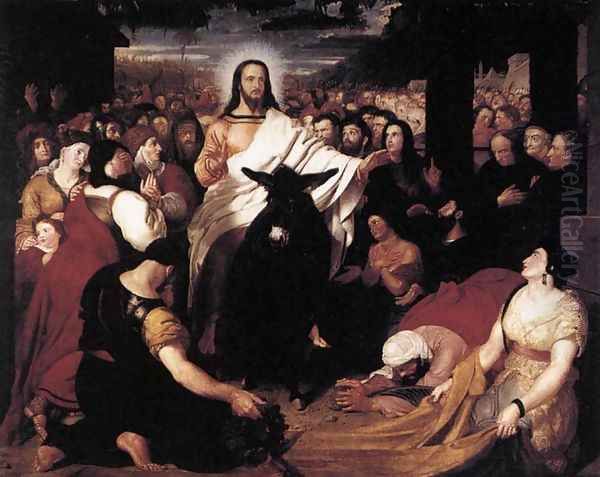
Perhaps his most famous work, Christ's Entry into Jerusalem (1814-1820), exemplifies his ambitions and his methods. This colossal painting, which took six years to complete, was exhibited independently to great public interest. Haydon, ever the showman, included portraits of contemporary figures within the crowd, such as William Wordsworth, John Keats, and even Voltaire (as a skeptical onlooker), adding a layer of contemporary relevance and intellectual engagement. The work was a popular success, touring England and Scotland and earning him a considerable sum, though much of it was quickly consumed by his mounting debts.
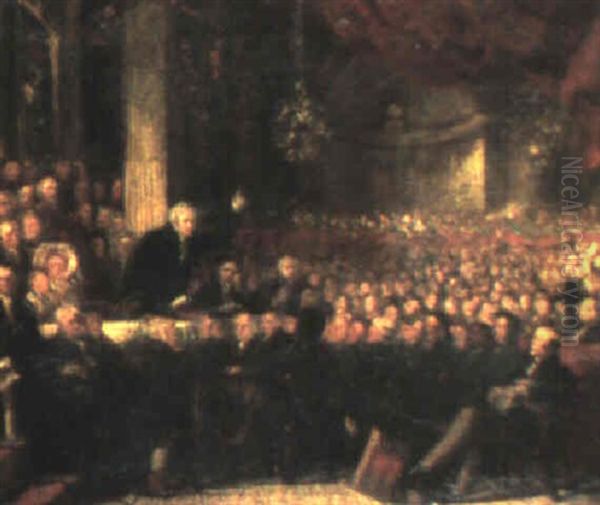
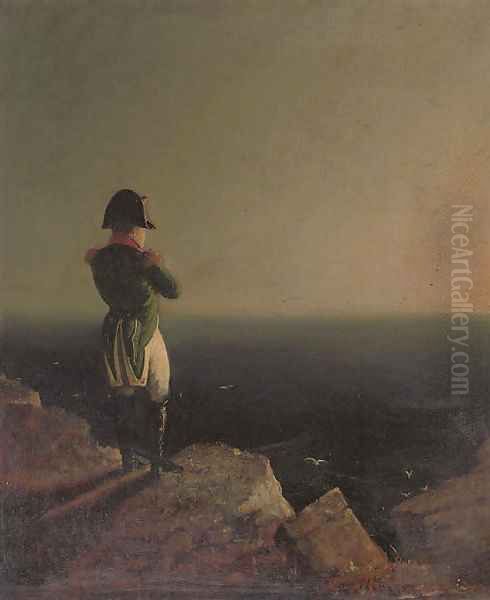
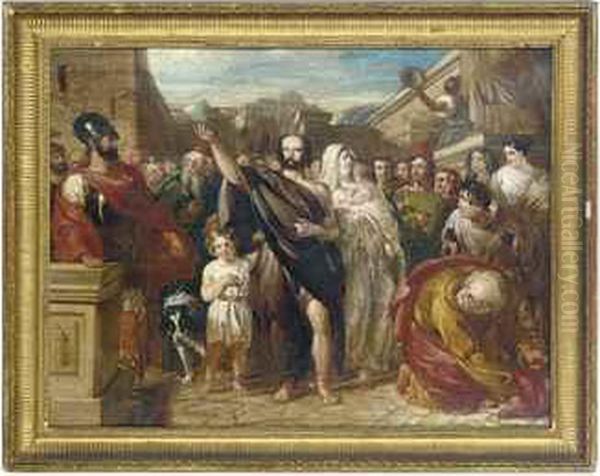
Other significant works include The Raising of Lazarus (1821-1823), another vast religious canvas that, while impressive, failed to replicate the financial success of Christ's Entry. His Napoleon Musing at St Helena (1831) became one of his most reproduced images, capturing the romanticized image of the defeated emperor. He also painted scenes from British history, such as Alfred and the Trial by Jury (1830s), and contemporary events, like The Reform Banquet (1834) and The Anti-Slavery Society Convention (1841), the latter a massive group portrait commissioned to commemorate the historic event, featuring numerous abolitionist figures.
Despite his technical skill and the undeniable power of some of his conceptions, Haydon's work often drew criticism. Some found his figures stiff, his drama overwrought, and his compositions lacking in subtlety or harmony. His relentless pursuit of the monumental sometimes led to works that were perceived as unwieldy or bombastic, failing to connect with the prevailing tastes of patrons who often favored smaller, more decorative pieces or portraits by artists like Sir Thomas Lawrence or Martin Archer Shee.
Financial Woes and Imprisonment
Haydon's unwavering commitment to large-scale historical painting, which found few consistent buyers, combined with his often improvident financial management, led to a life plagued by debt. He borrowed heavily to fund his ambitious projects and maintain his household, often relying on the generosity of friends and patrons, including figures like Sir George Beaumont and William Wordsworth. However, his proud and often confrontational nature alienated many potential supporters.
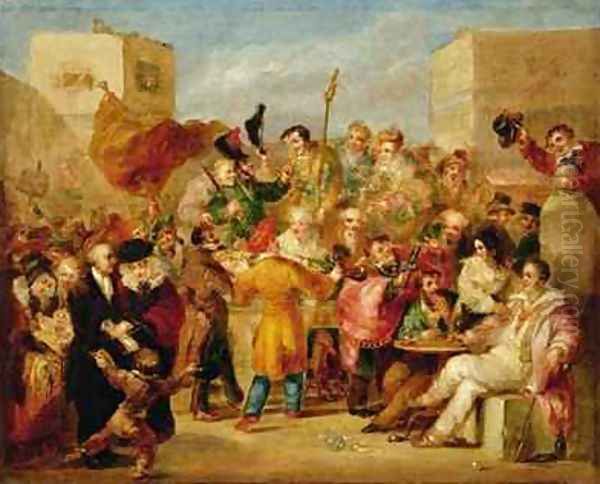
The consequence of his financial instability was repeated imprisonment for debt. Haydon was incarcerated in the King's Bench Prison on several occasions, first in 1823, then again in 1827, 1830, and 1836. These periods were deeply humiliating and distressing, yet he often continued to work, sketch, and write from prison. His painting The Mock Election (c. 1827), depicting a satirical election held by inmates of the King's Bench, was a direct product of one such confinement and was purchased by King George IV, a rare moment of royal patronage.
His financial struggles were a constant source of anxiety and despair, documented extensively in his journals. He railed against a system that he felt failed to support "high art" and lamented the public's preference for what he considered lesser genres. His inability to secure consistent state or institutional patronage for his grand historical schemes was a lifelong frustration.
Literary Endeavors and Art Theory
Beyond his painting, Haydon was a prolific writer and lecturer. His Autobiography and Journals, published posthumously, remain his most enduring legacy. These writings offer an invaluable, if highly subjective, account of the London art world in the early 19th century, filled with vivid portraits of his contemporaries, passionate defenses of his artistic principles, and heart-wrenching accounts of his personal struggles. They reveal a man of great intellect, deep feeling, and an almost paranoid conviction in his own genius and the malice of his detractors.
Haydon delivered numerous lectures on art and design across the country, advocating for the establishment of schools of design and for greater government support for the arts. He believed that art had a crucial role to play in national education and industrial progress. His ideas on art education were influential, and he played a role in the movement that eventually led to the establishment of the Government School of Design in 1837, a precursor to the Royal College of Art. He argued passionately for the decoration of public buildings with historical frescoes, a campaign that saw limited success during his lifetime but foreshadowed later developments.
His writings also included critical essays and pamphlets, often attacking the Royal Academy, which he saw as a conservative and self-serving institution that stifled true talent. While these polemics earned him many enemies, they also contributed to debates about the role and governance of artistic institutions in Britain.
Relationships with Contemporaries
Haydon's life was interwoven with many of the leading artistic and literary figures of his day. His friendship with John Keats was particularly significant. Haydon's ambition and his talk of grand artistic endeavors deeply impressed the young poet, and they shared a period of intense mutual admiration. Keats dedicated sonnets to Haydon, and Haydon included Keats's portrait in Christ's Entry into Jerusalem. However, the relationship eventually cooled, partly due to Haydon's financial demands and his overbearing personality.
He maintained a long, though sometimes tested, friendship with William Wordsworth, who also appeared in Christ's Entry. Wordsworth admired Haydon's dedication, though he was often exasperated by his financial imprudence. Other literary acquaintances included Charles Lamb, Leigh Hunt, Samuel Taylor Coleridge, and Sir Walter Scott.
Within the art world, his relationships were often more fraught. While he had early friendships with David Wilkie and Charles Lock Eastlake, his combative nature and his public attacks on the Royal Academy led to estrangement from many. He viewed successful contemporaries like Sir Thomas Lawrence with a mixture of envy and disdain. He had a complex relationship with J.M.W. Turner, another giant of the era who also tackled historical subjects, albeit with a vastly different stylistic approach. While Haydon acknowledged Turner's genius, he also criticized his lack of academic rigor. He also knew John Constable, whose dedication to landscape painting represented a different artistic path but one that also struggled for full academic acceptance initially. Haydon's pupils, such as William Bewick and George Lance, often found him an inspiring but demanding teacher.
Advocacy for Public Art and Education
A core tenet of Haydon's belief system was the necessity of public art and state support for artists engaged in "high art." He tirelessly campaigned for government commissions to decorate public buildings, such as the new Houses of Parliament, with large-scale historical frescoes. He envisioned these as a means of public education and national glorification, drawing parallels with the Renaissance masters who worked for church and state.
When competitions were finally announced for the decoration of the Houses of Parliament in the 1840s, Haydon eagerly submitted designs. However, his cartoons (preparatory drawings) were rejected, a bitter disappointment that he felt was a personal slight and a betrayal of the very principles he had championed for decades. This rejection, coupled with the failure of a concurrent public exhibition of his own works, proved to be a devastating blow. He saw younger artists, some of whom he had taught or influenced, like Daniel Maclise, achieving the kind of public commissions he had always dreamed of.
His efforts in art education were more tangible. He lectured widely, including in industrial cities like Manchester and Liverpool, promoting the importance of design education for artisans and manufacturers. He believed that improving the aesthetic quality of British goods would enhance their competitiveness. His advocacy contributed to a growing awareness of the need for formal design training.
Later Years and Tragic End
The final years of Haydon's life were marked by increasing desperation and despair. His lifelong financial struggles intensified, and his artistic ambitions seemed further than ever from realization. The rejection of his designs for the Houses of Parliament in 1843 was a crushing blow. In 1846, he organized an exhibition of his recent large paintings, including The Banishment of Aristides and Nero Playing the Lyre during the Burning of Rome, at the Egyptian Hall in Piccadilly. Tragically for Haydon, his exhibition coincided with the London appearance of General Tom Thumb, the American dwarf performer promoted by P.T. Barnum, whose show at the same venue drew massive crowds while Haydon's paintings were largely ignored.
This final public humiliation, compounded by overwhelming debt and a profound sense of failure, proved too much to bear. On June 22, 1846, after writing a poignant last entry in his journal that quoted Shakespeare's King Lear ("Stretch me no longer on this rough world"), Benjamin Robert Haydon took his own life in his studio. He first attempted to shoot himself, but the bullet failed to kill him instantly. He then completed the act by cutting his throat. He was found by his daughter, leaving behind his wife, Mary, whom he had married in 1821 and with whom he had several children (many of whom predeceased him), and a legacy of unfulfilled promise. His death sent shockwaves through the London art world and elicited sympathy even from some of his former adversaries.
Legacy and Art Historical Assessment
Benjamin Robert Haydon's legacy is complex and multifaceted. As a painter, his reputation has fluctuated. While some of his works, like The Judgment of Solomon and Christ's Entry into Jerusalem, are acknowledged for their ambition and occasional power, his overall oeuvre is often seen as uneven. Critics point to a certain grandiosity that sometimes tipped into melodrama, and a technical execution that did not always match his lofty conceptions. He was, in many ways, a man out of step with the prevailing tastes of his time, clinging to a vision of "high art" that found limited patronage in early 19th-century Britain.
However, his impact extends far beyond his canvases. His Autobiography and Journals are considered a primary source of immense value for understanding the period. They offer a raw, passionate, and deeply personal insight into the struggles of an artist and the dynamics of the art world. His advocacy for art education and state patronage, though often self-serving, contributed to important long-term developments in British art policy and institutions. He championed the Elgin Marbles when their value was still debated, and his anatomical studies and lectures influenced a generation of students.
Artists like George Frederic Watts, a later proponent of grand allegorical and historical painting, can be seen as inheritors of Haydon's ambition, albeit with greater critical and popular success. Haydon's insistence on the moral and intellectual purpose of art, while perhaps unfashionable in some later periods, continues to provoke debate.
Conclusion
Benjamin Robert Haydon remains a compelling, if flawed, figure. He was a man of immense talent, prodigious energy, and unshakeable self-belief, but also one whose pride, obstinacy, and perhaps a degree of paranoia, contributed to his professional and personal misfortunes. His life was a dramatic testament to the struggles of an artist who dared to dream on an epic scale in an era that was not always receptive to such grandeur. While he may not be counted among the very greatest of British painters like Turner or Constable, his passionate advocacy, his influential writings, and the sheer force of his tragic personality ensure his enduring place in the annals of art history. He serves as a poignant reminder of the often-painful disparity between artistic ambition and worldly success.