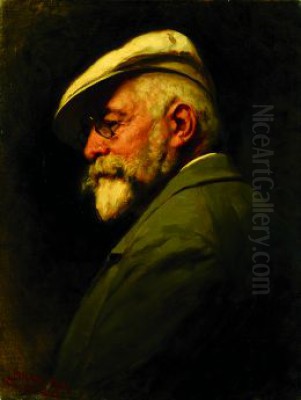
Gyula Benczúr stands as one of Hungary's most distinguished painters of the 19th and early 20th centuries, celebrated for his monumental historical compositions, elegant portraits, and significant contributions to art education. His life and work are intrinsically linked to the cultural and national aspirations of Hungary during a transformative period. His art, characterized by academic precision, romantic sensibility, and a flair for the dramatic, captured the spirit of an era and left an indelible mark on the landscape of European art.
Early Life and Formative Influences
Born on January 28, 1844, in Nyíregyháza, Hungary, Gyula Benczúr's early life saw his family relocate to Kassa (now Košice, Slovakia), which was then part of the Hungarian Kingdom. It was in Kassa that his artistic talents began to emerge, likely nurtured by the rich cultural environment of the city. The mid-19th century in Hungary was a period of burgeoning national consciousness, and art was increasingly seen as a vehicle for expressing national identity and historical narratives. This cultural milieu undoubtedly shaped young Benczúr's aspirations.
His formal artistic training commenced at the prestigious Munich Academy of Fine Arts in 1861. Munich, at the time, was a leading center for academic art in Europe, attracting students from across the continent. Here, Benczúr came under the tutelage of several influential figures, most notably Hermann Anschütz and later, and more significantly, Karl von Piloty. Piloty was a towering figure in the Munich School, renowned for his large-scale historical paintings that combined meticulous realism with dramatic storytelling. Other prominent artists associated with the Munich School around this time included Franz von Lenbach, known for his powerful portraits, and Franz Defregger, who specialized in historical and genre scenes.
The Munich Years and Rise to Prominence
Under Karl von Piloty's guidance, Benczúr honed his skills in historical painting, mastering the academic techniques of composition, draughtsmanship, and color. Piloty's emphasis on historical accuracy, psychological depth in figures, and theatrical staging profoundly influenced Benczúr's developing style. During his time in Munich, Benczúr began to produce works that garnered attention. His painting, László Hunyadi's Farewell (1866), was exhibited in Pest and received critical acclaim, marking his arrival as a significant talent. This work demonstrated his ability to handle complex multi-figure compositions and convey intense emotion, hallmarks of the Piloty school.
His success continued with other historical subjects. He also assisted Piloty on some of his major commissions, further immersing himself in the creation of grand historical narratives. The artistic environment in Munich was vibrant, with artists like Wilhelm von Kaulbach, Piloty's predecessor as director of the Academy, still influential, and the opulent, decorative style of Hans Makart beginning to make waves in Vienna and beyond, offering a different, though related, path for historical and allegorical art. Benczúr, however, remained more closely aligned with Piloty's dramatic realism.
Artistic Style: A Fusion of Academicism and Romanticism
Gyula Benczúr's artistic style is best characterized as a masterful blend of academic precision and romantic grandeur. His training instilled in him a deep respect for classical principles of composition, anatomical accuracy, and refined technique. His figures are solidly rendered, his details meticulously observed, and his compositions carefully balanced, often employing pyramidal structures or dynamic diagonals to guide the viewer's eye.
However, Benczúr infused this academic framework with a strong sense of drama, emotional intensity, and a rich, often vibrant, color palette. His historical scenes are not mere chronicles but are imbued with a theatrical quality, capturing pivotal moments with heightened emotion. He was particularly adept at depicting luxurious fabrics, gleaming armor, and opulent settings, which added to the splendor and impact of his works. Key colors like deep reds, golds, and rich greens frequently appear, lending a sense of gravitas and vitality to his canvases. This ability to combine detailed realism with romantic expressiveness set him apart.
Major Themes in Benczúr's Oeuvre
Benczúr's extensive body of work explored several key themes, each reflecting different facets of his artistic interests and the demands of his patrons.
Historical Painting: Chronicler of a Nation
Historical painting was central to Benczúr's career and reputation. In 19th-century Hungary, as in many other European nations, historical art played a vital role in constructing and reinforcing national identity. Benczúr's paintings often depicted significant events from Hungarian history, celebrating heroic figures and moments of national triumph or pathos. These works resonated deeply with a public eager for visual representations of their heritage. His approach was to meticulously research historical details, from costumes to settings, to lend authenticity to his scenes, while simultaneously imbuing them with a dramatic narrative force.
Portraiture: Capturing an Era's Elite
Alongside his historical epics, Benczúr was a highly sought-after portrait painter. He painted numerous prominent figures of his time, including royalty, aristocracy, politicians, and fellow artists. His portraits are characterized by their elegant realism, capturing not only a physical likeness but also the sitter's personality and social standing. He often employed rich textures and sophisticated color harmonies, creating images that were both dignified and psychologically insightful. His sitters included members of the Habsburg imperial family and the Hungarian nobility, cementing his status as a premier portraitist.
Religious and Mythological Subjects
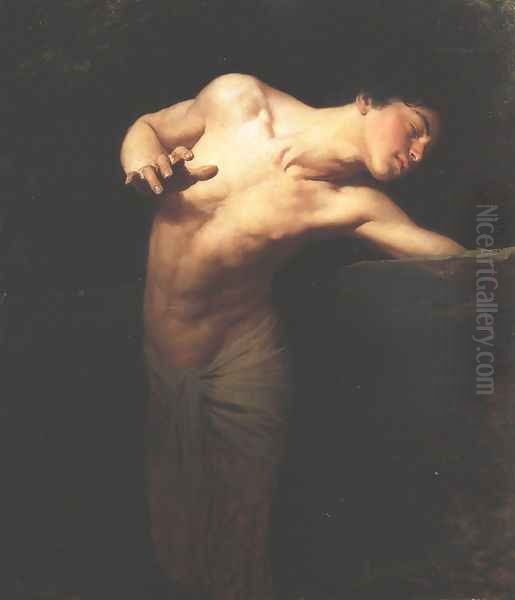
While less dominant than his historical works, Benczúr also engaged with religious and mythological themes. He created altarpieces, such as for St. Stephen's Basilica in Budapest, and other religious compositions that demonstrated his versatility and his ability to convey spiritual devotion and divine majesty. His mythological paintings often drew from classical antiquity, allowing him to explore themes of beauty, love, and heroism in a more allegorical vein, often showcasing his skill in depicting the human form and dynamic compositions. Works like Narcissus fall into this category, showcasing a more lyrical and sensual side to his art.
Masterpieces: Defining Works of Gyula Benczúr
Two monumental paintings stand out as quintessential examples of Benczúr's mastery in historical painting: The Baptism of Vajk and The Recapture of Buda Castle.
The Baptism of Vajk (1875)
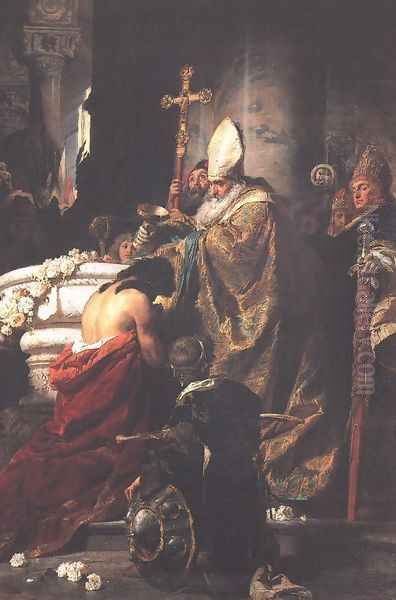
Completed in 1875, The Baptism of Vajk (also known as The Baptism of St. Stephen) is widely considered one of the seminal works in Hungarian art history. The painting depicts the baptism of Vajk, who would become Stephen I, the first Christian King of Hungary, an event of profound significance marking Hungary's conversion to Christianity and its alignment with Western Europe. The scene is rendered with immense solemnity and grandeur.
Benczúr's composition is masterful, focusing on the central figures of Vajk and the officiating clergy, surrounded by an assembly of nobles and attendants. The use of light is particularly striking, with a divine radiance illuminating the key participants, creating a strong contrast with the darker, richly detailed surroundings. The colors are opulent, with gold and crimson predominating, enhancing the regal and sacred atmosphere. Each figure is carefully individualized, their expressions conveying a range of emotions from piety to awe. The meticulous attention to historical costume and ecclesiastical regalia adds to the painting's authenticity and visual splendor. This work is housed in the Hungarian National Gallery in Budapest and remains a powerful symbol of Hungarian national and religious identity.
The Recapture of Buda Castle (1896)
Another monumental achievement is The Recapture of Buda Castle, completed in 1896 for the millennial celebrations of the Hungarian Conquest. This vast canvas depicts the dramatic moment in 1686 when the united Christian forces, including Hungarian troops, liberated Buda Castle from Ottoman rule after nearly 150 years of occupation. The painting is a dynamic and heroic portrayal of a pivotal victory in Hungarian history.
Benczúr fills the canvas with a swirling vortex of action: soldiers storming the ramparts, flags waving, and the chaos of battle vividly portrayed. The composition leads the eye towards the triumphant figures planting the Christian standard on the recaptured fortress. The artist's skill in rendering human anatomy in motion, the glint of armor, and the expressions of exertion and triumph is evident throughout. The painting is not just a historical record but an epic celebration of national valor and liberation. Like The Baptism of Vajk, this masterpiece is also a prized possession of the Hungarian National Gallery and serves as a potent reminder of a significant chapter in the nation's past.
Benczúr as an Educator: The Benczúr Master School
Beyond his own artistic production, Gyula Benczúr made a lasting contribution to Hungarian art as an educator. After achieving considerable success in Munich, where he himself became a professor at the Academy in 1876, he was invited back to Hungary. In 1883, he returned to Budapest to become a leading figure in the newly established system of art education. He was appointed director of the Master School for Painting (Benczúr Mesteriskola), a prestigious institution designed to provide advanced training to the most talented young artists.
He headed this master school until his death, shaping a generation of Hungarian painters. His teaching methods, rooted in the academic traditions he had absorbed in Munich, emphasized strong draughtsmanship, thorough knowledge of anatomy, and a disciplined approach to composition and color. Among his many students were artists who would go on to make their own significant contributions, including the American Impressionist Theodore Clement Steele, who studied with him briefly in Munich, the Swiss-born American portraitist Adolfo Müller-Ury, and Hungarian painters like Gyula Tornai. His daughters, Olga, Ida, and Elza Benczúr, also became artists, likely benefiting from his direct guidance. His influence extended the academic tradition in Hungary, though new artistic currents like Impressionism and Post-Impressionism, championed by artists such as Pál Szinyei Merse and the Nagybánya school artists like Károly Ferenczy, were also emerging and offering alternative paths.
Connections with Contemporaries
Throughout his career, Benczúr interacted with numerous leading artists of his time. In Munich, his primary mentor was Karl von Piloty, but he would have been aware of and likely interacted with other members of the Munich School. In Hungary, he was a contemporary of other major figures in 19th-century Hungarian art. Mihály Munkácsy, perhaps the most internationally famous Hungarian painter of the era, was known for his dramatic realism and depictions of peasant life and biblical scenes, offering a different but equally powerful vision. Bertalan Székely was another key figure in historical painting, slightly older than Benczúr, who also contributed significantly to the national romantic style. Károly Lotz, renowned for his monumental frescoes and allegorical paintings, was another prominent contemporary.
While Benczúr represented the pinnacle of academic historical painting, he was also aware of other artistic developments. He maintained connections with artists like Miklós Barabás, a leading figure in Biedermeier portraiture and lithography from an earlier generation, and Mihály Zichy, known for his romantic illustrations and paintings. He also had interactions with artists like Leopold Horowitz, a successful portrait painter of Jewish origin. These connections, whether as teacher, colleague, or respected master, placed Benczúr at the heart of the Hungarian art world.
International Recognition and Later Life
Gyula Benczúr's talent did not go unnoticed beyond Hungary and Germany. He received numerous accolades throughout his career, including a gold medal at the Paris Salon and awards at international exhibitions in Vienna, Berlin, and Munich. He was commissioned to paint portraits for European royalty, including King Ludwig II of Bavaria, who was a significant patron of the arts. These commissions and awards solidified his international reputation as a leading academic painter.
In his later years, Benczúr continued to paint and teach, remaining a highly respected figure in Hungarian cultural life. He built a villa with a studio in Bajza Street in Budapest, which became a cultural hub. Later, he established a summer residence and studio in Dolány (now Ambach, Germany), where he could work in a more tranquil environment. His dedication to his art and his students remained unwavering. He witnessed significant political and social changes in Hungary, including the period of the Austro-Hungarian Monarchy and the lead-up to World War I. His art, however, largely remained focused on the grand narratives of the past and the timeless elegance of portraiture.
Gyula Benczúr passed away on July 16, 1920, in Dolány (some sources state June 17, 1920, or generally 1920 at age 76), leaving behind a rich legacy. His death marked the end of an era for Hungarian academic painting.
Legacy and Benczúr's Works in Collections
Gyula Benczúr's legacy is multifaceted. As a painter, he created some of the most iconic images in Hungarian art, works that continue to be celebrated for their technical brilliance and their powerful evocation of historical and national themes. His influence as a teacher was profound, shaping the skills and artistic outlook of many younger artists. He played a crucial role in establishing and upholding the standards of academic art in Hungary at a time when the nation was forging its modern cultural identity.
Today, Benczúr's works are held in major public and private collections. The Hungarian National Gallery in Budapest houses the most significant collection of his masterpieces, including The Baptism of Vajk and The Recapture of Buda Castle, as well as numerous portraits and other historical paintings. The Nyíregyháza Museum, in his birth region, also holds works by him, including the painting Amora and a plaster statue of the artist. The Budapest History Museum also includes his works in its collection.
His paintings occasionally appear at international auctions, often commanding high prices, a testament to his enduring appeal and historical importance. Works like Narcissus and studies for his larger compositions can be found in various collections, offering insights into his working methods. The discovery of paintings like Mátyás and Beatrix in museum storage, later exhibited, highlights the ongoing interest in his oeuvre.
While artistic tastes have evolved since Benczúr's heyday, and new movements have taken center stage, his contribution to Hungarian and European art remains undeniable. He was a master of his craft, a chronicler of his nation's history, and a dedicated educator whose influence resonated for decades. His grand, dramatic, and meticulously rendered canvases continue to captivate audiences, offering a window into the artistic and cultural aspirations of 19th-century Hungary. His work stands alongside that of other great European academic painters of the era, such as Jean-Léon Gérôme in France or Lawrence Alma-Tadema in Britain, who similarly combined technical virtuosity with compelling subject matter.
Gyula Benczúr's art is a testament to the power of painting to shape collective memory and national identity, and his name remains synonymous with the golden age of Hungarian historical art.