Gaspar van Wittel: A Dutch Eye on the Italian Panorama
Gaspar van Wittel, known in Italy as Gaspare Vanvitelli, stands as a pivotal figure in the history of European landscape painting. Born in the Netherlands, he transplanted his Northern European precision and observational skills to the sun-drenched landscapes and bustling cityscapes of Italy, effectively becoming one of the founding fathers of the veduta (view painting) genre. His meticulous depictions of Rome, Naples, Venice, and other Italian locales not only captured the imagination of his contemporaries but also laid a crucial groundwork for succeeding generations of view painters, most notably Canaletto and Francesco Guardi. This exploration delves into the life, art, and enduring legacy of an artist who masterfully bridged Dutch topographical traditions with the burgeoning Italian taste for scenic representation.
The Formative Years and Dutch Heritage
The precise year of Gaspar van Wittel's birth is subject to some scholarly debate, with sources pointing to either 1652 or 1653. He was born in Amersfoort, a city in the province of Utrecht in the Netherlands. His original Dutch name was Caspar Adriaensz van Wittel. His early artistic training was rooted in the rich traditions of Dutch Golden Age painting. He is believed to have studied with Matthias Withoos, a painter known for his detailed still lifes, woodland scenes, and townscapes, often imbued with a sense of quiet observation. This apprenticeship would have instilled in Van Wittel a keen eye for detail, a mastery of perspective, and a dedication to rendering textures and light with accuracy – hallmarks that would later define his Italian vedute.
The artistic environment in the Netherlands during the mid-17th century was vibrant. Artists like Jan van Goyen and Salomon van Ruysdael had already established a strong tradition of landscape painting, while cityscape painters such as Jan van der Heyden were achieving remarkable feats of realism in their depictions of Dutch towns. Though Van Wittel would eventually make his name in a different country and with a slightly different focus, the Dutch emphasis on empirical observation and faithful representation of the visible world undoubtedly shaped his artistic outlook. He also would have been aware of the "Italianates," Dutch painters like Jan Both, Nicolaes Berchem, and Karel Dujardin, who travelled to Italy and brought back sunlit landscapes that were highly popular in the North.
The Journey to Italy and Roman Beginnings
Around 1674, at the age of approximately 21 or 22, Van Wittel made the momentous decision to travel to Italy, a common pilgrimage for Northern European artists seeking classical inspiration and new opportunities. He settled in Rome, a city that was then a magnet for artists from all over Europe. Rome, with its ancient ruins, baroque churches, and bustling piazzas, offered an inexhaustible supply of subjects. It was here that he Italianized his name to Gaspare Vanvitelli, and sometimes he was affectionately nicknamed "Gaspar degli Occhiali" (Gaspar of the Spectacles) in his later years, likely due to his failing eyesight and reliance on glasses.
Upon his arrival, Van Wittel initially found work with fellow Dutchman Cornelis Meyer, an hydraulic engineer involved in projects to survey and tame the Tiber River. This employment, while not directly artistic in the traditional sense, proved invaluable. It required him to create precise topographical drawings and plans, further honing his skills in perspective and accurate spatial representation. These technical drawings were a precursor to his later vedute, emphasizing clarity and detailed documentation of the landscape and urban environment. He became a member of the "Schildersbent" or "Bentvueghels," a society of mostly Dutch and Flemish artists active in Rome, known for their bohemian lifestyle and mutual support.
His talent did not go unnoticed for long. He began to collaborate with other artists, such as the Flemish painter Abraham Genoels, known for his classical landscapes. Van Wittel would often paint the staffage (human figures and animals) in the works of other landscape painters, a common practice at the time. However, his true calling lay in the independent creation of city views.
Pioneering the Veduta
While topographical views existed before Van Wittel, he is widely credited with transforming them into a distinct and popular genre in Italy. The veduta as developed by Van Wittel was more than just a map-like representation; it was a carefully composed, aesthetically pleasing depiction of a recognizable place, often enlivened with anecdotal details of daily life. He brought a Northern European sensibility for meticulous detail and atmospheric effect to Italian subjects.
His method often involved the use of a camera obscura, an optical device that projected an image of the surroundings onto a surface, which could then be traced. This tool helped him achieve the remarkable accuracy in perspective and architectural detail that characterizes his work. However, his paintings were not mere mechanical reproductions. He skillfully manipulated compositions, adjusted lighting, and carefully selected viewpoints to create harmonious and engaging images. His views are typically wide-angled, offering panoramic vistas that capture the grandeur and specificity of the location. The light in his paintings is often clear and cool, meticulously rendering shadows and reflections, a contrast to the often warmer, more idealized light of some of his Italian contemporaries.
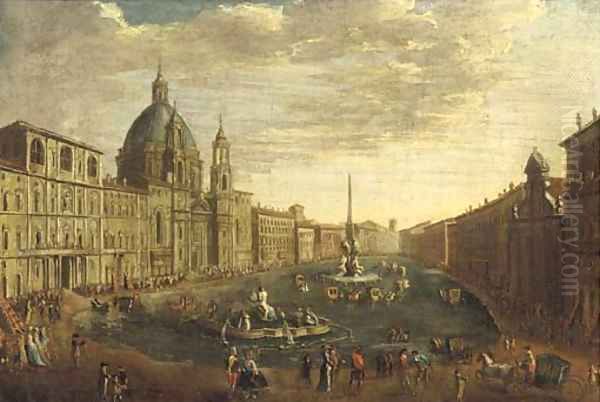
His early Roman vedute, dating from the 1680s, quickly found favor with both Italian patrons and foreign visitors on the Grand Tour, who desired sophisticated souvenirs of their travels. Works like his views of the Piazza Navona, Piazza del Popolo, and the Castel Sant'Angelo became iconic.
Masterpieces and Signature Works
Gaspar van Wittel's oeuvre is extensive, with numerous views of Rome, Naples, Venice, and other Italian cities and their environs. Several works stand out as particularly representative of his style and influence.
Views of Rome:
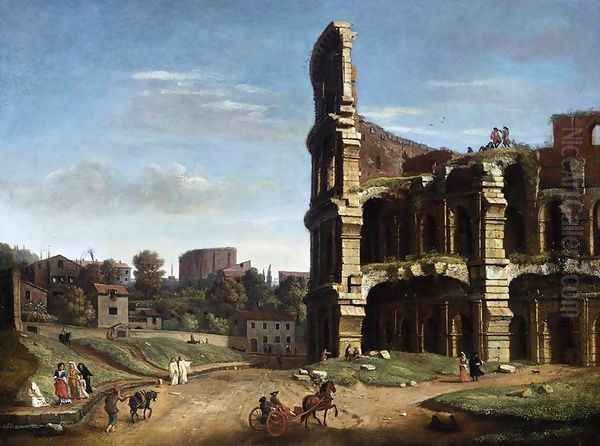
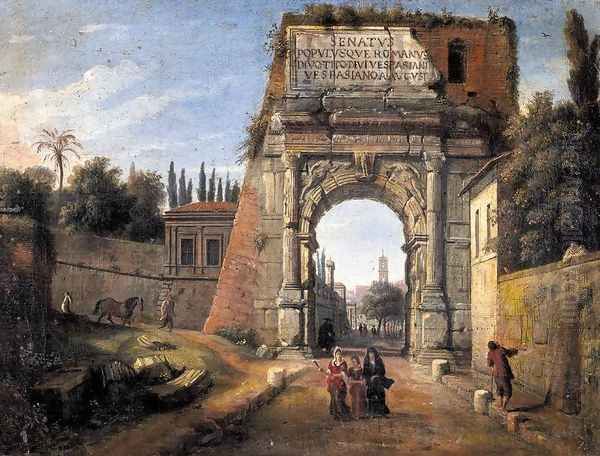
His depictions of Rome are perhaps his most famous. Piazza Navona, Rome (many versions exist) captures the vibrant life of the famous square, with Bernini's Fountain of Four Rivers as its centerpiece, surrounded by meticulously rendered palaces and churches. The Colosseum, Rome showcases the ancient amphitheater, often with surrounding ruins and contemporary figures, highlighting the passage of time. Panoramic View of St. Peter's Basilica, Rome is another subject he returned to multiple times, depicting the basilica and its grand piazza from various angles, always with an eye for architectural grandeur and spatial depth. The Arch of Titus is a fine example of his focus on specific ancient monuments within their urban context.
Views of Naples and its Bay:
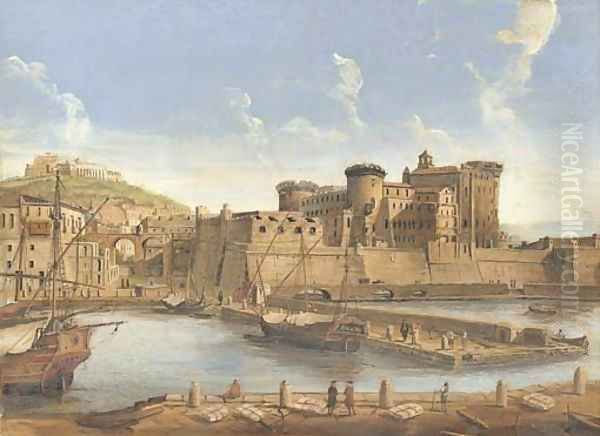
Van Wittel spent considerable time in Naples, particularly between 1699 and 1602, under the patronage of the Spanish Viceroy, the Duke of Medinaceli. His Neapolitan views are celebrated for their luminous quality and expansive scope. The Harbour of Naples (also in several versions) often shows the bustling port with Mount Vesuvius smoking in the distance, capturing the unique atmosphere of the city. Grotta di Pozzuoli (Grotto of Pozzuoli), depicting a Roman tunnel near Naples, was a popular subject, appealing to the era's interest in classical antiquity and picturesque landscapes. These works often feature a bright, clear light reflecting off the water, showcasing his skill in rendering maritime scenes.
Venetian Vedute:
Although perhaps less numerous than his Roman or Neapolitan scenes, Van Wittel also produced stunning views of Venice, such as depictions of the Bacino di San Marco and the Grand Canal. These works predate the famous Venetian vedutisti like Canaletto and Michele Marieschi, and it is highly probable that his Venetian scenes influenced Luca Carlevaris, who is often considered the first major Venetian view painter of the 18th century. Van Wittel’s Venetian works exhibit his characteristic precision and clarity, capturing the unique interplay of light, water, and architecture in La Serenissima.
His paintings are characterized by their elongated horizontal format, a high viewpoint that allows for a deep recession into space, and a meticulous rendering of architectural details. The staffage, though small, is always lively and well-observed, adding a sense of everyday reality to the scenes. He often depicted markets, processions, and ordinary people going about their business, making his cityscapes vibrant documents of 18th-century urban life.
Contemporaries and Artistic Milieu
Van Wittel did not work in a vacuum. His career in Italy spanned a period of rich artistic exchange. In Rome, he was part of a thriving community of Northern artists. Besides his early teacher Matthias Withoos and collaborator Abraham Genoels, other Dutch and Flemish artists like Jan Frans van Bloemen (nicknamed "Orizzonte"), known for his classical landscapes, and Hendrik Frans van Lint (nicknamed "Studio"), who also specialized in vedute, were active during his time. The influence of earlier Dutch Italianates like Jan Both and Cornelis van Poelenburgh, who had established a tradition of depicting Italian landscapes with a Northern sensibility, would also have been part of the artistic air he breathed.
The Italian artistic scene was equally vibrant. While Van Wittel was pioneering his detailed vedute, other forms of landscape painting were also popular. The idealized, classical landscapes of Claude Lorrain (who died in 1682, shortly after Van Wittel's arrival in Rome) and Gaspard Dughet continued to be influential. In the realm of architectural painting, Viviano Codazzi had earlier created capricci (architectural fantasies) and perspective views that shared some common ground with the developing veduta genre.
Van Wittel’s innovation lay in his systematic and highly detailed approach to depicting actual, recognizable city views. His success undoubtedly spurred on other artists. Luca Carlevaris in Venice, as mentioned, likely took cues from Van Wittel. Later, the great Venetian masters Giovanni Antonio Canal, known as Canaletto, and Bernardo Bellotto, would elevate the veduta to new heights of popularity and artistic refinement. While Canaletto developed a more luminous and atmospheric style, particularly in his Venetian scenes, the foundation of precise observation and topographical accuracy laid by Van Wittel is undeniable. Francesco Guardi, another Venetian, would later take the veduta in a more impressionistic and romantic direction.
In Naples, artists like Antonio Joli, who also painted vedute and worked for the Bourbon court, followed in the tradition that Van Wittel helped establish there. Giovanni Paolo Panini, active in Rome, became famous for his views of Roman antiquities and picture galleries, often with a more dramatic and monumental flair than Van Wittel, but sharing the same interest in depicting the city's splendors. The demand for such views was fueled by the Grand Tour, and Van Wittel was perfectly positioned to cater to this market.
Later Life, Challenges, and Family
Gaspar van Wittel enjoyed a long and successful career. He married Anna Lorenzani in Rome in 1697, and they had several children. One of his sons, Luigi Vanvitelli (1700–1773), became one of the most important Italian architects of the 18th century. Luigi is best known for designing the magnificent Royal Palace of Caserta near Naples, a colossal Baroque structure that rivaled Versailles. This familial connection to high-profile architectural projects further cemented the Van Wittel/Vanvitelli name in Italian cultural history.
Despite his success, Van Wittel faced challenges in his later years. As previously mentioned, his eyesight began to fail, which inevitably impacted his productivity and possibly the meticulousness of his very late works. The nickname "Gaspar degli Occhiali" suggests this was a known aspect of his later persona. He also experienced personal tragedy, including the death of his wife. He continued to paint, however, often revisiting popular compositions and relying on earlier drawings and studies.
He remained based primarily in Rome for most of his life, though he undertook significant journeys to Naples, Florence, Bologna, Venice, and other Italian cities, always sketching and gathering material for his paintings. His reputation was such that he received commissions from prominent Italian noble families, including the Colonna, Odescalchi, and Sacchetti, as well as from foreign dignitaries and collectors.
Gaspar van Wittel died in Rome on September 13, 1736, and was buried in the church of Santa Maria in Camposanto, near St. Peter's Basilica. He left behind a substantial body of work that had already profoundly influenced the course of landscape painting in Italy.
Legacy and Enduring Influence
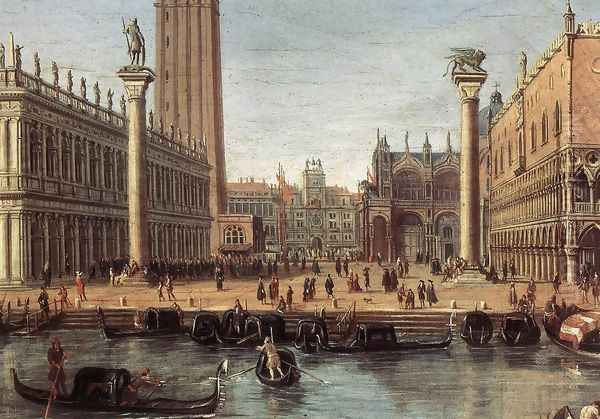
Gaspar van Wittel's primary legacy lies in his role as a key progenitor of the Italian veduta. He successfully fused the Dutch tradition of precise topographical rendering with the grandeur and picturesque qualities of Italian cityscapes. His paintings offered a new way of seeing and representing the urban environment, one that appealed to both the scientific interest in accuracy and the aesthetic appreciation for well-composed, detailed views.
His influence on subsequent generations of vedutisti is undeniable. Artists like Canaletto, Bellotto, and Carlevaris built upon the foundations he laid, each developing their own distinct styles but sharing a common debt to Van Wittel's pioneering approach. His use of the camera obscura became a standard tool for many view painters seeking perspectival accuracy.
Beyond his direct influence on painters, Van Wittel's works serve as invaluable historical documents. His detailed depictions of cities like Rome and Naples in the late 17th and early 18th centuries provide a vivid record of their appearance before later transformations. They capture not only the architecture but also the daily life, costumes, and customs of the period.
Art historians continue to study Van Wittel's work, appreciating his technical skill, his compositional intelligence, and his unique position as a Northern artist who profoundly shaped an Italian genre. His paintings are held in major museums and private collections around the world, including the Uffizi Gallery in Florence, the Museo di Roma, the National Gallery in London, and the Metropolitan Museum of Art in New York.
While some earlier critics might have found his work somewhat dry or less "spirited" compared to the more painterly Venetian school, contemporary appreciation recognizes the unique strengths of his style: the clarity of his vision, the precision of his hand, and the serene, almost crystalline quality of his light. He was a master of observation, a meticulous craftsman, and an artist who saw the poetry in the precise rendering of the world around him. Gaspar van Wittel, the Dutchman who became Gaspare Vanvitelli, remains a crucial link between Northern European realism and the Italian tradition of landscape and cityscape painting, an artist whose views continue to transport us to the Italy of centuries past.