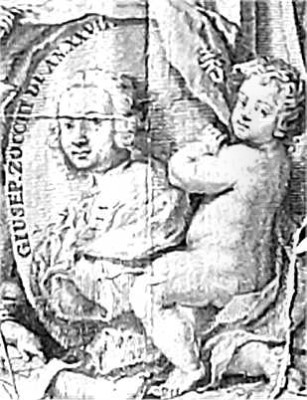
Giuseppe Zocchi (1711-1767) stands as a significant figure in the constellation of 18th-century Italian art, a painter and printmaker whose meticulous depictions of Florence and the Tuscan landscape have provided an invaluable visual record of his era. Born in Florence, or perhaps nearby Fiesole, Zocchi's artistic journey was shaped by the rich cultural heritage of his native city and the broader artistic currents sweeping across Italy and Europe. His legacy is primarily anchored in his exquisite vedute, or view paintings, which captured not only the architectural grandeur of Florence but also the idyllic charm of its surrounding villas and countryside.
Early Life and Artistic Formation
Zocchi's initial artistic training took place in Florence, a city still basking in the afterglow of its Renaissance zenith and alive with the flourishing Baroque and emerging Rococo styles. Details of his earliest teachers remain somewhat obscure, but it is known that his talent was recognized early on by the Marchese Andrea Gerini, a prominent Florentine nobleman and connoisseur. Gerini became Zocchi's most important patron, providing the financial support necessary for the young artist to broaden his horizons and refine his skills.
Under Gerini's aegis, Zocchi embarked on an extensive study tour, a common practice for aspiring artists of the period, though his was particularly comprehensive. He traveled to Rome, the epicenter of classical antiquity and Baroque splendor, where he would have undoubtedly studied the works of masters of architectural painting and landscape. His journeys also took him to Bologna, a center of academic art theory and practice, and to Milan. Crucially, he spent a significant period in Venice, the vibrant maritime republic renowned for its unique cityscape and its flourishing school of veduta painters.
The Venetian Sojourn and its Impact
The time Zocchi spent in Venice proved to be profoundly influential. It was here that he immersed himself in the art of printmaking, particularly etching, a medium that would become central to his most famous achievements. Venice was the undisputed capital of veduta painting, with artists like Canaletto (Giovanni Antonio Canal) and Francesco Guardi capturing its luminous atmosphere and intricate waterways. Zocchi was particularly drawn to the work of Michele Marieschi and Bernardo Bellotto.
Marieschi, known for his spirited and somewhat theatrical vedute, offered a model of dynamic compositions and lively brushwork. Bellotto, Canaletto's nephew and a formidable vedutista in his own right, was celebrated for his precise rendering of architectural detail and his often cooler, more analytical light. Studying their paintings and, importantly, their etchings, Zocchi absorbed the techniques and aesthetic principles of the Venetian school. This included a mastery of perspective, an ability to handle complex architectural forms, and a sensitivity to the interplay of light and shadow in urban environments. He learned how to populate his scenes with small, lively figures (staffage) that added a sense of daily life and scale to his views.
Return to Florence and the Grand Projects
Upon his return to Florence, Zocchi was well-equipped to undertake ambitious projects. His patron, Marchese Gerini, conceived of a monumental undertaking: to create a comprehensive visual record of Florence's principal landmarks and the most beautiful villas in Tuscany. This resulted in Zocchi's magnum opus, a series of prints that would secure his lasting fame.
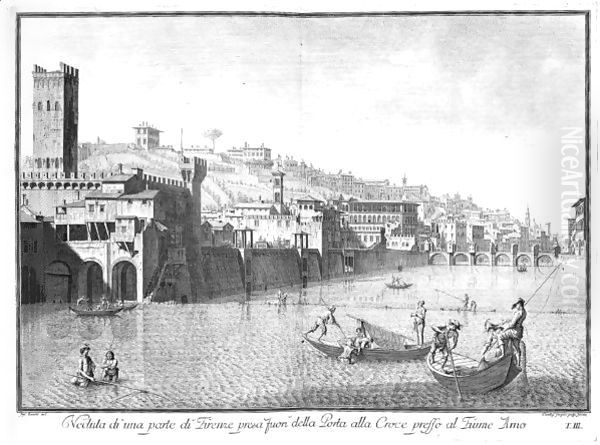
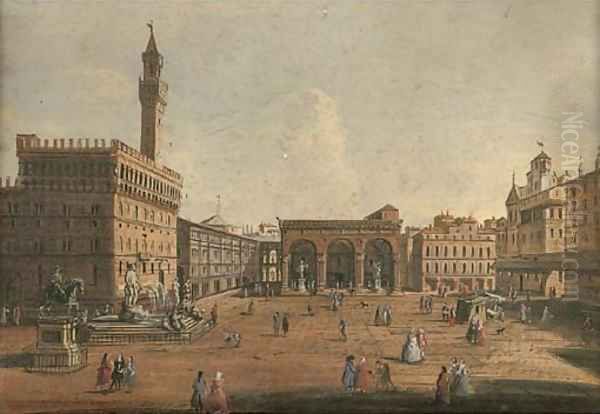
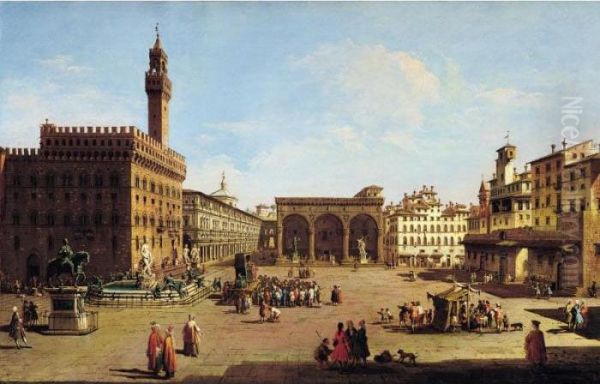
In 1744, two seminal sets of engravings based on Zocchi's original drawings and paintings were published. The first was Scelta XXIV vedute delle principali contrade, piazze, chiese, e palazzi della citta di Firenze (Selection of 24 Views of the Principal Districts, Squares, Churches, and Palaces of the City of Florence). This collection offered an unparalleled panorama of the city, from the bustling Piazza della Signoria to the serene banks of the Arno River, capturing iconic structures like the Duomo, the Ponte Vecchio, and the Palazzo Pitti.
The second set, published concurrently, was Vedute delle ville e d'altri luoghi della Toscana (Views of Villas and of Other Places in Tuscany). This series comprised fifty engravings and showcased the elegant country estates and picturesque landscapes that dotted the Tuscan countryside. Together, these two series formed an extraordinary visual archive, documenting the architectural and natural beauty of Florence and its environs with remarkable accuracy and artistic grace. The original drawings and many of the prints are now prized possessions of institutions like the Pierpont Morgan Library in New York.
A team of skilled engravers, including Johann Sebastian Müller (John Miller), Giuseppe Benedetti, Pietro Monaco, Charles Joseph Flipart, and Giovanni Battista Piranesi (though Piranesi's involvement was more as an etcher for some plates rather than a direct collaborator on the entire series under Zocchi's supervision for these specific sets), worked to translate Zocchi's detailed drawings and paintings into the printed medium, ensuring a wide dissemination of his vision.
Artistic Style and Techniques
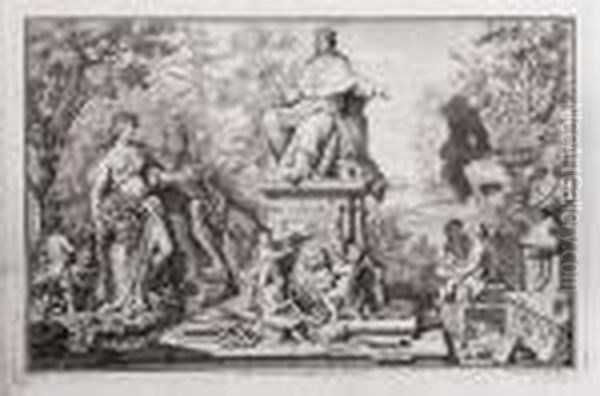
Zocchi's style is characterized by its clarity, precision, and an underlying elegance that aligns with the Rococo sensibilities of the mid-18th century. While influenced by the Venetian vedutisti, his work retains a distinctly Florentine character, perhaps a touch more restrained and focused on topographical accuracy than the often more atmospheric or theatrical Venetian views.
His cityscapes are meticulously rendered, with a keen eye for architectural detail. He employed a sophisticated understanding of linear perspective to create convincing spatial depth, often choosing viewpoints that offered expansive vistas or highlighted the harmonious arrangement of buildings. Unlike the sometimes starkly dramatic compositions of Giovanni Battista Piranesi, whose Roman views often emphasized the monumental and the sublime, Zocchi's Florentine scenes are typically bathed in a clear, even light, conveying a sense of order and civic pride.
His landscapes and villa views demonstrate a similar attention to detail combined with a lyrical appreciation for the Tuscan countryside. He captured the gentle rolling hills, the characteristic cypress trees, and the harmonious integration of architecture and nature. In works like La Real Villa del Poggio a Caiano, he not only depicted the grandeur of the villa itself but also its setting within the broader landscape, often including scenes of aristocratic leisure or rural life.
While the term "Rococo" is often associated with the more flamboyant decorative arts of France, its influence can be seen in Zocchi's work in the graceful lines, the delicate rendering of foliage, and the overall sense of lightness and charm that pervades his compositions. There's a refinement and a sophisticated ease that distinguishes his art from the weightier drama of the High Baroque. His style shows an independent streak, even when drawing from artists like Giovanni Paolo Panini, who was renowned for his depictions of Roman ruins and capricci (architectural fantasies). Zocchi’s work, while sometimes featuring classical elements, generally leaned towards a more direct representation of the existing world, though imbued with his characteristic elegance.
Zocchi and the Pietre Dure Workshops
Beyond his paintings and prints, Zocchi also made significant contributions to the celebrated Florentine tradition of pietre dure (hardstone mosaic). He provided designs and cartoons for the Grand Ducal workshops, the Opificio delle Pietre Dure, which specialized in creating intricate inlaid pictures and decorative objects from precisely cut and fitted pieces of semi-precious stones.
His landscape and cityscape designs were particularly well-suited for translation into this demanding medium. The clarity of his compositions and his skill in rendering architectural and natural forms provided excellent models for the pietre dure artisans. Some of his etchings were specifically adapted for use in creating these luxurious objects, some of which were destined for high-ranking patrons, including Francis I, Holy Roman Emperor (formerly Francis Stephen, Grand Duke of Tuscany), for whom Zocchi designed game boards executed in pietre dure and sent to Vienna. This involvement underscores Zocchi's versatility and his engagement with different facets of Florentine artistic production.
Decorative Works and Other Commissions
Zocchi was not solely a veduta painter or printmaker. He also undertook decorative commissions, including frescoes and oil paintings for palaces and churches. He is known to have worked on decorative schemes in Florence, and his talents were also sought in other cities, such as Siena and Rome, where he created murals and easel paintings.
These decorative works often displayed a lighter, more Rococo sensibility, incorporating allegorical figures, ornamental motifs, and illusionistic architectural elements. While perhaps less famous than his vedute, these projects demonstrate the breadth of his artistic skills and his ability to adapt his style to different contexts and requirements. There is evidence of his involvement in projects that showcased the opulent interiors of the time, including depictions of Italian courtly porcelain rooms, rendered with a symmetrical composition and delicate brushwork that highlighted the Rococo aesthetic.
Anecdotes and Lesser-Known Facets
While Zocchi is celebrated for his published prints, some aspects of his career are less widely known. His early and extensive travels, funded by Gerini, were not just about learning printmaking in Venice but also about absorbing the artistic traditions of Rome, Bologna, and Milan, which collectively enriched his visual vocabulary.
His connection with the world of luxury crafts, particularly porcelain decoration and pietre dure, suggests an artist attuned to the refined tastes of his patrons and the broader decorative trends of the 18th century. This interaction between the "fine arts" of painting and the "decorative arts" was characteristic of the period.
There are also indications of ambitious projects that remained unrealized, such as a plan to create frescoes for the gallery of the Villa Medici. Such unfulfilled commissions are common in the lives of many artists but hint at the scope of Zocchi's ambitions and reputation.
His artistic style, while rooted in Italian traditions, also resonated with, and perhaps even influenced, trends in Northern European landscape painting. His meticulous yet picturesque views offered a model that could be appreciated and adapted by artists beyond Italy, contributing to the broader European fascination with Italian scenery, a fascination fueled by the Grand Tour.
Collaborations and Artistic Milieu
Zocchi operated within a vibrant artistic community. His collaboration with a team of engravers for his major print series was essential for their success. Artists like Joseph Wagner, a prominent publisher and engraver in Venice, also played a role in the dissemination of vedute, and Zocchi would have been aware of such networks.
His relationship with Marchese Andrea Gerini was clearly pivotal, but he also interacted with other connoisseurs and artists. For instance, he is known to have painted a small portrait of Gerini, and his Venetian period likely brought him into contact with figures such as Antonio Maria Zanetti the Elder, a noted critic, engraver, and collector who was a significant figure in Venetian artistic circles.
The influence of earlier masters of landscape and architectural painting, such as Gaspar van Wittel (Vanvitelli), who was a pioneer of veduta painting in Rome, or even Viviano Codazzi, known for his architectural perspectives, formed part of the artistic heritage upon which Zocchi and his contemporaries built. While Zocchi developed his own distinct style, he was part of an evolving tradition. His work can be seen as a Florentine counterpart to the Venetian vedute of Canaletto, Bellotto, and Guardi, and to the Roman views of Panini and Piranesi, each artist contributing to the rich tapestry of 18th-century Italian view painting. He also shares some common ground with French landscape and cityscape painters of the era, such as Claude Joseph Vernet, known for his seascapes and landscapes, or Hubert Robert, famed for his picturesque views of ruins.
Specific Masterpieces and Their Significance
The Scelta XXIV vedute and the Vedute delle ville remain Zocchi's crowning achievements. These collections are more than just beautiful pictures; they are invaluable historical documents. They preserve a vision of Florence and Tuscany at a specific moment in time, before the significant urban and social changes of the 19th and 20th centuries. Architectural historians, urban planners, and social historians turn to Zocchi's prints for insights into the 18th-century city and countryside.
Individual plates from these series are masterpieces of composition and detail. For example, his view of the Piazza del Duomo in Florence meticulously captures the Baptistery, Giotto's Campanile, and the facade of the Cathedral, bustling with the daily life of the city. His depiction of the Ponte Santa Trinita offers a graceful perspective of the bridge and the Arno, with elegant figures promenading along its banks.
In the villa series, views like that of the Villa di Pratolino (though by then largely altered from its original Medici splendor) or the Villa La Petraia convey the grandeur and charm of these aristocratic retreats, often set within carefully designed gardens and expansive landscapes. Zocchi’s ability to capture both the man-made and natural elements with equal finesse is a hallmark of these works.
The Broader Context: Zocchi and 18th-Century European Art
Zocchi's career unfolded during a period of significant cultural exchange across Europe, largely facilitated by the Grand Tour. Wealthy young aristocrats and intellectuals, primarily from Britain but also from other Northern European countries, traveled to Italy to experience its classical heritage and contemporary culture. This created a fervent demand for souvenirs, particularly vedute, which served as mementos of their travels.
Zocchi's prints, being more affordable and portable than large oil paintings, catered perfectly to this market. His works helped to shape the perception of Florence and Tuscany for a wider European audience, contributing to the romanticized image of Italy that persisted for generations. Artists like Richard Wilson, a Welsh landscape painter, were profoundly influenced by their time in Italy, and the availability of prints by artists like Zocchi would have further disseminated Italianate landscape conventions.
His work also reflects the Enlightenment's interest in empirical observation and documentation. While artistically composed, his views possess a high degree of topographical accuracy, aligning with the era's burgeoning scientific spirit and its desire to catalogue and understand the world. This "rationalization" of landscape, presenting it in a clear, ordered, and detailed manner, was a characteristic feature of much 18th-century view painting.
Legacy and Enduring Importance
Giuseppe Zocchi died in Florence in 1767. His most significant legacy lies in his comprehensive and artistically accomplished visual record of Florence and Tuscany. His prints continue to be admired for their technical skill, their aesthetic appeal, and their historical value. They offer a window into the world of 18th-century Tuscany, capturing its architectural splendors, its serene landscapes, and the daily life of its inhabitants.
His influence extended to subsequent generations of artists, both Italian and foreign, who continued the tradition of veduta painting or drew inspiration from his meticulous approach to landscape and cityscape. The fact that his works were copied and reissued indicates their popularity and enduring appeal.
In the realm of pietre dure, his designs contributed to the prestige of this uniquely Florentine art form. His ability to translate complex scenes into effective cartoons for mosaic work demonstrates his versatility and his understanding of different artistic media.
Today, Zocchi is recognized as one of the foremost Italian vedutisti of the 18th century. While perhaps not as universally famous as Canaletto or Piranesi, his contribution to the genre, particularly his focus on Florence and Tuscany, is unique and invaluable. His works are sought after by collectors and are essential resources for scholars studying the art, architecture, and social history of 18th-century Italy. He masterfully combined precision with Rococo elegance, creating a body of work that continues to delight and inform. His views are not merely topographical records but are imbued with an artistic sensibility that captures the timeless beauty of a region that has captivated visitors for centuries.