Dominicus van Tol, a notable painter of the Dutch Golden Age, carved out a career primarily in Leiden, working within the esteemed tradition of the fijnschilders, or "fine painters." Born into an era of unprecedented artistic flourishing in the Netherlands, Van Tol's life and work are intrinsically linked to his famous uncle and mentor, Gerard Dou. While often viewed through the lens of Dou's immense influence, Van Tol developed a distinct, albeit related, artistic voice, contributing his own nuanced interpretations of genre scenes that captivated the Dutch art market. His paintings, characterized by meticulous detail, subtle narratives, and a refined handling of light and texture, offer a valuable window into seventeenth-century Dutch life and artistic practices.
Early Life and Artistic Formation in Leiden
Dominicus van Tol is believed to have been born in Leiden around 1635. His familial background was rooted in the professional class rather than an established artistic dynasty; his father, grandfather, and at least one brother were notaries public. His mother, however, was the daughter of a glassmaker, perhaps providing an early, albeit indirect, connection to the world of craftsmanship. This upbringing in Leiden, a prominent center for art and learning, would have exposed the young Van Tol to a vibrant cultural environment.
The most significant factor in Van Tol's artistic development was undoubtedly his relationship with Gerard Dou (1613-1675). Dou, himself a pupil of the legendary Rembrandt van Rijn (1606-1669) in Rembrandt's early Leiden period, became the founding father of the Leiden fijnschilder school. Van Tol was not only Dou's nephew but is also widely documented as having been his pupil and assistant in Dou's busy studio. This apprenticeship placed Van Tol at the very heart of the fijnschilder movement, allowing him to absorb its core tenets directly from its leading proponent. The meticulous technique, the preference for small-scale cabinet pictures, and the depiction of intimate domestic scenes that characterized Dou's oeuvre became foundational elements of Van Tol's own artistic language.
In 1664, Dominicus van Tol achieved a significant professional milestone by becoming a member of the Guild of Saint Luke in Leiden. Membership in the guild was essential for artists wishing to practice independently, take on pupils, or sell their work publicly. This indicates that by this time, Van Tol had established himself as a recognized painter in his own right, ready to embark on an independent career.
The Leiden Fijnschilder Tradition and Van Tol's Place Within It
The Leiden fijnschilders were renowned for their extraordinarily detailed and polished style. Gerard Dou pioneered this approach, moving away from the broader, more expressive brushwork of his teacher Rembrandt, towards a technique that emphasized smooth surfaces, imperceptible brushstrokes, and an almost photographic rendering of textures and materials. This style found immense favor with Dutch collectors, who admired the technical virtuosity and the intimate, often charming, subject matter.
Other prominent artists associated with the Leiden fijnschilder school, and thus contemporaries or near-contemporaries whose work Van Tol would have known, included Frans van Mieris the Elder (1635-1681), who was perhaps Dou's most gifted pupil and a master of elegant genre scenes. Pieter Cornelisz van Slingelandt (1640-1691) was another faithful follower of Dou, known for his painstaking detail that sometimes even surpassed his master's. Quiringh Gerritsz van Brekelenkam (c. 1622/1629 - c. 1669/1670), though perhaps less polished than Dou or Mieris, also worked in Leiden, producing lively genre scenes. While artists like Gabriël Metsu (1629-1667) and Jan Steen (1626-1679) also spent time in Leiden and shared an interest in genre subjects, their styles often incorporated a broader handling or a more overtly comical or moralizing tone, distinguishing them somewhat from the core fijnschilder group.
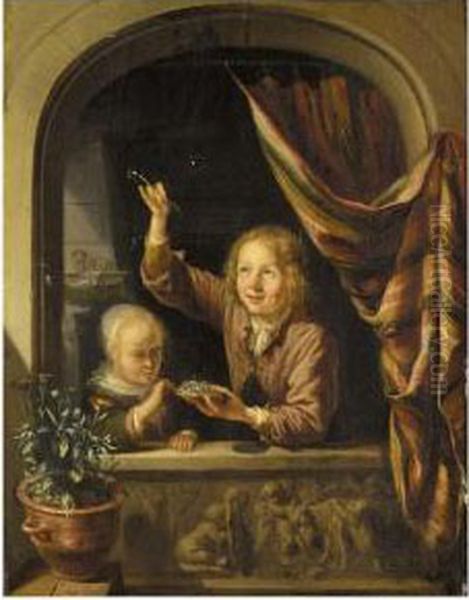
Dominicus van Tol positioned himself firmly within this tradition. His works demonstrate a clear adherence to the fijnschilder aesthetic: carefully composed interior scenes, meticulous attention to the rendering of fabrics, metals, and other materials, and a smooth, enamel-like finish. He frequently adopted themes and compositional devices popularized by Dou, such as figures seen through arched stone windows (a trompe-l'œil motif Dou favored), domestic interiors, and scenes involving children.
Artistic Style, Themes, and Signature Motifs
While deeply indebted to Gerard Dou, Dominicus van Tol was not merely a slavish copyist. Art historians note that his works, while emulating Dou's subjects and meticulousness, often exhibit a slightly different sensibility. Some scholars suggest Van Tol's figures can be somewhat more robust or less idealized than Dou's, and his palette, while rich, might occasionally differ in its specific harmonies. He was particularly adept at capturing the play of light, especially candlelight, a skill highly prized among the fijnschilders and one that Dou himself excelled in. Godfried Schalcken (1643-1706), another of Dou's pupils, would later become particularly famous for his mastery of nocturnal and candlelight scenes, building on this shared interest.
Van Tol's subject matter typically revolved around genre scenes: depictions of everyday life, often with a focus on domestic interiors, women engaged in household tasks, scholars in their studies, and children at play. These seemingly straightforward scenes often carried subtle moralizing or symbolic undertones, a common feature in Dutch Golden Age painting. For instance, motifs like birdcages, mousetraps, or children blowing bubbles could allude to themes of love, temptation, or the transience of life (vanitas).
He often revisited compositions made famous by Dou, sometimes introducing variations in figures, settings, or details. This practice was not uncommon at the time and could be seen as both an homage to his master and an attempt to create new works for a market eager for Dou-like paintings. His skill in emulating Dou's style was such that, for many years, some of Van Tol's works were misattributed to his more famous uncle.
Representative Works: A Closer Look
Several paintings exemplify Dominicus van Tol's style and thematic concerns. Among his most well-known is "Boy with a Mousetrap by Candlelight." This painting, now in the collection of the Dutch National Cultural Heritage Agency, showcases his skill in rendering the effects of artificial light. The scene depicts a young boy, illuminated by a candle, holding a mousetrap. The intense chiaroscuro creates a sense of intimacy and drama. The mousetrap itself was a common motif in Dutch art, often symbolizing the snares of love or other forms of temptation. This particular work was once attributed to Gerard Dou, a testament to Van Tol's ability to master his uncle's style. Its history is also notable as it was one of the artworks looted by the Nazis during World War II and subsequently restituted.
Another significant work is "Children at a Window Blowing Bubbles." This theme, also popular with Dou and other fijnschilders like Frans van Mieris the Elder, uses the motif of bubbles as a vanitas symbol, reminding the viewer of the fragility and brevity of life and earthly pleasures. Van Tol's rendition would typically feature children framed by a stone window, a common trompe-l'œil device, meticulously rendering their expressions and the delicate, iridescent bubbles.
"Children with a Mousetrap" is a variation on the theme seen in the candlelight version, likely a daytime scene, allowing for a different exploration of light and texture. The interaction between the children and the symbolic object would have been the central focus.
"A Woman at the Window with a Dead Bird" is another composition that echoes themes explored by Dou and his circle. A dead bird could symbolize lost love, innocence, or the fleeting nature of life. The window setting, a hallmark of the Leiden school, serves to frame the figure and create a sense of depth, drawing the viewer into the intimate scene. The meticulous rendering of the woman's attire, the bird's feathers, and the surrounding architectural details would have been paramount.
These works demonstrate Van Tol's commitment to the fijnschilder ideals of technical perfection, intimate subject matter, and subtle symbolism. His ability to create appealing variations on established themes ensured his popularity with contemporary collectors.
Career Trajectory: Leiden, Utrecht, and Amsterdam
Dominicus van Tol spent the majority of his formative and early independent career in Leiden. However, records indicate that his time in his native city was not without its challenges. Despite his skill and connection to Dou, he appears to have faced financial difficulties. In 1669, he made the decision to leave Leiden and relocate to Utrecht.
Utrecht was another major artistic center in the Netherlands, with its own distinct traditions, notably influenced by the Utrecht Caravaggisti like Gerard van Honthorst (1592-1656) and Hendrick ter Brugghen (1588-1629) earlier in the century, who were known for their dramatic use of light and shadow. By Van Tol's time, Utrecht still had a thriving artistic community, including still-life painters like Jan Davidsz. de Heem (1606-1684) who had also worked in Leiden. Van Tol's reasons for moving are not explicitly documented, but it may have been an attempt to find a less competitive market or new patronage.
His stay in Utrecht was interrupted by the tumultuous events of the Rampjaar (Disaster Year) of 1672, when the Dutch Republic was invaded by France under Louis XIV, along with England and other allies. This invasion caused widespread economic disruption and social upheaval. Like many others, Van Tol appears to have fled the insecurity, moving to Amsterdam for a period. Amsterdam was the largest and wealthiest city in the Republic, a major hub for art commerce, and home to numerous artists, including, at that time, the aging Rembrandt.
After the immediate crisis subsided, Van Tol returned to Utrecht. He is recorded as rejoining the Guild of Saint Luke in Utrecht, suggesting his intention to re-establish his career there. However, archival evidence indicates that his financial struggles persisted. Throughout his career, despite the apparent appeal of his finely painted works, he seems to have been plagued by debt.
Relationship with Gerard Dou and Other Contemporary Painters
The relationship with Gerard Dou was undoubtedly the cornerstone of Van Tol's artistic identity. As his nephew and pupil, Van Tol had privileged access to Dou's techniques, compositions, and studio practices. He is often cited as one of Dou's closest and most successful followers, capable of producing works that closely mirrored his master's style and quality. This close association was both a blessing and a curse: it provided him with a marketable style and a clear artistic path, but it also meant his work was often overshadowed by Dou's greater fame, leading to misattributions and a somewhat secondary status in art historical narratives.
Beyond Dou, Van Tol would have been aware of, and likely interacted with, other artists in Dou's circle. As mentioned, Pieter Cornelisz van Slingelandt and Quiringh Gerritsz van Brekelenkam were fellow Leiden painters working in a similar vein. Godfried Schalcken, another Dou pupil, shared an interest in refined genre scenes and candlelight effects.
In Utrecht, he would have encountered a different artistic environment. While the influence of the earlier Caravaggisti had waned, Utrecht remained a center for various genres. Painters like Nicolaus Knüpfer (c. 1609-1655), though deceased by the time Van Tol arrived, had left a legacy of small-scale historical and biblical scenes with lively figures. The city also had a strong tradition of flower and still-life painting.
In Amsterdam, even if his stay was relatively brief, he would have been in the midst of a bustling art scene. Artists like Nicolaes Maes (1634-1693), another former Rembrandt pupil who had shifted from biblical and genre scenes to fashionable portraiture, were active there. The elegant genre scenes of painters like Eglon van der Neer (1635/36-1703) or Caspar Netscher (1639-1684), though often associated with The Hague, represented a sophisticated style that was popular across the Netherlands. While direct collaborations or documented friendships with many of these artists are scarce, Van Tol operated within this broader network of Dutch Golden Age painters, sharing common thematic interests and competing for the attention of discerning patrons.
Later Life, Death, and Legacy
Dominicus van Tol's later years seem to have been spent in Utrecht, though details remain somewhat sparse. Despite his artistic output, his financial difficulties appear to have continued. He passed away relatively young, at the age of about 41. His burial is recorded on December 26, 1676, in the Pieterskerk in Amsterdam, not Leiden's famous Pieterskerk where Gerard Dou is interred. This suggests he may have moved back to Amsterdam or had strong connections there towards the end of his life, though the reasons for his burial in Amsterdam rather than Utrecht, where he was last documented as working, are not entirely clear.
In the centuries following his death, Dominicus van Tol's reputation became largely subsumed under that of Gerard Dou. His skill in emulating Dou's style led to many of his works being attributed to his more famous uncle, a common fate for highly skilled pupils of renowned masters. It was only with more systematic art historical research in the late 19th and 20th centuries that scholars began to disentangle his oeuvre and reattribute works to him, allowing for a clearer understanding of his individual contribution. The 1990 reattribution of "Boy with a Mousetrap by Candlelight" is a case in point.
The looting of some of his works by the Nazis during World War II and their subsequent restitution is a modern chapter in the story of his paintings, highlighting their enduring value and the complex histories artworks can acquire. Today, his paintings are held in various museums and private collections, appreciated for their technical refinement and their charming depictions of seventeenth-century Dutch life.
Conclusion: An Accomplished Follower and Independent Artist
Dominicus van Tol stands as a significant figure among the Leiden fijnschilders. While his career was profoundly shaped by the towering influence of his uncle and teacher, Gerard Dou, he was more than a mere imitator. He mastered the meticulous techniques and popular themes of the fijnschilder school, producing works of high quality that appealed to contemporary tastes. His paintings, with their careful compositions, exquisite detail, and subtle narratives, particularly his adept handling of candlelight, demonstrate considerable artistic skill.
Though he may not have achieved the widespread fame or financial success of artists like Dou or Frans van Mieris the Elder, Van Tol made a distinct contribution to the rich tapestry of Dutch Golden Age genre painting. His life, marked by movements between Leiden, Utrecht, and Amsterdam, and by persistent financial challenges, reflects the often precarious existence of artists even in a period of great cultural patronage. As art historical scholarship continues to refine our understanding of this era, Dominicus van Tol emerges as an accomplished artist in his own right, a testament to the depth and breadth of talent within the circle of the Leiden "fine painters." His work continues to offer delight and insight into the world of seventeenth-century Holland.