Dominique Hubert Rozier: A Master of French Still Life in the 19th Century
The landscape of 19th-century French art is rich and varied, populated by figures who revolutionized artistic expression and those who quietly perfected established genres. Among the latter was Dominique Hubert Rozier, a painter whose dedication to the art of still life earned him recognition in his time and a modest but enduring place in art history. While perhaps not as globally renowned as some of his Impressionist contemporaries, Rozier's work reflects a deep understanding of form, texture, and the subtle beauty of everyday objects, positioning him as a significant practitioner within his chosen field.
It is important at the outset to clarify a point of potential confusion that sometimes arises due to a similarity in names. Dominique Hubert Rozier, the painter (1840-1901), is an entirely different individual from Jean-François Pilâtre de Rozier (1754-1785), the famed chemist, physicist, and pioneering aeronaut. The latter tragically became one of the first aviation fatalities in a hot air balloon accident in 1785. This article focuses solely on Dominique Hubert Rozier, the artist whose life and work unfolded in the vibrant artistic milieu of later 19th-century France.
Early Life and Artistic Formation
Dominique Hubert Rozier was born on October 21, 1840. His formative years were spent in a place called Rozier, which likely lent its name to his family or vice versa. For his secondary education, he attended school in Rodez as an "interne," or boarding student. This classical education would have provided him with a foundational knowledge base typical of the era. Following his schooling, Rozier moved to Paris, the undeniable epicenter of the art world. There, he initially found employment in the publishing company owned by his uncle, Jean. This immersion in the world of books and printed matter fostered a passion for literature and knowledge. His work for the publishing house also involved travel, taking him to various schools and bookstores across France, broadening his horizons and experiences.
However, the allure of the visual arts eventually took precedence. Rozier made the pivotal decision to pursue a career as a painter. To hone his skills, he sought tutelage under Antoine Vollon (1833-1900). This choice of master was significant. Vollon was a highly respected painter, primarily known for his masterful still lifes, landscapes, and genre scenes. He was often compared to Jean-Baptiste-Siméon Chardin for his ability to imbue ordinary objects with a sense of dignity and profound realism. Vollon's influence on Rozier would have been substantial, particularly in developing a keen eye for detail, a sensitivity to light and shadow, and a robust technique for rendering textures. Vollon himself was part of a generation that bridged Realism and an appreciation for painterly technique that would resonate with the burgeoning Impressionist movement.
The Artistic Milieu: Still Life in 19th-Century France
To understand Rozier's contribution, it's essential to consider the status of still life painting in 19th-century France. Historically, within the academic hierarchy of genres, still life (nature morte) was often ranked lower than historical, religious, or portrait painting. However, the legacy of 18th-century masters like Chardin had ensured its continued appreciation. In the 19th century, still life experienced a resurgence in popularity, valued for its potential for technical display, intimate expression, and exploration of formal qualities.
Artists like Henri Fantin-Latour (1836-1904) became celebrated for their exquisite floral still lifes and group portraits of contemporary artists and writers. Even Édouard Manet (1832-1883), a pivotal figure in the transition from Realism to Impressionism, produced remarkable still lifes, such as his "Asparagus" paintings, which demonstrated a fresh, modern approach to the genre. The Realist movement, championed by Gustave Courbet (1819-1877), also embraced everyday subjects, and while Courbet was more known for landscapes and figurative works, his robust handling of paint influenced the depiction of all subjects.
Later in the century, the Impressionists, including Claude Monet (1840-1926) and Pierre-Auguste Renoir (1841-1919), occasionally turned to still life, exploring the effects of light and color on objects. Paul Cézanne (1839-1906), though often associated with Post-Impressionism, would later revolutionize still life by focusing on underlying geometric structures and multiple perspectives, pushing the genre towards modernism. Within this dynamic environment, Rozier carved out his niche, adhering to a more traditional, yet subtly evolving, approach to still life.
Rozier's Artistic Career and Exhibitions
Dominique Hubert Rozier established himself as a dedicated still life painter. His training under Vollon provided him with a solid foundation in realist techniques, emphasizing the tactile qualities of objects and the play of light. While some sources suggest an "Impressionist style" in certain works, it is more likely that his art, like Vollon's, absorbed some of the lighter palettes and looser brushwork associated with Impressionism without fully abandoning Realist principles. His work was characterized by what contemporary descriptions might call "delicate brushstrokes" and "soft colors," suggesting a refined and sensitive approach.
Rozier was an active participant in the art scene, exhibiting his works in various Salons and exhibitions across France. Records indicate his paintings were shown in Amboise, Lyon, Montpellier, Roubaix, and Tourcoing. These regional exhibitions were crucial for artists to gain visibility, patronage, and critical recognition outside the highly competitive Parisian Salons. The fact that his works were acquired by museums in these cities further attests to his contemporary success and the appeal of his art. For instance, the Musée des Beaux-Arts in Lyon and the Musée Fabre in Montpellier were, and remain, significant institutions.
One collaborative project mentioned in some records is a work titled "Décoration plafond, table, chaises, sapin et vin" (Decorative ceiling, table, chairs, pine wood and wine), purportedly created with a Léon Ruel in 1950. However, given that Dominique Hubert Rozier passed away in 1901, this date is problematic and likely refers to a different artist or is a misattribution. Such discrepancies are not uncommon in historical records, especially for artists who were not in the absolute first rank of fame.
Representative Works and Artistic Style
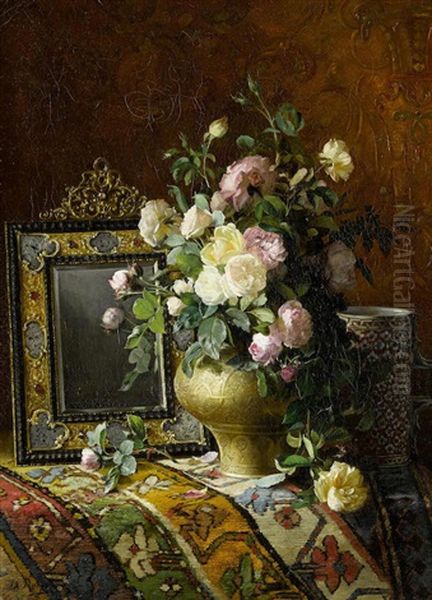
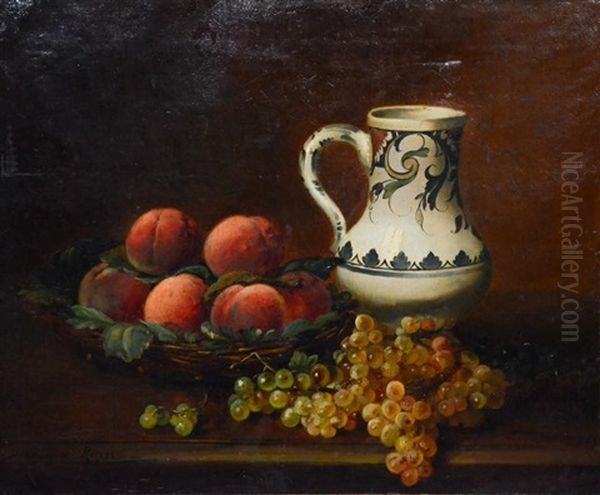
Rozier's oeuvre primarily consisted of still lifes, depicting arrangements of fruit, flowers, tableware, and other household objects. These subjects allowed him to explore the interplay of textures – the gleam of silver, the transparency of glass, the softness of fruit, the richness of fabrics.
One of his noted works is "Still Life with Tablecloth." While specific images and detailed analyses of this particular piece are not always readily available in general surveys, the title itself is evocative of a common theme in still life painting. Such a composition would likely feature a carefully arranged assortment of objects on a draped table, allowing Rozier to demonstrate his skill in rendering folds of fabric, the reflections on polished surfaces, and the varied textures of the items displayed. If this work indeed shows Impressionistic tendencies, it might involve a brighter palette and a more visible brushstroke than a strictly academic still life, capturing the fleeting effects of light.
Another work attributed to him is "Roses." This painting is particularly interesting as it was featured in an animated video titled "Object Love," where it was used to explore themes of Memento Mori and Vanitas. Floral still lifes, especially those featuring roses, have a long tradition in art history of symbolizing beauty, love, and the transience of life. The rose, with its delicate petals that inevitably wilt and fade, is a potent symbol of mortality. The Vanitas theme, popular in Dutch Golden Age painting and recurrent throughout art history, reminds the viewer of the fleeting nature of earthly pleasures and possessions. If Rozier's "Roses" was interpreted in this light, it suggests a depth to his work beyond mere decorative appeal, engaging with profound philosophical concepts. Artists like Jan Davidsz. de Heem (1606-1684) or Rachel Ruysch (1664-1750) were masters of this symbolic floral painting in earlier centuries, and the tradition continued.
An "Oval Portrait of a Grand Lady at Tea," described as an 18th-century French noblewoman, has also been attributed to Rozier. This attribution is somewhat unusual for a painter primarily known as a 19th-century still life specialist. If accurate, it could represent a copy of an older work, a commission in a historical style, or an early exploration of different genres. However, without further visual confirmation and provenance, it's difficult to integrate this definitively into his primary body of work, which firmly centers on still life. It's more probable that his focus remained on the genre he excelled in, following the path of his teacher Vollon and contemporaries like Blaise Desgoffe (1830-1901), who was renowned for his incredibly detailed and illusionistic still lifes of objets d'art.
Rozier's style, as gleaned from general descriptions, likely balanced the meticulous realism inherited from masters like Chardin and Vollon with a sensitivity to the changing artistic currents of his time. He would have been aware of the Impressionists' experiments with light and color, even if he did not fully adopt their revolutionary techniques. His contemporaries in still life painting ranged from the highly polished academic style to more painterly approaches. For example, Antoine Berjon (1754-1843), from an earlier generation but influential in Lyon, was a master of flower painting. Rozier's work would have found its place within this spectrum.
Contemporaries and the Broader Art World
Dominique Hubert Rozier worked during a period of immense artistic ferment. The official Salon system, while still powerful, was being challenged by independent exhibitions, most notably those of the Impressionists. Artists like Camille Pissarro (1830-1903), Alfred Sisley (1839-1899), Berthe Morisot (1841-1895), and Edgar Degas (1834-1917), alongside Monet and Renoir, were redefining the very nature of painting, focusing on capturing fleeting moments, the effects of light, and contemporary life.
While Rozier was not an Impressionist in the radical sense, he, like many artists of his generation, could not have been entirely immune to their influence, particularly regarding palette and brushwork. His teacher, Vollon, while a Realist, was admired by many younger painters for his vigorous technique. Other Realist painters whose influence lingered included Jean-François Millet (1814-1875), known for his peasant scenes, and the aforementioned Courbet. The Barbizon School painters, such as Théodore Rousseau (1812-1867) and Charles-François Daubigny (1817-1878), had also emphasized direct observation from nature, a principle that extended to the truthful depiction of objects in still life.
There is no specific record of direct collaborations or close personal friendships between Rozier and the leading avant-garde figures of his time. Many artists, while aware of new movements, continued to work in more established styles, finding success and patronage within those frameworks. Rozier appears to be one such figure, contributing to the rich tapestry of French art through his dedicated practice of still life. His participation in regional exhibitions suggests a career built on solid craftsmanship and appeal to a broad range of collectors and institutions.
Legacy and Conclusion
Dominique Hubert Rozier passed away on November 9, 1901. He left behind a body of work that exemplifies the enduring appeal of still life painting. While he may not have been an innovator on the scale of Cézanne or Van Gogh (whose still lifes were also transformative), Rozier's paintings are valuable for their skillful execution, their quiet beauty, and their reflection of the artistic tastes and values of his era.
His work, often characterized by careful composition, a sensitive rendering of light and texture, and an appreciation for the humble objects of daily life, connects to a long tradition of still life painting. The themes of Memento Mori and Vanitas, potentially present in works like "Roses," add a layer of intellectual depth, inviting contemplation on the nature of existence.
In the grand narrative of art history, artists like Dominique Hubert Rozier play a crucial role. They represent the consistent, high-quality artistic production that forms the backbone of any artistic period. While revolutions and radical departures often capture the spotlight, the steady evolution and refinement of established genres by dedicated practitioners like Rozier are equally important for a complete understanding of the art of the past. His paintings continue to be appreciated in the collections that hold them, offering a window into the artistic sensibilities of late 19th-century France and the timeless allure of the still life. His connection to Antoine Vollon firmly places him within a lineage of French Realist painters who found profound beauty and artistic challenge in the depiction of the ordinary.