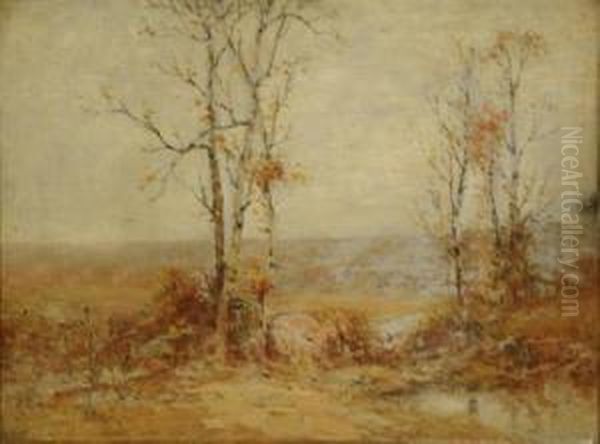
Edward Loyal Field (1856-1914) was an American artist whose career unfolded during a transformative period in American art. He is primarily recognized for his evocative landscape paintings and etchings, created in the Tonalist style. Field's work is characterized by its subtle color harmonies, atmospheric effects, and a profound sense of nostalgia for the pastoral, often depicting the quiet beauty of the American countryside, particularly scenes from New York State and, as noted, Tennessee. His art offers a window into a late 19th and early 20th-century sensibility that sought solace and spiritual connection in nature, moving away from the grand, literal depictions of earlier landscape traditions.
Early Life and Artistic Awakening
Born in Galesburg, Illinois, in 1856, Edward Loyal Field's early life set the stage for an artistic journey that would see him absorb European influences before forging his distinct American voice. While specific details about his earliest artistic inclinations are not extensively documented, it is clear that he possessed a passion for art that led him to seek formal training. Like many aspiring American artists of his generation, Field understood that a European sojourn, particularly in Paris, was essential for honing one's craft and gaining credibility in the art world.
This pursuit of artistic excellence took him to Paris, the undisputed center of the art world in the 19th century. There, he enrolled in the atelier of the renowned French painter Carolus-Duran (Charles Auguste Émile Durand). Carolus-Duran was a highly respected figure, known for his elegant portraiture and his departure from some of the stricter academic methods of the École des Beaux-Arts. His studio attracted a diverse group of international students, including the celebrated American expatriate John Singer Sargent, who became one of Carolus-Duran's most famous pupils. Studying under such a master would have exposed Field to sophisticated techniques in oil painting, particularly regarding brushwork, color, and the direct observation of the subject.
The Parisian Influence and the Barbizon Legacy
The artistic environment in Paris during Field's studies was rich and varied. While Impressionism was making its revolutionary impact, the influence of the earlier Barbizon School remained potent, especially for landscape painters. The Barbizon School, active from roughly the 1830s to the 1870s, was a pivotal movement that shifted landscape painting away from idealized, classical scenes towards more intimate, realistic, and emotionally resonant depictions of nature. Artists like Jean-Baptiste-Camille Corot, Théodore Rousseau, Jean-François Millet, and Charles-François Daubigny were central figures. They often worked en plein air (outdoors) in the Forest of Fontainebleau near the village of Barbizon, capturing the fleeting effects of light and atmosphere.
The Barbizon painters emphasized mood, subtle tonal gradations, and a poetic interpretation of the rural landscape. Their work resonated deeply with many American artists who traveled abroad, offering an alternative to both the highly detailed style of the Hudson River School and the radical optical experiments of the Impressionists. Field, during his time in France, would undoubtedly have encountered Barbizon paintings, either directly or through their pervasive influence on French landscape art. This exposure was crucial in shaping his later adoption of Tonalism.
The Emergence of Tonalism in America
Upon his return to the United States, Edward Loyal Field became associated with Tonalism, an artistic style that flourished in America from roughly the 1880s through the 1910s. Tonalism was not a formally organized movement with a manifesto but rather a shared sensibility among a group of artists. It drew heavily from the Barbizon School's aesthetic and the atmospheric, evocative works of James McNeill Whistler. Tonalist painters sought to capture the mood and poetic essence of a landscape rather than its literal details. They favored intimate scenes, often depicted at dawn, dusk, or on overcast days, when light is diffused and colors are muted.
Key proponents of American Tonalism included George Inness, whose later works became increasingly spiritual and abstract; Dwight William Tryon, known for his delicate, hazy landscapes; Alexander Helwig Wyant, whose works often conveyed a melancholic beauty; Ralph Albert Blakelock, famous for his moonlit scenes and heavily impastoed surfaces; and Henry Ward Ranger, who was a significant advocate for the style. These artists, like Field, aimed to evoke feeling and contemplation through their subtle handling of color, light, and atmosphere.
Edward Loyal Field's Tonalist Aesthetic
Edward Loyal Field's work fits squarely within the Tonalist tradition. He excelled in creating landscapes that were imbued with a quiet, introspective quality. His "color aesthetic," as noted, was central to his practice. Rather than using bright, vibrant colors in the Impressionist vein, Field employed a more restricted palette, focusing on harmonious arrangements of closely related tones – often greens, browns, grays, and soft blues. This approach allowed him to emphasize the overall mood and atmospheric conditions of a scene.
A defining characteristic of Field's paintings and etchings is his skillful manipulation of "value and marking" to create a sense of depth and atmosphere. Distant objects in his compositions often appear "blurred" or softened, receding into a hazy background. This technique not only enhances the illusion of spatial depth but also contributes to the dreamlike, poetic quality of his work. It draws the viewer in, encouraging a contemplative engagement with the scene rather than a purely observational one. His landscapes are rarely specific topographical records; instead, they are generalized, evocative interpretations of nature.
Themes of Rural Nostalgia
Field's art frequently expresses a "nostalgia and admiration for rural life." This was a common theme among Tonalist painters and reflected a broader cultural sentiment in late 19th-century America. As the nation rapidly industrialized and urbanized, many artists and writers looked to the countryside as a repository of simpler values, tranquility, and spiritual sustenance. Field's depictions of quiet streams, wooded interiors, pastoral fields, and rustic structures like old farmhouses or boat houses tap into this yearning for a connection with nature and a less complicated past.
His Tennessee landscapes, specifically mentioned, would have provided rich subject matter for this sensibility. The rolling hills, misty valleys, and verdant forests of the region offered ample opportunities to explore the subtle interplay of light and atmosphere that was so central to Tonalism. These scenes were not just picturesque views but were imbued with a sense of lived experience and emotional resonance.
Notable Works: "The Boat House" and Beyond
One of Field's representative works is the etching The Boat House, created in 1889. Etching, as a medium, lends itself well to the Tonalist aesthetic. The artist can achieve a wide range of tones, from delicate grays to rich blacks, and can create soft, atmospheric effects through techniques like varied biting of the plate and selective wiping of ink. The Boat House likely exemplifies Field's ability to capture a specific mood – perhaps the quiet stillness of a secluded waterway or the gentle decay of a man-made structure reclaimed by nature. The subject itself, a simple boat house, aligns with the Tonalist preference for unpretentious, everyday scenes that could evoke deeper feelings.
While The Boat House is a key example, Field produced numerous other works, primarily oil paintings, that explored similar themes and stylistic concerns. Titles such as "Autumn Evening," "A Grey Day," "The Edge of the Woods," or "Twilight Pasture" (hypothetical, but typical of Tonalist naming conventions) would reflect his preoccupation with specific times of day and atmospheric conditions. His body of work, viewed collectively, demonstrates a consistent dedication to capturing the subtle, poetic beauty of the American landscape.
Field and the Artist Colony Movement
Edward Loyal Field was also associated with the artist colony in Arkville, New York, in the Catskill Mountains. Artist colonies became increasingly popular in America in the late 19th and early 20th centuries, providing artists with affordable living, camaraderie, and inspiring natural surroundings. Arkville, along with nearby Pakatakan, attracted a number of landscape painters, including Alexander Helwig Wyant before his move to the area, and later figures like John Francis Murphy, another prominent Tonalist.
Life in an artist colony would have allowed Field to immerse himself in his work, surrounded by like-minded peers. The shared environment often fostered stylistic developments and provided opportunities for exhibition and patronage. The landscapes of the Catskills, with their rolling hills, dense forests, and picturesque valleys, were ideal subjects for Tonalist painters like Field.
Technical Approach and Mediums
Field was proficient in both oil painting and etching. In his oil paintings, he would have likely built up his surfaces with layers of thin glazes to achieve the desired tonal subtlety and atmospheric depth. His brushwork, while not as overtly expressive as some, would have been carefully controlled to render the soft transitions of light and shadow characteristic of Tonalism. The emphasis was always on the overall harmony of the composition rather than on bravura technical display.
His work in etching, as seen in The Boat House, allowed for a different kind of intimacy and graphic power. Etching requires a mastery of line and tone, and Field would have used these elements to create rich, atmospheric prints. The process of etching itself, with its reliance on chemical processes and the artist's hand, can produce uniquely expressive results. For Field, it was another avenue to explore the moody, evocative qualities of the landscape.
Field in the Context of American Art
Edward Loyal Field practiced during a period when American art was asserting its own identity while still looking to Europe for inspiration. The generation of artists that included Field, Inness, Whistler, and Tryon played a crucial role in moving American landscape painting beyond the more literal and often grandiose vision of the Hudson River School painters like Albert Bierstadt or Frederic Edwin Church. While the Hudson River School celebrated the sublime and majestic aspects of the American wilderness, Tonalism offered a more personal, introspective, and spiritual engagement with nature.
Field's work, therefore, can be seen as part of this broader shift towards a more subjective and poetic approach to art. He was not an innovator on the scale of Whistler or Inness, but he was a skilled and sensitive practitioner of the Tonalist style, contributing to its popularity and its distinctive American character. His paintings and etchings resonated with a public that was increasingly seeking art that offered emotional and spiritual solace.
Other contemporaries whose work might have intersected with or provided a contrasting backdrop to Field's include figure painters like Thomas Eakins, known for his unflinching realism, or Impressionist-influenced artists like Childe Hassam and John Henry Twachtman, who, while also interested in atmosphere, employed a brighter palette and more broken brushwork. The American art scene at the turn of the century was diverse, and Tonalism represented one significant and influential current within it.
Legacy and Recognition
Edward Loyal Field, like many Tonalist painters, experienced a period of popularity during his lifetime, but his reputation, along with that of Tonalism in general, declined with the rise of Modernism in the early 20th century. The Armory Show of 1913, which introduced European avant-garde art to America on a large scale, signaled a dramatic shift in artistic tastes. The quiet, introspective art of the Tonalists seemed out of step with the bold experimentation and new subject matter of movements like Cubism and Fauvism.
However, in more recent decades, there has been a renewed appreciation for Tonalism and artists like Edward Loyal Field. Art historians and collectors have recognized the unique beauty and emotional depth of Tonalist landscapes. Field's work is now found in various public and private collections, and he is acknowledged as a competent and sensitive contributor to this important chapter in American art history. His paintings and etchings serve as a reminder of a time when art sought to capture the intangible, the spiritual, and the poetic essence of the natural world.
His dedication to the "color aesthetic" and his ability to evoke a profound sense of place and mood through subtle means ensure his continued relevance. The nostalgia for rural life that permeates his work still resonates today, perhaps even more so in an increasingly fast-paced and technologically driven world.
Conclusion: The Enduring Appeal of Field's Art
Edward Loyal Field stands as a notable figure among American Tonalist painters. His artistic journey, from his studies in Paris under Carolus-Duran to his mature work depicting the serene landscapes of America, reflects a deep engagement with the prevailing artistic currents of his time. He skillfully adapted the lessons of the Barbizon School and the broader Tonalist sensibility to create a body of work characterized by its atmospheric beauty, subtle color harmonies, and evocative portrayal of rural life.
While perhaps not as widely known as some of his Tonalist contemporaries like George Inness or Dwight Tryon, Field's contributions are significant. His paintings and etchings, such as The Boat House, offer a quiet yet compelling vision of nature, imbued with a sense of peace, nostalgia, and introspection. He masterfully used his "color aesthetic" and his control over value and mark-making to create scenes that invite contemplation and evoke a deep emotional response. As an art historian, I see Edward Loyal Field as an artist who successfully captured a particular American spirit, one that found solace and profound meaning in the gentle, unassuming beauty of the pastoral landscape. His work remains a testament to the enduring power of art to connect us to the subtleties of the natural world and the inner landscapes of human emotion.