Edwin Austin Abbey stands as a towering figure in American art, a master illustrator and muralist whose work bridged the Gilded Age and the early twentieth century. Born in Philadelphia on April 1, 1852, Abbey rose from humble beginnings to achieve international acclaim, leaving an indelible mark on both sides of the Atlantic. His meticulous draftsmanship, romantic imagination, and dedication to historical accuracy established him as a leading exponent of a richly narrative and decorative style, particularly celebrated for his interpretations of Shakespearean and medieval themes.
Early Life and Artistic Awakening in Philadelphia
Philadelphia in the mid-nineteenth century was a burgeoning cultural center, and it was here that Edwin Austin Abbey's artistic journey began. His innate talent for drawing was apparent from a young age. At fourteen, he commenced formal art studies under Isaac L. Williams, a local landscape and portrait painter. This foundational training provided him with the basic skills necessary to pursue his burgeoning passion.
In 1868, Abbey enrolled at the prestigious Pennsylvania Academy of the Fine Arts (PAFA), one of America's oldest and most respected art institutions. There, he studied under Christian Schussele, a German-born artist known for his historical paintings. Schussele's academic approach, emphasizing rigorous drawing and composition, would have a lasting impact on Abbey's meticulous technique. The environment at PAFA, which had also nurtured artists like Thomas Eakins and Mary Cassatt, though their paths diverged stylistically, provided a stimulating atmosphere for the young artist.
Even during his student years, Abbey began to seek practical application for his skills. In 1870, he took a position as an apprentice draftsman for the publishing firm Van Ingen & Snyder. This early exposure to the world of commercial illustration was pivotal, steering him towards a medium where his precise drawing and narrative abilities could flourish. It was also in 1870 that his first published illustration appeared in Harper's Weekly, a significant milestone for the aspiring artist.
The Rise of a Premier Illustrator: Harper & Brothers
Recognizing the greater opportunities in New York City, the epicenter of American publishing, Abbey relocated in 1871. He quickly secured a position with Harper & Brothers, one of the most influential publishing houses of the era. This marked the beginning of a two-decade association that would solidify his reputation as one of America's foremost illustrators.
At Harper's, Abbey contributed to flagship publications like Harper's Weekly and Harper's Monthly Magazine. His early work was influenced by the prevailing trends in black-and-white art, particularly from French and German illustrators whose work was becoming increasingly accessible in America. He worked alongside other talented artists in the Harper's art department, including Charles Parsons, who served as the art director and provided valuable guidance.
Abbey's illustrations were characterized by their clarity, detail, and ability to capture the essence of a literary scene. He developed a remarkable proficiency in pen and ink, a medium that demanded precision and control, especially given the wood engraving techniques used for reproduction at the time. His dedication to research, particularly in historical costume and settings, lent an air of authenticity to his work that was highly valued.
He became particularly renowned for his illustrations of English literature. His interpretations of Robert Herrick's pastoral poetry, Oliver Goldsmith's charming narratives, and Charles Dickens's vivid characters were widely admired. These commissions not only brought him popular success but also deepened his engagement with English history and culture, themes that would dominate his later career. His work for these authors demonstrated a growing sophistication and an ability to convey subtle emotional nuances. Other prominent American illustrators of the period, such as Howard Pyle and A.B. Frost, were also shaping the "Golden Age of Illustration," and Abbey was a leading light within this movement.
A Transatlantic Shift: Embracing England
The allure of England, with its rich historical tapestry and vibrant artistic scene, proved irresistible to Abbey. In 1878, Harper & Brothers dispatched him to England, ostensibly to gather authentic visual material for illustrations of Robert Herrick's poems and other English subjects. What was initially intended as a temporary assignment evolved into a permanent relocation.
Abbey found England immensely stimulating. He immersed himself in its landscapes, architecture, and museums, meticulously sketching and absorbing the atmosphere. The artistic community in London was welcoming, and he soon formed connections with prominent British and fellow American expatriate artists. He became a close friend of John Singer Sargent, another American artist who had found fame in Europe. Their friendship would be a significant source of mutual support and artistic exchange throughout their careers.
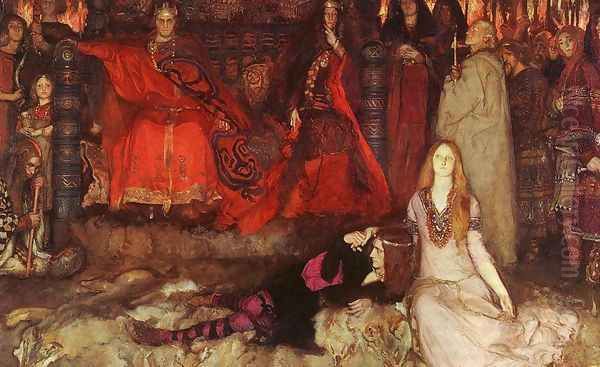
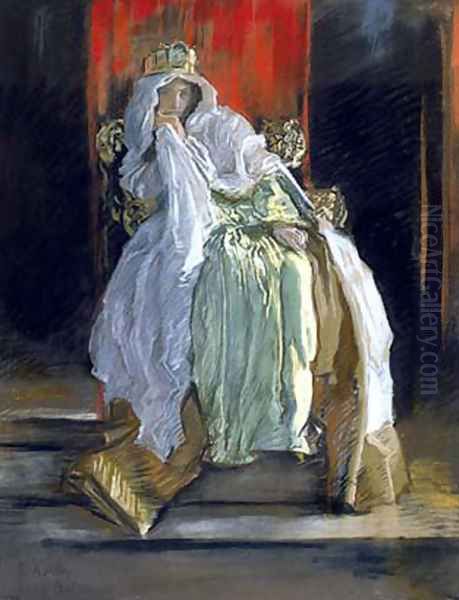
In 1883, Abbey formally settled in England, making his home in the picturesque Cotswolds village of Broadway, Worcestershire, which became an informal artists' colony frequented by figures like Sargent, Henry James, and Alfred Parsons. That same year, his growing reputation was recognized by his election to the Royal Institute of Painters in Water Colours. He continued to produce illustrations, notably a celebrated series for Shakespeare's comedies, which further enhanced his international standing. These Shakespearean illustrations, rich in detail and character, are considered among his finest achievements in the medium.
His engagement with the British art establishment deepened over the years. He was elected an Associate of the Royal Academy of Arts in 1896 and a full Royal Academician (RA) in 1898, prestigious honors that underscored his acceptance and success within the British art world. He also became a member of the National Academy of Design in New York, maintaining his ties to the American art scene.
The Grand Canvas: Murals and Historical Paintings
While illustration remained a significant part of his output, Abbey increasingly turned his attention to oil painting and large-scale mural projects. This shift allowed him to explore historical and literary themes on a more ambitious scale, drawing upon his meticulous research and narrative skills. His style, often characterized by its detailed realism, dramatic compositions, and rich coloration, found a powerful outlet in these larger formats.
His work resonated with the Pre-Raphaelite sensibility that had significantly impacted British art, with its emphasis on literary subjects, historical accuracy, and a high degree of finish. Artists like Dante Gabriel Rossetti, John Everett Millais, and Edward Burne-Jones had paved the way for a revival of romantic and historical themes, and Abbey's work, while distinct, shared some of these preoccupations. He was also a contemporary of British academic painters like Frederic Leighton, Lawrence Alma-Tadema, and Frank Dicksee, whose grand historical and classical scenes dominated the Royal Academy exhibitions.
The Boston Public Library: "The Quest of the Holy Grail"
Abbey's most famous mural cycle, and arguably his magnum opus, is "The Quest and Achievement of the Holy Grail," commissioned for the Boston Public Library. This ambitious project, undertaken between 1890 and 1901, comprises fifteen large panels that adorn the library's delivery room, a space designed by the renowned architectural firm McKim, Mead & White.
The subject, drawn from Arthurian legend, particularly Sir Thomas Malory's "Le Morte d'Arthur" and Alfred, Lord Tennyson's "Idylls of the King," was perfectly suited to Abbey's romantic inclinations and his expertise in medieval lore. He undertook extensive research, traveling to Brittany and studying medieval armor, tapestries, and manuscripts to ensure the historical accuracy of the costumes, settings, and heraldry.
The panels narrate the story of Sir Galahad's spiritual journey to find the Holy Grail. Abbey's compositions are dynamic and theatrical, filled with richly clad figures, dramatic lighting, and symbolic details. The series begins with the infant Galahad and follows him through his knighting, his visions, his trials, and his ultimate success in achieving the Grail. The murals are celebrated for their narrative clarity, their decorative richness, and their evocative power. They represent a significant contribution to the American Renaissance, a period characterized by a renewed interest in classicism and the integration of art and architecture in public buildings. Other artists contributing to the Boston Public Library's decoration included John Singer Sargent and the French master Pierre Puvis de Chavannes.
The Pennsylvania State Capitol Murals
Following the success of the Boston murals, Abbey received another major commission, this time for the Pennsylvania State Capitol in Harrisburg. Between 1902 and his death in 1911, he worked on a series of monumental murals depicting allegorical and historical scenes related to the Commonwealth of Pennsylvania.
These works include "The Apotheosis of Pennsylvania," a vast canvas in the House of Representatives Chamber, which features an allegorical representation of the state surrounded by figures embodying its industries, arts, and historical personages. Other significant murals in the Capitol by Abbey include scenes from Pennsylvania's history, such as "Penn's Treaty with the Indians" and depictions of its natural resources and industries. He also designed four large circular medallions for the dome, representing Religion, Law, Art, and Science.
These murals, like his Boston series, are characterized by their grand scale, meticulous detail, and symbolic richness. They reflect the era's ambition to create public buildings that were not merely functional but also served as repositories of cultural and historical meaning. Abbey's work at the Capitol was part of a larger decorative program that also included contributions from artists like Violet Oakley and Joseph Lindon Smith. Unfortunately, Abbey's declining health prevented him from completing the entire scheme as originally envisioned.
"The Coronation of King Edward VII"
Another significant commission was the official painting of the coronation of King Edward VII, which took place in Westminster Abbey in 1902. Abbey was chosen for this prestigious task, a testament to his high standing in British art circles. The resulting painting, completed in 1904 and now in the Royal Collection, is a masterful depiction of the elaborate ceremony, capturing the pomp and pageantry of the occasion with remarkable detail and accuracy. It involved numerous sittings from the principal figures and required Abbey to meticulously reconstruct the scene. This work further solidified his reputation as a painter capable of handling complex, large-scale historical subjects.
Artistic Style: Detail, Drama, and Historical Veracity
Edwin Austin Abbey's artistic style was a unique amalgamation of meticulous realism, romantic sensibility, and a deep reverence for historical accuracy. Whether working in pen and ink, watercolor, or oil, his commitment to detail was paramount. He believed that authenticity in costume, architecture, and artifacts was crucial to convincingly portray historical and literary narratives. This often involved extensive research, collecting period clothing and props, and creating numerous preparatory sketches.
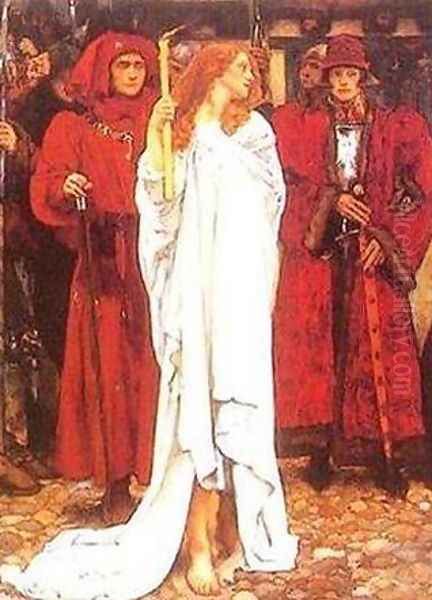
His compositions were often theatrical, imbued with a sense of drama and movement. He had a keen eye for staging scenes effectively, using lighting, gesture, and facial expression to convey emotion and advance the narrative. This dramatic quality was particularly evident in his Shakespearean illustrations and his large-scale murals, where he managed complex groups of figures with skill.
While influenced by the academic traditions of his training and the romanticism of the Pre-Raphaelites, Abbey's style remained distinctly his own. He was less interested in the overt symbolism or moralizing tone of some of his contemporaries and more focused on the vivid re-creation of a past era or a literary world. His figures, while often idealized, possessed a tangible human quality.
His palette, especially in his oil paintings and murals, was rich and often jewel-like, though he could also employ more somber tones to create specific moods. His handling of textures—the gleam of armor, the richness of velvet, the roughness of stone—was particularly adept, contributing to the overall verisimilitude of his scenes.
Contemporaries and Artistic Milieu
Abbey's career unfolded within a vibrant and complex artistic landscape, both in America and England. He was part of a generation of American artists who sought training and recognition abroad, often finding inspiration in European traditions while forging their own distinct artistic identities.
In England, his closest artistic relationship was undoubtedly with John Singer Sargent. They were not only friends but also mutual admirers of each other's work, often sharing studio space and traveling together. Their artistic dialogues and shared experiences in the Anglo-American expatriate community were significant. Other American artists active in Europe during this period included James McNeill Whistler, whose aestheticism offered a different path, and Mary Cassatt, who became associated with the Impressionists in Paris.
Abbey's work also engaged with the legacy of the Pre-Raphaelite Brotherhood and the broader Victorian taste for historical and literary subjects. He would have been familiar with the work of artists like Ford Madox Brown and William Morris, in addition to the aforementioned Rossetti, Millais, and Burne-Jones. His dedication to craftsmanship and decorative effect aligned with aspects of the Arts and Crafts movement, although his primary focus remained on narrative painting and illustration.
In the realm of illustration, he was a contemporary of other highly skilled practitioners. In America, Howard Pyle was a dominant figure, known for his historical adventure stories and his influential teaching. In Britain, artists like Arthur Rackham and Edmund Dulac were creating their own distinctive styles of fantasy and fairytale illustration, though their approach often leaned more towards whimsy than Abbey's historical realism.
Later Years and Unfinished Visions
The later years of Abbey's life were marked by continued artistic activity but also by declining health. The immense physical and mental demands of his large-scale mural projects, particularly the Pennsylvania State Capitol commission, took a toll. He poured his energy into these monumental works, often to the detriment of his well-being.
Despite his health challenges, he continued to work diligently. He maintained his studio in England, Morgan Hall, in Fairford, Gloucestershire, a carefully curated environment filled with the historical artifacts and costumes that fueled his imagination. He also kept a London studio to facilitate his work on major commissions and his participation in the Royal Academy.
Tragically, Abbey died on August 1, 1911, in London, at the age of 59, before he could complete all the murals planned for the Pennsylvania State Capitol. Some of the remaining work was completed by his assistant, Ernest Board, and later by Violet Oakley, who took over significant portions of the Capitol's decorative scheme. His relatively early death cut short a career that was still at the height of its powers.
Legacy and Enduring Influence
Edwin Austin Abbey left a rich and multifaceted artistic legacy. He was a pivotal figure in the Golden Age of American Illustration, elevating the medium through his technical skill, historical research, and imaginative interpretations of literature. His illustrations for Shakespeare, Herrick, and Goldsmith remain classics of the genre.
His transition to mural painting marked a significant contribution to the American Renaissance, a movement that sought to adorn public spaces with art that edified and inspired. "The Quest of the Holy Grail" in the Boston Public Library stands as one of the most important mural cycles in America, a testament to his ambition, artistry, and narrative power. His murals in the Pennsylvania State Capitol, though partly unfinished by his own hand, are also key monuments of public art from this period.
Abbey's dedication to historical accuracy and his ability to bring the past to life resonated deeply with the sensibilities of his time. While artistic tastes shifted in the twentieth century with the rise of modernism, there has been a renewed appreciation for Abbey's work in recent decades, recognizing its technical brilliance, imaginative scope, and cultural significance.
His extensive collection of preparatory drawings, sketches, oil studies, and historical costumes was bequeathed by his widow, Gertrude Mead Abbey, to the Yale University Art Gallery, forming the Edwin Austin Abbey Memorial Collection. This invaluable resource provides deep insight into his working methods and artistic development and remains a vital center for the study of his art. Yale also administers the Edwin Austin Abbey Memorial Fund for Mural Painting in the United States, which supports the creation of public murals, continuing his legacy in a tangible way.
Exhibitions of his work continue to be organized, and his paintings and illustrations are held in major museum collections, including the Metropolitan Museum of Art in New York, the Museum of Fine Arts, Boston, and numerous institutions in Britain. Through these collections and ongoing scholarship, Edwin Austin Abbey's contributions to American and British art continue to be explored and celebrated, securing his place as a master of historical narrative and decorative splendor. His influence can be seen in later illustrators who valued meticulous research and dramatic storytelling, and his murals helped set a standard for public art in America.