Francesco Allegrini da Gubbio: A Baroque Master of Fresco and Drawing
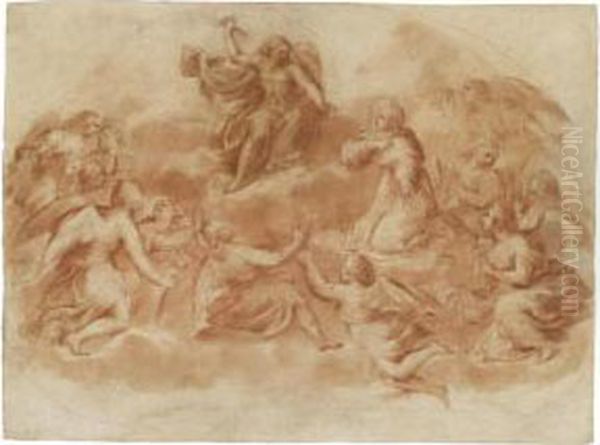
Francesco Allegrini da Gubbio stands as a notable figure in the vibrant artistic landscape of 17th-century Italy, a period dominated by the dynamism and theatricality of the Baroque style. Primarily active in Rome, Allegrini carved a niche for himself as a prolific painter of frescoes and an accomplished draftsman. His career, though perhaps not as universally heralded as some of his towering contemporaries, contributed significantly to the decoration of ecclesiastical and palatial spaces, leaving behind a body of work that reflects both the prevailing artistic currents and his individual sensibilities. However, the study of Allegrini is not without its complexities, particularly concerning the precise details of his biography, which have been a subject of some art historical discussion.
Biographical Ambiguities and Early Life
One of the primary challenges in constructing a definitive biography of Francesco Allegrini lies in conflicting accounts from early art historians. The painter and biographer Pellegrino Antonio Orlandi (1660-1727) proposed a birth year of 1587 for Allegrini in Gubbio, an ancient town in Umbria. Conversely, Filippo Baldinucci (1625-1696), another influential biographer, suggested a later birth year, 1624. This discrepancy significantly alters the timeline of his career and his relationship with his artistic forbears and contemporaries. Most modern scholarship tends to lean towards the earlier date, placing his death in 1663, which would give him a lifespan of approximately 76 years.
Francesco was the son of Flaminio Allegrini, also a painter, sometimes referred to as Flaminio Allegrini da Cantiano. The artistic lineage likely played a role in Francesco's early exposure to the painter's craft. There is some debate regarding Flaminio's own training, with certain sources suggesting he may have been a pupil of the revolutionary Michelangelo Merisi da Caravaggio, while others connect him more firmly with Giuseppe Cesari, known as the Cavalier d'Arpino. If Flaminio did indeed study with Caravaggio, it would imply an early, albeit perhaps indirect, exposure for Francesco to the dramatic naturalism and chiaroscuro that Caravaggio championed.
Regardless of his father's precise tutelage, Francesco Allegrini's formal artistic education is more consistently linked to the workshop of the Cavalier d'Arpino. D'Arpino was a highly successful and influential painter in Rome at the turn of the 17th century, known for his late Mannerist style that gradually incorporated Baroque elements. Training under d'Arpino would have provided Allegrini with a solid foundation in drawing, composition, and the techniques of large-scale fresco painting, which were in high demand for the decoration of Rome's burgeoning churches and palaces.
Ascent in Rome and the Influence of Pietro da Cortona
Francesco Allegrini's career truly blossomed in Rome, the epicenter of Baroque art. After his initial training, a pivotal phase in his development was his association with Pietro da Cortona (1596/7-1669). Cortona was one of the triumvirate of High Baroque masters in Rome, alongside Gian Lorenzo Bernini and Francesco Borromini, and his exuberant, illusionistic ceiling frescoes set a new standard for decorative painting. Allegrini is documented as having entered Cortona's studio or, at the very least, worked in close collaboration with him.
This association with Cortona was profoundly influential. Allegrini absorbed Cortona's dynamic compositional strategies, his rich and vibrant color palette, and his ability to orchestrate complex figural groups across vast surfaces. While Allegrini developed his own distinct artistic voice, the impact of Cortona's grand manner is evident in many of his major commissions. He learned to manage large-scale projects, a skill essential for a painter specializing in frescoes, and to imbue his scenes with the energy and movement characteristic of the High Baroque. This period likely saw him honing his skills in both buon fresco (true fresco, painted on wet plaster) and fresco secco (painted on dry plaster).
His activity in Rome brought him into contact with a thriving artistic community. The city was a magnet for artists from across Italy and Europe, including painters like Andrea Sacchi, a rival of Cortona who favored a more classical Baroque style, Giovanni Lanfranco, another master of illusionistic dome painting, and French artists like Nicolas Poussin and Claude Lorrain, who were forging their own paths. The artistic environment was one of intense competition but also of shared learning and stylistic cross-pollination.
Major Commissions and Notable Works
Francesco Allegrini's reputation grew through a series of significant commissions for both religious institutions and private patrons. He was particularly sought after for his narrative frescoes, which adorned the walls and ceilings of numerous Roman edifices.
Among his documented works in ecclesiastical settings are frescoes in the Church of Santa Ufemia (Sant'Eufemia) in the Vatican and in the Basilica di San Marco Evangelista al Campidoglio, also in Rome. These projects would have involved depicting scenes from the lives of saints or biblical narratives, requiring a mastery of human anatomy, perspective, and storytelling. The ability to convey complex theological messages through compelling visual narratives was paramount.
He also undertook decorations for various Roman palaces. One such commission was for the residence of Cardinal Giovanni Battista Deti. Such private commissions often allowed for a wider range of subject matter, including mythological or allegorical scenes, in addition to religious ones. These projects underscored his growing status within the Roman art world, as patronage from cardinals and noble families was a key indicator of success.
Perhaps one of his most celebrated achievements is the series of frescoes in the Palazzo Doria Pamphilj (sometimes referred to in older or less precise sources as the St. Uffizi Palace, but the Pamphilj commission is more widely recognized for battle scenes by artists of this circle). Here, he is credited with powerful depictions, including the "Battaglia di Mureto" (Battle of Muret). Battle scenes were a popular genre in Baroque art, offering opportunities for dramatic compositions, dynamic action, and the portrayal of intense emotion. Allegrini excelled in capturing the chaos and energy of combat, a testament to his compositional skills and his understanding of human and equine anatomy in motion.
He is also noted for his work in the Vatican Loggette (small loggias or halls within the Papal Palace), contributing to the ongoing decoration of this historic complex. Such commissions, directly for the papal court, were highly prestigious. For instance, he worked on decorations for the private rooms of Pope Alexander VII Chigi and contributed to projects under Pope Innocent X Pamphilj, further cementing his reputation. Other significant church decorations include work in Sant'Agnese in Agone and San Domenico e Sisto.
Beyond frescoes, Allegrini also produced oil paintings, though he is less famous for these. An example cited is "Christ in Glory with Angels and a Saint Kneeling in Adoration," which would showcase his handling of color, light, and devotional sentiment on canvas. Another work, "Papa Leone Magno Confronta Attila" (Pope Leo the Great Confronts Attila), demonstrates his engagement with significant historical-religious themes, a popular subject that allowed for grand, narrative compositions.
Artistic Style: Baroque Dynamism and Refined Sensibility
Francesco Allegrini's style is firmly rooted in the Baroque, yet it possesses individual nuances. His work is characterized by a "delicate brushwork" and "rich colors," creating visually appealing and often sumptuous surfaces. He was particularly adept at conveying "dynamism and emotion," essential qualities for the dramatic narratives he often depicted. The influence of High Renaissance masters like Raphael can be discerned in the grace and clarity of some of his figures, an influence that was common among many Baroque artists who sought to emulate Raphael's compositional harmony.
While absorbing the High Baroque exuberance of Pietro da Cortona, Allegrini's work sometimes exhibits a "late Mannerist sensibility" or a "late sentimentalism." This suggests a refinement and a certain elegance that could, at times, temper the full-blown theatricality of some of his contemporaries. This quality might be seen in the expressive faces of his figures or in the lyrical flow of his compositions. His figures are often animated and expressive, their gestures and postures conveying the narrative's emotional core.
His battle scenes, like the "Battle of Muret," are particularly illustrative of his ability to manage complex, multi-figure compositions with a sense of controlled energy. He could depict the fervor of conflict without sacrificing clarity, ensuring that the narrative remained legible amidst the action. This balance between dynamism and legibility was a hallmark of successful Baroque narrative painting. The influence of Caravaggio, perhaps through his father or Cavalier d'Arpino, might be seen in a certain robustness in his figures or a strategic use of light and shadow to model forms and enhance drama, though his palette was generally brighter and more varied than Caravaggio's.
Allegrini the Draftsman: A Prolific and Skilled Hand
Beyond his extensive work as a fresco painter, Francesco Allegrini was an exceptionally prolific and gifted draftsman. Drawing was a fundamental part of artistic training and practice in the 17th century, serving as a tool for study, for developing compositions, and for presenting ideas to patrons. Allegrini's drawings are noted for their "quick, sketchy strokes" and a "keen observation" of detail, suggesting a rapid and confident hand.
His drawings often capture the initial spark of an idea, with figures rendered in energetic lines that convey movement and form with remarkable economy. These preparatory sketches, often in pen and ink with wash, reveal his working process, showing how he explored different poses, groupings, and compositional arrangements before committing them to the final painted surface. Subjects range from religious and mythological scenes to studies of individual figures and drapery.
A significant corpus of his drawings survives today, housed in prestigious collections worldwide. Among these are the National Gallery of Scotland in Edinburgh, the Teylers Museum in Haarlem (Netherlands), the University Library in Jena (Germany), and the Metropolitan Museum of Art in New York. The dispersal of these drawings across major collections attests to their recognized quality and art historical importance. For art historians, these drawings are invaluable, not only for understanding Allegrini's own creative process but also for studying the broader practices of Baroque workshops. Sometimes, drawings are the only surviving evidence of lost or destroyed fresco cycles.
The attribution of drawings can be complex, and some of Allegrini's works on paper have, at times, been confused with those of other artists, including, occasionally, Caravaggio, particularly if they exhibited strong chiaroscuro or a certain raw energy. However, dedicated scholarship has helped to define his distinctive graphic style.
Interactions with Contemporaries and the Artistic Milieu
Francesco Allegrini operated within a competitive and intellectually stimulating artistic environment in Rome. His direct collaboration with Pietro da Cortona was formative. He would have been aware of, and likely interacted with, many other leading artists of the day.
The Roman art scene was dominated by figures like Gian Lorenzo Bernini, whose sculptural and architectural works defined the visual character of Baroque Rome. While primarily a sculptor and architect, Bernini also painted and oversaw large decorative projects, creating a pervasive artistic influence. Francesco Borromini, Bernini's great rival, was revolutionizing architecture with his dynamic and complex spatial designs.
Among painters, Andrea Sacchi represented a more classical and restrained strand of the Baroque, often seen as an alternative to Cortona's High Baroque exuberance. Giovanni Lanfranco was another major figure, particularly known for his illusionistic dome frescoes, such as that in Sant'Andrea della Valle, which predated and influenced Cortona's own ceiling paintings. Artists like Guido Reni and Domenichino (Domenico Zampieri), though trained in Bologna, spent significant periods in Rome and contributed to major decorative cycles, bringing with them the influence of the Carracci reform. Guercino (Giovanni Francesco Barbieri) was another Emilian master whose dramatic use of light and shadow and rich color found favor in Rome.
While direct collaborative records with all these figures may not exist for Allegrini, he would have undoubtedly seen their work, competed for similar commissions, and participated in the broader artistic discourse of the city. The snippets mention a possible connection or contemporary activity with Gaspard Dughet, a painter of French origin active in Rome, known for his classical landscapes, often with biblical or mythological figures. Dughet was Poussin's brother-in-law and was influenced by him. If Allegrini and Dughet moved in similar circles or worked on similar thematic material, it points to the interconnectedness of the artistic community.
The mention of a work by Allegrini once being misattributed to Nicolas Poussin is also telling. Poussin was a towering figure of French Classicism working in Rome, and such misattributions, while later corrected, highlight the complexities of connoisseurship and the stylistic overlaps or perceived similarities that can occur.
Art Historical Controversies and Anecdotes
The life and work of Francesco Allegrini are accompanied by several art historical debates and points of interest, as highlighted in the provided information.
The most significant is the aforementioned discrepancy in his birth year (1587 vs. 1624) and, consequently, his death year. This confusion between the accounts of Orlandi and Baldinucci has implications for understanding his place within generational cohorts of artists and the timeline of his influences and commissions. Resolving such discrepancies often relies on meticulous archival research, seeking out baptismal records, contracts, or other contemporary documents.
The identity and training of his father, Flaminio Allegrini, also present a point of discussion, particularly the tantalizing but not definitively proven link to Caravaggio as a teacher. If true, this would add an interesting layer to Francesco's artistic heritage.
Attribution issues are common in art history, and Allegrini's oeuvre is no exception. The instance of a painting being mistakenly attributed to Nicolas Poussin until 1964 underscores how an artist's work can be re-evaluated over time as scholarship progresses. Similarly, the fact that his drawings were sometimes attributed to other artists, including Caravaggio, speaks to the challenges of distinguishing hands, especially when styles share certain superficial characteristics or when an artist is less famous than the one to whom the work is misattributed.
His specialization in battle scenes, such as the "Battle of Muret," is noteworthy. These works, praised for their "dramatic and violent sense," catered to a taste for heroic and action-packed narratives. The ability to organize such complex scenes effectively was a significant skill.
The characterization of his style as being influenced by masters like Pietro da Cortona and even Caravaggio, while also displaying a "late Baroque style" in its detailed execution that contrasted with some aspects of his era, points to an artist who synthesized various influences into a personal idiom. This "late Baroque" or "late sentimentalist" trait suggests a refinement and perhaps a more intimate emotionality that could be seen as looking forward to later Rococo sensibilities or as a specific facet of the diverse expressions within the broader Baroque.
Legacy and Enduring Reputation
Francesco Allegrini, though perhaps not achieving the household-name status of a Bernini, Caravaggio, or Cortona, was a respected and highly productive artist in his time. His contributions to the decoration of Rome's sacred and secular spaces were significant. He was a master of the fresco technique, capable of executing large-scale narrative cycles with skill and dramatic flair.
His legacy is twofold. Firstly, it resides in his surviving frescoes, which continue to adorn the churches and palaces for which they were created. These works offer insight into the religious beliefs, historical narratives, and aesthetic preferences of 17th-century Rome. They stand as testaments to the grandeur and artistic vitality of the Baroque period.
Secondly, his numerous drawings are highly valued by collectors and museums. They are appreciated for their intrinsic artistic quality – their energy, spontaneity, and technical skill – and for the light they shed on Baroque workshop practices and the creative process of a prolific painter. The study of his drawings helps art historians to understand the preparatory stages of fresco painting and to appreciate the foundational role of draftsmanship in Baroque art. Artists like Carlo Maratta, a leading painter in Rome in the later 17th century, would have continued the tradition of meticulous draftsmanship.
While overshadowed by some of the giants of his era, scholars recognize Francesco Allegrini as an important figure within the Roman Baroque school. His ability to synthesize influences from artists like Cavalier d'Arpino and Pietro da Cortona, while developing a personal style characterized by dynamic compositions, rich color, and expressive figures, marks him as a noteworthy contributor to the artistic fabric of his time. His work continues to be studied for its technical proficiency and its embodiment of Baroque aesthetics. The ongoing scholarly interest in his life and work, including the efforts to clarify biographical details and refine attributions, ensures his continued place in the annals of art history.