Francesco Botticini, born Francesco di Giovanni Botticini in Florence around 1446, stands as a notable, if sometimes overlooked, figure in the vibrant artistic milieu of the Early Italian Renaissance. Active primarily in his native Florence, his career spanned a crucial period of artistic innovation and intellectual ferment. Though perhaps not as universally recognized today as some of his towering contemporaries, Botticini carved out a distinct niche for himself, producing a significant body of work, predominantly religious in nature, that reflects both the established traditions of Florentine painting and the emerging stylistic currents of his time. His life and art offer a valuable window into the workshop practices, patronage systems, and theological concerns that shaped Quattrocento Florence.
Early Life and Artistic Formation
Francesco Botticini's journey into the world of art began in a family already connected to artistic production. His father, Giovanni di Domenico, was recorded as a painter of playing cards (naibi), a craft that, while perhaps considered minor, still required skill in design and execution. This familial background likely provided an early exposure to the visual arts and the practicalities of a workshop environment.
Botticini's formal artistic training commenced in 1459, a pivotal year when, at the age of approximately thirteen, he was documented as an apprentice, or salaried assistant, in the workshop of Neri di Bicci. Neri di Bicci was a highly prolific and well-established Florentine painter, running one of the city's busiest workshops. His style was somewhat conservative, rooted in the traditions of artists like Fra Angelico and Fra Filippo Lippi, but his workshop was a hub of activity, producing numerous altarpieces and devotional panels. Although Botticini's tenure with Neri di Bicci was relatively brief, lasting less than a year according to records, this initial immersion in a professional workshop would have been formative, providing him with foundational skills in drawing, panel preparation, and paint application.
Following his departure from Neri di Bicci's studio, Botticini's artistic education continued, likely through associations with other prominent Florentine masters. While direct, long-term apprenticeships are not as clearly documented, his stylistic development suggests exposure to and absorption of influences from several key figures. Among these, Andrea del Verrocchio and Cosimo Rosselli are frequently cited by art historians.
The Florentine Crucible: Workshops and Guilds
The Florence of Botticini's youth and maturity was an unparalleled center of artistic and intellectual activity. The city's wealth, derived from banking and trade, fueled a competitive system of patronage, with families, confraternities, and guilds commissioning works to adorn churches, public buildings, and private chapels. Artists typically operated within a workshop system, often collaborating on large projects and training the next generation of painters and sculptors.
Andrea del Verrocchio's workshop was one of the most dynamic and influential in Florence during the latter half of the 15th century. Verrocchio himself was a multifaceted artist – a sculptor, painter, and goldsmith – and his studio attracted a constellation of brilliant young talents. It was here that Leonardo da Vinci received his training, alongside other future luminaries such as Pietro Perugino and Lorenzo di Credi. If Botticini spent time in or was closely associated with Verrocchio's workshop, he would have been exposed to a rigorous emphasis on drawing (disegno), anatomical study, and the sophisticated rendering of form and light. The collaborative atmosphere and the diverse skills practiced in Verrocchio's studio would have been immensely stimulating.
Cosimo Rosselli was another significant Florentine painter with whom Botticini is thought to have had connections. Rosselli, who later contributed to the fresco cycle in the Sistine Chapel in Rome alongside Sandro Botticelli, Domenico Ghirlandaio, and Perugino, ran a successful workshop and was known for his competent, if sometimes less innovative, religious paintings.
By the early 1470s, Francesco Botticini was establishing himself as an independent master. In 1471, he became a member of the Compagnia dell'Arcangelo Raffaele (Confraternity of the Archangel Raphael) located at the church of Santo Spirito. The following year, in 1472, he is recorded as joining the Compagnia di San Luca (Confraternity of Saint Luke), the painters' guild in Florence. Membership in these organizations was crucial for an artist's professional standing, providing a network of colleagues, potential patrons, and a recognized status within the city's artistic community.
Artistic Style and Influences
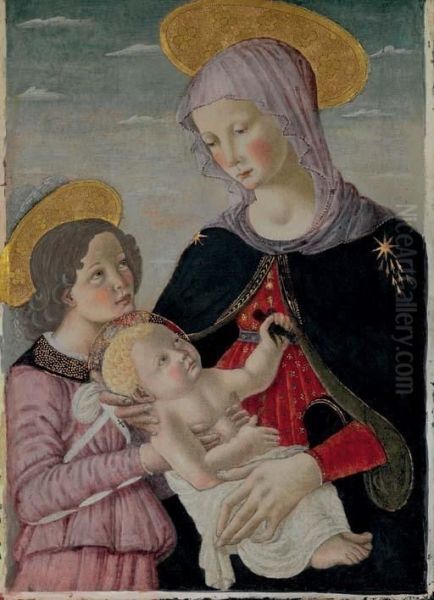
Francesco Botticini's artistic style is a fascinating amalgamation of various Florentine trends, demonstrating his ability to absorb and synthesize different influences while developing a personal idiom. His work is characterized by a clear, linear definition of form, a hallmark of Florentine disegno, often combined with a certain sweetness and grace in his figures, particularly in his depictions of the Madonna and Child and angelic beings.
The influence of his early master, Neri di Bicci, can be discerned in the somewhat traditional compositions and the diligent craftsmanship evident in Botticini's earlier works. However, he soon moved beyond Neri's more archaic style. The impact of Andrea del Verrocchio is arguably more profound, visible in the sculptural quality of some of Botticini's figures, a more sophisticated understanding of anatomy, and a greater expressiveness in faces and gestures. The meticulous attention to detail, especially in rendering hair, drapery, and landscape elements, also aligns with the practices of Verrocchio's circle.
Sandro Botticelli, his more famous (though unrelated) contemporary, also seems to have left an imprint on Francesco Botticini's art, or at least they shared certain stylistic affinities common to the period. This can be seen in the elongated, elegant figures and the lyrical quality present in some of Francesco's paintings. However, Francesco's style generally remained more grounded and less imbued with the complex Neoplatonic allegories that characterize much of Sandro's mature work. The similarity in their names has, historically, led to some confusion and misattributions, a common issue for art historians working with artists of this period.
Other prominent Florentine painters whose work likely informed Botticini's include Filippino Lippi, the talented son of Fra Filippo Lippi. Filippino's dynamic compositions and expressive figures were highly influential in late Quattrocento Florence. Domenico Ghirlandaio, known for his narrative clarity, detailed depictions of contemporary Florentine life within religious scenes, and his solid, well-structured figures, also represents a significant strand of Florentine painting with which Botticini would have been familiar. The broader influence of Fra Filippo Lippi, with his tender Madonnas and innovative compositional solutions, pervaded Florentine art and can be felt as an undercurrent in Botticini's work as well. Even earlier masters like Fra Angelico, with his radiant color and devotional sincerity, and Benozzo Gozzoli, with his charming narrative detail, formed part of the artistic heritage upon which Botticini built.
Botticini's palette is often characterized by clear, bright colors, and he demonstrated a good understanding of perspective and spatial composition, though perhaps without the obsessive scientific rigor of artists like Paolo Uccello or Piero della Francesca. His landscapes, while sometimes conventional, often feature carefully observed details of flora and rocky formations, providing evocative settings for his religious narratives. There is a certain earnestness and devotional sincerity in his work that appealed to his patrons, who were often religious confraternities or private individuals seeking art for chapels and personal devotion.
Major Works and Thematic Concerns
Francesco Botticini's oeuvre consists primarily of altarpieces and smaller devotional panels. Religious themes dominate, with numerous depictions of the Madonna and Child, saints, and scenes from the life of Christ and the Virgin Mary.
The "Assumption of the Virgin" (The Palmieri Altarpiece)
Undoubtedly Botticini's most famous and ambitious work is the monumental "Assumption of the Virgin," painted around 1475-1477 for the funerary chapel of Matteo Palmieri in the church of San Pier Maggiore in Florence (now in the National Gallery, London). Palmieri was a prominent Florentine humanist, apothecary, and politician, and the altarpiece was commissioned to commemorate him and his wife, Niccolosa de' Serragli.
This painting is remarkable not only for its scale and complex composition but also for its controversial theological content. The composition is divided into two zones: the lower zone depicts the earthly realm, with the apostles gathered around the Virgin's empty tomb, which is filled with lilies, symbolizing her purity. Donor portraits of Matteo Palmieri and his wife kneel in prayer on either side. The upper zone, the celestial realm, shows the Virgin Mary being assumed into heaven, surrounded by a dazzling array of nine angelic hierarchies, each meticulously rendered, with Christ at the apex ready to crown her.
The controversy surrounding the painting stemmed from its association with Palmieri's epic poem, "Città di vita" (City of Life). This poem, which drew on Dante and Neoplatonic ideas, presented an unorthodox view of the origin of human souls, suggesting they were originally neutral angels who, having failed to side with either God or Lucifer during the angelic rebellion, were then embodied as humans to be given a second chance. This doctrine was considered heretical by the Church. While Botticini's painting itself doesn't explicitly depict these heretical ideas, its connection to Palmieri and his poem led to accusations of heresy. Giorgio Vasari, in his "Lives of the Artists," recounts that the altarpiece was covered up or interdicted due to these concerns. Despite the controversy, the painting showcases Botticini's skill in managing a large-scale, multi-figure composition, his vibrant color sense, and his ability to convey a sense of divine splendor. The detailed cityscape in the background, likely representing Florence, adds another layer of interest.
Other Notable Works
Beyond the Palmieri Altarpiece, Botticini produced a range of other significant works:
"Madonna and Child Enthroned with Saints and Angels": Several variations of this theme exist, showcasing his ability to create serene and dignified compositions suitable for altarpieces. Examples include works featuring saints such as John the Baptist, Jerome, Francis, or local patron saints, often accompanied by charming angelic musicians. One such example is the "Madonna and Child Enthroned with Saints John the Baptist, Pancras, Sebastian, and Peter" (Empoli, Museo della Collegiata di Sant'Andrea), which demonstrates his mature style.
"Madonna and Child with the Young Saint John the Baptist": This popular Florentine theme was treated by Botticini on multiple occasions, often in tondo (circular panel) format or as smaller devotional paintings. These works emphasize the tender interaction between the figures and are characterized by graceful lines and delicate expressions.
"Saint Nicholas of Tolentino": Representations of individual saints were also part of his output. A work like this would have been commissioned for a specific chapel or by a patron with a particular devotion to the saint.
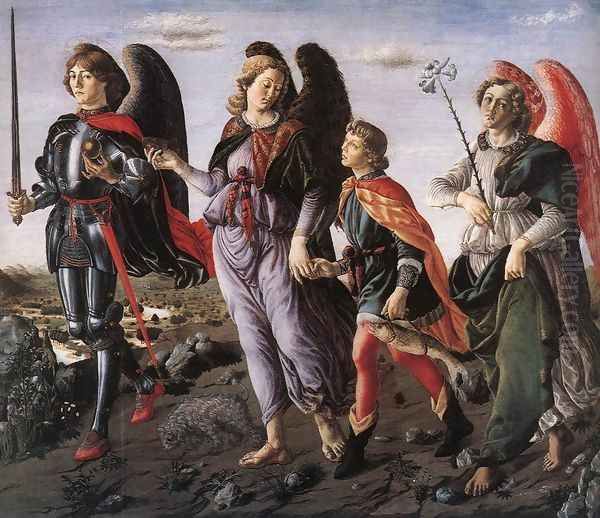
"The Three Archangels with Tobias": This subject, derived from the Book of Tobit, was popular in Florence, particularly with confraternities dedicated to the Archangel Raphael, the guardian of travelers. Botticini's version (Florence, Uffizi Gallery) is a notable example, displaying his characteristic figure types and attention to detail in the landscape and costumes. The work is often compared to similar compositions by artists like Filippino Lippi and the workshop of Verrocchio.
"Saint Jerome in Penitence with Saints Damasus, Eusebius, Paula, and Eustochium" (The San Gerolamo Altarpiece): Originally for the high altar of the church of the convent of San Gerolamo in Fiesole (now National Gallery, London), this work, dating from the 1490s, shows Botticini's later style. It features a central panel of Saint Jerome in the wilderness, flanked by panels depicting other saints associated with him. The predella below illustrates scenes from their lives.
"Coronation of the Virgin": Another grand celestial theme that Botticini tackled, showcasing his ability to depict heavenly hierarchies and divine glory, similar in some respects to the upper zone of the Palmieri Altarpiece.
His works are found in numerous collections worldwide, including the Galleria Palatina (Palazzo Pitti) in Florence, the Louvre in Paris, the Metropolitan Museum of Art in New York, and the Museo Soumaya in Mexico City, attesting to the dispersal of his art over centuries.
The "Assumption of the Virgin": A Deeper Look at Controversy and Context
The Palmieri Altarpiece, or "Assumption of the Virgin," warrants further discussion due to its central place in Botticini's oeuvre and the historical debates it ignited. Matteo Palmieri (1406-1475) was a respected figure in Florentine society, known for his learning and civic service. His poem, "Città di vita," completed shortly before his death, was an ambitious attempt to synthesize Christian doctrine with classical philosophy, particularly Neoplatonism, which was experiencing a revival in Florence through figures like Marsilio Ficino.
Palmieri's specific theological deviation concerned the nature of angels and human souls. The orthodox view held that human souls were created directly by God at the moment of conception. Palmieri, however, drawing on Origenist ideas (Origen being an early Church Father whose views were later condemned), proposed that human souls were pre-existent angelic spirits. This was a significant departure from established dogma.
When Botticini was commissioned to paint the altarpiece for Palmieri's funerary chapel, it was intended to be a visual testament to Palmieri's piety and his hopes for salvation. The inclusion of the donor portraits, a common practice, firmly linked the sacred scene to the earthly patron. The depiction of the angelic hierarchies in the upper zone, while visually spectacular, could have been interpreted by those aware of Palmieri's poem as an allusion to his specific cosmological views.
The charge of heresy, as reported by Vasari, suggests that the painting, by association with Palmieri's controversial writings, became a focal point for theological scrutiny. It is important to note that artists in this period often worked closely with patrons or their theological advisors on the iconographic programs of their commissions, especially for significant works like altarpieces. Botticini would have likely been instructed on the specific details to include. The extent to which Botticini himself understood or subscribed to Palmieri's unorthodox views is unknown and likely secondary to his role as the skilled executor of the commission.
The controversy surrounding the Palmieri Altarpiece highlights the complex interplay between art, theology, and patronage in Renaissance Florence. It also underscores the potential risks involved when artistic expression or personal belief veered too close to what the Church considered heterodox.
Relationships with Contemporaries and Workshop Practices
Francesco Botticini operated within a dense network of artistic relationships in Florence. His training and subsequent career placed him in contact, direct or indirect, with many of the leading artists of his day.
His time in Neri di Bicci's workshop, however brief, connected him to a long-standing Florentine tradition. Neri's own father, Bicci di Lorenzo, and grandfather, Lorenzo di Bicci, were painters, making Neri part of an established artistic dynasty.
The association with Andrea del Verrocchio's studio, even if not a formal, long-term apprenticeship, would have been particularly significant. Verrocchio's workshop was a crucible of innovation. Besides Leonardo da Vinci, Pietro Perugino, and Lorenzo di Credi, other artists like Francesco di Simone Ferrucci also passed through or were influenced by Verrocchio. The exchange of ideas, techniques, and even preliminary drawings was common in such environments. Botticini's refined modeling and attention to detail may well reflect the high standards set in Verrocchio's circle.
His relationship with Sandro Botticelli is primarily one of nominal similarity and shared cultural context rather than direct collaboration or master-pupil lineage. Both artists responded to the prevailing artistic currents in Florence, but their stylistic trajectories diverged. The confusion between them, however, has persisted in art historical literature and popular perception.
Botticini would also have been aware of the work of artists like Antonio and Piero Pollaiuolo, known for their dynamic figures and exploration of anatomy and movement, often inspired by classical sculpture. The narrative clarity and compositional skills of Domenico Ghirlandaio, who ran another major Florentine workshop, would also have been part of the artistic landscape Botticini navigated.
Like most successful artists of his time, Francesco Botticini likely maintained his own workshop. This would have involved training apprentices and employing assistants to help with the preparation of panels, grinding of pigments, and execution of less critical parts of commissioned works. This collaborative workshop system was essential for meeting the demand for art and for transmitting skills to the next generation. His son, Raffaello Botticini (1477 – c. 1520), followed in his father's footsteps, becoming a painter and inheriting the workshop upon Francesco's death. Raffaello continued to work in a style derived from his father, sometimes leading to difficulties in distinguishing their respective hands, particularly in works from the workshop's later period or those completed by Raffaello after Francesco's death.
Misattributions, Scholarly Reassessment, and Legacy
For a period, Francesco Botticini's artistic identity was somewhat obscured, partly due to the towering reputation of Sandro Botticelli and the occasional confusion arising from their similar names. Additionally, the more traditional aspects of his style, when compared to the groundbreaking innovations of artists like Leonardo da Vinci or the High Renaissance masters who followed, perhaps led to him being relatively undervalued by some later art historians.
However, modern scholarship, beginning notably with the work of art historians in the late 19th and 20th centuries, has done much to clarify Botticini's oeuvre and reassess his contribution to Early Renaissance art. Detailed stylistic analysis, documentary research, and the comparative study of his works have helped to establish a more secure catalogue of his paintings and to differentiate his hand from that of his contemporaries and his son, Raffaello. The monograph by Lisa Venturini (1994) represents a significant milestone in Botticini studies, providing a comprehensive overview of his life and work and firmly establishing his importance as a distinct artistic personality.
The re-evaluation of artists like Francesco Botticini is crucial for a more nuanced understanding of the Renaissance. While "great masters" rightfully command attention, the artistic fabric of a period is woven from the contributions of many talented individuals. Botticini's career demonstrates the vitality of the Florentine workshop system, the diverse stylistic currents at play, and the ways in which artists responded to the devotional needs and intellectual preoccupations of their society.
His legacy is that of a skilled and diligent painter who, while working within the established conventions of his time, produced works of considerable beauty, technical proficiency, and, in the case of the Palmieri Altarpiece, enduring historical interest. He successfully navigated the competitive Florentine art world, secured important commissions, and contributed to the rich artistic heritage of the Quattrocento. His son, Raffaello, continued the workshop tradition, ensuring that the Botticini name remained active in Florentine art into the early 16th century.
Conclusion: Francesco Botticini's Place in Art History
Francesco Botticini died in Florence on January 16, 1497 (some sources suggest 1498), at the age of about 51. He left behind a substantial body of work that firmly situates him as a significant painter of the Florentine Early Renaissance. While he may not have possessed the revolutionary genius of a Leonardo or the poetic intensity of a Sandro Botticelli, Francesco Botticini was a master craftsman with a distinct artistic voice. His paintings, characterized by their clear compositions, graceful figures, vibrant colors, and meticulous detail, effectively met the devotional and aesthetic demands of his patrons.
His art reflects a synthesis of influences, from the workshop traditions of Neri di Bicci to the more sophisticated naturalism and expressive power associated with Andrea del Verrocchio and his circle. He engaged with the dominant religious themes of his era, creating altarpieces and devotional panels that adorned churches and private homes throughout Florence and its environs. The Palmieri Altarpiece, his most celebrated and controversial work, remains a testament to his ambition and skill, and a fascinating document of the intersection of art, humanism, and theology in Quattrocento Florence.
Through the dedicated work of art historians, Francesco Botticini has emerged from the shadows of his more famous contemporaries to be recognized as an important artist in his own right. His career illuminates the broader artistic culture of Renaissance Florence, a city teeming with talent, where artists like Botticini played a vital role in shaping the visual landscape and fulfilling the spiritual and aesthetic aspirations of their society. His paintings continue to be appreciated for their devotional sincerity, their refined execution, and the window they offer into a pivotal moment in the history of Western art.