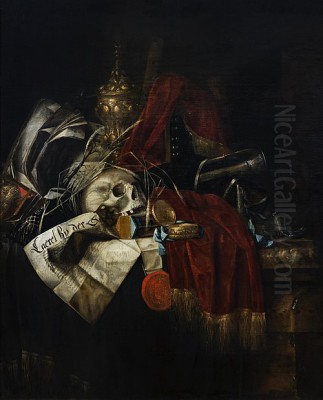
Franciscus Gysbrechts, a Flemish painter active during the latter half of the 17th century, carved a distinct niche for himself in the vibrant art world of the Dutch Golden Age and its peripheries. Though biographical details about him remain somewhat scarce compared to his more famous contemporaries, his surviving works, particularly his masterful trompe-l'oeil and vanitas still lifes, speak volumes of his skill, ingenuity, and understanding of the profound themes that preoccupied his era. As the son of the equally, if not more, renowned painter Cornelis Norbertus Gijsbrechts, Franciscus inherited a rich artistic legacy, which he adeptly built upon, leaving his own indelible mark on the history of art.
Early Life and Artistic Lineage in Antwerp
Franciscus Gysbrechts is generally believed to have been born in Antwerp, a bustling artistic hub, around 1649. More precise records indicate he was baptized in Antwerp on February 25, 1649. He was the son of Anna Moons and Cornelis Norbertus Gijsbrechts, a painter who would later achieve significant fame as a court artist in Denmark, specializing in the very genres his son would come to master. The artistic environment of Antwerp, with its strong guilds and traditions in still life and genre painting, undoubtedly shaped young Franciscus's early sensibilities.
It is almost certain that Franciscus received his primary artistic training from his father. In the 17th century, it was common practice for sons to apprentice with their fathers, learning the craft from a young age within the family workshop. This direct tutelage would have provided Franciscus with an intimate understanding of Cornelis's techniques, thematic concerns, and innovative approaches to trompe-l'oeil – the art of "deceiving the eye." The influence of Cornelis Norbertus Gijsbrechts is palpable in Franciscus's work, yet Franciscus was no mere copyist; he developed his own distinct voice and variations within the established family style.
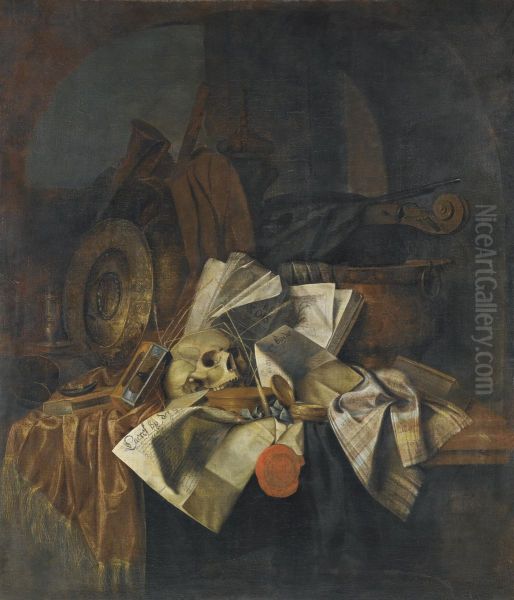
The Gijsbrechts family name was already associated with artistic skill. Cornelis Norbertus was himself likely influenced by the rich tradition of Flemish still life painting, which included pioneers like Osias Beert the Elder, Clara Peeters, and Frans Snyders, who had elevated the genre with their meticulous detail and often symbolic content. Later masters such as Jan Davidsz. de Heem further pushed the boundaries of opulent still life, or "pronkstilleven." While the Gijsbrechts focused less on opulence and more on illusion and intellectual puzzles, the underlying technical skill required was a shared heritage.
The Shadow and Light of a Famous Father: Cornelis Norbertus Gijsbrechts
To understand Franciscus, one must first appreciate the artistic stature of his father, Cornelis Norbertus Gijsbrechts (active c. 1657–1675). Cornelis was a virtuoso of trompe-l'oeil. His works often featured "chaotic" studio walls, letter racks (quodlibets), hunting gear, or the reverse side of paintings, all rendered with such astonishing realism that viewers were tempted to reach out and touch the depicted objects. He played with the very nature of painting, questioning the boundaries between reality and representation.
Cornelis Norbertus Gijsbrechts's career took a significant turn when he entered the service of the Danish King Frederick III around 1668, and later his successor Christian V, in Copenhagen. He remained there until about 1672. During his Danish period, he produced some of his most iconic and ambitious trompe-l'oeil works, many of which are still preserved in the Danish Royal Collection at Rosenborg Castle or the Statens Museum for Kunst. These include elaborate compositions depicting hunting equipment, musical instruments, and the famous "easel" paintings, which create the illusion of a painting in progress.
This paternal success and specialization undoubtedly set the stage for Franciscus. He would have been intimately familiar with his father's methods: the careful arrangement of objects, the precise rendering of textures, the subtle manipulation of light and shadow to create convincing three-dimensionality, and the intellectual playfulness inherent in the genre. The themes of vanitas – the transience of life and the futility of earthly pursuits – were also central to Cornelis's oeuvre, often interwoven with his trompe-l'oeil deceptions.
Franciscus's Emergence: Early Works and Travels
While specific details of Franciscus Gysbrechts's early independent career are not extensively documented, it is known that he was active as a painter. Some sources suggest that he may have accompanied his father to the Danish court or joined him there. Given their shared specialization, it is plausible that they collaborated or that Franciscus assisted in his father's workshop before establishing his own reputation.
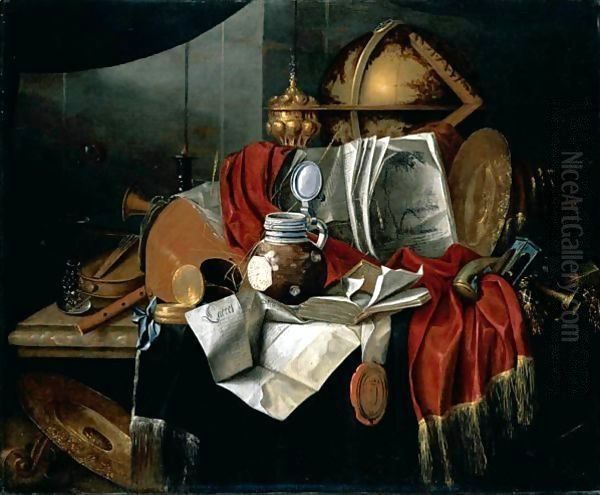
Art historical records indicate Franciscus was active from at least 1672, a period that coincides with his father's departure from the Danish court. However, some scholars propose earlier activity. There is evidence suggesting Franciscus may have worked in Germany during the 1660s. Specifically, mentions of activity in Regensburg, possibly in connection with the Imperial Diet or even in the service of Emperor Leopold I, have surfaced, though concrete commissions or documented patronage from this period are elusive. Hamburg has also been cited as a potential place of work around 1664-1665.
His first securely dated works begin to appear in the early 1670s. These paintings demonstrate a clear continuation of the trompe-l'oeil and vanitas traditions championed by his father. Franciscus, however, often brought a slightly different sensibility to his compositions, sometimes with a more overt or densely packed symbolism in his vanitas pieces.
The Art of Trompe-l'oeil: Deceiving the Senses
Franciscus Gysbrechts excelled in trompe-l'oeil, a genre that enjoyed immense popularity in the 17th century. The term, French for "deceive the eye," refers to paintings that create such a convincing illusion of three-dimensionality that the viewer momentarily mistakes the depicted objects for real ones. This required not only exceptional technical skill but also a keen understanding of perspective, light, and the psychology of perception.
Artists like Samuel van Hoogstraten, a Dutch contemporary, were also renowned for their perspective boxes and trompe-l'oeil paintings, demonstrating the widespread fascination with illusionistic art across the Low Countries. The appeal of trompe-l'oeil lay in its intellectual wit, its playful challenge to the viewer's senses, and its demonstration of the artist's supreme technical mastery. It was a form of visual game, delighting patrons with its cleverness.
Franciscus Gysbrechts's trompe-l'oeil works often feature arrangements of everyday objects: letters, documents, artists' tools, musical instruments, or hunting paraphernalia, seemingly tacked to a wooden board or casually assembled. A prime example is his "Trompe l’Oeil with Violin, Painting Tools and Self-Portrait" (1674). In this intricate piece, a violin appears to hang from a nail, casting a shadow, while brushes, a palette, a maulstick, and a small, almost hidden self-portrait of the artist are meticulously rendered, creating a compelling illusion of a shallow space filled with tangible items. The inclusion of the self-portrait adds another layer, a self-referential nod to the artist as the creator of this deception.
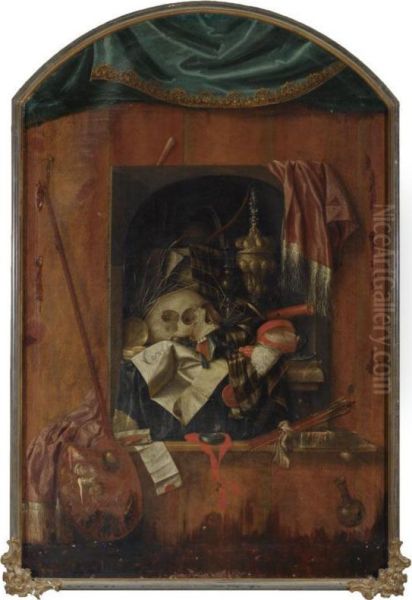
Another significant work, "Trompe l’Oeil with Studio Wall and Vanitas Still Life," showcases a cluttered artist's wall. Here, Gysbrechts combines the trompe-l'oeil of the studio setting with a distinct vanitas still life within it, demonstrating his ability to merge these related but distinct thematic concerns. The objects – sketches, a palette, brushes, and a framed vanitas painting – are rendered with such precision that they seem to project from the canvas.
Vanitas: Meditations on Mortality and Meaning
Closely linked to his trompe-l'oeil practice was Franciscus Gysbrechts's engagement with the vanitas theme. Vanitas still lifes were a moralizing genre, reminding viewers of the fleeting nature of earthly life, the vanity of worldly pleasures, and the inevitability of death. The term derives from the biblical Book of Ecclesiastes: "Vanity of vanities, all is vanity." These paintings were particularly prevalent in the Calvinist Netherlands, where they served as a visual sermon.
Gysbrechts's vanitas compositions are rich in symbolism. Common motifs include:
Skulls: The most direct symbol of death (memento mori).
Hourglasses or clocks: The passage of time.
Snuffed-out candles or oil lamps: The extinguished flame of life.
Musical instruments and sheet music: The ephemeral nature of pleasure and worldly pursuits.
Books and globes: The limits of human knowledge and earthly ambition.
Jewelry, coins, and luxurious fabrics: The vanity of wealth and material possessions.
Flowers (often wilting) and fruit (often decaying): The transience of beauty and life.
Soap bubbles: The brevity and fragility of life (homo bulla – "man is a bubble").
One of Franciscus Gysbrechts's notable vanitas works is simply titled "Vanitas Still Life." These paintings typically feature a carefully arranged collection of such symbolic objects, often set against a dark, dramatic background. For instance, a skull might be juxtaposed with an open book, a lute with its strings broken, a guttering candle, and perhaps a wilting flower. The meticulous realism of the trompe-l'oeil technique, when applied to vanitas subjects, made the moral message even more potent: these symbols of decay and transience were presented as undeniably "real."
Artists like Edwaert Collier, Pieter Claesz, and Willem Claesz. Heda were also masters of the vanitas and "monochrome banketje" (monochromatic banquet) still lifes, each bringing their own nuances to the genre. Gysbrechts's contribution lies in the seamless integration of vanitas symbolism with the heightened illusionism inherited from his father, creating works that were both visually stunning and intellectually profound.
Notable Compositions and Their Characteristics
Beyond the general categories of trompe-l'oeil and vanitas, specific works by Franciscus Gysbrechts highlight his artistic concerns and skills.
"Quodlibet" Paintings: The term "quodlibet" (Latin for "what you please" or "whatever you like") in art refers to a trompe-l'oeil painting depicting a collection of flat objects like letters, prints, playing cards, or ribbons, seemingly tacked or stuck onto a board. Franciscus, like his father, produced such works. These compositions were particularly popular for their personal and often humorous allusions, as the items depicted could be tailored to the patron's interests. His "Quodlibet with Meninas" is an intriguing example, potentially referencing the famous work by Diego Velázquez, suggesting an awareness of broader European artistic currents.
"The Attributes of the Painter": This theme, explored by various artists, allowed Gysbrechts to reflect on his own profession. Such paintings would typically depict the tools of the artist's trade – palettes, brushes, easels, pigments, perhaps casts or books – arranged in a still life. These works served not only as a display of technical skill but also as an assertion of the painter's intellectual status, aligning art with the liberal arts rather than mere craft.
His compositions are often characterized by a dense arrangement of objects, a rich, sometimes somber palette, and a meticulous attention to texture. Whether depicting the smooth, cold surface of a skull, the delicate transparency of a soap bubble, or the worn wood of a picture frame, Gysbrechts demonstrated an extraordinary ability to replicate the visual and tactile qualities of the world around him.
The Danish Connection and Later Career
The period from roughly 1668 to 1672, when Cornelis Norbertus Gijsbrechts was active at the Danish court in Copenhagen, is crucial. While Franciscus's presence there isn't as definitively documented as his father's, it is highly probable he spent time in Copenhagen, possibly working alongside or under his father. The Danish Royal Collection holds numerous works by "Gijsbrechts," and art historians have worked to distinguish the hands of father and son. Franciscus's signed and dated works from the 1670s often show a strong affinity with the themes and techniques popularized by his father during the Danish period.
After Cornelis Norbertus left Denmark around 1672, Franciscus seems to have continued working, producing signed pieces. His known activity extends to at least 1676 or 1677. The circumstances of his later life and death are not well-documented. Some art historical accounts suggest he died around 1677. There is speculation that after his father's departure from Copenhagen, Franciscus might have sought patronage elsewhere, with some unconfirmed suggestions of activity in Stockholm, Sweden, including a potential large mural. However, concrete evidence for this Swedish period is lacking.
The relative scarcity of information about Franciscus Gysbrechts's later years contributes to his somewhat enigmatic status. Unlike artists such as Rembrandt van Rijn or Johannes Vermeer, whose lives and careers have been extensively researched, Franciscus remains a figure primarily understood through his surviving artworks.
Artistic Style: A Synthesis of Realism and Symbolism
Franciscus Gysbrechts's artistic style can be summarized as a masterful blend of meticulous realism and profound symbolism, executed with exceptional technical skill.
Illusionism: His primary stylistic hallmark is his command of trompe-l'oeil. He understood how to manipulate perspective, light, shadow, and texture to create convincing illusions of three-dimensional space and tangible objects on a two-dimensional surface. This was not mere trickery but a sophisticated exploration of the nature of representation.
Detailed Realism: Every object in his paintings is rendered with painstaking attention to detail. The sheen on a silver candlestick, the grain of wood, the crinkles in a piece of parchment, the translucency of glass – all are captured with remarkable fidelity. This hyper-realism was essential for both the success of the trompe-l'oeil and the impact of the vanitas message.
Symbolic Depth: His vanitas paintings are laden with iconographic meaning. He employed a rich vocabulary of symbols to convey complex moral and philosophical ideas about time, mortality, and the ephemeral nature of human existence. This intellectual content elevated his still lifes beyond mere depictions of objects.
Compositional Skill: Gysbrechts carefully arranged his objects to create balanced yet dynamic compositions. In his trompe-l'oeil works, the arrangements often appear casual or even chaotic, enhancing the illusion of a real, unposed scene. In his vanitas pieces, the objects are often more formally grouped to emphasize their symbolic relationships.
Use of Light and Shadow (Chiaroscuro): Like many Baroque artists, Gysbrechts skillfully used light and shadow to model forms, create a sense of depth, and add drama to his compositions. His lighting is often focused and directional, highlighting key objects and casting convincing shadows that contribute to the trompe-l'oeil effect.
Influence of his Father: The thematic and stylistic parallels with Cornelis Norbertus Gijsbrechts are undeniable. Franciscus operated within a tradition established by his father, but he was not simply an imitator. He developed his own variations and perhaps a slightly more melancholic or introspective tone in some of his vanitas works.
Contemporaries and the Broader Artistic Context
Franciscus Gysbrechts worked during a period of extraordinary artistic ferment in Northern Europe. The Dutch Golden Age was at its zenith, with masters like Rembrandt, Vermeer, Frans Hals, and Jacob van Ruisdael producing iconic works. In Flanders, though past its peak glory of Rubens and Van Dyck, a strong tradition of genre and still life painting continued with artists like David Teniers the Younger and Gonzales Coques.
Within the specific realm of still life and trompe-l'oeil, Gysbrechts was part of a vibrant international community. Besides his father and the aforementioned Samuel van Hoogstraten and Edwaert Collier, other artists exploring similar themes included the German-Danish court painter Wolfgang Heimbach, who also worked for Frederick III, and Dutch artists like Willem Kalf, known for his opulent pronkstilleven, or Abraham Mignon, famed for his flower pieces often imbued with vanitas undertones. In France, Jean-Baptiste Monnoyer was a leading still life painter, and later, Jean-Baptiste-Siméon Chardin would elevate still life to new heights of poetic realism. Even in Spain, artists like Juan Sánchez Cotán had earlier pioneered a stark, illusionistic form of still life.
The courts, like the Danish court where the Gijsbrechts family found patronage, were important centers for artistic exchange. Artists traveled, and prints circulated, disseminating styles and ideas. The presence of artists like Karel van Mander III and Abraham Wuchters at the Danish court indicates a cosmopolitan artistic environment. Franciscus Gysbrechts's work, therefore, should be seen not in isolation but as part of this broader European conversation about realism, illusion, and the deeper meanings of art.
Legacy and Art Historical Significance
Franciscus Gysbrechts, though perhaps overshadowed by his father in terms of historical fame and the sheer audacity of some of Cornelis's trompe-l'oeil inventions (like the "Reverse of a Framed Painting"), remains an important figure in the history of still life and illusionistic painting. His works are prized for their technical brilliance, their intellectual depth, and their quintessential Baroque sensibility.
His contributions include:
Perpetuation and Refinement of Trompe-l'oeil: He helped sustain the popularity and development of this intriguing genre, demonstrating its enduring appeal.
Powerful Vanitas Imagery: His vanitas still lifes are compelling visual meditations on universal themes, executed with a sincerity and skill that make them timeless.
A Bridge in the Gijsbrechts Legacy: He forms a crucial link in the Gijsbrechts artistic lineage, absorbing his father's innovations and carrying them forward.
Representation in Collections: His works are found in significant museum collections, including the Statens Museum for Kunst in Copenhagen, various regional museums in Europe, and private collections, allowing contemporary audiences to appreciate his skill.
While the precise details of his life may be incomplete, Franciscus Gysbrechts's paintings offer a clear testament to his talent. He was a painter who could not only deceive the eye but also engage the mind and stir the soul. His art invites us to look closely, to marvel at the illusion, and to ponder the fleeting nature of the very world he so convincingly depicted. In the grand tapestry of 17th-century art, Franciscus Gysbrechts holds a secure and respected place as a master of his chosen genres. His meticulous craftsmanship and thoughtful engagement with the profound themes of his time ensure his continued relevance and appreciation among art historians and enthusiasts alike.