François Dumont (1751–1831) stands as one of the preeminent French miniaturists of the late 18th and early 19th centuries. His career spanned a tumultuous period in French history, witnessing the opulence of the Ancien Régime, the upheaval of the French Revolution, the rise and fall of Napoleon Bonaparte, and the subsequent Bourbon Restoration. Through all these changes, Dumont maintained a remarkable consistency in his artistic output, producing exquisitely detailed and psychologically insightful miniature portraits that captured the likenesses of royalty, aristocracy, and prominent figures of his time. His work is characterized by its delicate execution, refined elegance, and the intimate portrayal of his sitters, making him a sought-after artist whose legacy endures in the collections of major museums worldwide.
Early Life and Artistic Formation
Born in Lunéville, in the Duchy of Lorraine, in 1751, François Dumont emerged from a region with a rich artistic heritage. His early artistic inclinations were nurtured locally, and he is believed to have received initial training from Jean Girardet, a painter known for his historical scenes and portraits. Lunéville, at the time, was a significant cultural center, particularly under the rule of Stanisław Leszczyński, the deposed King of Poland and Duke of Lorraine. This environment likely provided the young Dumont with exposure to various artistic currents and the patronage system that supported artists.
Seeking broader opportunities and more advanced instruction, Dumont, like many aspiring artists of his generation, made his way to Paris. The capital was the undisputed center of the European art world, home to the prestigious Académie Royale de Peinture et de Sculpture, which dictated artistic standards and provided crucial avenues for exhibition and recognition. In Paris, Dumont would have immersed himself in the study of works by established masters and honed his skills, particularly in the specialized art of miniature painting. This demanding genre required exceptional precision, a keen eye for detail, and the ability to work on a small scale, often on delicate surfaces like ivory.
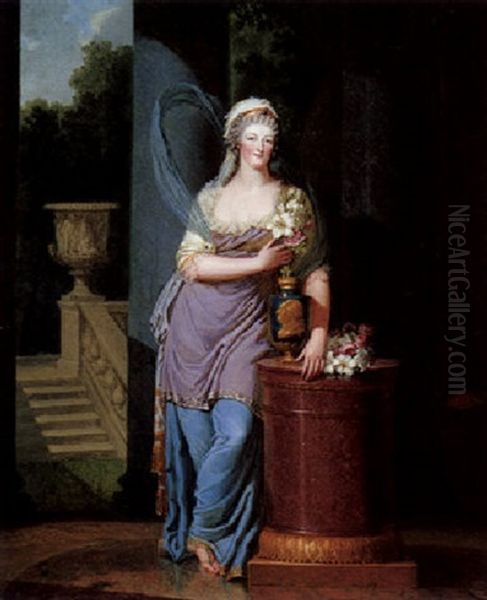
The 1770s and 1780s in Paris were a vibrant period for the arts. While the Rococo style, with its lightness and sensuality, as exemplified by artists like Jean-Honoré Fragonard and François Boucher (though Boucher died in 1770, his influence lingered), was still appreciated, a more sober and morally serious Neoclassical style was gaining ascendancy. This shift was championed by figures such as Jacques-Louis David, whose powerful historical paintings would soon redefine French art. Portraiture, in both large and miniature formats, remained highly popular, serving to commemorate individuals, express social status, and foster personal connections.
Ascent to Prominence and Royal Patronage
François Dumont's talent did not go unnoticed for long in the competitive Parisian art scene. By the 1780s, he had established a reputation as a skilled miniaturist. A significant milestone in his career came in 1788 when he was received (agréé) by the Académie Royale de Peinture et de Sculpture. Membership in the Academy was a mark of high distinction, granting artists official recognition and the right to exhibit at the prestigious Salon, the official art exhibition. For a miniaturist to achieve this status underscored the high regard in which his work was held, as miniature painting, while popular, was sometimes considered a lesser art form compared to large-scale history painting or portraiture.
His acceptance into the Academy coincided with his appointment as a painter to Queen Marie Antoinette. This royal patronage was a testament to his exceptional skill and the appeal of his delicate and refined style. The Queen, a significant patron of the arts, favored artists who could capture her likeness with both elegance and a degree of fashionable sensibility. Dumont’s ability to create intimate and flattering portraits on a small scale made him an ideal choice for the personal and often sentimental nature of miniature commissions. He also received commissions from other members of the royal family and the court, including King Louis XVI himself.
During this period, Dumont would have been working alongside other prominent court artists. Élisabeth Vigée Le Brun, for instance, was one of Marie Antoinette's favorite portraitists, known for her elegant and often informal depictions of the Queen and her children. Adélaïde Labille-Guiard, another successful female artist and academician, also enjoyed royal and aristocratic patronage. While these artists often worked on a larger canvas, the demand for miniatures remained strong, serving as personal keepsakes, diplomatic gifts, or tokens of affection. Dumont's success in this niche was therefore significant.
The Art of the Miniature: Dumont's Style and Technique
Miniature painting in the late 18th century was a highly specialized art form. Artists typically worked on thin sheets of ivory, which provided a luminous, translucent surface ideal for capturing the subtleties of flesh tones and delicate details. Dumont mastered this medium, employing fine brushes to apply watercolors or gouache with meticulous precision. His technique often involved a combination of stippling (creating tones and forms through tiny dots) and hatching (using fine parallel lines), allowing for subtle gradations of color and a smooth, polished finish.
Dumont’s portraits are characterized by their refined elegance and psychological acuity. He possessed a remarkable ability to capture not only a physical likeness but also a sense of the sitter's personality and inner life. His subjects often gaze directly at the viewer, creating an intimate connection despite the small scale of the work. The costumes and hairstyles are rendered with exquisite detail, reflecting the fashions of the day, yet they rarely overwhelm the sitter's face, which remains the focal point. Backgrounds are typically simple, often a muted wash of color or a suggestion of sky, ensuring that all attention is directed towards the individual.
Compared to some of his contemporaries, Dumont’s style leaned towards a Neoclassical clarity and precision, though infused with a gentle sensitivity. He avoided the overt sentimentality found in the work of some Rococo-influenced artists, yet his portraits are rarely cold or austere. There is a warmth and humanity in his depictions that made them highly appealing. His contemporaries in the field of miniature painting included artists like Peter Adolf Hall, a Swedish-born artist who was highly influential in Paris, known for his free and painterly style, and Louis-Marie Sicard (Sicardi), another celebrated miniaturist of the era. Dumont’s work, while perhaps less flamboyant than Hall's, was prized for its consistent quality and refined execution.
Representative Works
Among François Dumont's most famous and historically significant works are his portraits of Queen Marie Antoinette. One notable example, often cited, depicts the Queen in a blue dress, adorned with pearls and a feather in her hair. Such portraits showcase Dumont's skill in capturing the Queen's delicate features, her regal bearing, and the luxurious textures of her attire. These miniatures served not only as personal mementos for the Queen and her circle but also as images that could be easily replicated and disseminated, albeit to a select audience.
He also painted King Louis XVI, and his ability to secure commissions from both the King and Queen underscores his esteemed position at court. Beyond the immediate royal family, Dumont portrayed numerous members of the aristocracy and influential figures of the Ancien Régime. Each portrait, though small, was a carefully crafted work of art, designed to be held in the hand, worn as jewelry, or kept in a precious case.
The demand for such portraits was high. They were exchanged as gifts between loved ones, carried by travelers as reminders of home, and used in diplomatic exchanges. The intimate scale of miniatures fostered a personal connection with the image that was different from the experience of viewing a large, formal portrait. Dumont excelled in creating these precious objects, imbuing them with both artistic merit and sentimental value. His oeuvre includes portraits of men, women, and children, each rendered with his characteristic attention to detail and sensitive portrayal of character.
Navigating the French Revolution
The French Revolution, beginning in 1789, brought profound and violent changes to French society, and the art world was not immune. Artists who had enjoyed royal patronage, like Dumont, faced a precarious situation. The abolition of the monarchy, the Reign of Terror, and the execution of Louis XVI and Marie Antoinette in 1793 dramatically altered the landscape of artistic patronage. Many aristocrats, who had been key clients for portraitists, either fled the country or met a similar fate.
Despite his close association with the fallen monarchy, François Dumont managed to navigate this turbulent period. This suggests a degree of adaptability and perhaps a recognition of his artistic skill that transcended political affiliations. While commissions from the former court ceased, new patrons emerged from the ranks of the revolutionary government and the rising bourgeoisie. The desire for portraiture, as a means of self-representation and commemoration, persisted, albeit with a shift in clientele and perhaps in the style of presentation.
Other artists faced similar challenges. Jacques-Louis David, for example, became a fervent supporter of the Revolution and its official artist, producing iconic images like "The Death of Marat." His Neoclassical style, with its emphasis on civic virtue and heroism, resonated with the ideals of the new republic. Miniaturists like Jean-Baptiste Isabey, who was reportedly a pupil of Dumont and later of David, also found success during this period, adapting his style to suit the changing tastes and patrons, eventually becoming a favorite of Napoleon and Empress Joséphine. Dumont’s ability to continue working suggests he too found ways to adapt, perhaps focusing on less overtly political subjects or cultivating a new network of clients.
The Napoleonic Era and Later Career
With the rise of Napoleon Bonaparte, first as Consul and then as Emperor, a new era of artistic patronage began. Napoleon understood the power of art as a tool for propaganda and self-glorification, and he commissioned numerous works to commemorate his military victories and legitimize his rule. While large-scale historical paintings and grand portraits were favored, miniature painting continued to thrive.
François Dumont continued to be active during the Napoleonic Empire and the subsequent Bourbon Restoration. He painted portraits of figures associated with the new regime, demonstrating his enduring appeal as a miniaturist. His style, characterized by its elegance and precision, remained well-suited to the demands of high-status portraiture. He exhibited at the Salon regularly until 1827, showcasing his continued productivity and relevance in the Parisian art world.
During this later phase of his career, he would have witnessed the rise of younger artists and evolving artistic trends. The Neoclassicism of David and his followers, such as Jean-Auguste-Dominique Ingres (though Ingres's major impact came slightly later) and Antoine-Jean Gros (known for his Napoleonic battle scenes and portraits), continued to be influential, but Romanticism was also beginning to emerge as a powerful force. Artists like Théodore Géricault and Eugène Delacroix were challenging Neoclassical conventions with their emphasis on emotion, drama, and exotic subjects.
Despite these shifts, Dumont remained committed to his specialized art form. He painted portraits of King Louis XVIII and King Charles X after the restoration of the Bourbon monarchy, indicating his ability to maintain favor across different political regimes. This adaptability, coupled with his consistent artistic quality, ensured his continued success throughout a long and distinguished career. Other portraitists of this era, such as François Gérard, also navigated these political changes successfully, producing elegant portraits for a succession of rulers and prominent figures.
Contemporaries and the Artistic Milieu
François Dumont operated within a vibrant and competitive artistic milieu. As a miniaturist, his direct contemporaries and potential rivals included the aforementioned Peter Adolf Hall, Louis-Marie Sicard, and Jean-Baptiste Isabey. Isabey, in particular, became one of the most celebrated miniaturists of the Napoleonic era and beyond, known for his highly polished and sophisticated portraits. While Isabey may have achieved greater international fame, Dumont maintained a strong reputation for the quality and refinement of his work.
Beyond the world of miniaturists, Dumont's career overlapped with numerous significant painters. The towering figure of Jacques-Louis David cast a long shadow over French art, and his Neoclassical ideals influenced many. Portraitists like Élisabeth Vigée Le Brun and Adélaïde Labille-Guiard, as mentioned, were prominent during the Ancien Régime. Later, under Napoleon and the Restoration, artists like François Gérard and Antoine-Jean Gros were leading portrait painters.
The art of sculpture also flourished, with figures like Jean-Antoine Houdon creating remarkably lifelike and psychologically penetrating portraits in marble and bronze. The artistic environment in Paris was dynamic, with ongoing debates about style, subject matter, and the role of art in society. The Académie, the Salon, and the various private studios and artistic circles fostered both collaboration and competition.
Dumont’s friendship with the still-life painter Anne Vallayer-Coster, another successful female academician, is also noteworthy. They were contemporaries, and both enjoyed royal patronage. Such connections highlight the interconnectedness of the Parisian art world, where artists across different genres and specializations interacted and influenced one another. Even artists working in different styles, such as Jean-Baptiste Greuze, known for his sentimental genre scenes and moralizing subjects, contributed to the rich tapestry of late 18th-century French art. The landscape painter Hubert Robert, famous for his picturesque views of ruins, also enjoyed considerable success during this period.
Legacy and Historical Assessment
François Dumont died in Paris in 1831, leaving behind a significant body of work that attests to his skill and artistry. He is remembered as one of the leading French miniaturists of his time, a master of a demanding and delicate art form. His portraits are valued not only for their artistic merit but also as historical documents, providing a visual record of the prominent figures of a transformative era in French history.
His influence can be seen in the work of his pupils and followers. While the popularity of miniature painting began to decline with the advent of photography in the mid-19th century, the tradition of fine miniature work, as exemplified by Dumont, set a high standard. His ability to capture both likeness and character with such precision and elegance ensures his enduring reputation.
Art historians today recognize Dumont for his technical mastery, the consistent quality of his output, and his ability to adapt to changing political and social circumstances. His works are held in major museum collections, including the Louvre in Paris, the Wallace Collection in London, and the Metropolitan Museum of Art in New York, where they are studied and admired for their exquisite detail and historical significance. He successfully navigated the patronage systems of the Ancien Régime, the Revolution, the Napoleonic Empire, and the Restoration, a testament to both his artistic talent and his professional acumen.
While perhaps not as revolutionary a figure as Jacques-Louis David, or as internationally renowned in his lifetime as Jean-Baptiste Isabey in his later years, François Dumont holds a secure place in the history of French art. He represents the pinnacle of a particular artistic tradition, creating intimate and enduring portraits that continue to fascinate and delight viewers. His dedication to the art of the miniature, in an age of grand artistic statements and dramatic societal shifts, speaks to the enduring human desire for personal mementos and finely crafted objects of beauty.
Conclusion
François Dumont's career as a miniaturist offers a fascinating window into the art world of late 18th and early 19th-century France. From his early training in Lunéville to his rise as a court painter in Paris, he demonstrated exceptional talent and dedication to his craft. His miniature portraits, characterized by their delicate execution, psychological insight, and refined elegance, captured the likenesses of some of the most famous figures of his era, including Queen Marie Antoinette and successive French monarchs.
Navigating the treacherous currents of the French Revolution and the subsequent political transformations, Dumont maintained a successful career, adapting to new patrons and evolving tastes while remaining true to his artistic principles. His work stands as a testament to the enduring appeal of miniature portraiture and his own mastery of this intricate art form. Today, François Dumont is recognized as a key figure in the history of miniature painting, an artist whose meticulous skill and sensitive portrayals created lasting images of an age of profound change. His legacy is preserved in the exquisite works he left behind, each a small masterpiece of precision and artistry.