Franz von Matsch (1861–1942) stands as a significant, if sometimes overshadowed, figure in the vibrant artistic landscape of Vienna during the late 19th and early 20th centuries. An Austrian painter and sculptor, Matsch was a prominent exponent of the historicist and early Art Nouveau styles that characterized the grand Ringstrasse era. His career was marked by prestigious public commissions, a fruitful collaboration with the burgeoning talent Gustav Klimt, and a steadfast adherence to academic traditions even as modernism began to reshape the European art world.
Early Life and Artistic Formation
Born in St. Pölten, Lower Austria, Franz Matsch's artistic inclinations led him to Vienna, the imperial capital and a burgeoning center of artistic innovation. He enrolled at the Kunstgewerbeschule (School of Arts and Crafts), an institution pivotal in shaping the applied arts in Austria-Hungary. It was here that he honed his skills in drawing, painting, and decorative design. His education instilled in him a deep appreciation for classical forms, meticulous craftsmanship, and the integration of art with architecture, principles that would define much of his career.
During his studies, Matsch formed a close bond with two fellow students: Gustav Klimt and his younger brother, Ernst Klimt. This trio, sharing similar artistic ambitions and a pragmatic approach to securing work, would soon embark on a collaborative venture that would leave an indelible mark on Vienna's architectural landmarks. Their professor, Ferdinand Laufberger, a respected historical painter, undoubtedly influenced their early stylistic leanings towards academic realism and historical subject matter.
The Künstler-Compagnie: A Triumvirate of Talent
In 1883, Franz von Matsch, Gustav Klimt, and Ernst Klimt formally established the "Künstler-Compagnie" (Artists' Company). This collective was a strategic move, allowing them to undertake large-scale decorative projects that were in high demand for the newly constructed public buildings lining Vienna's magnificent Ringstrasse. Their ability to work harmoniously, often subsuming individual styles for a cohesive overall effect, made them highly sought after by prominent architects of the day, such as Gottfried Semper and Karl von Hasenauer.
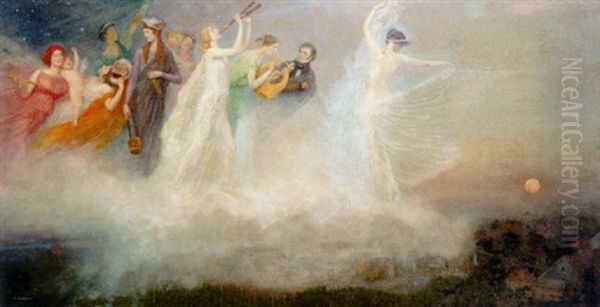
The Künstler-Compagnie quickly gained recognition for its professionalism and artistic quality. Their early commissions included decorative paintings for buildings in Reichenberg (Liberec), Fiume (Rijeka), and for the Romanian Royal Palace. However, their breakthrough came with commissions for two of Vienna's most prestigious cultural institutions: the Burgtheater (Imperial Court Theatre) and the Kunsthistorisches Museum (Museum of Art History).
Monumental Murals: The Burgtheater and Kunsthistorisches Museum
The commission to decorate the grand staircases of the new Burgtheater, completed between 1886 and 1888, was a significant achievement for the young artists. Matsch, alongside the Klimt brothers, created a series of lunettes and ceiling paintings depicting scenes from the history of theatre, from ancient Greek drama to Shakespearean plays. Matsch's contributions, such as "Thespis' Cart" and scenes from Molière, demonstrated his skill in historical narrative and his adherence to a clear, academic style, which was well-received by the conservative Viennese establishment. The overall project was a triumph, earning the artists the Golden Cross of Merit from Emperor Franz Joseph I.
Following this success, the Künstler-Compagnie was entrusted with decorating the spandrels and intercolumnar spaces of the grand staircase in the Kunsthistorisches Museum (1890-1891). Here, they depicted allegorical figures and scenes representing various periods of art history, from Egyptian and Greek antiquity through the Renaissance. Matsch's panels, such as those representing Roman and Early Christian art, again showcased his classical training and ability to integrate painting seamlessly with the opulent architectural setting designed by Hasenauer and Semper. These works further solidified their reputation and placed them in the lineage of great decorative painters like Hans Makart, whose monumental style had dominated Viennese art in the preceding decades.
The Achilleion Palace and "The Apotheosis of Achilles"
Beyond the collaborative projects, Matsch also undertook significant individual commissions. One of the most notable was for Empress Elisabeth of Austria, who commissioned him to create frescoes for her lavish summer palace, the Achilleion, in Corfu, Greece. Built between 1890 and 1892, the palace was themed around the Greek hero Achilles. Matsch was tasked with decorating the main ceremonial staircase with scenes from Achilles' life.
His magnum opus there is the monumental ceiling fresco, "The Apotheosis of Achilles" (or "The Triumph of Achilles"). This dramatic composition depicts Achilles, victorious yet doomed, ascending to Olympus or being carried into the heavens after his death. The work is a powerful example of late historicism, imbued with a sense of pathos and grandeur. It showcases Matsch's mastery of complex figural arrangements, dynamic movement, and rich, albeit somewhat academic, color palettes. The choice of subject reflected the Empress's own romantic and melancholic fascination with heroism and tragic destiny. This commission brought Matsch international recognition and further established his credentials as a leading historical painter.
The University of Vienna Ceiling Paintings: A Point of Divergence
The Künstler-Compagnie received its most ambitious and ultimately controversial commission in 1894: to create allegorical paintings for the ceiling of the Great Hall (Aula) of the University of Vienna. The theme was "The Triumph of Light over Darkness," to be represented by allegories of Philosophy, Medicine, and Jurisprudence, with Matsch assigned "Theology" and the central panel.
However, the artistic landscape was shifting. Ernst Klimt had tragically died in 1892, effectively dissolving the original Künstler-Compagnie, though Matsch and Gustav Klimt continued to collaborate. By the time Gustav Klimt presented his radical, symbolist, and erotically charged interpretations of "Philosophy" (1900) and "Medicine" (1901), they were met with public outcry and fierce criticism from the university faculty and conservative critics for their perceived pessimism and departure from traditional allegorical representation.
Matsch, in contrast, completed his panel "Theology" (and the central "Triumph of Light") in a more conventional, academic style that, while competent, lacked the provocative innovation of Klimt's work. The controversy surrounding Klimt's panels, which were ultimately rejected by the university and never installed, marked a definitive artistic parting of ways between the two former collaborators. Klimt would go on to become a founding member and the first president of the Vienna Secession in 1897, a movement that explicitly broke with the academic traditions Matsch continued to uphold. Other artists who joined Klimt in the Secession included Koloman Moser, Josef Hoffmann, Joseph Maria Olbrich, and Carl Moll, all of whom sought new artistic expressions.
The Anker-Uhr: A Masterpiece of Art Nouveau Timekeeping
Despite the artistic currents moving towards modernism, Matsch continued to receive important commissions. One of his most beloved and enduring public works is the Anker-Uhr (Anker Clock), located on the Hoher Markt in Vienna's city center. Designed between 1911 and 1914 for the Anker Insurance Company, this monumental musical clock is a masterpiece of Art Nouveau design and engineering.
The clock features a bridge spanning an alleyway, adorned with intricate copper and bronze work. Over a twelve-hour period, twelve historical figures or pairs of figures from Viennese history parade across the clock face, each accompanied by a piece of music relevant to their era. These figures include Marcus Aurelius, Charlemagne, Leopold VI, Walther von der Vogelweide, Rudolf IV and his wife, Hans Puchsbaum (architect of St. Stephen's Cathedral), Emperor Maximilian I, Johann Andreas von Liebenberg (mayor during the Siege of Vienna), Ernst Rüdiger von Starhemberg (defender of Vienna), Prince Eugene of Savoy, Empress Maria Theresa and Franz I, and finally, Joseph Haydn. Matsch designed the figures and the overall artistic concept, demonstrating his versatility and his ability to work within the elegant, flowing lines of the Art Nouveau style while still incorporating historical themes. The Anker-Uhr remains a popular tourist attraction and a testament to Matsch's skill in public art.
Academic Career and Later Life
Franz von Matsch's adherence to established artistic norms and his proven track record in monumental decoration made him a respected figure within Vienna's official art institutions. From 1893 to 1902 (sources vary slightly on the end date, with some stating 1895-1901), he served as a professor at the Kunstgewerbeschule, the very institution where he had trained. In this role, he influenced a new generation of artists, imparting the principles of academic draftsmanship and decorative composition.
While Gustav Klimt and his Secessionist colleagues, and later Expressionists like Egon Schiele and Oskar Kokoschka, pushed the boundaries of art, Matsch remained a proponent of a more conservative, albeit highly skilled, artistic approach. He continued to work on portraits, allegorical paintings, and decorative schemes. He was ennobled in 1912, becoming Franz Ritter von Matsch, a recognition of his significant contributions to Austrian art and culture.
His style, while rooted in the 19th-century historicist tradition, did absorb some elements of Art Nouveau, particularly in his decorative work like the Anker-Uhr. However, he never fully embraced the radical subjectivism or stylistic experimentation that came to define early 20th-century modernism. His paintings are characterized by technical proficiency, balanced compositions, and a clear narrative or allegorical intent. Works like his portraits of Viennese society figures or his later historical and mythological scenes maintained a high level of craftsmanship.
Artistic Style: Classicism, Historicism, and Art Nouveau Influences
Franz von Matsch's artistic style can be primarily characterized as academic historicism, deeply influenced by classical and Renaissance art. His training emphasized anatomical accuracy, meticulous rendering of detail, and the creation of harmonious, often grand, compositions. This is evident in his large-scale murals for the Burgtheater and Kunsthistorisches Museum, where historical and allegorical figures are depicted with clarity and dignity.
His mythological works, such as "The Apotheosis of Achilles," reveal a romantic sensibility, imbuing classical themes with dramatic intensity and emotional depth, reminiscent of some aspects of Baroque art. While he was a contemporary of the Impressionists and Post-Impressionists like Claude Monet, Edgar Degas, Vincent van Gogh, and Paul Cézanne, their revolutionary approaches to light, color, and form did not significantly alter Matsch's fundamentally academic approach to painting.
However, Matsch was not immune to the prevailing artistic currents of his time. The influence of Art Nouveau (Jugendstil in German-speaking countries) is discernible in the flowing lines, decorative motifs, and overall design of works like the Anker-Uhr. Here, the organic forms and stylized figures align with the aesthetic principles championed by artists like Alphonse Mucha or Hector Guimard, albeit in a distinctly Viennese interpretation.
Unlike Gustav Klimt, who evolved from historicism to a highly personal and iconic Symbolist style, incorporating gold leaf and mosaic-like patterns, Matsch remained more grounded in traditional representational techniques. His figures are typically solid and three-dimensional, his narratives clear and accessible. This stylistic conservatism, while perhaps making him seem less revolutionary than some of his contemporaries, ensured his continued success with official patrons and the broader public who appreciated his skill and the legibility of his art.
Legacy and Conclusion
Franz von Matsch passed away in Vienna in 1942. His career spanned a period of immense artistic change, from the heyday of Ringstrasse historicism to the rise of Viennese modernism and beyond. While his name is often mentioned in conjunction with Gustav Klimt, particularly in discussions of their early collaborations, Matsch was an accomplished artist in his own right, with a distinct body of work that contributed significantly to the visual culture of fin-de-siècle Vienna.
His major public works, including the murals in the Burgtheater and Kunsthistorisches Museum, the frescoes in the Achilleion Palace, and the beloved Anker-Uhr, remain important landmarks and testaments to his skill as a painter, sculptor, and designer. As a professor, he also played a role in shaping the next generation of Austrian artists.
While the avant-garde movements of the early 20th century, led by figures like Klimt, Schiele, Kokoschka, and later abstract pioneers such as Wassily Kandinsky or Piet Mondrian, ultimately set the course for modern art, artists like Franz von Matsch represent the enduring strength and appeal of academic traditions. His work provides a crucial context for understanding the artistic environment from which Viennese modernism emerged, often in direct opposition to the very principles Matsch upheld. He remains a key figure for appreciating the richness and diversity of Austrian art at a time of profound cultural transformation. His contributions ensure his place as a respected master of monumental and decorative art in the late Habsburg Empire.