Giovanni Battista Cipriani: A Florentine Master in Georgian England
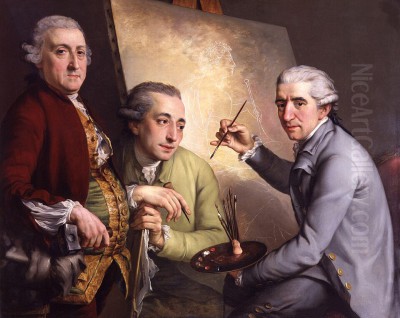
Giovanni Battista Cipriani stands as a significant figure in the transition from the Rococo to the Neoclassical style in eighteenth-century Britain. A native of Florence, his artistic talents blossomed in Italy before he was drawn to the burgeoning art scene of London. There, he became a celebrated painter, draughtsman, and designer, leaving an indelible mark on the decorative arts, public institutions, and the very aesthetic sensibilities of his adopted country. His elegant compositions, inspired by classical antiquity and Renaissance masters, resonated with the intellectual and artistic currents of the Age of Enlightenment, making him a foundational member of the Royal Academy of Arts and a sought-after collaborator for architects and craftsmen.
Early Life and Artistic Formation in Italy
Giovanni Battista Cipriani was born in Florence in 1727, into a family with roots in nearby Pistoia. His early artistic inclinations were nurtured in the rich cultural environment of Tuscany, a region steeped in the legacy of the Renaissance. His formal training began under Ignazio Hugford, an English painter of Florentine birth who had himself studied under Anton Domenico Gabbiani. Hugford, a connoisseur and art dealer as well as a painter, likely provided Cipriani with a solid grounding in academic drawing and an appreciation for the Old Masters.
Following his studies with Hugford, Cipriani further honed his skills, possibly for a brief period, in the studio of Antonio Domenico Gabbiani, a prominent late Baroque Florentine painter. This traditional apprenticeship system would have involved copying masterworks, studying anatomy, and mastering the techniques of oil painting and fresco. Florence, with its unparalleled collections in the Uffizi Gallery and Pitti Palace, offered a young artist like Cipriani endless opportunities for study and inspiration, from the works of Michelangelo and Raphael to those of Andrea del Sarto and Pontormo.
This period in Florence was crucial for developing his refined draughtsmanship, particularly his skill with pen and ink, which would later become one of his hallmarks. The Florentine tradition, with its emphasis on disegno (design or drawing) as the foundation of all arts, profoundly shaped his approach. Even before leaving Italy, Cipriani was beginning to establish a reputation for his elegant and graceful style.
The Roman Sojourn and Neoclassical Currents
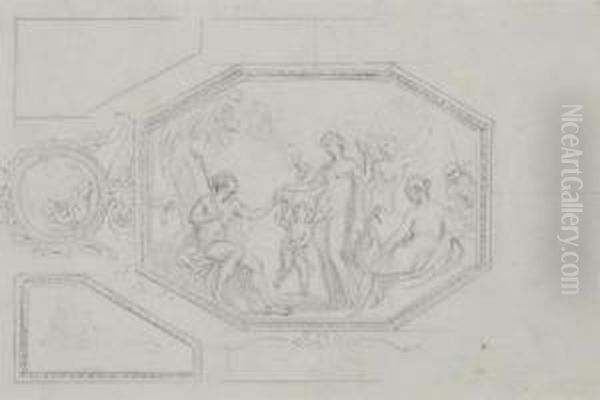
Between 1750 and 1753, Cipriani resided in Rome. This was a transformative period for any aspiring artist, as Rome was the epicenter of a burgeoning intellectual and artistic movement: Neoclassicism. The city was a magnet for artists from across Europe, drawn by its ancient ruins, its Renaissance and Baroque masterpieces, and the intellectual ferment surrounding the rediscovery of classical antiquity. Excavations at Herculaneum (begun 1738) and Pompeii (begun 1748) were revealing a lost world, fueling a passion for classical forms, motifs, and ideals.
In Rome, Cipriani would have encountered the theories of Johann Joachim Winckelmann, whose writings championed the "noble simplicity and calm grandeur" of Greek art. He would have seen the works of artists like Anton Raphael Mengs and Pompeo Batoni, who were already pioneering Neoclassical painting. It was in this stimulating environment that Cipriani met two individuals who would be pivotal in his career: the architect William Chambers and the sculptor Joseph Wilton. Both were British artists undertaking their Grand Tour, immersing themselves in classical art and architecture. Their shared enthusiasm for the antique and their developing professional ambitions forged a strong bond.
Cipriani's time in Rome allowed him to absorb the principles of Neoclassicism directly. He studied ancient sculpture, architectural remains, and the works of Renaissance masters like Raphael, who was revered by Neoclassicists for his clarity, harmony, and idealized forms. This Roman experience solidified his artistic direction and provided the connections that would lead him to a new chapter in his life and career.
Relocation to England and Rise to Prominence
In 1755, at the invitation of William Chambers and Joseph Wilton, Giovanni Battista Cipriani made the momentous decision to relocate to England. He arrived in London accompanied by his new friends and collaborators, ready to make his mark on the British art world. London at this time was a rapidly expanding and increasingly wealthy city, with a growing demand for art and luxury goods. The aristocracy and affluent merchant class were keen patrons, often influenced by their experiences on the Grand Tour.
Cipriani quickly established himself. His refined Italianate style, imbued with the emerging Neoclassical sensibility, was well-received. He found patronage for historical paintings, but it was his talent for decorative work that brought him particular acclaim. His ability to create elegant, classically inspired designs for a variety of applications made him highly sought after.
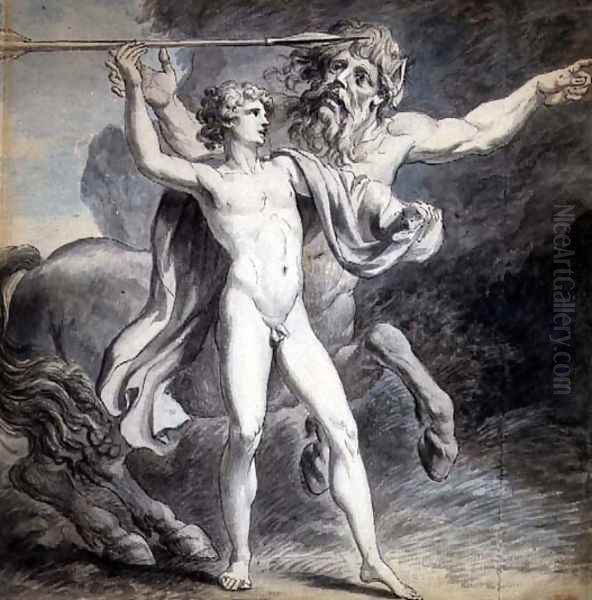
He became a central figure in the artistic community. In 1768, he was a founding member of the Royal Academy of Arts, a testament to his established reputation. Other founding members included luminaries such as Sir Joshua Reynolds (its first President), Thomas Gainsborough, Benjamin West, Angelica Kauffman, Mary Moser, his friend William Chambers (the Academy's first Treasurer), and Joseph Wilton. Cipriani's involvement with the Royal Academy was significant; he not only exhibited there regularly but also designed the Academy's diploma, a prestigious commission that featured allegorical figures and classical motifs, beautifully engraved by his close friend Francesco Bartolozzi.
Artistic Style and Thematic Concerns
Cipriani's artistic style is characterized by its elegance, grace, and a delicate linearity, particularly evident in his drawings and designs for engraving. He drew heavily on classical mythology, history, and allegory, themes that were central to Neoclassical art. His figures are often idealized, with a smooth, polished finish, reminiscent of antique sculpture and High Renaissance painting. While he worked in oils, he was particularly celebrated for his drawings in pen and ink, often with wash, which displayed a remarkable fluency and charm.
His compositions are typically balanced and harmonious, avoiding the dramatic intensity of the Baroque or the playful asymmetry of the Rococo. Instead, he favored clarity of narrative and a certain lyrical quality. His color palette, especially in his decorative paintings, tended towards lighter, more delicate hues, suitable for the elegant interiors of the period.
Key themes in his work include scenes from Greek and Roman mythology, such as depictions of gods and goddesses, muses, and mythological lovers. Allegorical figures representing virtues, the arts, or seasons were also common. He produced historical paintings, though these are perhaps less well-known today than his decorative schemes and his designs for prints. His religious subjects, such as The Descent of the Holy Ghost, demonstrate his ability to handle sacred themes with appropriate dignity and grace. One of his notable history paintings is The Death of Cleopatra, a subject that allowed for both classical pathos and an exotic setting.
Major Decorative Commissions
Cipriani's talents found extensive application in the decoration of grand houses and public buildings. He collaborated frequently with leading architects of the day, most notably Robert Adam and Sir William Chambers, whose Neoclassical architectural schemes provided perfect settings for Cipriani's painted embellishments.
For Robert Adam, Cipriani provided decorative paintings for several important country houses. At Kedleston Hall in Derbyshire, he painted roundels and panels for Adam's magnificent interiors, contributing to one of the most complete expressions of Neoclassicism in England. He also executed illusionistic murals for Lansdowne House in London, showcasing his skill in creating sophisticated spatial effects. His work at Syon House, another Adam masterpiece, included ceiling paintings.
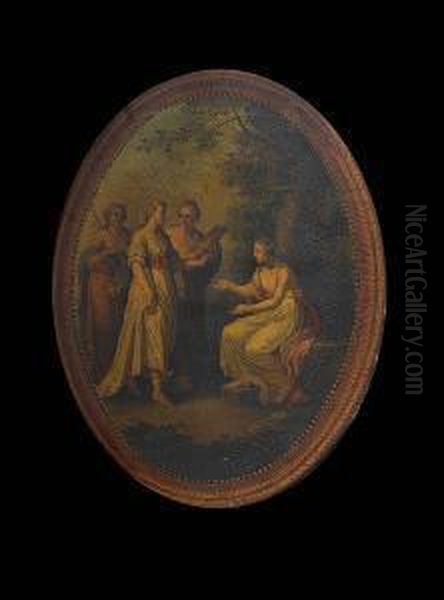
His association with Sir William Chambers led to significant commissions for public buildings. For Somerset House, Chambers's grand public office complex in London, Cipriani provided numerous decorative paintings for ceilings and walls, many of which can still be seen today. These works, often allegorical in nature, complemented Chambers's stately architecture. He also contributed painted panels to the magnificent Gold State Coach, designed by Chambers in 1762, which is still used in British coronations. Further royal commissions included ceiling decorations at Windsor Castle and for the Rubens Room at Buckingham Palace (then Buckingham House). He also painted decorative schemes for Whitehall buildings.
These decorative projects often involved painting directly onto plaster (secco) or on canvas panels that were then installed. The subjects were typically mythological or allegorical, rendered in his characteristic graceful style, and designed to harmonize with the overall architectural and decorative concept of the room.
Cipriani as a Draughtsman and Designer
Beyond his large-scale decorative paintings, Cipriani was an exceptionally prolific and versatile draughtsman and designer. His drawings were highly prized in their own right, admired for their technical skill and aesthetic appeal. He produced countless designs for book illustrations, frontispieces, and trade cards. His facility with pen and ink, combined with his inventive compositions, made his designs ideal for translation into engravings.
His design work extended to a wide range of objects and applications. He designed furniture, or at least decorative elements for furniture, contributing to the Neoclassical taste promoted by designers like Robert Adam and Thomas Chippendale. He created designs for medallions, cameos, and other small decorative objects, often collaborating with craftsmen like Josiah Wedgwood, whose jasperware pottery frequently featured classical reliefs based on designs by artists like Cipriani and John Flaxman.
Cipriani also ventured into theatre design, creating stage scenery and decorations for London theatres. This work, though ephemeral, would have showcased his ability to create grand and evocative visual effects. His versatility was a key to his success, allowing him to contribute to many facets of the burgeoning Neoclassical style in Britain. His designs were widely disseminated through prints, influencing taste far beyond the elite circles of his direct patrons.
Collaborations and Artistic Circle
Cipriani was part of a vibrant artistic community in London, and collaboration was a hallmark of his career. His closest and most enduring artistic partnership was with the Italian engraver Francesco Bartolozzi. Bartolozzi, who also settled in London and became a founding member of the Royal Academy, was a master of the stipple engraving technique, which allowed for subtle tonal gradations and was perfectly suited to reproducing the delicacy of Cipriani's drawings. Countless designs by Cipriani were engraved by Bartolozzi, popularizing Cipriani's style and making his compositions accessible to a wider audience. These prints covered a vast range of subjects, from mythological scenes to sentimental allegories and portraits.
His collaborations with architects Sir William Chambers and Robert Adam were fundamental to his success in decorative painting. These architects integrated Cipriani's work into their holistic designs for interiors, creating some of the most iconic spaces of the British Neoclassical movement.
Within the Royal Academy, Cipriani interacted with a diverse group of artists. Sir Joshua Reynolds, the Academy's president, was a leading proponent of the "Grand Manner" in painting, which shared Neoclassicism's emphasis on idealization and classical sources. Thomas Gainsborough, though often seen as Reynolds's rival and more inclined towards naturalism and Rococo elegance, also collaborated with Cipriani on at least one occasion: they produced transparent paintings for a new concert hall in Hanover Square.
Other Royal Academicians with whom Cipriani would have associated include the Swiss-born Angelica Kauffman, another prominent Neoclassical painter who specialized in historical and allegorical scenes and also worked extensively with Robert Adam and had her designs engraved by Bartolozzi. Benjamin West, an American-born painter, became a leading figure in historical painting in Britain. Sculptors like Joseph Wilton and Joseph Nollekens, and architects like George Dance the Younger, were also part of this milieu. The Irish painter James Barry, known for his ambitious historical murals, was another contemporary pushing the boundaries of Neoclassical art. Cipriani's interactions extended to musicians as well, including Thomas Arne and Johann Christian Bach, reflecting the interdisciplinary nature of London's cultural life.
The Role of Engraving: Cipriani and Bartolozzi
The partnership between Giovanni Battista Cipriani and Francesco Bartolozzi was one of the most fruitful artistic collaborations of the 18th century. Bartolozzi's skill as an engraver was instrumental in disseminating Cipriani's designs and establishing his reputation far beyond the circles of those who could commission original paintings or visit the grand houses he decorated.
Bartolozzi excelled in various engraving techniques, but he became particularly famous for his mastery of stipple engraving and the "crayon manner." Stipple engraving uses dots of various sizes and densities to create tonal values, resulting in soft, subtle effects that could beautifully replicate the delicacy of chalk drawings or wash. This technique was perfectly suited to Cipriani's graceful lines and subtle modeling.
Together, they produced a vast number of prints. These included reproductions of Cipriani's historical and mythological paintings, allegorical compositions, designs for book illustrations, admission tickets, and decorative motifs. The subjects ranged from the serious and classical to the charmingly sentimental, catering to the diverse tastes of the print-buying public. Prints after Cipriani's designs became ubiquitous, adorning the walls of middle-class homes and finding their way into albums and collections.
This widespread dissemination through prints was crucial to Cipriani's influence. It helped to popularize Neoclassical motifs and a particular type of graceful, idealized figural representation. The "Cipriani-Bartolozzi" style became a recognizable aesthetic, influencing other designers and craftsmen in fields ranging from ceramics (like Wedgwood) to textiles and furniture decoration. While this collaboration was immensely successful, it also occasionally led to questions of authorship, as the engraver's contribution was so significant in translating the original design into a new medium.
Anecdotes, Challenges, and Contemporary Reception
Despite his success and his integral role in the British art establishment, Cipriani's career was not without its nuances and challenges. As an Italian immigrant, he navigated the complexities of a foreign culture, though London was relatively cosmopolitan, especially in artistic circles. His talent and amiable personality seem to have facilitated his integration.
One interesting aspect of his contemporary reception is that while his decorative work and designs were highly fashionable and widely admired for their elegance, his more ambitious historical paintings perhaps did not achieve the same level of critical acclaim as those by, for example, Benjamin West or James Barry. The prevailing taste, heavily influenced by Sir Joshua Reynolds's Discourses, prized large-scale historical and epic subjects as the highest form of art. Cipriani's strength lay more in grace and charm than in dramatic power or profound intellectual depth, which might explain why his decorative genius sometimes overshadowed his achievements as a painter of grand narratives in the eyes of some critics.
There's an anecdote concerning his friend Bartolozzi, who was apparently notorious for his poor time management and for taking on more commissions than he could handle. This sometimes led to delays and legal issues for Bartolozzi, which could have indirectly affected the timely dissemination of some of Cipriani's designs intended for engraving.
The very popularity of his style, particularly as disseminated through prints, eventually led to a degree of overexposure. By the end of the 18th century and into the early 19th, as Romanticism began to take hold, the delicate Neoclassicism of Cipriani and Bartolozzi started to seem somewhat anachronistic or overly sentimental to a new generation. However, during his lifetime and for several decades after, his influence was pervasive.
Legacy and Influence on Later Artists
Giovanni Battista Cipriani died in Hammersmith, London, on December 14, 1785, and was buried in the Chelsea burial ground. He left behind a significant artistic legacy. His most immediate impact was on the development and popularization of the Neoclassical style in Britain. Through his paintings, decorative schemes, and especially the widely circulated engravings after his designs, he helped to shape British taste for several decades.
His influence can be seen in the work of numerous decorative painters and designers who followed him. His elegant figural style and his repertoire of classical motifs became standard elements in the decorative arts of the late 18th and early 19th centuries. Artists working in fields such as ceramics, silverware, and furniture design frequently drew inspiration from his work. The Adam style, in particular, owes a debt to Cipriani's painted contributions.
Francesco Bartolozzi, his primary collaborator, not only disseminated Cipriani's work but also trained a generation of engravers, further extending the reach of this particular aesthetic. While Cipriani did not run a large teaching studio in the manner of some of his contemporaries, his role as a founding member and instructor at the Royal Academy schools would have allowed him to influence younger artists. His drawings were certainly studied and copied.
While the grander, more heroic aspects of Neoclassicism were championed by artists like Benjamin West and later history painters, Cipriani's contribution lay in infusing British art with a lyrical, graceful classicism. His work provided a softer, more accessible counterpoint to the sterner forms of Neoclassicism. Even as artistic styles evolved, the charm and elegance of Cipriani's designs ensured their enduring appeal, and they are still admired today for their refinement and technical skill. His work is preserved in numerous public collections, including the British Museum and the Victoria and Albert Museum, as well as in the historic houses he helped to decorate.
Scholarly Assessment and Collections
Art historians recognize Giovanni Battista Cipriani as a key figure in the establishment of Neoclassicism in Britain. His ability to synthesize Italian artistic traditions with the demands of British patronage made him a pivotal artist of his time. Scholarly works, such as entries in the Encyclopædia Britannica and specialized art historical journals like RACAR (Revue d'art canadienne / Canadian Art Review), have explored various facets of his career, from his architectural drawings to his role in art criticism and his contributions to specific building projects.
His drawings, in particular, have received considerable scholarly attention. Collections of his ornamental designs, such as Scelta di ornamenti antichi e moderni, published posthumously, attest to his inventiveness and his importance as a source for Neoclassical motifs. Modern exhibitions and catalogues have further illuminated his contributions, often focusing on his drawings or his collaborations with figures like Bartolozzi or Chambers.
His works are held in major museum collections worldwide. In the United Kingdom, significant holdings of his drawings and prints can be found at the British Museum, the Victoria and Albert Museum, the Royal Academy of Arts, and the Courtauld Gallery. Many of his decorative paintings remain in situ in the historic houses and public buildings for which they were commissioned, such as Somerset House and Kedleston Hall, offering a direct insight into their original context. These collections and preserved works provide invaluable resources for understanding Cipriani's artistic output and his place within the broader European Neoclassical movement.
Conclusion: An Enduring Elegance
Giovanni Battista Cipriani's journey from Florence to London marked a significant transfer of artistic ideas and skills that enriched British art in the latter half of the 18th century. As a painter, draughtsman, and designer, he brought a refined Italianate grace to the burgeoning Neoclassical style. His collaborations with leading architects like Sir William Chambers and Robert Adam, and his prolific partnership with the engraver Francesco Bartolozzi, ensured that his elegant vision of antiquity permeated British visual culture, from the grandest stately homes to widely accessible prints. A founding father of the Royal Academy, Cipriani not only contributed to the institutional framework of British art but also left an enduring legacy of beauty, harmony, and classical inspiration that continues to be appreciated for its distinctive charm and artistic merit.