John Henry Frederick Bacon, MVO (Member of the Royal Victorian Order), ARA (Associate of the Royal Academy), stands as a significant, if sometimes overlooked, figure in the landscape of late Victorian and Edwardian British art. Active during a period of rich artistic diversity and societal change, Bacon carved a niche for himself as a painter of poignant genre scenes, striking portraits, and meticulously rendered historical and ceremonial subjects. His work, characterized by its technical skill, narrative clarity, and empathetic portrayal of human emotion, offers a valuable window into the tastes and sensibilities of his time.
Early Life and Artistic Foundations
Born in Kennington, South London, on November 4, 1865, John Henry Frederick Bacon was immersed in an artistic environment from a young age. His father, John Cardanall Bacon, was a respected lithographer, providing the young Bacon with an early introduction to the world of visual representation and printmaking. This familial background undoubtedly nurtured his innate artistic talents, which became evident early in his life.
Recognizing his son's promise, John Cardanall Bacon supported his formal artistic education. John Henry Frederick Bacon commenced his studies at the Westminster School of Art, a notable institution that trained many successful artists. There, he studied under Professor Frederick Brown, a prominent painter and influential teacher who would later become the Slade Professor of Fine Art. Brown's emphasis on solid draughtsmanship and observation likely played a role in shaping Bacon's meticulous approach.
Following his time at Westminster, Bacon advanced to the prestigious Royal Academy Schools in London. The Royal Academy was, at this time, the paramount institution for art education and exhibition in Britain. Admission was competitive, and the curriculum was rigorous, focusing on classical principles, life drawing, and the study of Old Masters. It was here that Bacon honed his skills in oil painting and composition, preparing him for a professional career. His dedication and talent were recognized in 1888 when he was awarded the Creswick Prize by the Royal Academy for a landscape painting, an early indicator of his capabilities.
Emergence as an Illustrator and Painter
Before fully establishing himself as a painter in oils, Bacon made a name for himself as a proficient black-and-white illustrator. This was a common path for many artists of the period, as illustrated magazines and books were immensely popular and provided a steady source of income. At the remarkably young age of 18, around 1883, Bacon undertook a professional tour to India and Burma. This journey, likely commissioned for illustrative work, would have exposed him to new cultures, landscapes, and visual stimuli, broadening his artistic horizons beyond the confines of London.
His work as an illustrator for publications such as The Graphic and Cassell's Magazine showcased his ability to capture narrative and character with clarity and precision, skills that would translate effectively into his later paintings. This grounding in illustrative work, which demanded an understanding of storytelling and an ability to convey complex scenes efficiently, served him well.
By the late 1880s and early 1890s, Bacon began to exhibit his oil paintings more regularly, particularly at the Royal Academy's annual Summer Exhibition. This was the most important venue for an artist to gain recognition and patronage in Britain. His submissions often featured genre scenes, historical episodes, and portraits, aligning with the prevailing tastes of the Academy and its patrons.
Artistic Style, Themes, and Influences
John Henry Frederick Bacon's artistic style can be broadly categorized within the academic tradition of the late 19th century, yet it possessed a distinct character. His paintings are marked by their meticulous attention to detail, a rich and often harmonious color palette, and a strong emphasis on narrative. He excelled at capturing the subtleties of human expression, imbuing his figures with personality and emotional depth.
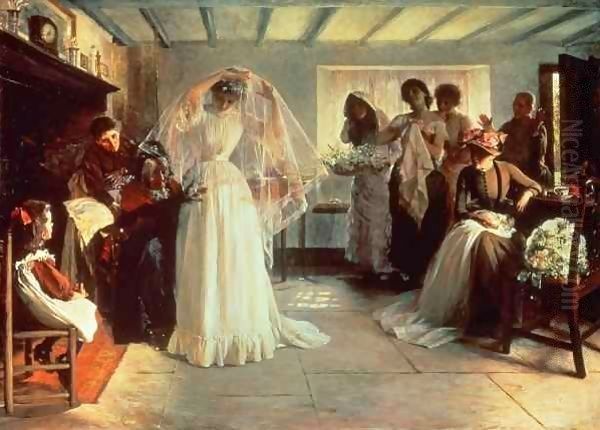
His genre paintings often depicted scenes of everyday life, love, and domesticity, sometimes with a sentimental or moralizing undertone, which was popular with Victorian audiences. Works like "The Wedding Morning" (1892) and "A Confession of Love" (1901) exemplify his ability to tell a story and evoke an emotional response through carefully staged compositions and expressive figures. These paintings often resonated with the middle-class values and aspirations of the era.
In his historical and literary subjects, Bacon demonstrated a keen sense of drama and an ability to reconstruct past eras with convincing detail. He drew upon a range of sources, from British history to classical mythology and biblical narratives. These works allowed him to explore grander themes and more complex compositions, showcasing his academic training.
Portraiture was another significant aspect of Bacon's oeuvre. He painted numerous prominent individuals, and his portraits were praised for their likeness and their ability to convey the sitter's character. His approach to portraiture was less flamboyant than that of, say, his contemporary John Singer Sargent, but it was marked by a solid, dependable quality and a sensitive rendering of his subjects.
Bacon's work shows an awareness of broader artistic currents. While firmly rooted in the academic tradition championed by figures like Lord Frederic Leighton and Sir Lawrence Alma-Tadema, with their emphasis on classical finish and narrative clarity, there are also hints of the influence of the Pre-Raphaelites, particularly in the detailed rendering of textures and the emotional intensity of some of his figures, reminiscent of earlier works by Sir John Everett Millais or John William Waterhouse. However, Bacon's style generally remained more conservative and less overtly symbolic than that of artists like George Frederic Watts. He navigated a path that balanced traditional academic expectations with a personal, empathetic touch.
Notable Works and Commissions
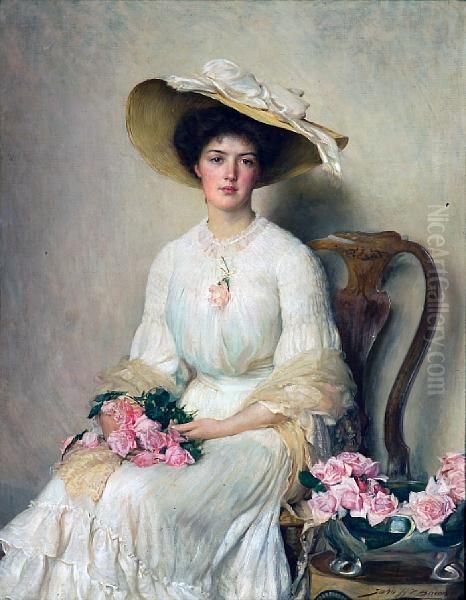
Throughout his career, John Henry Frederick Bacon produced a considerable body of work, with several pieces gaining particular acclaim. One of his most frequently cited paintings is Jeune femme aux roses (Young Woman with Roses), dated 1903. This work, likely a portrait or an idealized genre piece, would have showcased his skill in rendering delicate features, rich fabrics, and the beauty of floral arrangements, all hallmarks of his refined technique and appealing subject matter.
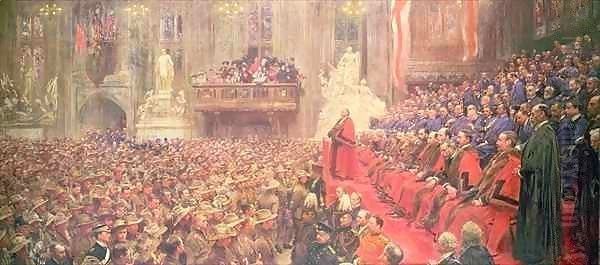
A significant commission that brought Bacon considerable prestige was the painting of the coronation of King George V and Queen Mary in Westminster Abbey in 1911. Titled "The Homage-Giving, Westminster Abbey, 22 June 1911," this large and complex work required immense skill in organizing numerous figures, capturing accurate likenesses of royalty and dignitaries, and conveying the grandeur and solemnity of the occasion. Such official commissions were highly sought after and cemented an artist's reputation. This painting is now part of the Royal Collection and is displayed in Buckingham Palace, a testament to its historical and artistic importance.
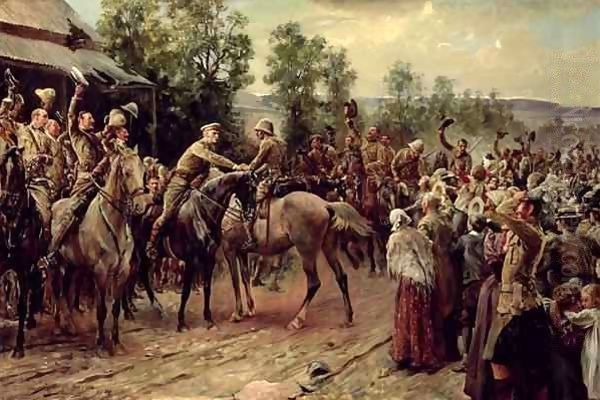
Other notable works include "The Relief of Ladysmith" (1900), depicting a scene from the Boer War, which tapped into patriotic sentiment, and "The New Member," a genre scene capturing a moment in social life. His religious paintings, such as "Peace Be To You" (1897) and "Gethsemane," also found an appreciative audience, reflecting the continued importance of biblical themes in Victorian and Edwardian art. These works often displayed a quiet reverence and a focus on the human aspects of sacred stories, distinguishing them from the more overtly dramatic religious art of some of his predecessors like William Holman Hunt.
His ability to handle large-scale compositions with numerous figures, as seen in the coronation painting, was a significant asset, setting him apart from artists who specialized solely in smaller, more intimate scenes. This versatility contributed to his success and recognition. He was, in many ways, a successor to painters like William Powell Frith, who excelled at depicting large-scale contemporary events and social panoramas, though Bacon's approach was perhaps less overtly satirical and more focused on the dignity of the occasion or the sentiment of the scene.
Recognition and Royal Patronage
John Henry Frederick Bacon's consistent quality and popular appeal led to significant recognition from the art establishment. In 1899, he was elected an Associate of the Royal Watercolour Society (ARWS), acknowledging his skill in that medium. A more significant honor came in 1903 when he was elected an Associate of the Royal Academy (ARA). This was a major step towards becoming a full Royal Academician (RA) and signified his acceptance into the upper echelons of the British art world.
His success in securing the commission for King George V's coronation portrait further elevated his status. In recognition of his services to the Crown, particularly for this important work, Bacon was appointed a Member of the Royal Victorian Order (MVO) in 1913. The Royal Victorian Order is a dynastic order of knighthood established by Queen Victoria, given for personal service to the monarch. This was a significant honor, reflecting royal favor and acknowledging his contribution to commemorating a key moment in national history.
His work was regularly exhibited and often favorably reviewed. He was part of a generation of skilled academic painters, including figures like Sir Frank Dicksee, Solomon J. Solomon, and Sir Luke Fildes, who maintained the traditions of narrative and representational art even as newer, more avant-garde movements like Impressionism and Post-Impressionism were beginning to gain traction in Britain, championed by artists like Walter Sickert and members of the New English Art Club (where Bacon's former tutor, Fred Brown, was influential).
Personal Life
In 1894, John Henry Frederick Bacon married. Sources indicate he had a beloved wife and a large family, eventually fathering seven children. The family resided for a time at "Pillar House" in Harwell, Berkshire. This domestic stability likely provided a supportive backdrop for his demanding artistic career. His genre scenes, often depicting tender family moments or romantic encounters, may well have drawn inspiration from his own experiences and observations of domestic life.
Tragically, Bacon's successful career was cut short. He died relatively young, on January 24, 1914, at the age of 49, reportedly from acute bronchitis. His premature death meant that he did not live to see the full impact of the First World War on British society and art, nor did he achieve the status of a full Royal Academician, which he seemed well on his way to attaining.
The Challenge of a Shared Name: Distinguishing Bacons in History
It is important to distinguish John Henry Frederick Bacon, the painter, from other prominent historical figures who share the same surname, as this can sometimes lead to confusion.
The most famous is Sir Francis Bacon (1561-1626), the Elizabethan and Jacobean philosopher, statesman, scientist, lawyer, and author. This Francis Bacon is renowned as a key figure in the scientific revolution, advocating for the empirical method. He served as Attorney General and Lord Chancellor of England. Controversies surrounding this Francis Bacon include accusations of corruption that led to his political downfall, and the persistent, though largely discredited by mainstream scholarship, "Baconian theory" which posits him as the true author of William Shakespeare's plays. These aspects of Sir Francis Bacon's life have no connection to John Henry Frederick Bacon, the artist.
Another historical figure is Nathaniel Bacon (c. 1647-1676), a colonist in Virginia who was the instigator of Bacon's Rebellion in 1676 against the rule of Governor William Berkeley. This rebellion, driven by various grievances including frontier defense against Native Americans, was a significant event in colonial American history. Again, this individual is entirely distinct from the British painter.
Furthermore, the art world itself has another, much later, highly celebrated Francis Bacon (1909-1992). This Irish-born British figurative painter was one of the most influential artists of the 20th century, known for his raw, emotionally charged, and often disturbing imagery. His works command extremely high prices at auction – for instance, his triptych "Three Studies of Lucian Freud" sold for $142.4 million in 2013, and other works have fetched tens of millions. These auction records and this particular artistic style belong to this 20th-century Francis Bacon, not to John Henry Frederick Bacon.
John Henry Frederick Bacon (1865-1914) operated in a different artistic sphere and historical period from these other namesakes. His contributions were to the academic art tradition of late Victorian and Edwardian England.
J.H.F. Bacon in the Context of His Contemporaries
To fully appreciate John Henry Frederick Bacon's place, it's useful to consider him alongside his contemporaries. The late Victorian and Edwardian art scene was vibrant and varied. The Royal Academy, while dominant, was not the only force. The Aesthetic Movement, with figures like James McNeill Whistler (though often at odds with the establishment), had emphasized "art for art's sake." The Newlyn School painters, such as Stanhope Forbes and Frank Bramley, were focusing on realistic depictions of rural life, often painted en plein air.
Bacon, however, largely remained within the orbit of the Royal Academy, producing works that appealed to its exhibition standards and its audience. His narrative paintings can be seen in the tradition of earlier Victorian storytellers like Augustus Egg or William Holman Hunt (in his more secular mode), though Bacon's style was generally less overtly didactic and more smoothly academic than the often intensely detailed and symbolic work of the Pre-Raphaelites.
His portraiture can be compared to that of other successful society portraitists of the era, such as Hubert von Herkomer or the aforementioned Sir Luke Fildes, who also undertook significant royal commissions. While perhaps not achieving the international fame or dazzling brushwork of John Singer Sargent, Bacon provided a solid, reliable, and sensitive alternative, appreciated for its craftsmanship and character insight.
His historical paintings engaged with a tradition kept alive by artists like Ernest Crofts, who specialized in military scenes, or Edwin Austin Abbey, an American expatriate who became renowned in Britain for his large-scale historical murals and Shakespearean subjects. Bacon's contribution to this genre was marked by his ability to combine historical accuracy with human drama.
Legacy and Collections
John Henry Frederick Bacon's premature death at 49 meant his career, though successful, did not span as long as many of his contemporaries. However, he left behind a significant body of work that was popular in its day and continues to be appreciated for its technical skill and narrative charm.
His works are held in various public and private collections. As mentioned, "The Homage-Giving, Westminster Abbey" is in the Royal Collection. Other paintings can be found in regional galleries in the United Kingdom. His illustrations appeared in widely circulated periodicals, contributing to the visual culture of the late 19th and early 20th centuries.
While the dramatic shifts in art brought about by Modernism in the early 20th century led to a decline in the critical appreciation of academic painters like Bacon for a period, there has been a renewed interest in Victorian and Edwardian art in more recent decades. Scholars and collectors now recognize the quality, craftsmanship, and cultural significance of these artists.
John Henry Frederick Bacon's auction performance reflects this. While his works do not command the astronomical sums of the 20th-century Francis Bacon, they are regularly sold at reputable auction houses, with prices varying according to the size, subject matter, and quality of the piece. His more significant oil paintings can achieve respectable five-figure sums, indicating a solid market appreciation for his work. For instance, a painting like "The Ballad" or "The Duet" would be representative of the type of work that appears at auction.
Conclusion
John Henry Frederick Bacon, MVO, ARA, was a talented and successful artist who made a notable contribution to British art in the late Victorian and Edwardian eras. As a painter of genre scenes, historical subjects, and portraits, he demonstrated considerable technical skill, a fine sense of narrative, and an ability to capture human emotion with sensitivity. His education at the Westminster School of Art and the Royal Academy Schools provided him with a strong academic foundation, which he applied to a wide range of subjects, from intimate domestic scenes to grand ceremonial occasions like the coronation of King George V.
Though his career was cut short by his early death, he achieved significant recognition, including an Associateship of the Royal Academy and royal honors. While the tides of artistic taste shifted dramatically in the 20th century, John Henry Frederick Bacon's work endures as a fine example of the academic tradition, offering valuable insights into the cultural and artistic milieu of his time. He remains a figure worthy of study for his craftsmanship, his storytelling ability, and his role in the rich tapestry of British art history.