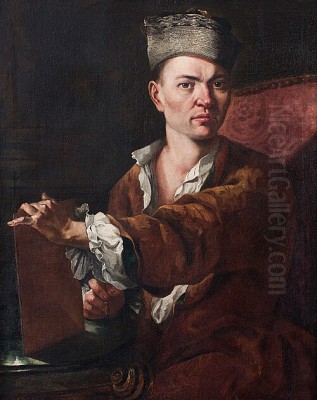
Paul Troger stands as one of the most significant Austrian painters of the late Baroque period. His prolific output, particularly in the realm of monumental frescoes and altarpieces, left an indelible mark on the artistic landscape of Central Europe in the 18th century. Born on October 30, 1698, in Welsberg, Pustertal, within the County of Tyrol (then part of the Habsburg Monarchy, now Monguelfo-Tesido, Italy), Troger's journey from a modest background to becoming a leading figure in Viennese art circles is a testament to his talent and dedication. He passed away in Vienna on July 20, 1762, leaving behind a rich legacy that continued to influence subsequent generations of artists. His nationality was Austrian, and he spent the majority of his productive life within the Austrian Empire.
Early Life and Artistic Formation in Italy
Paul Troger's early artistic inclinations were nurtured in his homeland, but it was his extensive period of study and work in Italy that truly shaped his distinctive style. He hailed from a family of modest means; his father was a tailor. Recognizing his talent, he received initial support that enabled him to travel to Italy, the crucible of Baroque art. This journey, undertaken in his youth, proved to be a formative experience, exposing him to the masterpieces of Italian painting and the vibrant artistic currents of the time.
During his Italian sojourn, which spanned several years, Troger immersed himself in the study of various regional schools. He spent time in Venice, where the rich colorism and dynamic compositions of artists like Sebastiano Ricci and Giovanni Battista Pittoni made a profound impression on him. The Venetian emphasis on light and atmospheric effects would become a hallmark of Troger's own work. He also reportedly received patronage from Giovanni Battista Piazzetta, another leading Venetian painter, whose dramatic use of chiaroscuro and expressive figures likely resonated with the young Austrian artist.
Troger's travels also took him to Rome, the epicenter of the High Baroque. Here, he would have encountered the grandeur of monumental fresco cycles by artists such as Pietro da Cortona and Andrea Pozzo, masters of illusionistic ceiling painting. The works of earlier masters, including the revolutionary naturalism of Caravaggio and the classical idealism of the Carracci school, particularly Annibale Carracci, would also have been available for study. He is noted to have studied at the Accademia di San Luca in Rome.
Furthermore, Troger spent time in Naples, a city with a vibrant artistic scene heavily influenced by Caravaggism and later, a more decorative Baroque style. It is documented that he worked with or was significantly influenced by Francesco Solimena, a dominant figure in Neapolitan painting. Solimena's grand, theatrical compositions and sophisticated use of light and shadow were highly influential throughout Europe, and Troger absorbed these lessons, adapting them to his own evolving artistic vision. Some sources also suggest an early training period with Paul Zeiller, possibly his father or a relative, before his Italian journey, and later studies in Vienna with artists like Sebastiano Conca.
This comprehensive Italian education provided Troger with a rich visual vocabulary and technical mastery. He learned the principles of large-scale composition, the dramatic use of light and color, and the techniques of fresco painting, which would become central to his career.
Defining the Troger Style: Light, Dynamism, and Illusion
Upon his return to Austria, Paul Troger brought with him a style that was deeply informed by his Italian experiences yet possessed a unique character. His art is characterized by its dynamic compositions, a light-filled palette, and a remarkable ability to create illusionistic spaces, particularly in his ceiling frescoes. While an early influence of Caravaggism, with its strong contrasts of light and dark, can be discerned in some of his initial works, Troger progressively moved towards a lighter, more luminous color scheme. This shift reflected a broader trend in late Baroque and Rococo art but was also a personal stylistic development.
Troger's figures are typically imbued with a sense of movement and vitality. He excelled at depicting complex multi-figure compositions, often arranged along sweeping diagonal lines that draw the viewer's eye upwards into the painted heavens. His understanding of perspective and foreshortening allowed him to create breathtaking illusions of depth, making stone vaults appear to open up to celestial visions. This was particularly effective in his ceiling frescoes, where saints, angels, and allegorical figures seem to float and interact in a luminous, ethereal space.
The use of light was paramount in Troger's work. He masterfully manipulated light and shadow not only to model forms and create a sense of volume but also to enhance the emotional and spiritual impact of his scenes. His colors are often bright and clear, contributing to the overall sense of airiness and luminosity that pervades his best works. This preference for a lighter palette distinguished him from some of the more somber tones of the earlier Baroque.
His approach to religious subjects was both dramatic and accessible. He could convey profound spiritual narratives with a sense of immediacy and emotional engagement, making the divine seem almost tangible. This ability to blend the spectacular with the relatable was a key factor in his success as a painter of religious art.
Masterpieces in Fresco and on Canvas
Paul Troger's oeuvre is extensive, but he is perhaps best known for his monumental fresco cycles that adorn numerous churches and monasteries throughout Austria and neighboring regions. These large-scale commissions allowed him to fully deploy his skills in composition, illusionism, and color.
One of his most celebrated achievements is the series of frescoes in the Benedictine Abbey of Göttweig, Lower Austria. The ceiling fresco in the Imperial Staircase, depicting the Apotheosis of Emperor Charles VI as Apollo, is a prime example of his mature style. Created in the 1730s, this work showcases Troger's mastery of illusionistic perspective, with figures soaring into a brilliantly lit sky. The vibrant colors and dynamic composition create a sense of awe-inspiring grandeur, fitting for its imperial theme. The abbey's summer refectory also features his work.
Another significant commission was for the Hradisko Monastery (Kloster Hradisch) in Olomouc, Moravia (now in the Czech Republic). Here, Troger painted the ceiling fresco Christ's Feeding of the 5000 (circa 1731) in the monastery's main hall. This vast composition is a tour-de-force of narrative painting, skillfully organizing a multitude of figures within a coherent and dramatic scene. The work demonstrates his ability to handle complex iconographic programs and to integrate his paintings seamlessly with the surrounding architecture.
Troger also executed important frescoes for Altenburg Abbey, where he collaborated with his student Johann Jakob Zeiller on the library and church frescoes. The library ceiling, depicting scenes related to wisdom and learning, is particularly noteworthy. He also created significant frescoes for Seitenstetten Abbey, further cementing his reputation as a leading fresco painter.
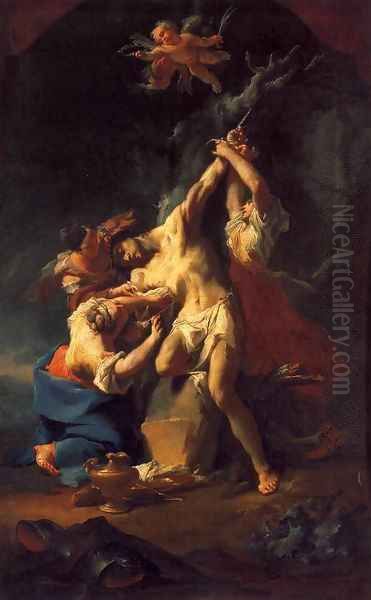
Beyond frescoes, Troger was a highly accomplished painter of altarpieces. His St. Sebastian and the Women (circa 1746), now housed in the Kunsthistorisches Museum in Vienna, is a powerful and moving depiction of the martyred saint. The painting combines dramatic intensity with a refined sensibility, showcasing his skill in oil painting. He also created notable altarpieces for St. Margaret's Church, including St. Margaret with Apostles and the Sermon of St. Nicholas, which highlight his ability to convey religious narratives with clarity and emotional depth. His work Adoration of the Lamb is also cited as an example of a stylistic shift in the early 1740s towards more slender and clearly defined lines.
Beyond the Brush: Troger's Graphic Works
While Paul Troger is primarily celebrated for his monumental paintings, he was also a skilled draughtsman and printmaker. His drawings, often preparatory studies for his larger commissions, reveal his meticulous working process and his mastery of human anatomy and composition. These sketches provide valuable insights into his creative development and his ability to translate complex ideas into visual form.
Troger also produced a number of etchings. Though not as extensive as his painted oeuvre, his prints demonstrate a fine command of the etching needle and an ability to achieve subtle tonal variations. One such example is the rare etching The Shepherd Boy and the Staff, which showcases a more intimate and perhaps pastoral side of his artistic interests. His graphic works, like his paintings, often feature dynamic figures and a strong sense of light and shadow, albeit translated into the linear medium of printmaking. These works contributed to the dissemination of his style and further underscore his versatility as an artist.
A Guiding Hand: Troger at the Vienna Academy
Paul Troger's influence extended beyond his own artistic production through his significant role as an educator. In 1728, he became a member of the Imperial Academy of Fine Arts in Vienna (Kaiserliche Akademie). His reputation and skill led to his appointment as a professor at the Academy in 1745. He later served as its Rector (or Director) for two terms, from 1754 to 1757. This position placed him at the forefront of artistic training in the Habsburg capital, allowing him to shape the development of the next generation of Austrian painters.
As a teacher, Troger was highly respected. He imparted the principles he had learned in Italy and honed through his own practice, emphasizing strong draughtsmanship, dynamic composition, and the effective use of light and color. His own success as a painter of large-scale frescoes and altarpieces provided a powerful example for his students. The Vienna Academy, under figures like Troger and his contemporary Michelangelo Unterberger (who also served as Rector), became a crucial institution for fostering artistic talent and establishing Vienna as a major art center.
The Legacy of a Teacher: Troger's Students
Troger's impact as an educator is evident in the careers of his many talented students, who went on to become important artists in their own right. Perhaps his most famous pupil was Franz Anton Maulbertsch (1724-1796), who became one of the leading figures of late Baroque and Rococo painting in Central Europe. Maulbertsch inherited Troger's dynamism and expressive power, developing an even more radical and emotionally charged style, characterized by flickering light, intense colors, and highly dramatic compositions.
Another notable student was Johann Ignaz Mildorfer (1719-1775), who, like Troger, excelled in fresco painting and created numerous works for churches and monasteries. Johann Baptist Wenzel Bergl (1719-1789) was also a significant pupil, known for his exotic landscape frescoes and decorative schemes that leaned towards the Rococo.
Johann Jakob Zeiller (1708-1783), who collaborated with Troger at Altenburg Abbey, was profoundly influenced by his master's style and iconographic approach. Zeiller became an important religious painter, carrying Troger's influence into the later 18th century. The success of these and other students attests to Troger's effectiveness as a teacher and his central role in the Austrian artistic tradition. His teachings helped to solidify a distinct Austrian school of Baroque painting, characterized by its vibrancy, illusionism, and emotional intensity.
A Network of Artists: Troger and His Peers
Paul Troger operated within a vibrant artistic community and interacted with many leading figures of his time. His collaborations and connections reveal the interconnectedness of the art world in 18th-century Central Europe.
During his time in Rome, he is said to have had contact with Anton Raphael Mengs, a German painter who would become a leading proponent of Neoclassicism, and Johann Joachim Winckelmann, the influential art historian and archaeologist. These encounters, even if brief, place Troger within the broader intellectual currents of European art.
In Vienna, he collaborated with fellow artists on various projects. His association with Michelangelo Unterberger, an Italian painter active in Vienna and also a Rector of the Academy, was significant. Both artists contributed to the flourishing of monumental painting in the city. Troger also worked alongside Johann Georg Schmidt (often called "Wiener Schmidt") on commissions for altarpieces.
His relationship with Daniel Gran (1694-1757) is noteworthy. Gran was another leading Austrian Baroque painter, and together with Troger, he represents the pinnacle of Austrian fresco painting in their era. While they were contemporaries and sometimes competitors for major commissions, their work collectively defined the high standards of monumental decoration in the Habsburg lands. Both artists had formative experiences in Italy and brought a sophisticated, Italianate style to Austrian art.
Troger also engaged with sculptors, as frescoes and altarpieces were often part of larger decorative programs that included sculptural elements. For instance, he worked on projects in buildings that also featured the work of prominent sculptors like Georg Raphael Donner (1693-1741), one of Austria's most important Baroque sculptors. The interplay between painting and sculpture was a key characteristic of Baroque ecclesiastical interiors.
Furthermore, Troger's work can be seen in the context of slightly older Austrian masters like Johann Michael Rottmayr (1654-1730), who was a pioneer of Baroque ceiling painting in Austria. Troger built upon the foundations laid by artists like Rottmayr, developing a lighter and more dynamic style that reflected the evolving tastes of the 18th century.
Later Career and Evolving Expressions
As Paul Troger moved into the later stages of his career, his style continued to evolve, though he remained committed to the fundamental principles of Baroque dynamism and illusionism. Around 1740-1741, art historians note a stylistic shift in his work, for example, in his Adoration of the Lamb. His forms became somewhat more slender, and his lines more clearly defined, moving away from the heavier modeling of some earlier pieces. This refinement may reflect an adaptation to the emerging Rococo sensibility, which favored elegance and grace.
Despite his continued productivity, Troger's health reportedly began to decline in his later years, particularly from the mid-1750s onwards. This may have impacted his ability to undertake the physically demanding work of large-scale fresco painting personally, leading him to rely more on his workshop and assistants for the execution of some later commissions, though he would still provide the designs. This was a common practice for highly sought-after masters with large workshops.
His focus remained predominantly on religious art, fulfilling commissions for churches, monasteries, and other ecclesiastical patrons. This specialization was typical for many leading artists of the Baroque era, as the Church was one of the most significant patrons of the arts. The demand for religious imagery to adorn newly built or renovated sacred spaces provided ample opportunities for painters like Troger.
His tenure as Rector of the Vienna Academy in the mid-1750s marked a period of significant administrative responsibility, alongside his artistic practice. Even as his health may have waned, his influence through his teaching and his established body of work remained profound.
Enduring Significance: Troger's Place in Art History
Paul Troger's artistic achievements and his historical evaluation firmly place him as a pivotal figure in the Austrian Baroque. He is celebrated for his exceptional skill in fresco painting, his dynamic compositions, his luminous color palette, and his ability to create breathtaking illusionistic spaces. His works transformed the interiors of numerous churches and monasteries, creating immersive spiritual environments that engaged and inspired congregations.
His assimilation of Italian Baroque influences, particularly from Venice and Naples, and his subsequent development of a personal style, were crucial for the maturation of Austrian painting in the 18th century. He successfully translated the grandeur and dynamism of the Italian Baroque into an Austrian context, creating a regional school that was both sophisticated and distinctive.
Troger's role as an educator at the Vienna Academy of Fine Arts was equally important. Through his teaching, he directly shaped the next generation of Austrian painters, most notably Franz Anton Maulbertsch, ensuring the continuation and further development of the Baroque tradition. His influence extended well into the late 18th century through his students.
Historically, Troger is recognized as one of the "great three" of Austrian Baroque ceiling painting, alongside Johann Michael Rottmayr and Daniel Gran. While Rottmayr represented an earlier phase and Gran a contemporary force, Troger brought a particular vibrancy and lightness that bridged the High Baroque and the emerging Rococo. His works are considered masterpieces of Central European art and continue to be studied and admired for their technical brilliance and artistic vision. The frescoes at Göttweig Abbey, in particular, are often cited as high points of Austrian Baroque decoration.
Conclusion
Paul Troger was more than just a prolific painter; he was an innovator, an educator, and a central figure in the cultural life of 18th-century Austria. From his formative years in Italy to his celebrated career in Vienna and beyond, he consistently demonstrated a mastery of his craft and a profound artistic vision. His monumental frescoes and altarpieces, characterized by their dynamic energy, luminous color, and breathtaking illusionism, transformed ecclesiastical spaces and left an enduring legacy. Through his influential role at the Vienna Academy and the numerous students he mentored, Troger's impact resonated through subsequent generations, solidifying his status as a cornerstone of Austrian Baroque art. His contributions ensured that Austria played a significant role in the broader narrative of European art during one of its most exuberant periods.