Wilhelm Kray: A Luminous Journey Through Myth and Idealized Beauty
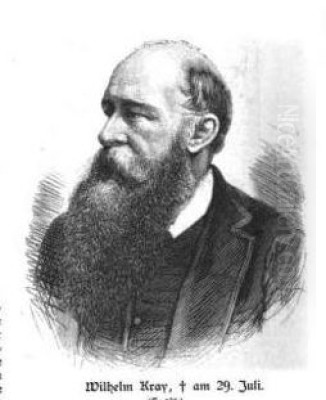
Wilhelm Kray (1828–1889) was a German painter whose artistic endeavors carved a distinct niche within the vibrant and multifaceted art world of the 19th century. Though perhaps not as universally recognized today as some of his contemporaries, Kray's oeuvre offers a fascinating window into the prevailing tastes and artistic currents of his time, particularly the enduring appeal of mythological narratives, romanticized genre scenes, and the idealized depiction of the human form, especially the female figure. His work, characterized by a polished academic technique and a penchant for luminous, often Italianate settings, continues to attract interest for its aesthetic charm and its embodiment of late Romantic and Academic ideals.
Early Life and Artistic Formation
Born in Berlin in 1828, Wilhelm Kray embarked on his artistic journey during a period of significant cultural and political transformation in the German states. His initial artistic training took place at the prestigious Berlin Academy of Arts (Königlich Preußische Akademie der Künste). The Academy, a bastion of classical and academic tradition, would have provided Kray with a rigorous grounding in drawing, anatomy, perspective, and the study of Old Masters. Figures like Wilhelm von Schadow, who had been a director at the Düsseldorf Academy and influential in German academic art, shaped the pedagogical landscape, emphasizing meticulous technique and elevated subject matter.
During his formative years, Kray would have been exposed to the lingering influences of Neoclassicism, the burgeoning force of Romanticism, and the emerging currents of Realism. The Berlin art scene was dynamic, with artists like Adolph Menzel pioneering a unique form of historical realism, while others continued to explore mythological and allegorical themes. This environment undoubtedly shaped Kray's early artistic sensibilities, instilling in him a respect for technical skill and a leaning towards subjects that allowed for imaginative and idealized representation. His early works likely reflected this academic training, focusing on historical or literary themes executed with precision.
The Italian Sojourn: A Defining Influence
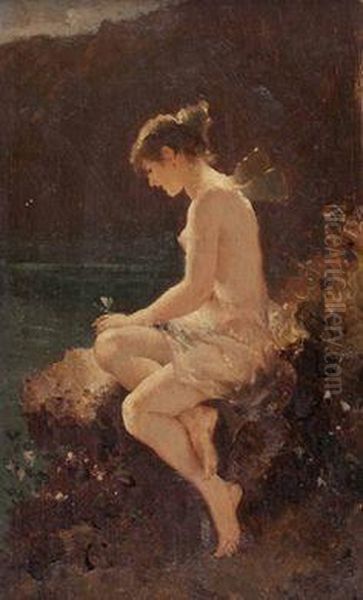
A pivotal period in Wilhelm Kray's artistic development was his time spent in Italy, particularly in Rome and Venice. For countless artists from Northern Europe, Italy was the quintessential destination for artistic pilgrimage. The allure of classical antiquity, the masterpieces of the Renaissance and Baroque periods, and the unique quality of Mediterranean light proved irresistible. Kray was no exception, and his experiences in Italy profoundly impacted his thematic choices and stylistic evolution.
In Rome, he would have immersed himself in the study of ancient ruins, classical sculpture, and the grand compositions of masters like Raphael and Michelangelo. The city itself, a living museum, offered endless inspiration. The Roman Campagna, with its picturesque landscapes and historical resonance, also captivated many artists. Venice, with its shimmering canals, opulent architecture, and the rich color palettes of Titian, Veronese, and Tintoretto, offered a different but equally potent source of inspiration. The Venetian emphasis on color and light, and its tradition of sensual, atmospheric painting, likely resonated deeply with Kray's developing aesthetic. This Italian influence is palpable in much of his subsequent work, evident in the warm, golden light, the idyllic settings, and the frequent depiction of mythological figures associated with classical antiquity.
Artistic Style and Thematic Concerns
Wilhelm Kray's artistic style is firmly rooted in the academic tradition of the 19th century. His paintings are characterized by a high degree of finish, smooth brushwork that often conceals the artist's hand, and meticulous attention to detail. He demonstrated a strong command of anatomy and perspective, creating compositions that are well-balanced and clearly legible. His figures, particularly his female nudes and semi-nudes, are typically idealized, conforming to classical notions of beauty. There is a distinct sensuality in his portrayal of the female form, often imbued with a gentle eroticism that was popular in Salon painting of the era.
Thematically, Kray was drawn to subjects that allowed for the depiction of beauty, grace, and narrative. Mythological scenes, often featuring nymphs, goddesses, and figures from classical legends, were a recurring motif. Works depicting Psyche, Undine, or sirens and mermaids allowed him to explore themes of love, temptation, and the mysterious allure of the feminine. He also painted romanticized genre scenes, often set in idyllic Italianate landscapes, featuring charming figures in picturesque costumes. These scenes, while not strictly mythological, often carried a similar air of enchantment and escapism. The influence of Romanticism is evident in the emotional tone of his work, which often evokes a sense of longing, reverie, or gentle melancholy.
Kray's use of color and light is particularly noteworthy. He favored warm, luminous palettes, often suffused with a golden glow reminiscent of the Mediterranean sun. This contributes to the dreamlike, idealized quality of his paintings. His compositions are typically narrative, telling a story or capturing a poignant moment, inviting the viewer to engage with the scene on an emotional and imaginative level.
Masterpieces and Signature Works
Several paintings stand out as representative of Wilhelm Kray's artistic vision and skill. "The Temptation" is one such work, likely depicting a scene of mythological or allegorical seduction. In such paintings, Kray masterfully combined his skill in rendering the human form with a narrative that, while potentially titillating, was often couched in the respectability of classical or literary themes. His figures would be gracefully posed, their expressions conveying subtle emotions, set against a backdrop that enhances the mood of the scene.
Another significant theme for Kray was the figure of Psyche, the mortal princess from Greek mythology whose beauty rivaled that of Aphrodite and who endured many trials for the love of Eros. Paintings of Psyche allowed Kray to explore themes of innocence, love, and perseverance, often depicting her in moments of vulnerability or contemplation. Similarly, his interpretations of "The Lorelei," the Rhine maiden whose enchanting song lured sailors to their doom, or "Undine," the water spirit who sought a human soul through marriage, tapped into popular Romantic folklore and provided ample opportunity for depicting ethereal female beauty in natural, often aquatic, settings.
Works like "Bathing Nymphs" or "The Fisherman and the Mermaid" further exemplify his fascination with mythological water creatures and the interplay between the human and the supernatural. These paintings often feature lush landscapes or seascapes, with the figures integrated harmoniously into their surroundings. The water itself, rendered with a sense of translucency and movement, often plays a significant role in the composition and mood. Kray's ability to imbue these scenes with a sense of enchantment and idealized beauty was a hallmark of his appeal.
Kray and His Contemporaries: A Comparative Glance
To fully appreciate Wilhelm Kray's position in 19th-century art, it is essential to consider him in the context of his contemporaries. The art world of this era was incredibly diverse, with various movements and schools coexisting and often influencing one another.
In Germany, Kray's academic style and mythological themes can be compared to artists like Anselm Feuerbach (1829-1880), who also spent considerable time in Italy and painted classical subjects with a melancholic grandeur. Arnold Böcklin (1827-1901), though Swiss, was highly influential in Germany and shared Kray's interest in mythology, albeit often with a more symbolic and sometimes unsettling tone. Franz von Lenbach (1836-1904) became renowned for his portraits, while Adolph Menzel (1815-1905) was a master of historical realism and scenes of contemporary life, representing a different artistic direction. Carl Spitzweg (1808-1885) captured the Biedermeier spirit with his charming and humorous genre scenes.
The Düsseldorf School of painting, with figures like Andreas Achenbach (1815-1910) and Oswald Achenbach (1827-1905) known for their dramatic landscapes, and Karl Friedrich Lessing (1808-1880) for his historical and landscape paintings, represented a major force in German art, emphasizing detailed realism and often romantic themes. While Kray shared the technical polish, his focus was more on the idealized figure and mythological narrative.
Internationally, Kray's work aligns with the broader Academic tradition prevalent in France and Britain. The French painter William-Adolphe Bouguereau (1825-1905) is perhaps one of the closest parallels, renowned for his highly polished, idealized depictions of mythological figures and graceful nudes. Jean-Léon Gérôme (1824-1904) and Alexandre Cabanel (1823-1889) were other leading French academic painters, excelling in historical, mythological, and Orientalist subjects. Their work, like Kray's, was characterized by technical virtuosity and an appeal to established tastes.
In Britain, artists like Lord Frederic Leighton (1830-1896) and Sir Lawrence Alma-Tadema (1836-1912) produced meticulously detailed and beautifully rendered scenes from classical antiquity, often with a focus on archaeological accuracy and idealized beauty. John William Waterhouse (1849-1917), though working slightly later and associated with Pre-Raphaelitism and Symbolism, also frequently depicted mythological women and scenes of enchantment, sharing some thematic common ground with Kray. The Austrian painter Hans Makart (1840-1884) was known for his opulent historical and allegorical compositions, reflecting a similar taste for grand, decorative painting. Kray's work, therefore, can be seen as part of this widespread European phenomenon of academic art that celebrated beauty, narrative, and technical skill.
Exhibitions and Recognition
Throughout his career, Wilhelm Kray regularly participated in major art exhibitions, which were crucial for an artist's visibility and reputation in the 19th century. He exhibited his works at the Berlin Academy exhibitions, a primary venue for artists in the Prussian capital. His paintings were also likely shown in other important German art centers, such as Munich, which hosted large international exhibitions at the Glaspalast.
Participation in these exhibitions would have brought Kray's work to the attention of critics, collectors, and the broader public. While detailed records of every exhibition he participated in or specific awards he may have received are not always readily accessible, his consistent production and the survival of his works indicate a degree of contemporary success and recognition. His paintings, with their appealing subject matter and polished execution, would have found favor with a bourgeois clientele that appreciated art that was both aesthetically pleasing and morally uplifting, or at least decoratively acceptable within the bounds of classical tradition. The popularity of reproductions, such as engravings or photographs of his paintings, would have further disseminated his imagery.
Anecdotes and Personal Insights
Specific, well-documented anecdotes about Wilhelm Kray's personal life or eccentricities are somewhat scarce, as is often the case for artists who did not achieve the very highest echelons of fame or cultivate a deliberately public persona. However, his artistic choices themselves offer insights. His persistent dedication to mythological themes and the idealized female form suggests a deeply ingrained romantic sensibility and a genuine fascination with the classical world and its stories.
His extended stays in Italy were not merely study trips but seem to have been transformative experiences that shaped his entire artistic outlook. One can imagine him sketching amidst the ruins of the Roman Forum or by the Venetian lagoons, absorbing the atmosphere that he would later translate onto canvas. The consistent quality of light and the idyllic mood in his paintings suggest an artist who sought to create a world of beauty and harmony, perhaps as an escape from or a contrast to the industrializing and often turbulent realities of 19th-century Europe.
The recurring motif of water spirits, nymphs, and mermaids in his work might also hint at a particular fascination with the elemental and the mysterious aspects of nature, and the allure of the "femme fatale" or the enchantress, a common trope in Romantic and Symbolist art. While his depictions are generally more gentle and less overtly threatening than those of some of his contemporaries, the theme of enchantment and the power of female beauty is undeniably central to his art.
Artistic Mentors and Student Relationships
As mentioned, Wilhelm Kray received his foundational training at the Berlin Academy of Arts. The professors and artistic environment there would have constituted his primary mentorship. The academic system of the time emphasized learning from established masters and copying classical and Renaissance artworks. While specific names of individual professors who had a particularly profound impact on Kray might require deeper archival research, the general influence of the academic curriculum – with its focus on drawing from life, anatomical studies, and compositional principles – is evident in his work.
It is less clear whether Kray himself became a prominent teacher with a large circle of students. Many successful academic painters did take on pupils, either privately or within an academy setting. However, Kray's legacy seems to rest more on his own artistic output rather than on a significant pedagogical role. His influence, if any, on younger artists would likely have been through the example of his exhibited works, which demonstrated a particular approach to mythological and genre painting that other artists might have emulated or reacted against.
Later Years and Legacy
Wilhelm Kray continued to paint throughout his life, remaining largely faithful to the style and themes that he had developed and refined over his career. He passed away in Munich in 1889. By the time of his death, the art world was already undergoing profound changes. Impressionism had challenged the dominance of academic art, and Post-Impressionist movements were beginning to emerge, paving the way for the radical artistic innovations of the 20th century.
In the wake of modernism, the reputation of many academic painters, including Kray, declined. Their work was often dismissed as old-fashioned, overly sentimental, or lacking in genuine artistic innovation. However, in more recent decades, there has been a scholarly and public re-evaluation of 19th-century academic art. Art historians and collectors have begun to appreciate anew the technical skill, imaginative power, and cultural significance of these artists.
Wilhelm Kray's legacy lies in his contribution to this tradition. His paintings offer a vision of idealized beauty, romantic enchantment, and mythological storytelling that appealed to the tastes of his time and continues to hold a certain charm. His work serves as a valuable example of how classical themes and academic techniques were adapted and reinterpreted in 19th-century Germany, reflecting both a continuity with artistic tradition and the particular cultural sensibilities of the era. His paintings can be found in various public and private collections, and they occasionally appear at auction, attesting to an enduring interest in his luminous and imaginative art. He remains a noteworthy figure for those studying German academic painting and the broader currents of 19th-century European art.