Władysław Czachórski: A Polish Master of Academic Realism
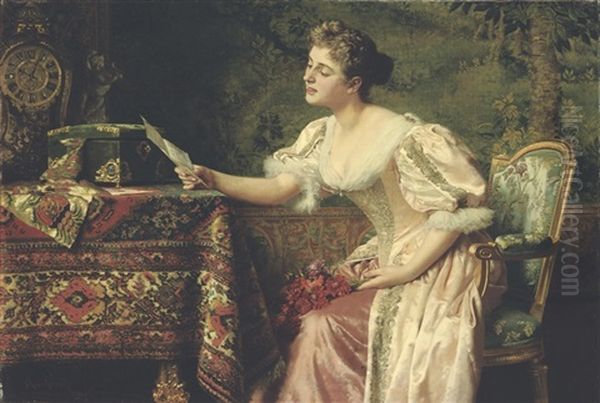
Władysław Czachórski (1850-1911) stands as one of Poland's most distinguished painters of the late 19th and early 20th centuries, a prominent figure within the Academic art tradition. Renowned for his exquisite attention to detail, particularly in rendering luxurious fabrics, delicate flowers, and the refined beauty of his female subjects, Czachórski carved a significant niche for himself in the European art world, especially within the influential Munich School. His oeuvre, encompassing portraits, genre scenes, still lifes, and depictions of Shakespearean drama, reflects the prevailing tastes and artistic standards of his era, while also showcasing a distinctly Polish sensibility.
Early Life and Artistic Awakening
Born on September 22, 1850, in Lublin, Congress Poland (then part of the Russian Empire), Władysław Czachórski hailed from a noble family. His early life, though not extensively documented in terms of direct artistic prodding, undoubtedly exposed him to the cultural milieu of the Polish gentry. It was in this environment that his artistic inclinations began to surface. The Poland of his youth was a nation grappling with its partitioned status, a reality that often fueled a strong sense of national identity and cultural preservation among its artists and intellectuals.
His formal artistic journey commenced in 1866 when he enrolled at the Warsaw School of Fine Arts (Szkoła Sztuk Pięknych w Warszawie). Here, he studied under the tutelage of Rafał Hadziewicz, a notable Polish painter whose own work spanned Neoclassicism and Romanticism. Hadziewicz, having studied in Paris and Rome, would have imparted a foundational understanding of classical principles and academic rigor. This initial training in Warsaw laid the groundwork for Czachórski's meticulous approach to drawing and composition, skills that would become hallmarks of his mature style. Other influential figures in Polish art at the time, such as Wojciech Gerson, also taught at the Warsaw School and fostered a generation of artists who would seek further training abroad.
The Path to Munich: Dresden and Academic Refinement
After a year in Warsaw, Czachórski, like many aspiring artists from Central and Eastern Europe, sought advanced training in established artistic centers. In 1867, he moved to Dresden, Germany, to attend the Dresden Academy of Fine Arts. Dresden, with its rich artistic heritage and esteemed academy, offered further opportunities to hone his skills. The academic environment there would have reinforced the importance of precise draughtsmanship, anatomical accuracy, and the study of Old Masters.
However, it was his subsequent move to the Munich Academy of Fine Arts (Akademie der Bildenden Künste München) in 1869 that proved most formative. Munich, at this time, was a major European art hub, rivaling Paris in its attraction for international students. He studied there until 1873 under several influential professors. Among them was Hermann Anschütz, known for his historical paintings. More significantly, he was a student of the renowned Karl von Piloty, a leading figure in German historical realism and a magnet for ambitious young painters. Piloty's grand historical canvases, characterized by dramatic compositions and meticulous detail, profoundly influenced a generation of artists, including many Poles who formed the core of the "Munich School." Alexander Wagner, another of his teachers, also specialized in historical and genre scenes.
Under Piloty's guidance, Czachórski absorbed the tenets of Academic Realism, focusing on flawless technique, smooth brushwork that concealed the artist's hand, and a commitment to verisimilitude. His talent was quickly recognized, and he received a silver medal from the Munich Academy in 1873 upon graduation, specifically the Magna Cum Laude distinction, for his painting Hamlet Receiving the Actors. This early success signaled his mastery of the academic style and his potential for a distinguished career. During his Munich years, he associated with other Polish artists, including Józef Brandt, a leading figure of the Polish Munich School known for his dynamic historical and battle scenes, and Aleksander Gierymski, who, though also trained in Munich, would later explore more naturalistic and impressionistic tendencies.
Hallmarks of Czachórski's Style: Elegance and Detail
Upon completing his studies, Czachórski embarked on travels to France and Italy between 1874 and 1877, further enriching his artistic vision by direct exposure to the masterpieces of Renaissance and Baroque art, as well as contemporary French academic painters like Jean-Léon Gérôme and William-Adolphe Bouguereau. He eventually settled in Munich in 1879, establishing a studio and becoming a central figure among the Polish artists there. Munich would remain his primary base for the rest of his life, although he maintained strong ties with Poland, regularly exhibiting his works in Warsaw, Krakow, and Lviv.
Czachórski's mature style is characterized by an almost photographic realism and an extraordinary ability to render textures. He became particularly famous for his depictions of elegant young women in opulent interiors, often dressed in sumptuous silk, satin, and velvet gowns. These figures are typically portrayed in moments of quiet contemplation, reading letters, arranging flowers, or simply exuding an air of refined melancholy. Works like Lady with Roses, The Letter, and Reading Woman exemplify this genre. His meticulous attention to the play of light on different surfaces – the sheen of fabric, the translucency of porcelain, the delicate petals of flowers – was unparalleled.
His still lifes, often incorporated into his genre scenes or painted as standalone pieces, further demonstrate his technical virtuosity. He had a particular fondness for painting roses, capturing their velvety texture and subtle gradations of color with breathtaking accuracy. These floral elements were not mere decorative additions but often carried symbolic weight, alluding to themes of beauty, transience, and love. His skill in this area drew comparisons with Dutch Golden Age masters of still life.
Shakespearean Visions and Literary Themes
A significant portion of Czachórski's oeuvre was dedicated to scenes from Shakespearean plays. This was a common practice among Academic painters, who found rich narrative and dramatic potential in classical literature. His early success with Hamlet Receiving the Actors (1873) was followed by other notable Shakespearean interpretations.
Perhaps his most famous work in this vein is Juliet's Funeral (also known as The Burial of Juliet or Pogrzeb Julii), painted around 1873-1874. This poignant depiction captures the sorrowful procession, rendered with the artist's characteristic attention to detail in costume and emotional expression. Another significant piece is Hamlet (sometimes titled Hamlet and the Ghost or Hamlet Contemplating Yorick's Skull), which showcases his ability to convey psychological depth within a highly polished academic framework. These works were lauded for their technical brilliance and their evocative power, though, like many academic interpretations of literary classics, they sometimes sparked discussion about fidelity to the source material versus artistic license. The dramatic intensity and historical settings of Shakespeare's plays provided an ideal vehicle for Czachórski's meticulous realism and his interest in human emotion.
Recognition, Esteem, and the Munich Art Scene
Czachórski's refined technique and appealing subject matter brought him considerable fame and commercial success during his lifetime. His paintings were highly sought after by collectors across Europe and America. He exhibited widely, participating in international exhibitions in Munich, Berlin, Vienna, Paris, and beyond, often winning medals and accolades. He was an active member of the Munich artists' association and the Berlin Academy of Fine Arts. In 1893, he was awarded the Order of St. Michael by the Bavarian government, a testament to his standing in the German art world.
In Poland, he was celebrated as one of the nation's foremost artists. His works were regularly shown at the "Zachęta" Society for the Encouragement of Fine Arts in Warsaw and other prestigious venues. He maintained connections with fellow Polish artists in Munich, such as Wacław Szymanowski, who was both a painter and sculptor, and Roman Kochanowski, known for his atmospheric landscapes. While Czachórski's style was firmly rooted in Academicism, the Munich Polish community also included artists exploring different paths, like Józef Chełmoński with his dynamic portrayals of Polish rural life, or Maksymilian Gierymski, whose sensitive landscapes and genre scenes prefigured a more naturalistic approach.
Despite his success, the Academic style Czachórski championed was, by the late 19th and early 20th centuries, facing challenges from emerging avant-garde movements like Impressionism, Post-Impressionism, and Symbolism. Artists like Olga Boznańska, another Pole who studied in Munich but developed a more personal, psychologically charged style influenced by Impressionism, represented these newer currents. Similarly, Jacek Malczewski, though also trained in Munich, became a leading figure of Polish Symbolism. Even Leon Wyczółkowski, initially associated with the Munich realists, later embraced Impressionist techniques and themes from the Young Poland movement.
Czachórski and His Contemporaries: Cooperation and Context
Władysław Czachórski's career unfolded within a vibrant and competitive European art scene. As a prominent member of the Munich School, he was part of a significant artistic current that emphasized realism, technical polish, and often, narrative content. His relationship with contemporaries was multifaceted. Within the Polish circle in Munich, there was a sense of camaraderie and shared national identity, even as artistic styles diverged. He shared a studio for a time with Wincenty Wodzinski, another Polish painter.
His work can be contextualized alongside other highly successful European Academic painters. In France, artists like William-Adolphe Bouguereau and Jean-Léon Gérôme enjoyed immense popularity for their mythological scenes and meticulously rendered historical subjects. In Britain, Lawrence Alma-Tadema captivated audiences with his depictions of classical antiquity, executed with a similar precision to Czachórski's. In Poland itself, Henryk Siemiradzki, based mostly in Rome, achieved international fame with his grand-scale academic paintings of ancient Roman life, often on a more monumental scale than Czachórski's intimate genre scenes. Jan Matejko, the titan of Polish historical painting, focused on large, patriotic canvases depicting key moments in Polish history, a different thematic concern but sharing the 19th-century emphasis on skilled representation.
The competition among these artists was often for patronage, exhibition space, and critical acclaim. Czachórski's success in securing awards and a loyal clientele indicates his ability to navigate this competitive environment effectively. His adherence to the academic tradition, while eventually seen as conservative by proponents of modernism, was precisely what appealed to the tastes of many influential collectors and institutions of his time.
The Shadow of War: The Fate of "Cleopatra"
Like many European artists whose works became valuable cultural assets, Czachórski's legacy was touched by the upheavals of the 20th century. One notable instance concerns his painting Cleopatra. During World War II, this work was among the countless art objects looted by the Nazi regime as part of their systematic plundering of cultural heritage from occupied territories, orchestrated by organizations like the Einsatzstab Reichsleiter Rosenberg (ERR).
The painting Cleopatra was specifically listed as having been confiscated from the collection of a Jewish owner in France. The efforts to trace and restitute Nazi-looted art have been ongoing for decades, a complex process involving international cooperation and meticulous provenance research. The fate of Czachórski's Cleopatra highlights the vulnerability of art during times of conflict and the enduring importance of cultural heritage preservation. This specific incident underscores how an artist's work can become entangled in broader historical events far beyond their lifetime.
Legacy and Reappraisal
Władysław Czachórski passed away in Munich on January 13, 1911. At the time of his death, he was a highly respected and financially successful artist. However, in the decades that followed, as Modernist aesthetics came to dominate art history and criticism, Academic art, including Czachórski's, fell out of favor. It was often dismissed as overly sentimental, technically proficient but lacking in innovation or profound artistic vision. Figures like Stanisław Wyspiański, a leading light of the Young Poland movement with his multifaceted talents in painting, drama, and design, came to represent the more progressive spirit in Polish art at the turn of the century.
In recent decades, however, there has been a significant scholarly and public reappraisal of 19th-century Academic art. Art historians now approach figures like Czachórski with a more nuanced understanding, recognizing their technical mastery, their role within their specific cultural context, and their appeal to contemporary audiences. His paintings are appreciated for their exquisite craftsmanship, their evocative portrayal of an era of elegance and refinement, and their contribution to the broader narrative of European art.
Today, Władysław Czachórski's works are held in major Polish museums, including the National Museum in Warsaw and the National Museum in Krakow, as well as in private collections worldwide. They continue to enchant viewers with their meticulous detail, luminous surfaces, and the quiet charm of their subjects. He remains a key figure for understanding the Polish contribution to the Munich School and the enduring appeal of Academic Realism, an artist who, through his dedication to beauty and technical perfection, created a lasting legacy. His paintings offer a window into the aesthetic sensibilities of the late 19th century, a world of grace, luxury, and artistic finesse.