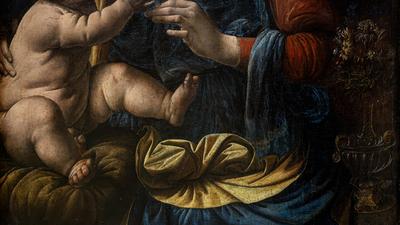
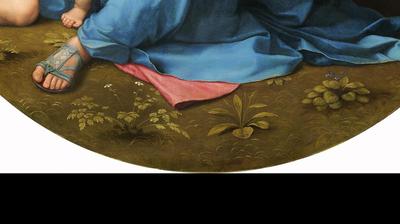
In 1480, a young Leonardo da Vinci painted the Benois Madonna, an intimate portrayal of motherhood that forever changed the course of Renaissance art. At the heart of the panel, a youthful Mary sits with her infant son. She is not a distant queen, but a playful mother, leaning forward with a toothless, radiant smile. She holds a tiny four-petaled flower, which the Christ child grasps with chubby, fumbling hands. Their bodies are intertwined in a moment of pure, domestic joy, creating a sense of life that feels remarkably spontaneous and real. Leonardo’s mastery of light transforms the scene. A soft glow enters from a window, washing over the pale, porcelain skin of the figures. Notice how the shadows are not harsh, but melt like smoke into the folds of the heavy, dark garments—a technique that gives the bodies a three-dimensional, sculptural weight.
The muted tones of the background allow the warm, golden light on their faces to become the focal point, pulling the viewer into their private world. This painting marks a departure from the stiff, formal icons of the past. Instead, Leonardo captures a fleeting, human emotion, replacing divinity with a tender, earthly connection between a parent and child. It is a quiet celebration of the beauty found in the simplest of gestures.