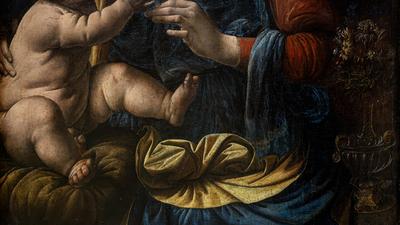
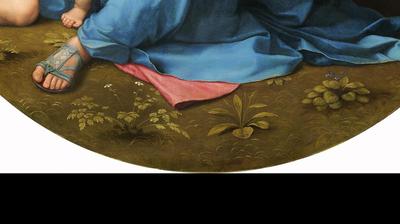
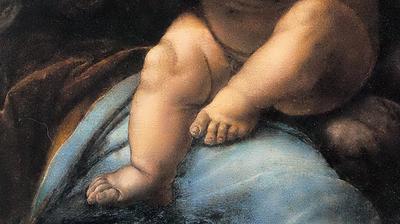
In the quiet dimness of late fifteenth-century Milan, Leonardo da Vinci painted the Madonna Litta. Completed around 1490, this intimate masterpiece captures a timeless moment of maternal devotion, drawing us into a world of profound stillness and grace. The Virgin Mary sits in a dark interior, her profile framed against two arched windows that open onto a hazy, distant landscape. She holds the Christ child close to her breast. The infant looks away from his mother, his eyes meeting ours, while his small hand gently rests upon her bosom. In his other hand, he clutches a tiny goldfinch—a delicate symbol of future sacrifice held with childhood innocence. Leonardo’s mastery of light creates a soft glow that seems to radiate from within the figures themselves. Notice the subtle sfumato, that misty blurring of edges, which gives the skin a gentle texture as smooth as porcelain.
The deep blues of Mary’s cloak and the rich reds of her dress emerge from warm shadows, harmonizing with the muted tones of the background. The composition is balanced and pyramidal, guiding the eye in a continuous circle of affection. This painting transcends a mere religious scene; it is a meditation on the human bond. Through his delicate brushwork, Leonardo captures the weight of a child’s body and the silent, protective gaze of a mother. It remains a breathtaking testament to the beauty found in a single, quiet breath of love.