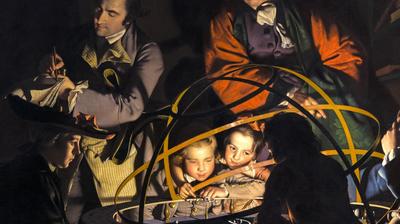
In 1771, Joseph Wright of Derby completed his hauntingly beautiful masterpiece, The Alchemist Discovering Phosphorus. This painting captures a singular moment of accidental wonder within the walls of a dark, cavernous laboratory. At the heart of the scene, an elderly alchemist kneels in a state of religious awe. His arms are spread wide, his face illuminated by a sudden, brilliant flash of light. He is not looking at gold, but at a glass flask emitting a ghostly, luminous vapor. Beside him, two young assistants watch from the shadows, their expressions a mix of curiosity and quiet apprehension.
The most striking feature is the dramatic contrast between light and shadow. A cold, brilliant white glow erupts from the vessel, cutting through the heavy, warm darkness of the stone room. This intense light catches the delicate textures of the alchemist’s velvet robes and the metallic sheen of the scientific instruments scattered across the floor. The composition pulls the eye toward the glowing center, creating an atmosphere that feels both scientific and deeply spiritual. This work captures the transition from ancient mysticism to modern chemistry. It portrays the pursuit of knowledge not as a dry calculation, but as a moment of profound, breathtaking revelation. In this glowing silence, we witness the exact second a discovery changes the world forever.