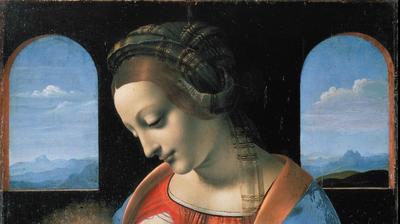
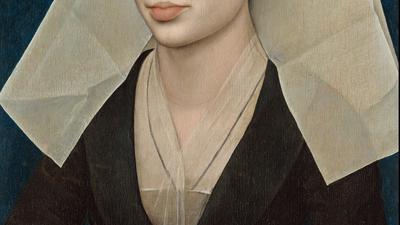
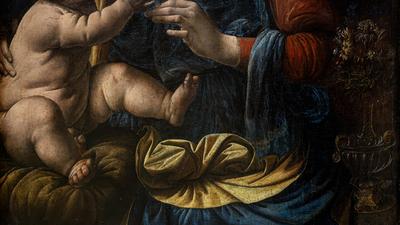
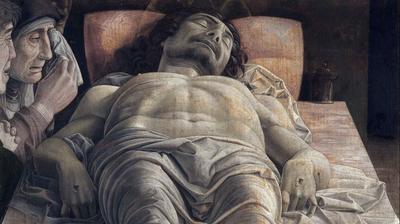
In the quiet halls of the Louvre Museum, a mysterious gaze follows every passerby. This is La Belle Ferronnière, a masterpiece painted around 1495 by the legendary Leonardo da Vinci. It remains one of the most intimate portraits of the Italian Renaissance. A young woman sits behind a dark wooden parapet, her body turned slightly away while her eyes fix directly upon the viewer. She wears a rich, crimson dress adorned with delicate ribbons and golden embroidery. Around her forehead rests a slender black cord, holding a single, shimmering jewel that catches the light right at the center of her brow. Leonardo’s mastery is felt in the soft glow that illuminates her skin against the deep, velvety black background. Notice the subtle transition of light and shadow—the famous sfumato—which blurs the edges of her jawline and the corners of her mouth. The warm shadows create a sense of three-dimensional depth, making her feel as though she might draw breath at any moment. The texture of her hair is smooth and heavy, tucked neatly to frame a face of quiet intensity.
The brilliance of this work lies in its psychological depth. There is a hidden tension in her expression—a mixture of alertness and guarded thought. Unlike the smiling portraits of the era, she possesses an enigmatic presence that feels modern and defiant. She stands as a timeless testament to the complexity of the human soul, captured forever in oil and wood.