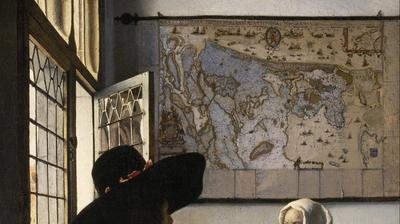
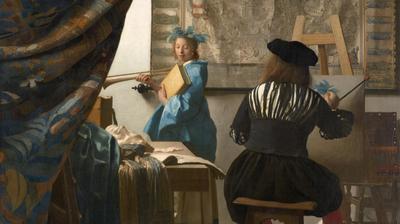
In 1662, Johannes Vermeer completed one of his most enigmatic masterpieces, The Music Lesson. Within this quiet interior, time seems to stand still, capturing a fleeting moment of domestic intimacy in seventeenth-century Delft. A young woman stands with her back to the viewer, her fingers resting on the keys of a virginal. Beside her, a gentleman watches closely, his posture attentive as he listens to the melody. Their relationship remains a mystery, yet a subtle tension fills the air. If you look closely at the mirror above the instrument, you can see the lady’s face reflected, her gaze tilted slightly toward her teacher, revealing a hidden connection that the initial perspective conceals.
Vermeer’s mastery of light is breathtaking. A soft glow filters through the leaded glass windows, washing over the white marble floor and the rich, heavy texture of the Persian rug draped over the table. The palette is a harmony of muted tones—cool blues and creamy whites punctuated by the vibrant red of the bodice. Every object, from the gleaming white pitcher to the gentle curve of the cello on the floor, is rendered with photographic precision. This painting is more than a study of music; it is a meditation on sight and sound. Through his careful composition, Vermeer invites a sense of quiet voyeurism, making the space feel both expansive and deeply private. It is a silent symphony of light and shadow, frozen in eternal stillness.