Aleksander Augustynowicz (1865-1944) stands as a significant figure in the landscape of Polish art, a painter whose career spanned a tumultuous period in his nation's history. His work, predominantly rooted in Realism, offers a poignant glimpse into the social fabric, cultural identity, and artistic currents of late 19th and early 20th century Poland. Born in Krosno, then part of Austrian Galicia, Augustynowicz's life and art were intrinsically linked to the Polish experience, reflecting both its pastoral beauty and the everyday lives of its people. His journey as an artist took him from provincial beginnings to esteemed art academies, through periods of travel and study abroad, and ultimately established him as a respected painter, particularly known for his sensitive portraits and evocative genre scenes.
Early Life and Formative Education
Born on February 7, 1865, in Krosno, a town in southeastern Poland, Aleksander Augustynowicz's early years were spent in a region rich with cultural heritage but also marked by the complexities of Poland's partitioned status. His initial education was received locally, including schooling in Rzeszów. It was clear from a young age that his inclinations lay towards the arts, a path that would lead him to the heart of Poland's artistic life.
The pivotal moment in his formal artistic training came in 1883 when he enrolled at the renowned Jan Matejko Academy of Fine Arts in Krakow (then known as the Szkoła Sztuk Pięknych w Krakowie). This institution was the crucible of Polish artistic talent, presided over by the towering figure of Jan Matejko himself, whose monumental historical paintings aimed to preserve and promote Polish national consciousness. Studying in Krakow between 1883 and 1886, Augustynowicz would have been immersed in an environment that revered technical skill and often emphasized patriotic themes.
During his time at the Krakow Academy, Augustynowicz studied under influential figures. While Jan Matejko's overarching influence was undeniable, his direct tutors included artists such as Władysław Łuszczkiewicz, a historian and painter, Feliks Szynalewski (also noted as Feliks Szałasny in some sources), and Izydor Jabłoński. These instructors would have imparted the academic traditions of the time, focusing on drawing, composition, and the faithful representation of reality. The atmosphere in Krakow was vibrant, with contemporaries like Jacek Malczewski, Leon Wyczółkowski, and Stanisław Wyspiański beginning to forge their own distinct paths, pushing the boundaries of Polish art.
Munich Studies and Broadening Horizons
Following his initial studies in Krakow, Augustynowicz, like many aspiring artists from Central and Eastern Europe, sought to broaden his artistic horizons by traveling to Munich. The Royal Academy of Fine Arts in Munich was a major international art center, attracting students from across the continent. Polish artists, in particular, formed a significant colony there, often referred to as the "Munich School" of Polish painters. Figures like Józef Brandt, Alfred Wierusz-Kowalski, and Maksymilian Gierymski had already established strong reputations there, often focusing on Polish historical scenes, landscapes, and genre paintings.
Augustynowicz's time in Munich, though perhaps not as prolonged as some, would have exposed him to different pedagogical approaches and the prevailing trends in German academic art, which emphasized meticulous detail and often a more somber palette. This experience, combined with his Krakow training, helped solidify his technical proficiency and likely reinforced his inclination towards Realism. He also reportedly spent time in Warsaw, where he began to achieve success with his oil paintings, and undertook travels to Italy and Hungary. These journeys were crucial for any artist of the period, offering direct encounters with the masterpieces of the Renaissance and Baroque in Italy, and diverse cultural influences in Hungary.
Artistic Style and Thematic Concerns
Aleksander Augustynowicz's artistic output is primarily characterized by Realism, though imbued with a distinct sensitivity and often a gentle, lyrical quality. He was a versatile painter, but his reputation largely rests on his portraits and genre scenes, particularly those depicting rural life and the everyday activities of Polish people, especially women.
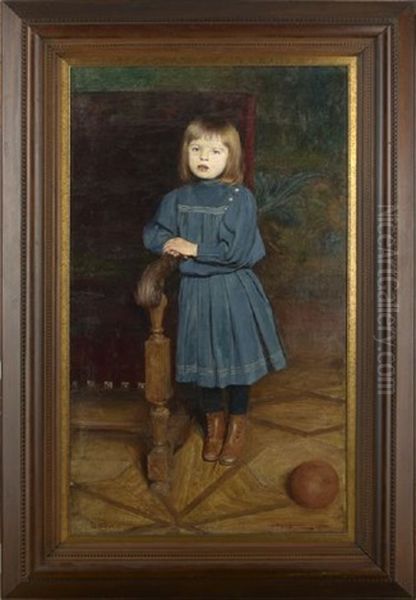
His portraits are noted for their psychological insight and careful rendering of character. He possessed the ability to capture not just a likeness but also the personality and inner state of his sitters. This skill made him a sought-after portraitist. His genre scenes often focused on themes of labor, domesticity, and the quiet dignity of ordinary individuals. Works depicting women engaged in traditional crafts, agricultural work, or within domestic settings are recurrent in his oeuvre.
Augustynowicz's technique was marked by solid draftsmanship and a nuanced use of color. While adhering to realistic representation, his brushwork could be delicate, and his palette, though often subdued, was capable of conveying subtle atmospheric effects and emotional tones. He predominantly worked in oils, but was also proficient in watercolors, a medium that allowed for a lighter touch and greater immediacy. His compositions were generally well-balanced and thoughtfully constructed, drawing the viewer's attention to the human element within the scene. Unlike some of his contemporaries who were drawn to the burgeoning Symbolist or Art Nouveau movements (Młoda Polska - Young Poland), Augustynowicz remained largely faithful to the realist tradition, finding ample expressive power within its conventions.
Notable Works and Their Significance
Several works by Aleksander Augustynowicz have gained recognition and are representative of his artistic concerns and style. Among these, Kobiety pracujące w polu (Women Working in the Field) is a significant example of his engagement with themes of rural labor. Such paintings not only documented a way of life but also often carried an undercurrent of respect for the resilience and contribution of the common people. The depiction of figures in the landscape, engaged in toil, was a common theme in 19th-century Realism, championed by artists like Jean-François Millet in France, and echoed by Polish artists like Józef Chełmoński.
Another frequently cited work is Dziewczyna przy prząślicy (Girl at the Distaff or Girl Spinning). This painting portrays a young woman engaged in the traditional craft of spinning, likely seated by a hearth. The scene evokes a sense of domestic tranquility and the continuity of traditional female roles. The careful attention to detail in the rendering of the figure, her attire, and the spinning equipment, alongside the play of light, showcases Augustynowicz's skill in creating an intimate and relatable scene. Such works resonated with a public that valued depictions of national customs and everyday life.
His painting titled MACIERZYŃSCY (The Macierzyński Family), likely a commissioned family portrait, would demonstrate his abilities in capturing group dynamics and individual personalities within a formal setting. Portraits were a crucial source of income for many artists, and Augustynowicz's success in this genre speaks to his technical skill and his ability to connect with his sitters. Another work, Pejzaż zimowy przed kościołem (Winter Landscape in Front of a Church), indicates his engagement with landscape painting, a genre that held particular importance in Polish art for its ability to evoke the national spirit and the beauty of the homeland. Artists like Julian Fałat were masters of the winter landscape, often in watercolor.
Career Development and Life in Lwów
After his studies and travels, Augustynowicz's career progressed steadily. He established himself as a professional artist, participating in exhibitions and gaining commissions. While he was active in Warsaw and Krakow, a significant period of his life was spent in Lwów (now Lviv, Ukraine). Lwów, at that time, was a major cultural center within the Austro-Hungarian Empire, with a vibrant Polish artistic and intellectual community. He settled in Lwów around 1895 and remained there for many years, becoming an active member of its artistic circles.
During his time in Lwów, he continued to paint portraits and genre scenes, and his work was regularly exhibited. He was associated with the Lwów Society of Friends of Fine Arts (Towarzystwo Przyjaciół Sztuk Pięknych we Lwowie) and participated in their exhibitions. This period saw him mature as an artist, refining his style and solidifying his reputation. The city itself, with its rich architecture and diverse population, would have provided ample inspiration. He also spent time in Zakopane during World War I, a mountain resort town that became a haven for many Polish artists and intellectuals, including Stanisław Witkiewicz, who championed the "Zakopane Style."
Later, from 1921 to 1925, Augustynowicz lived in Poznań, another important Polish city, before eventually returning to Krakow in 1925. His connection to Krakow, the city of his formative artistic education, remained strong throughout his life.
Contemporaries and the Polish Art Scene
Aleksander Augustynowicz worked during a dynamic era in Polish art. He was a contemporary of the leading figures of the Młoda Polska (Young Poland) movement, which flourished from roughly 1890 to 1918. Artists like Stanisław Wyspiański, Józef Mehoffer, Jacek Malczewski, and Olga Boznańska were pushing Polish art in new directions, embracing Symbolism, Art Nouveau, and early Expressionist tendencies. While Augustynowicz's style remained more conservative and rooted in Realism, he was undoubtedly aware of these developments and part of the broader artistic discourse.
He exhibited alongside many prominent artists. For instance, his works were shown in exhibitions that also featured Teodor Axentowicz, known for his elegant portraits and scenes of Hutsul life, and Władysław Benda, an illustrator and painter. He also had connections with artists active in various regional centers. The user's provided text mentions his association with Juliusz Makarewicz and Jan Kotowski, who were active in the Lublin region. He also exhibited with Władysław Roguski, Bronisław Gęstki, and Zygmunt Szpingier.
The Polish art scene was characterized by a strong sense of national identity, as artists sought to preserve and express Polish culture in the face of foreign occupation. Realists like Augustynowicz contributed to this by documenting Polish life and landscapes. Other notable realists or artists with strong realist phases included Aleksander Gierymski, known for his poignant scenes of Warsaw, and Włodzimierz Tetmajer, who often depicted peasant life with ethnographic detail. The legacy of historical painters like Wojciech Kossak, who continued the tradition of grand battle scenes and equestrian portraits, also formed part of the artistic milieu.
Later Years, Tragic End, and Legacy
The later years of Augustynowicz's life were overshadowed by the increasing political turmoil in Europe and the outbreak of World War II. He continued to paint, but the conditions for artists became exceedingly difficult under Nazi occupation. Aleksander Augustynowicz's life came to a tragic end in Warsaw. He died on August 23, 1944, during the Warsaw Uprising, a devastating and heroic chapter in Polish history. He was nearly 80 years old.
Despite the tragic circumstances of his death, Aleksander Augustynowicz left behind a substantial body of work that continues to be appreciated. His paintings are held in various Polish museums, including the National Museums in Krakow and Warsaw, and regional museums like the one in Krosno, his birthplace. His works also appear in private collections and occasionally surface at auctions, where they command respectable prices. For example, a watercolor measuring 64.5 x 51 cm reportedly sold for $20,000, indicating a continued market interest.
Academically, Augustynowicz is recognized as a skilled exponent of Polish Realism. While perhaps not as revolutionary as some of his Młoda Polska contemporaries, his contribution lies in his honest and empathetic portrayal of Polish society, his technical proficiency, and his dedication to his craft over a long career. His art provides valuable historical and cultural documentation, capturing the faces, customs, and landscapes of a Poland that was undergoing profound transformations. He is considered an important figure within the lineage of Polish painters who sought to reflect the national character and experience through their art, standing alongside figures like Władysław Wolski and Józef Kidoń in chronicling their times.
Conclusion
Aleksander Augustynowicz was an artist deeply embedded in the Polish artistic tradition of the late 19th and early 20th centuries. From his foundational studies in Krakow and Munich to his established career in Lwów and other Polish cities, he remained committed to a realist aesthetic, using it to explore themes of portraiture, rural life, and everyday labor. His paintings, characterized by their technical skill, sensitivity, and quiet dignity, offer a window into the soul of a nation. Though his life was tragically cut short during the Warsaw Uprising, his artistic legacy endures, securing his place as a respected and noteworthy Polish painter whose works continue to resonate with their depiction of human experience and cultural heritage. His art serves as a testament to the enduring power of realistic representation to convey both individual character and the broader social narratives of an era.