Alexander Vladimirovich Makovsky: A Chronicle of Russian Realism and Artistic Pedagogy
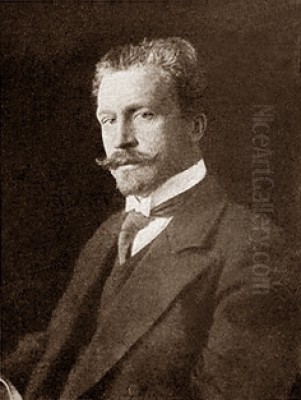
Alexander Vladimirovich Makovsky stands as a significant, if sometimes overshadowed, figure within the rich tapestry of Russian art during the late 19th and early 20th centuries. Born into a veritable dynasty of artists, his life and work were intrinsically linked to the prevailing currents of Realism and the influential Peredvizhniki (Wanderers) movement. While his father, Vladimir Yegorovich Makovsky, and uncle, Konstantin Yegorovich Makovsky, often command greater international recognition, Alexander Vladimirovich carved his own niche as a dedicated painter, a respected educator, and an active participant in the artistic life of his time. His contributions, particularly in genre painting, portraiture, and art education, merit a closer examination to fully appreciate the breadth of the Makovsky family's impact and the evolution of Russian art.
A Heritage Steeped in Art: Early Life and Influences
Alexander Vladimirovich Makovsky was born on March 24 (April 5, New Style), 1869, in Moscow. The environment into which he was born was not merely conducive to art; it was art itself. His father, Vladimir Yegorovich Makovsky (1846-1920), was a leading figure of the Peredvizhniki, celebrated for his poignant and often humorous genre scenes depicting the lives of ordinary Russians. His uncle, Konstantin Makovsky (1839-1915), was famed for his large-scale historical paintings and society portraits, enjoying immense popularity. Another uncle, Nikolai Yegorovich Makovsky (1841-1886), was also a painter, specializing in genre and landscape scenes. The Makovsky household was a hub of artistic discussion, creation, and interaction with other prominent cultural figures of the era.
This immersive artistic upbringing naturally guided Alexander towards a similar path. He received his initial artistic training at home, absorbing the principles and techniques that were the daily currency of his family. His formal education commenced at the prestigious Moscow School of Painting, Sculpture, and Architecture (MUZHVZ), an institution with which his family had strong ties. Here, he studied under some of the most respected artists and pedagogues of the time, including Vasily Polenov (1844-1927), a master of landscape and historical painting known for his lyrical and atmospheric works, and Illarion Pryanishnikov (1840-1894), another key Peredvizhnik known for his genre scenes.
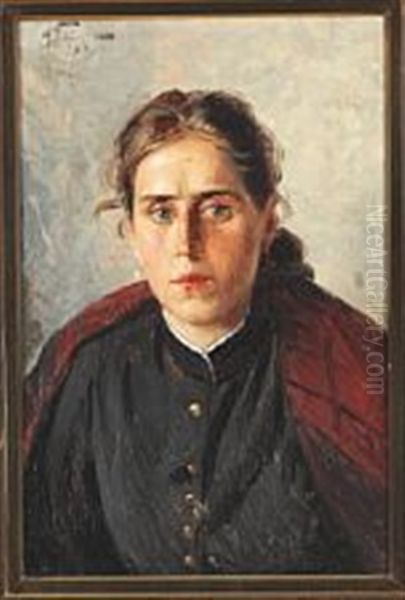
The most formative influence during his academic years, however, was arguably Ilya Repin (1844-1930). Repin, a towering figure in Russian Realism, recognized the young Makovsky's talent. In 1894, Alexander joined Repin's studio at the Imperial Academy of Arts in Saint Petersburg, a significant step that marked his transition to a more advanced stage of his artistic development. He graduated from the Academy in 1895, equipped with a strong foundation in the Realist tradition and the direct mentorship of one of its greatest exponents.
Parisian Interlude and Return to Russian Roots
Following his graduation, and in keeping with a common practice for promising Russian artists of the period, Alexander Makovsky traveled to Paris to further hone his skills and broaden his artistic horizons. The French capital was then the undisputed center of the art world, buzzing with new movements and ideas. He reportedly studied in the atelier of Fernand Cormon (1845-1924), a respected academic painter whose students included such diverse talents as Henri de Toulouse-Lautrec and Vincent van Gogh.
Exposure to French art, including the lingering influence of Realists like Gustave Courbet and Jean-François Millet, as well as the burgeoning Impressionist and Post-Impressionist movements, would undoubtedly have provided Makovsky with new perspectives. However, unlike some of his contemporaries who became more deeply engaged with Western European avant-garde styles, Makovsky's artistic compass remained firmly oriented towards the Russian Realist tradition. After his period of study abroad, he chose to return to Russia, where he would dedicate his career to depicting Russian life and landscapes.
Artistic Themes and Stylistic Characteristics
Upon his return, Alexander Makovsky focused primarily on genre painting, portraiture, and, to a lesser extent, landscape. His genre scenes often depicted everyday life in Russia, capturing moments from the lives of both urban and rural people. These works were characterized by a careful observation of detail, a sympathetic portrayal of his subjects, and a narrative clarity that was a hallmark of the Peredvizhniki school. While perhaps not possessing the biting social satire of his father Vladimir, or the grand historical sweep of his uncle Konstantin, Alexander's genre works exhibit a quiet dignity and an empathetic understanding of the human condition.
His portraits were also a significant part of his oeuvre. He painted likenesses of family members, fellow artists, and other notable figures. These portraits are generally characterized by their psychological insight and solid, competent execution, reflecting the strong academic training he had received. One notable example is his "Portrait of the Artist's Father, Vladimir Makovsky," which captures the elder artist with a sense of respect and intimacy.
In terms of style, Alexander Makovsky remained largely within the bounds of 19th-century Realism. His brushwork was generally controlled, his compositions well-structured, and his palette reflective of the naturalistic colors favored by the Peredvizhniki. There is a certain academic thoroughness to his work, emphasizing draftsmanship and a faithful representation of reality. While he would have been aware of Impressionistic techniques, particularly after his time in Paris, any influence is subtle, perhaps seen in a slightly lighter palette or more broken brushwork in some of his landscapes or outdoor scenes, but never fully embracing the Impressionist dissolution of form. His work "Idle Talk" (Пустые разговоры) is a good example of his genre painting, showcasing his ability to capture character and a specific social milieu.
The Peredvizhniki and Professional Engagements
Alexander Makovsky was an active participant in the artistic life of Russia, most notably through his involvement with the "Society for Traveling Art Exhibitions" (Tovarishchestvo peredvizhnykh khudozhestvennykh vystavok), commonly known as the Peredvizhniki or Wanderers. This group, co-founded by artists like Ivan Kramskoi (1837-1887), Grigory Myasoyedov (1834-1911), and Nikolai Ge (1831-1894), aimed to make art more accessible to the provincial public and to promote a nationally-oriented Realist art that engaged with contemporary social issues.
Alexander began exhibiting with the Peredvizhniki in 1893, even before formally completing his studies under Repin. This early acceptance underscores his alignment with the group's aesthetic and ideological principles. He became a full member of the Society and, from 1902, took on significant administrative responsibilities. He served as a treasurer and, importantly, from 1907 until 1922 (or 1923, sources vary slightly on the end date of his tenure), he was a member of the executive committee of the Peredvizhniki. This long period of service indicates his commitment to the organization and the respect he commanded among his peers, who included luminaries like Isaac Levitan (1860-1900), Vasily Surikov (1848-1916), Valentin Serov (1865-1911), and Viktor Vasnetsov (1848-1926). His role would have involved organizing exhibitions, managing finances, and helping to steer the Society through the increasingly complex artistic and political landscape of the early 20th century.
A Dedicated Educator
Beyond his own painting and his work with the Peredvizhniki, Alexander Vladimirovich Makovsky made substantial contributions as an art educator. In 1896, he began teaching at a private art school in Saint Petersburg. Later, in 1902, he established his own private art studio, also in Saint Petersburg, where he mentored aspiring artists. His commitment to pedagogy was further demonstrated by his authorship of several textbooks on painting and drawing, which would have disseminated his knowledge and the principles of Realist art to a wider audience.
His reputation as an educator grew, and his academic achievements were formally recognized. In 1911, he was awarded the title of "Academician" by the Imperial Academy of Arts, a significant honor. His teaching career culminated in his appointment in 1913 as a professor and dean (or rector, according to some sources) at the Higher Art School of the Imperial Academy of Arts in Saint Petersburg. This was a prestigious position, placing him at the helm of one of Russia's foremost art education institutions. In this capacity, he would have influenced the training of a new generation of Russian artists, guiding the curriculum and upholding the academic standards of the institution during a period of immense social and artistic change, leading up to and through the Russian Revolution. Artists like Kuzma Petrov-Vodkin (1878-1939) and Isaak Brodsky (1884-1939) were active during this transformative period, representing different facets of Russian art's evolution.
Representative Works: A Closer Look
While a comprehensive list of Alexander V. Makovsky's works is extensive, several pieces can be highlighted to illustrate his artistic concerns and style.
His genre scenes often focused on intimate, everyday moments. "Artist's Studio" (Мастерская художника) provides a glimpse into the creative space, a theme popular among artists. Such works often carry an autobiographical resonance, reflecting the environment most familiar to him.
"Idle Talk" (Пустые разговоры), as mentioned earlier, is another characteristic genre piece. It likely depicts a gathering, perhaps of middle-class or intellectual figures, engaged in conversation. The focus would be on the characterization of the individuals and the atmosphere of the social interaction, rendered with his typical Realist precision.
His portraits, such as the aforementioned "Portrait of the Artist's Father, Vladimir Makovsky," are valuable both as artworks and as historical documents. These works demonstrate his skill in capturing a likeness and conveying something of the sitter's personality. He also painted landscapes, though these are perhaps less central to his reputation than his genre scenes and portraits. These landscapes would typically depict Russian nature, rendered with a faithful, if not overtly romanticized, approach.
It is important to distinguish his oeuvre from that of his more famous relatives. For instance, highly narrative and socially charged works like "The Bank Crash" or "A Visit from the Poor" are hallmarks of his father, Vladimir E. Makovsky. Similarly, the opulent historical canvases and sensuous female portraits are characteristic of his uncle, Konstantin E. Makovsky. Alexander V.'s work, while sharing the family's Realist grounding, often possesses a more subdued, less dramatic quality, focusing on the quieter aspects of life and character.
Anecdotes and Personal Dimensions
The provided information mentions that Alexander Makovsky's works sometimes carried a humorous touch, a trait he might have inherited or learned from his father, whose genre scenes were often imbued with gentle humor and irony. This ability to find the amusing or quirky in everyday situations added a layer of relatability to Realist art.
His personal life, as noted, included his marriage to Anna Gramidova, with whom he had a son and a daughter. The suggestion that the marriage was not entirely harmonious is a detail that adds a human dimension, reminding us that artists, despite their public personas or creative achievements, navigate the same personal complexities as anyone else.
The reference to a potential shift in his artistic style towards a "darker, more pessimistic" tone in later years is intriguing. If this shift occurred, it might reflect the tumultuous socio-political events unfolding in Russia during the early 20th century, including the 1905 Revolution, World War I, and the 1917 Revolutions. Such profound societal upheavals often find expression in the arts, and it would not be surprising if Makovsky's later work mirrored the anxieties and uncertainties of the era. This would parallel the experiences of many artists of his generation, such as Nikolai Yaroshenko (1846-1898), whose works often carried strong social commentary, or later, artists who had to navigate the demands of the Soviet regime.
Later Years, Death, and Legacy
Alexander Vladimirovich Makovsky continued to work and teach through the turbulent years of revolution and the establishment of the Soviet state. The art world itself was undergoing radical transformation, with the rise of the Russian avant-garde movements like Suprematism (Kazimir Malevich) and Constructivism (Vladimir Tatlin, Alexander Rodchenko) challenging the dominance of Realism. The Peredvizhniki, as an institution, eventually dissolved in 1923, its mission in some ways fulfilled and in others superseded by new artistic and political realities.
Makovsky passed away on October 26, 1924, in Leningrad (formerly Saint Petersburg). He was 55 years old. He left behind a body of work that, while perhaps not as widely celebrated as that of some of his contemporaries or family members, represents a steadfast commitment to the Realist tradition and a significant contribution to Russian art education.
His paintings are held in various museum collections in Russia and other post-Soviet states, including the State Tretyakov Gallery in Moscow and the State Russian Museum in Saint Petersburg, as well as regional museums. His legacy is threefold: as a painter who skillfully depicted the life of his times; as a key figure in the later years of the Peredvizhniki movement, helping to sustain its activities; and, crucially, as an influential art educator who shaped a generation of artists through his teaching and administrative leadership at the Academy of Arts.
In the broader narrative of Russian art, Alexander Vladimirovich Makovsky exemplifies the dedicated professional artist who, while perhaps not a radical innovator, played a vital role in maintaining and transmitting artistic traditions during a period of profound change. His work serves as a valuable link in the chain of Russian Realism, connecting the great masters of the 19th century to the artists who would navigate the complex artistic landscape of the Soviet era. His life and career underscore the importance of the artistic family, the academic institution, and the artists' society in the cultural life of Russia. He remains a testament to the enduring power of Realist painting and the quiet dedication of a life spent in service to art. His contemporaries, like Abram Arkhipov (1862-1930) with his vibrant depictions of peasant life, or Sergei Ivanov (1864-1910) with his historical and social realist scenes, further illustrate the diverse yet interconnected world of Russian Realism in which Alexander Makovsky thrived.