Pavel Fedotov: A Critical Eye on Imperial Russia
Pavel Andreevich Fedotov stands as a monumental figure in the annals of Russian art, a painter and printmaker whose keen observations and satirical wit laid the groundwork for the critical realism movement that would come to define much of 19th-century Russian visual culture. Often hailed as the "Gogol of painting," Fedotov possessed an uncanny ability to dissect the social fabric of his time, exposing its vanities, hypocrisies, and the poignant struggles of its everyday citizens. His relatively short but intensely productive career left an indelible mark, transitioning Russian art from the fading grandeur of Romanticism and academic classicism towards a more direct and incisive engagement with contemporary life.
From Military Precision to Artistic Vision
Born in Moscow on June 22 (New Style: July 4), 1815, into a family of modest means – his father was a retired officer of low rank – Pavel Fedotov's early life did not immediately point towards a career in the arts. His father, Andrei Illarionovich Fedotov, had served diligently but achieved little wealth, and the family's circumstances were often straitened. Young Pavel, however, displayed an early aptitude for learning and a diverse range of interests.
In 1826, at the age of eleven, he was enrolled in the First Moscow Cadet Corps. This military institution, while primarily focused on training future officers for the Tsar's army, also provided a broader education. Fedotov excelled in his studies, showing a particular talent for mathematics, chemistry, and languages. Crucially, it was here that his artistic inclinations began to surface more formally, alongside an interest in music. He was known among his peers for his caricatures and sketches, often capturing the likenesses of his instructors and fellow cadets with a sharp eye for detail and a nascent sense of humor.
Upon graduating with distinction in 1834, Fedotov was assigned as an ensign to the prestigious Finland Guards Regiment, stationed in St. Petersburg. The imperial capital, with its vibrant cultural life and burgeoning artistic scene, offered new stimuli. While diligently performing his military duties, Fedotov began attending evening classes at the Imperial Academy of Arts. Though not a full-time student initially, these sessions provided him with foundational training in drawing and painting, likely under instructors such as the battle painter Alexander Ivanovich Sauerweid, known for his depictions of military life and equestrian scenes.
During his service, Fedotov continued to sketch and paint, often depicting scenes from military life, portraits of his comrades, and caricatures. His talent did not go unnoticed. A significant turning point came around 1837 with his watercolor painting, The Meeting of the Grand Duke (referring to Grand Duke Michael Pavlovich, brother of Tsar Nicholas I), which depicted the Grand Duke reviewing the troops. This work, and others like it, brought him to the attention of the imperial family. The Grand Duke himself was reportedly impressed, and this recognition perhaps emboldened Fedotov to consider art more seriously. He was granted permission to attend Academy classes more regularly and even received a modest allowance to support his artistic pursuits, a rare privilege for a serving officer.
The Artist Emerges: A Difficult Transition
Despite the encouragement, the dual demands of military service and artistic study were taxing. Fedotov yearned to dedicate himself entirely to painting. The decision was not an easy one. A military career, while perhaps not lucrative at his rank, offered a degree of security and social standing that the precarious life of an artist, especially one from a non-aristocratic background, could not guarantee.
However, the pull of art proved irresistible. In 1843, or by some accounts early 1844, after a decade of service and having risen to the rank of captain, Pavel Fedotov made the momentous decision to resign his commission. He exchanged the structured life of a soldier for the uncertain path of a professional artist. This was a courageous leap, driven by a profound inner calling. He was in his late twenties, and the financial support he had occasionally received while in service was no longer assured. He faced a period of considerable hardship, often living in poverty, a stark contrast to the societal echelons he would so astutely critique in his work.
Freed from military obligations, Fedotov immersed himself in his art. He initially focused on battle scenes and portraits, genres that were more established and potentially more lucrative. However, his true genius lay in observing and depicting the everyday life and social mores of his contemporaries. He began to shift his focus towards genre painting, a field that, while having precedents in Russian art with figures like Alexey Venetsianov who depicted peasant life with dignity, was about to be infused by Fedotov with a new, critical edge.
The Dawn of Critical Realism
The mid-1840s marked the beginning of Fedotov's most significant creative period. He began to develop a unique style characterized by meticulous detail, narrative complexity, and a subtle but biting social commentary. His paintings were not mere depictions of scenes; they were carefully constructed dramas, often with a moral or satirical undertone, inviting viewers to read the visual cues and understand the underlying social dynamics.
His approach was akin to that of a playwright or a novelist, carefully staging his characters and their environments to tell a story. He was deeply influenced by the satirical literature of his time, particularly the works of Nikolai Gogol, whose ability to expose the absurdities and moral failings of Russian society resonated with Fedotov's own artistic inclinations. He also drew inspiration from earlier European masters of genre and satire, such as the English painter William Hogarth, whose narrative series like "A Rake's Progress" offered a model for using art as a tool for social critique. The detailed interiors and character studies of Dutch Golden Age painters like Jan Steen or Adriaen van Ostade also provided a rich visual heritage for genre scenes.
In 1848, Fedotov achieved a significant breakthrough. His painting The Fresh Cavalier (also known as The Newly Decorated Officer or The Morning of an Official Who Has Received His First Decoration) was exhibited at the Academy of Arts and caused a sensation. The work depicted a minor bureaucrat, still in his dressing gown, proudly and somewhat ridiculously displaying his newly acquired medal to his unimpressed cook. The scene is a masterful study in vanity and self-importance, capturing the aspirations and pettiness of the burgeoning bureaucratic class. For this work, and others presented, the Academy of Arts awarded him the title of Academician, a significant recognition that cemented his status as a major artistic figure. He was specifically lauded as a "master of domestic scenes."
Masterpieces of Social Satire
Following the success of The Fresh Cavalier, Fedotov produced a series of masterpieces that remain iconic in Russian art. Each work offered a window into different strata of Russian society, rendered with humor, pathos, and an unerring eye for the telling detail.
The Major's Betrothal (or The Major's Courtship, Сватовство майора, 1848) is perhaps his most famous work. It depicts the awkward and transactional nature of marriage in a society obsessed with rank and wealth. A pompous, aging major, seeking a wealthy bride, is presented to the daughter of a rich merchant. The merchant family is flustered and eager, the bride feigns reluctance while clearly curious, and the major preens with self-satisfaction. Every detail, from the furnishings of the room to the expressions of the characters, contributes to the satirical portrayal of a marriage market where love is secondary to social and financial gain. The painting highlights the clash between the impoverished gentry, clinging to their titles, and the newly wealthy merchant class, seeking social legitimacy.
An Aristocrat's Breakfast (or A Young Man with a Maid, Завтрак аристократа, 1849-1850) offers another sharp critique, this time of impoverished nobility desperately trying to maintain appearances. A young aristocrat, dressed in a silk robe, is surprised by an unexpected visitor while hastily trying to hide his meager breakfast of a single piece of black bread. The room, though containing some trappings of former wealth, is sparsely furnished. The painting humorously exposes the pretense and financial decline of a segment of the aristocracy, a theme that resonated deeply in a society undergoing significant social and economic shifts.
The Fastidious Bride (or The Choosy Bride, Разборчивая невеста, c. 1847) tackles the theme of a woman who, having rejected many suitors in her youth in search of an ideal match, now finds herself aging and alone, facing the prospect of marrying a hunchbacked but wealthy man. The painting explores the societal pressures on women regarding marriage and the consequences of pride or perhaps unrealistic expectations. It’s a more somber work, tinged with a sense of regret and the harsh realities of a woman's limited choices in that era.
The Young Widow (Вдовушка, c. 1851-1852) showcases Fedotov's capacity for pathos alongside satire. It depicts a young woman, pregnant and grieving, surrounded by portraits of her deceased husband and the stark realities of her uncertain future. The room is filled with objects that speak of a comfortable past, now overshadowed by loss and impending hardship. While still a genre scene, it evokes a deeper emotional response, demonstrating Fedotov's empathy for those facing misfortune.
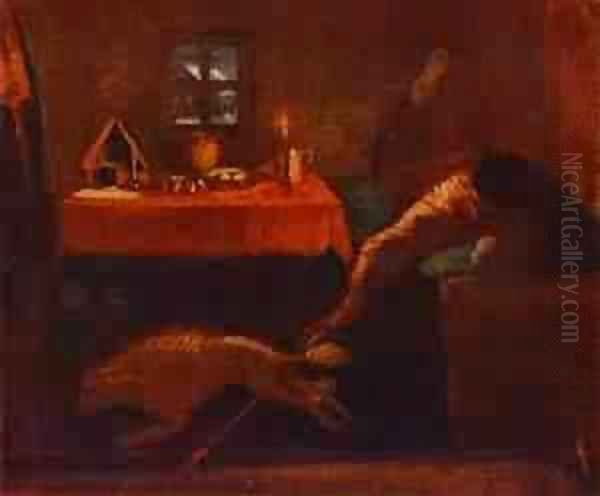
Encore, Encore! (Анкор, еще анкор!, 1851-1852) is one of his later, more enigmatic, and psychologically intense works. It portrays an officer in a dimly lit, desolate room, listlessly training his poodle to jump over a stick. The repetition implied by the title and the officer's bored, almost desperate expression suggest a profound sense of ennui, the crushing monotony and spiritual emptiness of provincial military life. The painting has a darker, more introspective tone than his earlier satires, perhaps reflecting Fedotov's own growing disillusionment.
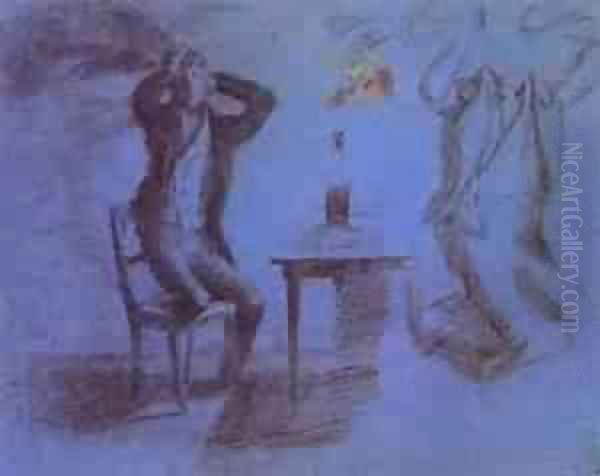
Fedotov's artistic process was meticulous. He would often create numerous preparatory sketches, experimenting with compositions and character expressions. He also wrote explanatory verses or "raeshniki" (rhyming couplets in a folk style) to accompany some of his paintings, further clarifying their narrative and satirical intent, a practice that underscored the literary quality of his visual storytelling.
Fedotov and His Artistic Milieu
Pavel Fedotov operated within a dynamic and evolving Russian art world. The dominant figure at the Imperial Academy of Arts during much of Fedotov's rise was Karl Bryullov, famed for his monumental historical painting The Last Day of Pompeii. Bryullov, a master of Romantic academicism, represented the established order. While Fedotov's genre scenes were a departure from Bryullov's grand historical narratives, Bryullov himself recognized Fedotov's talent, as evidenced by the awarding of the Academician title.
Another towering figure was Alexander Ivanov, who spent decades in Rome working on his magnum opus, The Appearance of Christ to the People. While Ivanov's spiritual and historical focus differed greatly from Fedotov's societal critiques, both artists were, in their own ways, seeking profound truths – Ivanov in religious revelation, Fedotov in the human condition as manifested in contemporary society.
Fedotov's work can be seen as building upon the foundations laid by earlier Russian genre painters like Alexey Venetsianov, who had brought a new dignity and realism to depictions of peasant life. However, Fedotov infused the genre with a critical, urban sensibility. He was also a contemporary of portraitists like Vasily Tropinin, who, like Venetsianov, often depicted commoners with warmth and individuality. While Orest Kiprensky, a leading Romantic portraitist, had passed away in 1836, his legacy of psychological depth in portraiture was part of the artistic atmosphere.
Fedotov's engagement with social themes also paralleled developments in Russian literature. Writers like Nikolai Gogol, Vissarion Belinsky (a prominent literary critic who championed realism), and the emerging Fyodor Dostoevsky were grappling with similar issues of social inequality, bureaucratic absurdity, and the "little man's" plight. Fedotov's art provided a visual counterpart to their literary explorations.
It is important to note that Fedotov, while a pioneer, did not have a large formal school of direct pupils in the traditional sense, partly due to his short career and his somewhat outsider status despite academic recognition. However, his impact was profound. He paved the way for the next generation of Russian realists, the Peredvizhniki (the Wanderers or Itinerants), who emerged in the 1860s and 1870s. Artists like Vasily Perov, with his poignant and often critical depictions of Russian life (e.g., The Drowned Woman, Troika), Ivan Kramskoi, a leading intellectual figure of the Peredvizhniki, Grigory Myasoyedov (The Zemstvo Dines), and later Ilya Repin, all owed a debt to Fedotov's pioneering efforts in making contemporary social reality a central subject for Russian art. Even Taras Shevchenko, the Ukrainian poet and painter, shared a contemporary concern for depicting the lives and struggles of ordinary people, often facing official censure for his views.
The Petrashevsky Circle and Tragic Decline
The late 1840s and early 1850s were a period of intense political repression in Russia under Tsar Nicholas I, particularly following the European revolutions of 1848. Intellectual circles that discussed Western philosophy, socialism, and social reform came under intense scrutiny. One such group was the Petrashevsky Circle, led by Mikhail Petrashevsky, which included writers like Fyodor Dostoevsky and Aleksey Pleshcheyev.
While Fedotov was not a formal member of the Petrashevsky Circle, he was acquainted with some of its participants and his art, with its critical undertones, was seen by some authorities as sympathetic to their reformist ideas. The satirical nature of his work, which poked fun at the nobility and bureaucracy, could be interpreted as subversive in the charged political climate. He faced increasing censorship and criticism from conservative quarters. The official press, while sometimes acknowledging his talent, often cautioned against his "negative" tendencies.
This pressure, combined with persistent poverty, overwork, and perhaps a predisposition to mental instability, took a severe toll on Fedotov. His financial situation remained precarious despite his growing fame. He struggled to support himself and his family, including his beloved sister. His eyesight began to fail, a devastating blow for a painter reliant on meticulous detail.
By the early 1850s, Fedotov began to show signs of severe mental illness. His behavior became erratic, and he suffered from delusions and paranoia. Friends and patrons, including some influential figures at the Academy, tried to help. There's a poignant anecdote of him, during his illness, asking the artist Alexander Beideman to record his artistic ideas, fearing he would not be able to execute them himself, hoping they might inspire future artists.
In the spring of 1852, his condition worsened dramatically. He was initially confined to a private clinic, but as his illness progressed and his funds depleted, he was transferred to the "All Who Sorrow" public asylum in St. Petersburg. His final months were tragic. The vibrant, witty artist who had so sharply observed the world around him was lost to mental darkness.
Pavel Andreevich Fedotov died on November 14 (New Style: November 26), 1852, at the young age of 37. He was buried in the Smolensk Orthodox Cemetery in St. Petersburg.
Legacy: The Enduring Gaze
Despite his tragically short life and the hardships he endured, Pavel Fedotov's legacy is immense. He is widely regarded as the founder of critical realism in Russian painting. His work marked a decisive shift away from the idealized subjects of academic art towards a direct and often unflattering engagement with contemporary Russian society.
Fedotov's paintings offered a mirror to his times, reflecting its absurdities, its injustices, and its human dramas with unparalleled acuity. He possessed a unique ability to combine humor with pathos, satire with sympathy. His characters, though often types, are rendered with psychological insight, making them feel alive and relatable even today. His compositions are masterfully constructed, rich in narrative detail, and visually engaging.
His influence on subsequent generations of Russian artists was profound. The Peredvizhniki, who championed realism and sought to make art accessible and relevant to the people, saw Fedotov as a crucial forerunner. His commitment to depicting Russian life in all its complexity, his critical stance towards social issues, and his empathy for the common person became hallmarks of their movement.
Beyond Russia, Fedotov's work can be appreciated in the broader context of 19th-century European realism. Like Honoré Daumier in France, Fedotov used his art to comment on the social and political realities of his day, employing satire and caricature to powerful effect.
Today, Pavel Fedotov's major works are prized possessions of Russia's leading museums, primarily the State Tretyakov Gallery in Moscow and the State Russian Museum in St. Petersburg. They continue to captivate audiences with their artistic brilliance, their historical insight, and their timeless commentary on human nature. He remains a testament to the power of art to not only reflect society but also to critique it, challenge it, and ultimately, to deepen our understanding of the human condition. His brief but brilliant career illuminated the path for a new direction in Russian art, one that looked unflinchingly at the world and dared to depict it, warts and all.