Alfred William Finch: A Luminous Bridge Between Pointillism and Art Nouveau Craft
Alfred William Finch (1854-1930) stands as a fascinating and somewhat underappreciated figure in the vibrant tapestry of late 19th and early 20th-century European art. A painter of remarkable sensitivity and a pioneering ceramicist, Finch navigated the currents of avant-garde movements, leaving an indelible mark on both Belgian Neo-Impressionism and the burgeoning Art Nouveau style in Finland. His career is a testament to artistic adaptability, intellectual curiosity, and a profound engagement with the materials and theories of his time. Born in Brussels to British parents, Joseph Finch and Emma Finch (née Holach), his dual heritage perhaps contributed to his broad artistic outlook, allowing him to absorb and synthesize influences from across Europe.
Early Life and Artistic Formation in Brussels
Alfred William Finch, often known as "Willy," spent his formative years in Ostend, a coastal city in Belgium, before returning to Brussels to pursue formal artistic training. He enrolled at the prestigious Académie Royale des Beaux-Arts, a bastion of traditional art education. However, like many aspiring artists of his generation, Finch found the academic curriculum stifling and yearned for more progressive avenues of expression. The late 19th century was a period of intense artistic ferment, with Impressionism having already challenged academic conventions, and new movements like Symbolism and Post-Impressionism beginning to emerge.
It was in this environment of artistic rebellion and innovation that Finch, alongside a group of like-minded young artists, sought to create a platform for art that broke free from the conservative Salon system. This desire for independence and a space to exhibit more experimental work was a common sentiment across Europe, leading to the formation of various secessionist groups.
The Genesis of Les XX: A Revolutionary Spirit
In 1883, Finch became a pivotal founding member of "Les Vingt" (The Twenty), often abbreviated as Les XX. This avant-garde group, co-founded with other progressive Belgian artists including the iconoclastic James Ensor, Théo van Rysselberghe, Fernand Khnopff, and Dario de Regoyos, aimed to promote new and international art, free from the constraints of juries and academic dogma. Les XX quickly became one of the most influential and radical art societies in Europe, organizing annual exhibitions that showcased not only the work of its members but also invited cutting-edge artists from abroad.
The exhibitions of Les XX were legendary, introducing Belgian audiences to the latest developments in French art and beyond. They invited luminaries such as Claude Monet, Pierre-Auguste Renoir, Camille Pissarro, and later, Georges Seurat, Paul Signac, Paul Gauguin, Vincent van Gogh, Paul Cézanne, and Henri de Toulouse-Lautrec. The inclusion of such diverse and often controversial artists underscored Les XX's commitment to artistic freedom and its role as a crucible for modern art. Finch's involvement from the outset placed him at the heart of these exciting developments.
Embracing Neo-Impressionism: The Influence of Seurat and Signac
Initially, Finch's painting style was rooted in a form of Realism, often depicting everyday scenes and landscapes with a sober palette. However, his artistic trajectory took a decisive turn towards Neo-Impressionism, also known as Pointillism or Divisionism. This shift was profoundly influenced by the work of French painters Georges Seurat and Paul Signac. Seurat's monumental painting, A Sunday Afternoon on the Island of La Grande Jatte, exhibited at the Les XX show in Brussels in 1887, was a revelation for many artists, including Finch.
Finch was captivated by Seurat's systematic application of color theory, where small, distinct dots of pure color were applied to the canvas, intended to blend optically in the viewer's eye rather than being pre-mixed on the palette. This technique aimed to achieve greater luminosity and vibrancy. Inspired, Finch began to experiment with the Pointillist technique, becoming one of its earliest and most dedicated practitioners in Belgium, alongside his Les XX colleague Théo van Rysselberghe. He also absorbed the influence of Camille Pissarro, who himself had a significant Neo-Impressionist phase.
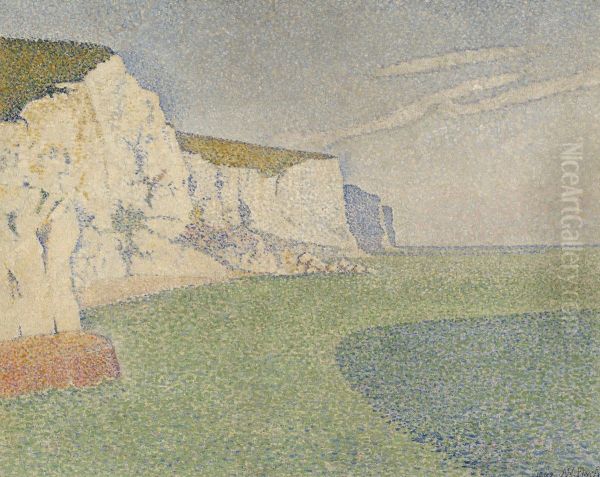
His paintings from this period demonstrate a meticulous application of color dots, creating shimmering, light-filled depictions of landscapes, coastal scenes, and urban views. He was particularly drawn to the effects of light on water and atmosphere, subjects well-suited to the Neo-Impressionist technique.
Key Paintings: Capturing Light and Atmosphere
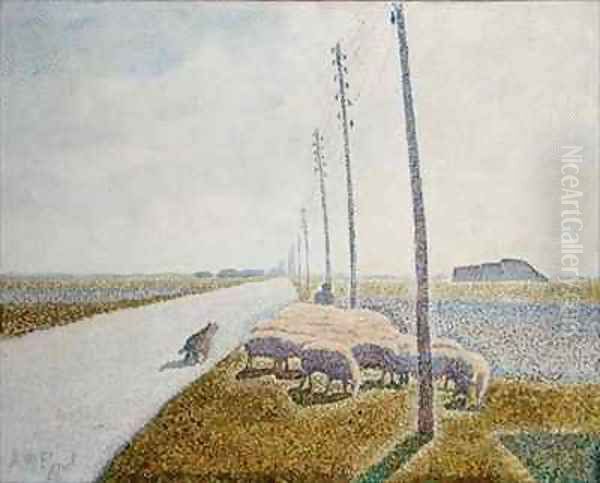
Finch's Neo-Impressionist oeuvre includes several notable works that showcase his mastery of the style and his sensitive observation of the natural world. Among his representative paintings are _The Cliffs of Dover_ and _Cliffs at South Foreland_. These works, likely depicting the iconic white cliffs of the English coast, would have provided ample opportunity for Finch to explore the interplay of light, color, and atmospheric effects using his pointillist technique. The texture of the chalk cliffs, the changing hues of the sea, and the vastness of the sky are rendered through a vibrant mosaic of color dots.
Another significant work is _Le Faubourg sous la neige ou Scène de rue en hiver_ (Suburb under Snow or Street Scene in Winter), dated 1886. This painting is particularly interesting due to a debate regarding its creation relative to Finch's direct exposure to Seurat's major works. While traditionally seen as a work influenced by Seurat, some scholarship suggests it might have been an early, independent exploration of broken color techniques predating the full impact of Seurat's 1887 Brussels exhibition. Regardless, it demonstrates Finch's early interest in capturing the nuanced effects of light and atmosphere, with the snow-covered scene providing a perfect canvas for subtle color harmonies and the depiction of diffuse light.
Other important paintings include _Hampton Court in the Rain_ and _Wimbledon Racecourse in the Drizzle_, which reveal his interest in English subjects and his ability to convey specific weather conditions through the pointillist method. The dampness of the air, the muted light, and the reflections on wet surfaces are all skillfully rendered. Works like _The Road to Nieuport_, _Roscoff Quay_, _Fulham, The Thames_, _August Night_, _Musée d'Uccle_, and _Amber Bay_ further illustrate his dedication to landscape and coastal scenes, often imbued with a tranquil, contemplative mood. His depictions of harbors, such as _Belgian Harbour_ and _Sailing Boats_, and coastal views like _Coast of Looe_ (Cornwall, England), highlight his enduring fascination with maritime environments.
Later, during his time in Finland, he continued to paint, producing works such as _Orchard at Louveciennes, Porvoo_ and _Orchard at La Hulpe_, demonstrating a continued engagement with landscape, perhaps with a stylistic evolution influenced by his new surroundings and his work in other media. _A Coppice in England_ and _The Workers_ suggest a breadth of subject matter, from intimate woodland scenes to depictions of labor.
A New Direction: The Turn to Ceramics
Despite his achievements as a painter and his active role in the avant-garde, Finch, like many artists, found it challenging to make a consistent living solely from painting. By the late 1880s and early 1890s, he began to explore other artistic avenues, leading him to the applied arts, specifically ceramics. This was not an uncommon trajectory; the late 19th century saw a growing interest in the decorative arts, fueled by movements like the British Arts and Crafts, championed by figures such as William Morris and Walter Crane, which sought to elevate craftsmanship and bridge the gap between fine and applied arts.
Finch's transition to ceramics was not an abandonment of his artistic principles but rather an extension of them into a new medium. He brought his painter's sensibility for color and form to clay, initially working in Belgium. His reputation as a skilled artist and his innovative approach soon garnered attention beyond his native country.
Finch and the Iris Factory: Forging Finnish Art Nouveau
A significant turning point in Finch's career came in 1897. He was invited by Count Louis Sparre, a Swedish painter and designer, to move to Porvoo, Finland, to establish and lead the ceramics department of the newly founded Iris factory. The Aktiebolaget Iris (Iris Company) aimed to produce high-quality furniture, textiles, and ceramics in the modern style, contributing to the burgeoning National Romantic and Art Nouveau (known as Jugendstil in German-speaking countries and Scandinavia) movements in Finland.
Finch's arrival in Finland was transformative for both him and the local art scene. He became a central figure in the development of Finnish Art Nouveau ceramics. At the Iris factory, he introduced advanced glazing techniques and modern designs, moving away from historicist imitation towards simpler forms and often bold, harmonious color combinations that echoed his Neo-Impressionist palette. His ceramics were characterized by their elegant shapes, often inspired by natural forms, and their distinctive glazes, which could be matte or richly colored and textured.
His work at Iris was highly influential, helping to establish a modern Finnish identity in the applied arts and raising the standard of ceramic production in the country. He trained local artisans and his designs were widely acclaimed, exhibited internationally, including at the Paris Exposition Universelle of 1900, where the Finnish Pavilion, designed by architects Herman Gesellius, Armas Lindgren, and Eliel Saarinen, made a significant impact, showcasing works by artists like Akseli Gallen-Kallela and, of course, ceramics from the Iris factory. Finch's contribution was crucial in positioning Finnish design on the international stage. He remained in Finland for the rest of his life, becoming a respected teacher and a vital link between European avant-garde art and Finnish artistic development.
Theoretical Contributions and Artistic Debates
Finch was not only a practitioner but also an intellectual who engaged with art theory. His deep understanding of color, honed through his Neo-Impressionist painting, informed his ceramic glazes. He also contributed to theoretical discussions. Notably, in 1902, he published an article in the Helsinki-based magazine Pääskylä (The Swallow) where he critically examined and, to some extent, challenged Paul Signac's theories on optical mixing. Signac, in his influential treatise D'Eugène Delacroix au Néo-Impressionnisme, had laid out the theoretical foundations of the movement, building on the work of Seurat and color theorists like Charles Blanc, Michel Eugène Chevreul, and Ogden Rood.
Finch's willingness to engage in such debates, even with a leading figure like Signac, demonstrates his independent thinking and his commitment to a nuanced understanding of color science and its application in art. This intellectual rigor complemented his practical skills as both a painter and a ceramicist. His critique likely stemmed from his own empirical experiences and observations, adding another layer to the ongoing discourse surrounding Neo-Impressionism.
Later Years, Teaching, and Enduring Legacy
After the Iris factory closed in 1902, Finch continued to be an influential figure in Finnish art. He taught ceramics at the Central School of Applied Arts in Helsinki (a predecessor of the Aalto University School of Arts, Design and Architecture) from 1902 until 1927. Through his teaching, he shaped a new generation of Finnish ceramicists and designers, instilling in them a respect for material, technique, and modern aesthetic principles.
His dual career as a painter and ceramicist is significant. While some artists moved between fine and applied arts, Finch achieved distinction in both. His paintings are important contributions to Belgian Neo-Impressionism, characterized by their lyrical beauty and technical finesse. His ceramic work played a vital role in the Finnish Art Nouveau movement, demonstrating how avant-garde principles could be successfully translated into functional and beautiful objects. He effectively bridged the gap between the easel painting traditions of artists like Seurat, Signac, and Pissarro, and the design-focused ethos of Art Nouveau figures such as Louis Comfort Tiffany in glass, René Lalique in jewelry and glass, or Hector Guimard in architecture and design.
Alfred William Finch passed away in Helsinki in 1930. His works are held in numerous public and private collections, including the Finnish National Gallery (Ateneum Art Museum) in Helsinki, the Royal Museums of Fine Arts of Belgium in Brussels, and other institutions across Europe. His legacy is that of a versatile and innovative artist who made significant contributions to two distinct yet interconnected fields. He was a pioneer who embraced new ideas, whether the scientific color theories of Neo-Impressionism or the organic dynamism of Art Nouveau, and skillfully adapted them to his chosen media.
Conclusion: A Multifaceted Modernist
Alfred William Finch's career exemplifies the interconnectedness of European art at the turn of the 20th century. As a founding member of Les XX, he was at the forefront of the avant-garde in Brussels, championing artistic freedom and introducing groundbreaking international art. His adoption and skillful adaptation of Neo-Impressionism place him among the key figures of that movement outside of France, alongside artists like Théo van Rysselberghe in Belgium and later figures like Henri-Edmond Cross.
His subsequent move to Finland and his transformative work at the Iris factory highlight his versatility and his significant impact on the development of Art Nouveau ceramics in the Nordic region. He successfully translated the principles of light and color from his paintings into the glazes and forms of his pottery, creating objects of enduring beauty and significance. Finch's journey from the rebellious circles of Les XX to the esteemed position of a leading ceramicist and teacher in Finland underscores a career defined by artistic integrity, innovation, and a lasting influence on the course of modern art and design. He remains a compelling example of an artist who successfully navigated and contributed to multiple facets of the modernist project. His life and work continue to be studied and appreciated for their aesthetic quality and their important role in the cultural exchanges that shaped European modernism, linking the artistic energies of Brussels, Paris, and Helsinki.